
What Makes a Gemstone Rare? A Connoisseur’s Guide to Scarcity and Value
Sep 4th 2026
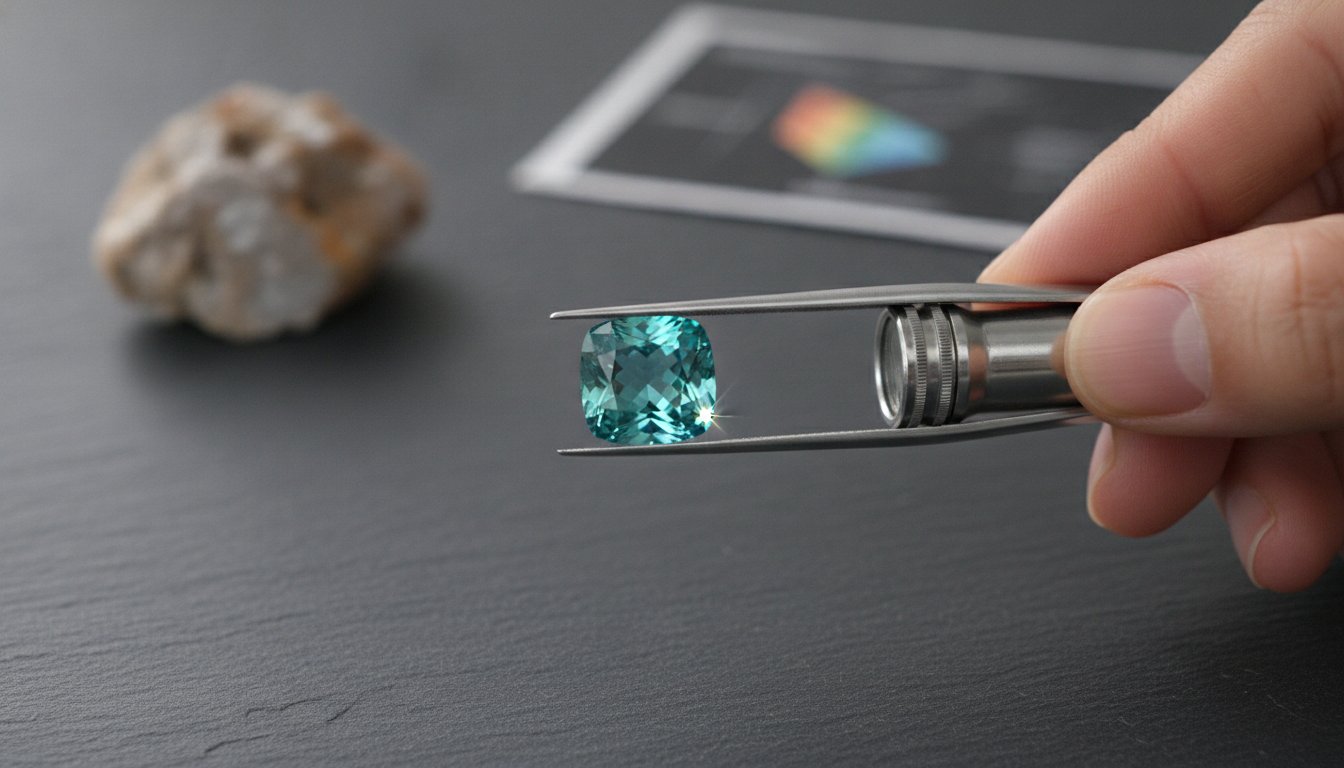
Why does a vibrant, unheated Paraiba tourmaline command a price that leaves other stunning gems in the dust? It's a question that strikes at the heart of true connoisseurship, as the line between a beautiful trinket and a legacy asset often feels blurred. You likely recognize that beauty is subjective, but value is driven by much more than a pretty face. Understanding what makes a gemstone rare requires looking past the surface sparkle to the complex interplay of geological chance, exceptional saturation, and market availability.
You've probably felt the frustration of staring at a laboratory report, wondering if a mention of "minor clarity enhancement" ruins a stone's investment potential. We're going to bridge that gap between mineralogy and the marketplace. You'll discover the intersection of geology, market demand, and the radical transparency that defines the world’s most elusive treasures. This guide provides a clear framework for assessing rarity, allowing you to distinguish between commercial-grade inventory and the investment-grade specimens that belong in a serious collection. We'll examine technical markers and ethical sourcing so you can build your portfolio with absolute confidence in every stone's integrity.
Key Takeaways
- Learn to distinguish between a mineral's abundance in the earth's crust and the extreme scarcity of gem-quality specimens fit for a fine collection.
- Gain a technical framework for evaluating what makes a gemstone rare by analyzing the critical interplay of color saturation, clarity standards, and carat weight.
- Understand why geographic origin acts as a premier brand in the industry, adding significant value through the unique geological terroir of historic mining regions.
- Identify the impact of enhancement status on market value, focusing on why unheated specimens are the ultimate prize for those seeking authentic scarcity.
- Discover how to transition from a casual buyer to a sophisticated collector by prioritizing objective stone quality over persuasive marketing narratives.
Understanding Gemstone Rarity: Scarcity, Demand, and the Market
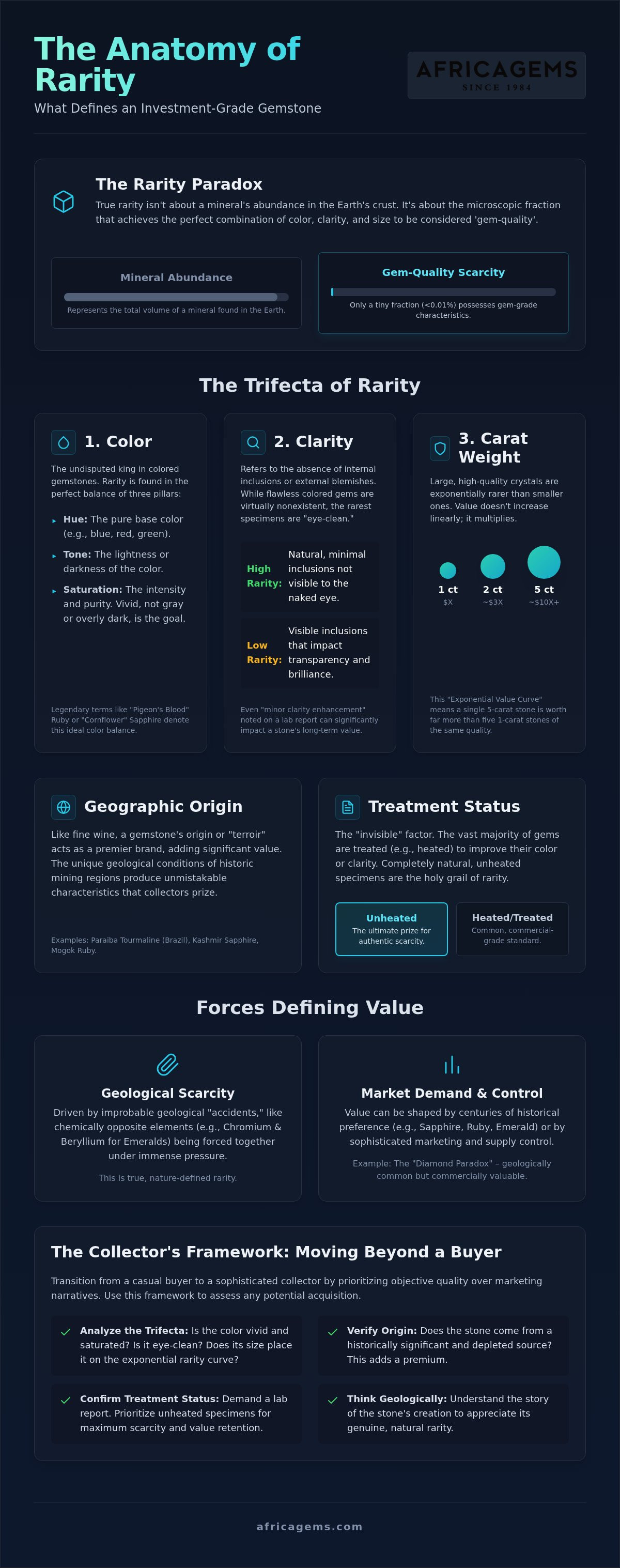
To the uninitiated, rarity is often equated solely with a price tag. To the connoisseur, the definition is far more nuanced. Understanding what makes a gemstone rare requires a dual appreciation for the specific combination of chemical purity and the violent geological occurrences that forged these treasures millions of years ago. We must distinguish between mineralogical rarity, which measures the total volume of a mineral in the Earth's crust, and gem-quality rarity. While a mineral might be relatively abundant, only a fraction of a percent usually possesses the transparency, saturation, and size to be classified as gem-grade.
This distinction explains the "Diamond Paradox." Geologically speaking, diamonds are far more common than many precious gemstones like fine ruby or alexandrite. Their high market value is a product of sophisticated commercial control and global marketing rather than true geological scarcity. For the Expert Enthusiast, the allure lies in stones that are genuinely elusive, where the supply is governed by nature rather than a corporate boardroom. It's a perspective that balances the cold hard facts of science with the emotional resonance of owning something truly unique.
Geological Scarcity vs. Commercial Availability
The creation of a fine gemstone is a geological accident. For example, the presence of chromium is what gives an emerald its lush green, yet chromium is rarely found in the same rock formations as the beryllium needed for the crystal to grow. These elements are chemical strangers that only meet under extreme tectonic pressure. Even when these accidents occur, the resulting material must be durable. Many rare minerals are stunning but too soft for jewelry, keeping them out of the commercial market. Additionally, supply chain disruptions in mining regions can cause temporary spikes in rarity, even for stones that are geologically available in the ground.
The Role of Demand in Defining Rarity
Market perception plays a massive role in how we define scarcity. The "Big Three," consisting of sapphires, rubies, and emeralds, have enjoyed centuries of historical preference, ensuring they remain the standard for rarity. However, discovery stories can shift the landscape overnight. When Paraiba tourmalines were first unearthed in the late 1980s, their neon glow created a frenzy that redefined what makes a gemstone rare in the modern era. While some collector gems like hauyne are geologically scarcer than any sapphire, their niche demand keeps them as secrets known only to the most dedicated insiders.
The Trifecta of Rarity: Color, Clarity, and Carat Weight
While geological origin provides the pedigree, the physical attributes of a stone determine its ultimate standing in the hierarchy of scarcity. In the colored gemstone market, color is the undisputed king. It's the primary driver of value and the most difficult attribute for nature to perfect. When we evaluate what makes a gemstone rare, we're looking for a specific harmony of hue, tone, and saturation that occurs only in the most exceptional circumstances. While diamonds rely heavily on a lack of color for value, colored stones are prized for the intensity and purity of their "face up" appearance.
Exceptional Color: The Scarcity of Pure Hue
Color is defined by three pillars: hue (the basic color), tone (the lightness or darkness), and saturation (the intensity). Most stones in the commercial market suffer from "graying out" or being too dark to show brilliance. A truly rare specimen possesses a vivid saturation without becoming overly dark. Achieving this balance is geologically improbable; it requires the perfect concentration of trace elements during crystal growth. This is why legendary descriptors like "Pigeon Blood" for rubies or "Cornflower" for sapphires carry such weight. These aren't just marketing terms. They represent a specific, elusive color profile that collectors spend lifetimes pursuing. For a deeper dive into these standards, consult The Ultimate Guide to Blue Sapphire Gemstones.
Size and Quality: The Exponential Rarity Curve
In the world of gems, size doesn't just add value; it multiplies it. This is known as the exponential value curve. A single 5-carat sapphire is significantly rarer than five 1-carat stones of the same quality. Large, gem-quality crystals are statistical anomalies. As a crystal grows, the likelihood of it encountering tectonic shifts, temperature fluctuations, or contaminating minerals increases. This is particularly true for species like Mozambique rubies, which rarely occur in clean specimens over 3 carats.
Clarity standards also shift based on the gemstone species. The GIA classifies gems into three types. Type 1 gems, like aquamarine, are expected to be eye-clean. Type 3 gems, most notably emeralds, are almost always included. Understanding these distinctions is vital. A "clean" emerald is a much greater rarity than a "clean" zircon. When building a collection, the goal is to find the best possible clarity for that specific species without sacrificing the richness of the color. Our collection of loose blue sapphires serves as an excellent benchmark for this balance, as they represent the gold standard for high-quality colored stone evaluation.
Geographic Origin and the Rarity of Source
In the high-stakes world of gem collecting, a stone's birthplace often carries more weight than its weight in carats. Origin acts as a premier brand, signaling a specific pedigree that savvy collectors recognize instantly. This value isn't arbitrary. It's rooted in geological "terroir," which is the unique combination of chemical elements, temperature, and pressure found in a specific location. These conditions create signature features that can't be replicated elsewhere. However, we must be cautious. A prestigious origin doesn't automatically guarantee an investment-grade stone. The quality of the specimen must always speak for itself. A poorly saturated sapphire from Kashmir is still less desirable than a vivid one from Madagascar. Sourcing from reputable, documented locations is also a pillar of ethical trade, ensuring your treasure has a transparent and responsible history that adds to its legacy value. This appreciation for origin and heritage is also central to the market for authentic Southwest turquoise, where T.Skies Jewelry specializes in hand-crafted pieces that celebrate the unique geological signatures of American mines.
Single-Source Wonders: The Case of Tanzanite
Some gems are defined by their geographical exclusivity. Tanzanite is the ultimate example, found only in a small, five-square-mile area at the foothills of Mount Kilimanjaro in Tanzania. This single-source status is a primary driver of what makes a gemstone rare in the modern market. Geologists believe the likelihood of finding another deposit is less than one in a million. This makes it a "gem of a generation," as the current supply is finite. This ticking clock on availability creates a sense of urgency for collectors who understand that nature won't provide a second chance. For those looking to understand the nuances of this blue-violet treasure, our Connoisseur’s Guide to Tanzanite explores why its rarity is tied so closely to its Tanzanian roots.
Legendary Origins: Burma Rubies and Colombian Emeralds
Certain locations have become synonymous with the highest expressions of a species. Burma (Myanmar) rubies are prized for their unique "silk," which are tiny rutile inclusions that scatter light and create a soft, glowing appearance. These loose Burma rubies remain the gold standard because they represent a geological anomaly that has yet to be surpassed. Many of these stones also possess a strong fluorescence that makes them glow in natural daylight. Similarly, Colombian emeralds are celebrated for their vibrant green, often attributed to the low iron content in the local shale. Collectors pay a significant premium for this documented heritage. It's a testament to how history and geology intertwine to define what makes a gemstone rare. When you hold a stone with a legendary origin, you're holding a piece of a story that spans centuries. This connection to a specific point on the map provides a layer of security and prestige that commercial-grade stones simply cannot offer. It transforms a mineral into a piece of history.
Treatment Status: The "Invisible" Factor in Rarity
In the pursuit of the world's most elusive treasures, what you don't see often matters as much as what you do. Most consumers are unaware that over 95% of the sapphires and rubies circulating in the global market have undergone some form of heat treatment. While heating is a stable and accepted industry practice, it fundamentally changes the category of scarcity. When we ask what makes a gemstone rare, the absence of human intervention is a massive differentiator. A stone that emerged from the earth with perfect saturation and clarity requires no "help" from a furnace. This natural perfection is why unheated specimens command such a significant premium among serious collectors.
At AfricaGems, our commitment to radical transparency is the cornerstone of every transaction. Founded by Marc Sarosi in 1984, we operate on the principle that every enhancement must be fully disclosed. Treatments range from standard thermal heating to more aggressive methods like lattice diffusion or glass filling. While standard heat is a routine enhancement, these more intrusive treatments can decimate a stone's long-term value. In the emerald market, the "No Oil" designation is the ultimate prize. Since most emeralds are treated with cedar oil to hide fractures, a specimen that is naturally clean enough to require no oiling is a geological miracle.
The Rarity of "Unheated" and "No Oil" Specimens
Collectors prioritize unheated stones because they represent the purest form of geological history. These stones retain their value far better than their treated counterparts during market fluctuations. They are finite assets that cannot be manufactured or replicated in a lab. For instance, loose Mozambique rubies that are certified unheated are increasingly difficult to source in sizes over two carats. Choosing a natural, untreated stone means you're investing in a specimen that nature perfected over millions of years without a secondary assist from modern technology.
The Necessity of Laboratory Reports
In a market where high-value transactions are common, a reputable laboratory report is your greatest security. Reports from top-tier labs like the GIA, GRS, or SSEF are non-negotiable for any rare gemstone purchase. These documents provide an objective third-party validation of a stone's origin and treatment status. You should look specifically for the "Comments" section to verify the degree of enhancement and the specific color nomenclature used by the gemologist. We ensure that every investment-grade piece in our inventory is accompanied by rigorous documentation. This methodical approach builds the confidence necessary for a legacy-oriented purchase. If you are ready to secure a truly exceptional specimen, browse our collection of investment-grade precious gemstones today.
How to Acquire and Invest in Rare Gemstones
Entering the world of high-value gem collecting requires more than just a large budget; it demands a disciplined eye and a strategic focus. Many successful collectors begin by specializing in a specific species or a legendary origin, such as Colombian emeralds or Mozambique rubies. This specialization allows you to develop a deep understanding of the subtle nuances that define value within that niche. Always remember the cardinal rule of the industry: buy the stone, not the story. While a romantic narrative about a "lost mine" is captivating, it doesn't change the physical reality of the gem. You must prioritize objective quality markers over persuasive marketing.
Buying loose gemstones is almost always superior to purchasing pre-set jewelry when you're looking for investment-grade material. A setting can easily hide chips, inclusions, or even signs of treatment that a laboratory would otherwise catch. By evaluating a loose stone, you can inspect it from every angle under proper lighting. Once you've secured a world-class specimen, our Custom Jewelry Design Services provide the perfect way to protect and showcase your find in a setting that reflects its unique character and value.
Identifying Investment-Grade Potential
Understanding what makes a gemstone rare involves recognizing a specific set of hallmarks that drive long-term appreciation. These include significant carat weight, exceptional color saturation, an absence of treatments, and a documented, prestigious origin. Smart collectors also look for the "Paraiba effect," which is the ability to identify rising stars in the market before they reach their peak price. Keeping a pulse on emerging deposits or shifting fashion trends can lead to significant gains. If you're unsure where to start your journey, you can consult with Marc Sarosi for personalized guidance tailored to your specific goals and aesthetic preferences.
The AfricaGems Approach to Rare Sourcing
Our sourcing philosophy is built on the concept of the Expert Enthusiast. Every stone in our inventory is hand-selected based on a simple but uncompromising standard: it must be a gem that Marc would personally want to own. This approach ensures that we only offer materials with genuine character and technical merit. Since our founding in 1984, we've built a 40-year legacy of trust and radical transparency. We don't just sell gems; we mentor our clients through the complexities of the market. Every purchase is backed by a personal guarantee of authenticity and full disclosure. We invite you to explore our Rare Gemstones Collection to discover the intersection of nature's beauty and investment-grade security.
Securing Your Legacy in Rare Materials
Owning a truly exceptional gemstone is a pursuit that balances scientific rigor with an appreciation for natural artistry. You now understand that what makes a gemstone rare isn't just a marketing label; it's a precise intersection of geological chance, prestigious origin, and the absence of human enhancement. By prioritizing unheated specimens and documented heritage, you're not just buying a stone. You're acquiring a finite piece of Earth's history that carries its own inherent security and prestige.
Since 1984, Marc Sarosi has utilized over 40 years of industry expertise to curate a collection defined by radical transparency and professional authority. We provide full disclosure on all gemstone treatments and offer free GIA or GRS reports on select high-value stones to ensure your absolute peace of mind. This methodical approach transforms a digital transaction into a personal consultation with a trusted mentor. If you're ready to begin or expand your portfolio, we invite you to explore our curated collection of Rare and Investment-Grade Gemstones. The world of elusive treasures is waiting for your discerning eye.
Frequently Asked Questions
What is the rarest gemstone in the world?
While painite once held the title, red diamonds and grandidierite are currently among the most elusive specimens. Rarity is a moving target influenced by new discoveries and mining exhaustion. For collectors, understanding what makes a gemstone rare often leads back to alexandrite or Paraiba tourmaline. These stones aren't just scarce in nature; they possess unique optical properties that distinguish them from more common mineral varieties.
Is a rare gemstone always more expensive than a diamond?
Price is a function of both rarity and demand. While a fine Paraiba tourmaline can easily outprice a colorless diamond of the same size, many geologically rare minerals have low market demand and thus lower prices. Diamonds benefit from a massive, controlled global market that maintains high value regardless of their actual geological abundance. In contrast, colored stones like unheated Mozambique rubies derive their value from genuine, non-artificial scarcity.
How does geographic origin affect a gemstone’s rarity?
Origin creates a specific pedigree based on the unique geological conditions of a location. A sapphire from Kashmir or a ruby from Burma carries a premium because those deposits produced a quality that has rarely been matched elsewhere. These historic mines are often exhausted, making stones with documented heritage exponentially harder to find. This scarcity is why origin remains a primary factor in determining what makes a gemstone rare for investment purposes.
Why are unheated gemstones considered rarer than treated ones?
Unheated stones are geological miracles that reached perfect saturation and clarity without human intervention. Since over 95% of sapphires and rubies require heat to reach commercial standards, a stone that is naturally beautiful is a significant outlier. These specimens are finite and cannot be manufactured. Collectors prioritize them for long-term value because their beauty is a testament to the Earth's raw, unassisted power rather than a lab technician's skill.
Does a laboratory report prove that a gemstone is rare?
A lab report is a tool for validation rather than a certificate of rarity itself. It provides objective data on species, origin, and treatment status, which are the building blocks of scarcity. While a report from the GIA or GRS confirms that a stone is an unheated pigeon-blood ruby, the rarity comes from the stone's physical properties. The report simply provides the professional security needed to verify those elusive attributes in a high-value transaction.
Can a gemstone be rare but have low value?
Can a gemstone be rare but have low value?
Geological scarcity doesn't always translate to high market value. Rare minerals like benitoite or hauyne are far scarcer than sapphires, yet they often command lower prices because they lack widespread consumer demand or the durability required for jewelry. For a gem to be valuable, it must possess beauty, durability, and rarity. Without this trifecta, a stone might be a curiosity for a mineralogist but a poor choice for a serious jewelry collector. This need for personal evaluation before a major purchase is shared by connoisseurs in other luxury fields; for instance, GemNi Fragrances Essentials allows enthusiasts to sample rare scents through decants to ensure they meet their specific standards of excellence.
Radical transparency is the most critical factor. You should look for full disclosure of all enhancements and a clear return policy. Reputable dealers like AfricaGems provide high-resolution photography and third-party laboratory reports to build buyer confidence. Verify the dealer's legacy and their commitment to ethical sourcing. A personal guarantee from the founder, like the one Marc Sarosi provides, ensures that the technical specifications are grounded in professional accountability.
Are lab-created gemstones considered rare?
Lab-created gemstones are not rare because they can be manufactured to meet demand. While Chatham lab-created gemstones offer exceptional beauty and the same chemical properties as natural stones, they lack the geological history and finite nature of earth-mined gems. They are a wonderful choice for those prioritizing aesthetics and ethics at a lower price point, but they don't possess the investment potential of a specimen that nature took millions of years to forge.

Article by
Marc Sarosi
Professional gemstone dealer for more than 40 years. Started off mining Aquamarine in Zambia, Africa and travelled throughout the continent in search of fine gems. Trusted authority on fine gemstones and have donated a fine collection of more than 27 extraordinary gemstones to the Smithsonian Institute Gem Hall for generations to see.