
What is a Native Cut Gemstone? A Collector’s Guide to Tradition vs. Precision
Mar 23rd 2026
That "imperfect" facet pattern on a 5.2-carat Burmese ruby isn't always a mistake; it's often a calculated choice to preserve the world's most intense color. When you ask what is a native cut gemstone, you're stepping into a centuries-old debate between the raw weight of tradition and the sparkle of modern engineering. You likely recognize the frustration of seeing a breathtaking sapphire only to notice a "window" that lets light leak through the center. It's a common fear among collectors that they're paying a premium for a stone that lacks professional polish or optical performance.
We'll unlock the mystery of these traditional techniques, showing you how to balance color-maximizing art with modern precision. You'll learn to spot the difference. We'll identify when a stone needs a 20% weight-loss recut and when it should be left exactly as the artisan intended. This guide provides the technical clarity you need to identify high-value gems at AfricaGems that offer both authentic character and investment-grade quality.
Key Takeaways
- Understand what is a native cut gemstone by exploring the traditional faceting techniques used at the source to maximize color depth and carat weight.
- Learn to identify the "belly" and "window" of a stone to determine if a traditional cut enhances its natural beauty or creates distracting light leaks.
- Discover how to balance the raw, saturated charm of traditional lapidary work against the mathematical symmetry and brilliance of modern precision faceting.
- Master a professional buyer’s checklist for evaluating color saturation and cut quality, ensuring your selection meets the highest connoisseur standards.
- Gain insight into the AfricaGems Difference and why our uncompromising hand-selection process filters out 90% of stones to curate only the most exquisite examples.
Defining the Native Cut: Tradition Meets the Mine
To truly define what is a native cut gemstone, you must first appreciate the ancient dialogue between a cutter and the raw earth. This term describes a gemstone faceted at its country of origin using traditional methods that have remained unchanged for centuries. In mining hubs like Ratnapura, Sri Lanka, or Chanthaburi, Thailand, cutters utilize hand-powered or basic mechanical laps to reveal the hidden beauty of the rough. It's a process that honors the mineral's natural journey from the crust to the sunlight.
These regions possess a heritage of Lapidary techniques dating back to the 5th century BC in Sri Lanka. In East Africa, particularly since the 1967 discovery of Tanzanite, local artisans have refined the art of maximizing a crystal's inherent properties. A native cut isn't an indicator of poor craftsmanship or a lack of skill. Instead, it reflects a different set of priorities rooted in the economics of the mine. While a Western precision cutter focuses on geometric symmetry and light return, a native cutter prioritizes weight retention and color saturation above all else.
Rough material cost often accounts for 70% to 85% of a finished gem's final value. Consequently, the cutter's primary goal is to lose as little of the precious mineral as possible. They often follow the natural shape of the rough crystal; this can result in "bellies" or slightly asymmetrical facets. By maintaining this mass, the cutter ensures the stone retains a deeper, more vibrant hue. Losing an extra 10% of weight to achieve perfect symmetry could mean a 20% loss in total market value for a rare unheated ruby. When collectors ask what is a native cut gemstone, they're often looking at a stone that has been optimized for its most breathtaking visual asset: its color.
The Origins of the Term
Trade professionals have seen the phrase "native cut" transition from a simple descriptor to a technical classification. By the 2026 market standards, gemologists use it to distinguish these stones from "commercial cuts" produced in high-volume factories or "precision cuts" created with digital aid. Source countries like Madagascar or Sri Lanka prioritize the face-up appearance and the preservation of rare color zones. Their aesthetic values center on the soul of the mineral rather than the mathematical perfection demanded by some Western labs. This distinction helps buyers understand that they're purchasing a piece of cultural history as much as a geological marvel.
The Role of the Source Country
Keeping the cutting industry close to the mines provides an immediate economic benefit to local communities and ensures the integrity of the supply chain. It also leverages thousands of years of collective knowledge. A master cutter in a Tanzanian workshop can identify the "best face" of a rough sapphire in seconds, a skill honed through handling thousands of carats. They understand how light interacts with specific local deposits better than any remote technician could ever hope to. Native cut is the balance between mineral preservation and initial market presentation.
The Anatomy of a Native Cut: Why Bellies and Windows Matter
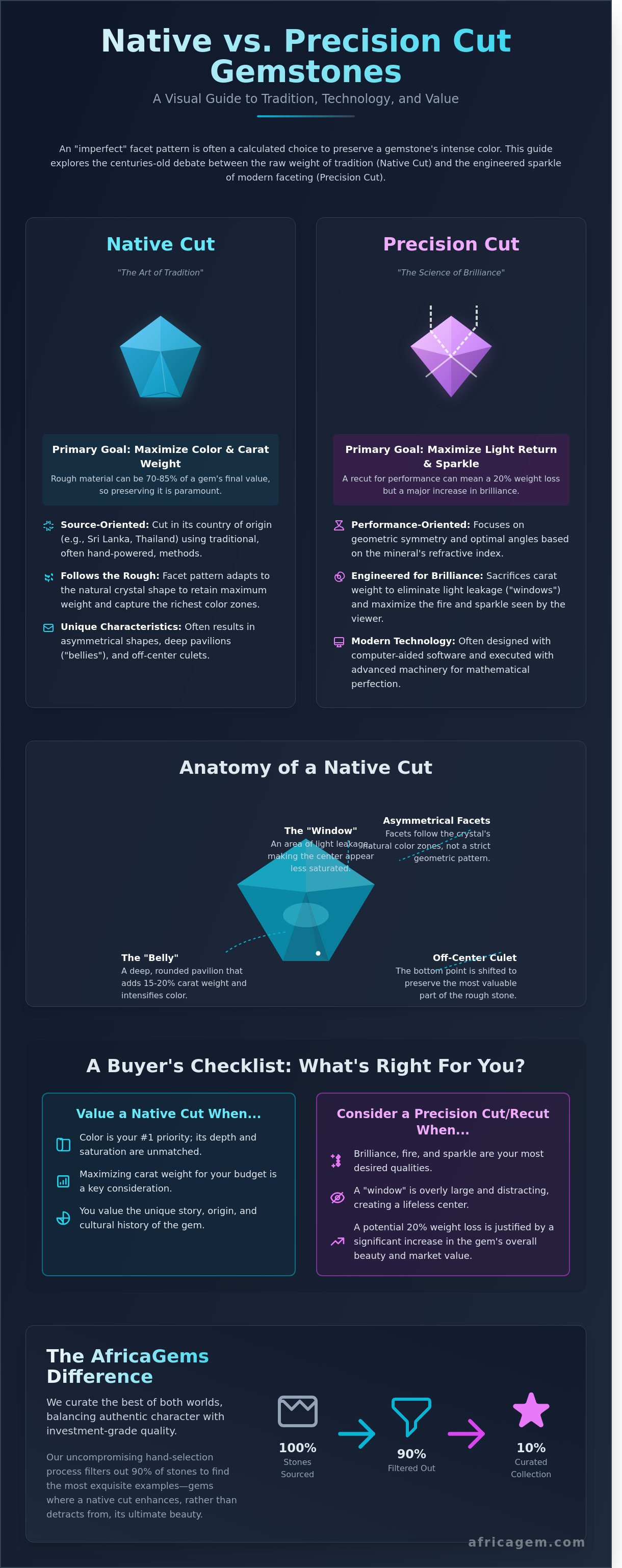
To understand what is a native cut gemstone, you must look beyond the surface sparkle and examine the stone's physical geometry. These gems are defined by a specific set of visual characteristics that prioritize the preservation of raw material over mathematical symmetry. While a precision-cut stone follows strict angles to maximize light return, a native cut follows the "soul" of the rough crystal. This approach often results in a prominent "belly," where the pavilion or the bottom of the stone is rounded and deep rather than sharply faceted. This extra weight, sometimes adding 15% to 20% to the final carat count, is a hallmark of traditional lapidary work in mining hubs like Ratnapura or Chanthaburi.
This weight retention comes with optical trade-offs. You will often notice an off-center culet, the tiny point at the bottom of the gem. This asymmetry isn't a sign of a novice hand. Instead, it's a deliberate choice to follow the richest color concentration within the crystal. Traditional gem cutting and polishing techniques have long favored this method to ensure the most vibrant hue reaches the viewer's eye, even if the stone's profile appears lopsided. When you hold a native cut, you're seeing a direct map of how that specific mineral grew in the earth.
The Science of Light Leakage
Light behaves differently when it hits the facets of a native cut. Every mineral has a "critical angle," which is the specific degree at which light is reflected back to your eye. For a sapphire, this is approximately 34.4 degrees. If a cutter creates facets shallower than this to save weight, the light passes straight through the bottom. This creates a "window," a transparent area in the center of the gem that looks like a clear pane of glass. While some collectors avoid windows, they're often necessary in overly dark material. A window can actually prevent a deeply saturated Mozambique ruby from looking like a black coal, allowing some light to breathe through the stone. Conversely, a "fat belly" can cause extinction, which are dark, dead zones where light gets trapped and fails to return, creating a moody, high-contrast look.
Visual Markers for Collectors
Spotting these traits is an essential skill for any serious connoisseur. You can identify a window by placing the gem over a white piece of paper with text on it. If you can read the letters through the center of the stone, it has a significant window. This is common in Blue Sapphires from Sri Lanka, where cutters strive to keep the stone's weight above critical price points like 2.0 or 5.0 carats. When evaluating these pieces, always compare the "face-up" brilliance against the profile view. A stone might look stunning from the top but reveal a massive, bulging pavilion when turned sideways. These characteristics tell the story of the stone's journey from the mine to the market. If you're looking for a stone that balances these traditional traits with exceptional beauty, you can browse our curated selection of ethically sourced gems to see these nuances in person.
Native Cut vs. Custom Precision Faceting: The Great Debate
The choice between a native cut and custom precision faceting isn't just a matter of aesthetics. It's a fundamental decision about how we value the treasures of the earth. Precision cutting relies on rigorous mathematical symmetry to achieve maximum light return. Native cutting, by contrast, focuses on maximizing the raw material's color depth and final carat weight. While GIA's definition of native cut highlights its traditional origins in source-country lapidaries, modern collectors often weigh these time-honored methods against the clinical perfection of Western precision cuts. At AfricaGems, we believe both styles have a place in a sophisticated collection, provided there's total transparency about the stone's journey.
Precision cutters use high-tech machinery to ensure every facet meets at a single point. This creates a stone with "meet-point" accuracy. Native cutters often work by hand and eye, prioritizing the preservation of the crystal's original volume. This difference creates a distinct price disparity. Precision-cut stones command a premium because they require more time and result in a higher loss of raw material. When you ask what is a native cut gemstone in the context of value, you're really asking about the balance between the weight of the rough and the brilliance of the finished product.
The Performance Comparison
Precision cutting emphasizes brilliance, which is the white light reflected back to the eye, and scintillation, the flashes of light seen when the stone moves. However, technical perfection can sometimes "wash out" a pale gemstone by reflecting too much light and diluting its color. Traditional native cuts often feature a "belly" or a deeper pavilion. This extra depth allows stones like Tanzanite or deep blue Sapphires to retain their rich, saturated hues. A precision cut on a light-toned aquamarine might make it look colorless, whereas a traditional native cut preserves its delicate blue essence through strategic light trapping.
The Carat Weight Factor
Gemstone pricing is non-linear. It jumps significantly at "magic numbers" like 1.00ct, 2.00ct, and 5.00ct. A native cutter will often sacrifice a bit of symmetry to keep a Sapphire at 1.02 carats rather than cutting it into a perfectly symmetrical 0.95-carat precision stone. The 0.07-carat difference might seem small, but the price per carat for a 1-carat stone is significantly higher than for a sub-carat stone. This is why understanding what is a native cut gemstone is vital for any serious investor. In the 2026 market, precision-cut Sapphires command a 25% to 40% price premium over native-cut equivalents of the same clarity and origin. This premium accounts for the higher labor costs and the fact that precision faceting often results in a 65% to 75% loss of the original rough material.
Choosing between these two styles depends on your personal philosophy as a collector. Precision cutting represents the triumph of human science over raw nature. Native cutting represents a respect for the stone's original form and its journey from the mine. For a 5-carat unheated Burma Ruby, the "native" character is often part of its provenance. Collectors frequently prefer the organic feel of a stone cut where it was discovered. It provides a tangible link to the earth. If you demand technical perfection and a "disco ball" effect, precision is your path. If you prioritize the stone's natural spirit and deep, saturated color, the native cut remains an exquisite choice.
A Buyer’s Checklist: How to Evaluate a Native Cut Gemstone
Understanding what is a native cut gemstone requires more than a glance at its surface. You must look through the stone to identify its true character and determine if its proportions honor the mineral's natural beauty. Use this professional checklist to evaluate your next potential acquisition with the eye of a seasoned connoisseur.
- Step 1: Assess color saturation. The primary goal of a native cut is often to retain weight, but this can sometimes sacrifice the richness of the hue. Look for areas where the color appears "extinguished" or overly dark. A superior cut should enhance the stone's pleochroism and natural glow rather than dulling its vibrant spirit.
- Step 2: Check for excessive windowing. Tilt the stone and look directly through the table. If you see a transparent "hole" or window in the center where light passes straight through to the background, the stone isn't reflecting light efficiently. Small windows are common, but a large, distracting window significantly reduces a gem's brilliance.
- Step 3: Examine the crown height and pavilion depth. Native cuts often feature a heavy "belly" or a deep pavilion to maximize carat weight. While learning what is a native cut gemstone, you'll notice that an overly deep pavilion can make a stone look smaller from the top than its carat weight suggests. Conversely, a crown that's too flat won't provide the "fire" or dispersion collectors crave.
- Step 4: Consider the recutting potential. If the stone has a magnificent color but a poor finish, assess if there's enough "meat" or extra crystal volume to allow for a precision recut. You're looking for stones with extra depth that a master lapidary can trim away to create perfect symmetry.
- Step 5: Verify the ethics. Always confirm the stone's journey. At AfricaGems, we prioritize stones that are conflict-free and ethically sourced. A reputable dealer should provide full disclosure regarding treatments and the specific origin of the rough material.
When is a Native Cut "Good Enough"?
In the world of rare minerals, perfection is often secondary to rarity. For exceptionally scarce varieties like color-changing Alexandrite or the sunset hues of Padparadscha Sapphires, a window or a slightly off-center culet is often acceptable to preserve the precious material. If the stone passes the "jewelry-ready" test, meaning a clever setting can hide pavilion bulges or minor asymmetries, it remains a valuable investment. You can consult with our experts at AfricaGems Custom Jewelry Design Services to see how a bespoke mounting can elevate a native-cut gem into a masterpiece.
The Financial Reality of Recutting
Recutting a native stone into a precision gem is a high-stakes calculation involving yield and value. You must prepare for a significant reduction in size to achieve ideal light performance. Most collectors experience a yield loss of 30% to 50% when fixing native proportions. This loss changes your cost basis immediately. Recutting a 2-carat native sapphire often results in a 1.2-carat precision gem. While the total weight drops, the price-per-carat for a precision-cut stone is typically 25% to 40% higher than its native-cut counterpart, often resulting in a stone that's more valuable despite being smaller.
Explore our curated collection of ethically sourced, high-quality gems today. Shop the AfricaGems Collection
The AfricaGems Philosophy: Curating the Best of Both Worlds
Understanding what is a native cut gemstone requires more than a simple definition. It demands a discerning eye for the delicate balance between raw weight and refined beauty. At AfricaGems, we don't view native cuts as inferior; we view them as opportunities for curation. While the primary goal of many traditional cutters is to maximize carat weight, our philosophy centers on the visual soul of the stone. This means we look for gems that possess the vibrant color and character inherent in traditional lapidary work while meeting modern standards for brilliance.
Marc Sarosi's selection process is notoriously strict. He rejects 90% of the native-cut stones he inspects. Most of these rejected gems suffer from deep bellies or significant windowing that drains the life from the stone. When you browse our collection, you're seeing the top 10% that passed his rigorous evaluation. This "AfricaGems Difference" ensures that every native-cut stone we offer rivals precision-cut gems in its ability to dance with light. We believe you shouldn't have to choose between the authentic origin of a stone and its aesthetic performance.
- Full Disclosure: We clearly label every cut style, ensuring you know exactly how your gemstone was shaped.
- Strict Curation: Only stones with exceptional color and acceptable symmetry make it into our inventory.
- Value Proposition: We find native cuts that offer the look of a precision stone at a more accessible price point.
Our commitment to honesty is the bedrock of our business. If a stone has a slightly off-center culet or a traditional pavilion, we tell you. This level of detail transforms a simple transaction into an educated investment. By providing this context, we help you understand what is a native cut gemstone in the context of real-world value and beauty, rather than just technical flaws.
Radical Transparency in 2026
As we move through 2026, the digital marketplace demands more than just a single photo. We've implemented a Radical Transparency protocol that provides 360-degree high-definition videos and macro photography from multiple angles for every stone. This Expert Enthusiast approach empowers you to see the exact saturation and clarity of a gem before it ever leaves our vault. Every purchase is anchored by our 100% ethical sourcing guarantee and a comprehensive gemstone certificate, providing the security you need for high-value acquisitions.
Your Next Steps in Collecting
Building a world-class collection starts with having the right tools. Our website's advanced filters allow you to sort by origin, color intensity, and specific cut parameters. If you find a stone you love but want to refine its look, our team is available to discuss custom design or the potential for professional recutting. We're here to act as your knowledgeable mentors in the world of rare minerals. Ready to find your center stone? You can browse our exquisite collection of Loose Sapphires today and experience the quality that sets us apart.
Choosing Your Path in the World of Fine Gemstones
Deciding between the heritage-driven appeal of a traditional cut and the clinical brilliance of modern faceting is a vital step for any serious collector. You've now explored how "bellies" preserve precious carat weight and how windows influence the stone's overall light performance. Understanding exactly what is a native cut gemstone empowers you to appreciate the cultural artistry used to maximize a crystal's natural yield directly at the source.
Since 1984, AfricaGems has curated a collection that honors both traditional craftsmanship and precision excellence. We provide 100% disclosure on all gemstone treatments and cut styles, ensuring you never have to guess about the integrity of your purchase. Every stone comes with a personal guarantee from our founder, Marc Sarosi, drawing on 40 years of lapidary expertise to protect your investment. Whether you're drawn to a soulful traditional gem or a mathematically perfect precision cut, you deserve a partner who values transparency as much as beauty.
Explore our hand-selected Loose Gemstones at AfricaGems
Your journey into the vibrant world of rare minerals is just beginning, and the right stone is waiting to tell its story in your collection.
Frequently Asked Questions
Is a native cut gemstone less valuable?
A native cut gemstone isn't always less valuable; its worth is often tied to weight retention and color density. While a precision cut maximizes brilliance, a native cut preserves up to 30% more mass from the original rough. In high-value minerals like a 5-carat Ruby, losing 1.5 carats to achieve perfect symmetry might decrease the total market value by $10,000 or more. Understanding what is a native cut gemstone helps collectors appreciate why these stones prioritize size and saturation.
Can all native cut gemstones be recut into precision cuts?
No, not every stone is a candidate for professional recutting. A lapidary must first evaluate the pavilion depth and the location of internal inclusions. If a 3-carat sapphire is too shallow, recutting it to precision standards could result in a 40% weight loss, leaving you with a stone under 1.8 carats. This reduction often makes the process financially unviable for 75% of rare specimens found in the market today.
What is the "window" in a native cut gemstone?
A window is a clear, washed-out area in the center of a gem where light leaks through the back. This occurs when pavilion facets are cut at angles shallower than the critical angle of the mineral, such as 34 degrees for quartz. When you tilt a stone 10 degrees and see the background through the center, you've identified a window. It reduces the overall "life" of the piece, often appearing in 60% of traditionally cut stones.
Why are sapphires and rubies so often native cut?
Most sapphires and rubies are native cut to maximize color saturation and weight retention from expensive rough material. In mining hubs like Sri Lanka or Burma, 90% of cutters prioritize keeping the stone's weight above key benchmarks like 1.00 or 2.00 carats. This practice ensures the highest possible per-carat price. A precision cut might improve light return, but it often sacrifices the deep, velvety hues that define top-tier Corundum.
Does a native cut affect the durability of the gemstone?
A native cut rarely impacts the structural integrity of a stone, but it can influence how it's set. Some traditional cuts result in an uneven or "knife-edge" girdle that measures less than 0.1mm in certain spots. These thin areas are 30% more likely to chip during the setting process or daily wear. Our experts at AfricaGems always inspect for these vulnerabilities to ensure your investment remains secure for decades.
How can I tell if a gemstone is native cut from a photo?
You can identify a native cut by looking for asymmetrical facet patterns and off-center culets in high-resolution photos. If the facet junctions don't meet precisely within a 0.5mm tolerance or if the table is tilted by more than 3 degrees, it's likely a native cut. These stones often show a "bow-tie" effect or a central window where the color appears significantly lighter than at the edges.
Is it better to buy a native cut and recut it myself?
Buying a native cut to recut is a strategy used by professional dealers to unlock value, but it carries significant risks. You must factor in a minimum 20% loss in carat weight and the cost of a master lapidary. Learning what is a native cut gemstone helps you spot stones with enough pavilion depth to survive the process. It's only profitable if the resulting precision stone commands a 40% higher price per carat.
What does "commercial cut" mean compared to native cut?
Commercial cuts are mass-produced in factories using automated laps to reach specific calibrated sizes like 6x4mm. While a native cut is performed by hand in the source country to save weight, a commercial cut focuses on speed and uniformity, often processing 500 stones per day. Native cuts often possess more character and better color retention, whereas commercial cuts provide the standardized dimensions needed for 95% of pre-made jewelry settings.