
What Color Is Tanzanite? The Connoisseur's Guide to its Multidimensional Hue
Apr 11th 2026
Imagine a gemstone so rare that it exists in only one four-kilometer strip of land near Mount Kilimanjaro, yet it refuses to stay a single color. When enthusiasts ask what color is tanzanite, they often expect a simple answer like blue, but the reality is a sophisticated interplay of physics and chemistry. You've likely felt frustrated by the conflicting descriptions found online, where one dealer claims a stone is sapphire blue while another calls it royal purple. It's difficult to feel secure in a high-value purchase when the very definition of the gem's hue feels like a moving target.
This guide illuminates the scientific secrets behind tanzanite's unique blue-violet spectrum and provides the tools you need to identify the most valuable color grades. We will demystify the "trichroic" nature of this mineral and show you exactly how to spot the high-saturation hues that define a true investment-grade gem. From the impact of professional heat treatment to the nuanced choice between blue-dominant and violet-dominant stones, you'll gain the insider knowledge required to select a masterpiece that reflects the AfricaGems Difference.
Key Takeaways
- Explore the rare gemological phenomenon of trichroism to understand how a single stone can radiate three distinct colors across its crystal axes.
- Learn exactly what color is tanzanite by identifying the subtle interplay between velvet blue and royal violet hues that define the most valuable specimens.
- Uncover the "chameleon effect" of light temperature and why your gemstone’s personality shifts beautifully from natural daylight to evening incandescent settings.
- Master the professional GIA grading criteria for saturation and tone to confidently distinguish between common pastel shades and high-investment vivid colors.
- Discover the essential steps for selecting ethically sourced, hand-picked tanzanite that meets the rigorous standards of the AfricaGems selection process.
The Science of Tanzanite Color: Zoisite and Trichroism
Tanzanite is the breathtaking blue-to-violet variety of the mineral zoisite. Its existence is a geological fluke, found exclusively in a small 4-kilometer strip of land in the Merelani Hills of Tanzania. This extreme geographical rarity is matched only by its complex optical properties. When collectors ask what color is tanzanite, they're often surprised to learn that its natural state is far from the vivid sapphire hues seen in high-end jewelry. In its raw form, tanzanite typically emerges from the earth as a brownish or yellowish-green crystal, looking more like a common pebble than a precious gem.
The secret to its color lies in the presence of vanadium. Trace amounts of this element replace aluminum within the zoisite crystal lattice during formation. Without vanadium, zoisite remains a relatively unremarkable mineral. However, the specific concentration and arrangement of these atoms allow tanzanite to absorb and reflect light in ways few other gemstones can. Determining what color is tanzanite in its rawest form reveals a surprising truth: it's rarely the blue we expect until human mastery or natural geothermal heat intervenes.
Understanding the Pleochroic Axis
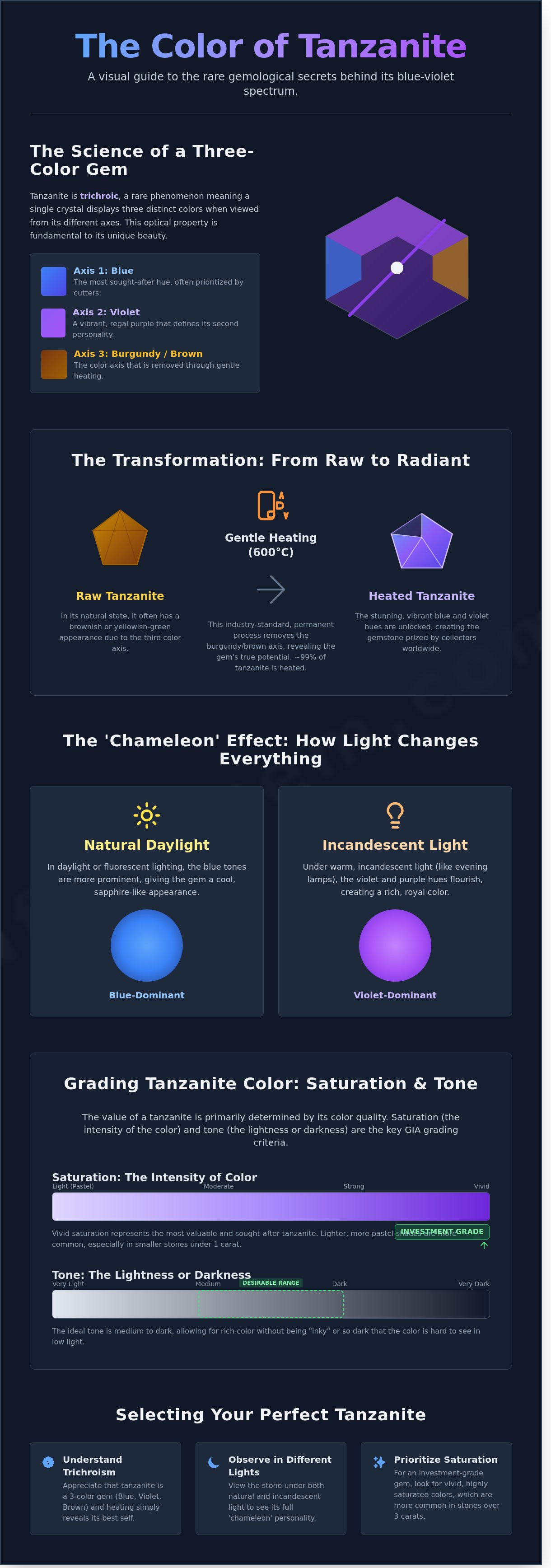
To appreciate the beauty of tanzanite, you must understand pleochroism. In simple terms, this is the ability of a gemstone to show different colors depending on which direction you look at it. It's not an optical illusion; it's a result of how light waves vibrate through the crystal's internal structure. Tanzanite is particularly famous for trichroism in tanzanite, meaning it can display three distinct colors across three crystal axes: blue, violet, and a deep burgundy or brown. This makes tanzanite one of the most color-complex gems in the world, requiring expert cutters to orient the stone perfectly to highlight the most desirable shades.
The Transformation: Natural Heat vs. Lab Heating
A gentle heating at 600 degrees Celsius permanently removes the muddy yellow-green axis to reveal the stone's hidden vibrance. This process is the industry standard, and approximately 99% of all tanzanite is heated to unlock its true potential. There are several myths surrounding this treatment, but at AfricaGems, we prioritize radical transparency.
- Stability: Heating is a permanent change that doesn't fade over time.
- Integrity: The process doesn't weaken the stone or lower its durability.
- Authenticity: Because the heat mirrors natural geothermal processes, a heated stone is still considered a natural gemstone of immense value.
This transformation is what allows the Expert Enthusiast to enjoy the saturated, velvety blues that have made this African treasure a global sensation. By removing the "mask" of brown and green, the cutter can finally showcase the exquisite interplay of blue and violet that defines the AfricaGems Difference.
The Tanzanite Spectrum: From Velvet Blue to Royal Violet
To truly understand what color is tanzanite, one must look beyond a single shade. This gemstone is famously pleochroic, meaning it displays different colors when viewed from different crystallographic directions. While the raw crystal often appears brownish, the professional heating process reveals the blue variety of zoisite that has captivated collectors since its 1967 discovery. The trade typically categorizes these colors into two dominant camps: Blue-dominant (vB) and Violet-dominant (bV). A vB stone mimics the prestigious "Velvet Blue" of a Kashmir sapphire, while a bV stone leans into a regal, vibrant purple that rivals the finest amethyst.
Saturation is the engine of value in this spectrum. In smaller specimens, particularly those weighing under 1.00 carat, the color is often a delicate lavender or soft periwinkle. This happens because the crystal lacks the physical depth to trap and intensify light. As you move into the 3.00 to 5.00 carat range, the saturation deepens significantly. The most coveted "Investment Grade" stones are those that reach a vivid, deep saturation without becoming "inky" or overly dark in low-light environments.
The Cutter's Dilemma: Blue vs. Violet Face-Up
Every tanzanite rough presents a difficult choice for the lapidary. Because the crystal has different color axes, the cutter must decide which color to prioritize for the "face-up" position. Cutting for a blue-dominant (vB) orientation is often a financial risk. This axis usually results in more significant weight loss from the original rough, sometimes sacrificing 15% to 20% more material than a violet-dominant cut. Consequently, true blue-dominant stones are rarer and carry a higher price per carat. If you prefer a look that mirrors a royal sapphire, you're seeking a stone cut on the blue axis. If you prefer the electric, dancing purples unique to this mineral, the violet-dominant cut is your ideal choice.
The Rare Red Flash Phenomenon
The hallmark of an AAAA or top-tier "Investment Grade" tanzanite is the presence of the red flash. This isn't a body color but a secondary optical effect. When light moves through a highly saturated stone, you'll see flashes of magenta, rose, or deep red sparking from the facets. These flashes are most prominent in stones with exceptional clarity and high vanadium content. You can verify this at home by using a strong, incandescent penlight in a dimly lit room. As you tilt the stone under the beam, look for those "inner fire" sparkles. Discovering these nuances is part of the AfricaGems experience, and viewing our ethically sourced tanzanite can help you identify these premium traits in person. We believe in radical transparency, ensuring every red flash and color shift is documented for our collectors.
Lighting and Environment: The 'Chameleon' Effect
Tanzanite is a trichroic gemstone, which means it displays different colors across three distinct crystal axes. This physical property is why the answer to what color is tanzanite often changes based on your immediate surroundings. In a professional office setting under cool fluorescent tubes, typically rated between 4,000K and 5,000K on the Kelvin scale, the stone displays a sharp, icy blue. Move to a candlelit dinner or a room with warm incandescent bulbs around 2,700K, and the gem undergoes a dramatic shift. It transforms into a rich, velvety violet or even a deep royal purple. This "chameleon" behavior is a hallmark of the species.
Your choice of jewelry setting also dictates the visual outcome. Platinum or 18k white gold acts as a mirror for the stone's cooler tones, making the blue pop with clinical precision. Conversely, yellow gold provides a warm contrast that can emphasize the subtle red flashes found in high-grade, "D-Block" stones. Capturing this beauty on camera is notoriously difficult. Most digital sensors are calibrated to prioritize blue light, often failing to record the complex violet wavelengths between 400nm and 450nm. To get an accurate photo, we recommend using a neutral grey background and diffused 5,500K daylight bulbs to prevent the sensor from washing out the violet depth.
Tanzanite Under Fluorescent vs. Incandescent Light
Natural daylight and fluorescent lighting enhance the stone's cool, crisp blue tones. This makes it an ideal gem for daytime wear where a sophisticated, calm appearance is desired. As the sun sets, the "Golden Hour" provides a transitional phase where the stone's brilliance reaches its peak, reflecting the orange and pink hues of the sky. Once you move indoors to incandescent light, the lower Kelvin temperature stimulates the red and violet axes of the crystal. This brings out the romantic, purple undertones that distinguish tanzanite from almost any other blue mineral on earth.
Tanzanite vs. Blue Sapphire: A Color Comparison
While a high-quality sapphire offers a deep, monochromatic blue, it lacks the pleochroic shift of tanzanite. Sapphire is generally more saturated but can appear "sleepy" or overly dark in low-light environments. Tanzanite remains vibrant, often showing more "electric" fire due to its unique light dispersion. When consumers ask what color is tanzanite compared to sapphire, they're often surprised by the violet-red flashes that sapphire simply cannot produce. From a value perspective, tanzanite allows collectors to acquire a vivid, 5-carat investment-grade stone for a significant discount compared to a Kashmir or Royal Blue sapphire of the same size and saturation. This price-to-color ratio makes it an exceptional choice for those seeking a bold, high-impact look with a unique optical personality.
Grading Tanzanite Color: Saturation and Tone
Understanding the GIA colored stone grading system is essential for any serious collector. While the primary hue tells us if a gem is blue or violet, the tone and saturation determine its true character and market value. Tone refers to the relative lightness or darkness of the gemstone, typically measured on a scale from 0 to 10. Saturation represents the intensity and purity of that color. It's a common mistake to assume that a darker stone is always better. If a stone's tone is too high, reaching an 8 or 9, it can actually quench the gem's internal fire. This results in an inky, lifeless appearance that fails to sparkle under low light.
The AfricaGems standard prioritizes saturation over sheer darkness. We look for stones that exhibit high intensity without sacrificing the gem's ability to reflect light. A perfectly graded tanzanite maintains its vibrant personality across different lighting conditions instead of turning black in the evening. This balance creates the breathtaking brilliance that distinguishes a premium gem from a commercial-grade specimen. We believe a stone should glow, not just sit dark in its setting.
The Value of Saturation
Saturation 6, often categorized as Vivid, is the gold standard for tanzanite. This level of color purity is exceptionally rare and directly influences the tanzanite price per carat. When you evaluate what color is tanzanite, you must look for the absence of grayish or brownish modifiers. These secondary colors act like a dull veil, reducing the stone's brilliance and overall desirability. A stone with high saturation appears electric because the color is concentrated and pure, ensuring it stands out as a true connoisseur's choice.
Size and Color Depth: The 5-Carat Threshold
Geology dictates that tanzanite's color depth is usually tied to its physical size. It's rare to find deep, vivid saturation in stones weighing less than 2 carats. Most smaller gems naturally exhibit a pastel lavender or soft cornflower blue. To achieve the deep, velvety saturation seen in museum-quality pieces, the crystal needs enough mass to absorb and reflect light effectively. This is why stones over 5 carats are so highly prized; they have the volume required to showcase the gem's full color potential.
Large, deeply colored specimens are increasingly recognized as a generation gem. As the Merelani Hills mines reach greater depths, the cost of extraction rises while the yield of high-quality crystals remains unpredictable. While small accent stones are beautiful for delicate jewelry, a center-stone showstopper over 5 carats offers a depth of color that smaller gems simply cannot replicate. If you're looking for an investment-grade piece, size and saturation are your primary metrics for quality.
To better understand how these grading factors influence market value, explore our comprehensive guide on the current tanzanite price per carat.
Choosing Your Perfect Tanzanite at AfricaGems
Marc Sarosi personally hand-selects every gemstone in our inventory. This isn't a bulk operation; it's a curated gallery where only a small percentage of available stones meet our rigorous standards for "eye-clean" clarity and saturation. We focus on stones that exhibit a vivid saturation level, ensuring your gemstone possesses the life and fire expected of a collector-grade piece. Our selection process filters out stones with windowing or poor proportions, prioritizing a cut that returns maximum light to the eye.
Ethical integrity guides our business. We've spent over 30 years building relationships with suppliers who adhere to fair trade principles in the Merelani Hills of Tanzania. Every stone comes with a full disclosure of its history. While 95% of tanzanite is heat-treated to transform its natural brownish-zoisite state into a stunning blue, we clearly label any rare, unheated specimens. This transparency ensures you know exactly what color is tanzanite in its most authentic form before you commit to a purchase.
Evaluating Color Online
Our grading system provides a technical roadmap for your purchase. When you see a code like "vB 6/5," you're looking at a precise gemological description. The "vB" indicates a violetish Blue primary hue. The "6" represents the tone, which is the depth of color, while the "5" signifies the saturation or vividness. We use neutral-gray backgrounds for all photography to prevent color contamination from surrounding reflections. Since tanzanite is pleochroic, it shows different colors from different angles. Our HD videos capture the stone in motion, allowing you to see the shift between sapphire blue and deep violet before it ever leaves our vault.
Bespoke Jewelry: Matching Color to Metal
Choosing the right metal can dramatically alter how the stone's color presents. White gold and platinum act as a crisp, neutral frame that emphasizes the cool, blue-dominant tones of a high-grade tanzanite. These metals are ideal for stones with a "vB" or "B" color grade. If your stone is a "bV" variety with strong red flashes, consider rose gold. The copper tones in rose gold harmonize with the warm violet and pinkish-red secondary flashes, creating a sophisticated, romantic aesthetic. Our custom design service allows you to build a setting that protects the stone while maximizing light entry, ensuring the unique personality of your tanzanite is always the focal point.
- Hand-Picked Quality: Every stone is inspected by Marc Sarosi for VS/VVS clarity.
- Full Disclosure: We provide clear documentation on all heat treatments and origin.
- Visual Accuracy: Neutral-background photography and HD video ensure no surprises.
- The AfricaGems Guarantee: We offer a 100% refund policy if the stone's color doesn't match our description.
Secure Your Legacy with a Masterpiece of Pleochroic Color
Tanzanite remains one of the most complex gemstones on the planet. Its trichroic nature means you're not just buying a single shade; you're investing in a shifting spectrum of royal velvet blue and deep violet. When you ask what color is tanzanite, you're really exploring how light interacts with its zoisite crystal structure to reveal rare burgundy flashes. These multidimensional hues are only found in a small 4-kilometer strip near Mount Kilimanjaro, making each high-saturation stone a finite treasure.
At AfricaGems, we've spent over 40 years refining our gemological expertise to ensure every stone meets the highest standards of saturation and tone. We provide full treatment disclosure on every single gem in our inventory. This radical transparency is backed by the personal guarantee of Marc Sarosi, ensuring your acquisition is both ethically sourced and world-class. You deserve a gem that stands up to the closest professional scrutiny while offering breathtaking beauty.
Explore Our Hand-Selected Collection of Loose Tanzanite
Finding a stone that speaks to your personal style is a rewarding journey of discovery. We're here to help you choose a tanzanite that will captivate for generations to come.
Frequently Asked Questions
What is the most valuable color of tanzanite?
The most valuable color of tanzanite is a deep, vivid royal blue that displays intense violet overtones and flashes of red. In the gemstone trade, these top-tier stones represent less than 1% of the total production from the Merelani Hills. Collectors prize this hue because it mimics the finest Kashmir sapphires. This specific saturation level is often graded as vivid or AAA by independent laboratories.
Does tanzanite color fade over time?
No, tanzanite color is stable and won't fade under normal wear or exposure to sunlight. Once the stone undergoes standard heat treatment at approximately 600 degrees Celsius, the color change is permanent. It's a durable gemstone with a hardness of 6 to 7 on the Mohs scale. You can wear your jewelry for 50 years without worrying about the hue losing its intensity or shifting back to its original state.
Is blue tanzanite more expensive than purple tanzanite?
Blue-dominant stones are generally more expensive and sought after by investors because they occur less frequently in nature. When asking what color is tanzanite, over 80% of connoisseurs envision the deep blue classification which commands a premium. While purple-dominant stones are beautiful, the market demand for a pure sapphire-blue look drives the price higher. This preference is consistently reflected in GIA grading reports and wholesale market trends.
Why does my tanzanite look different in the sun compared to my kitchen?
Your tanzanite changes appearance because of its pleochroic nature and how it reacts to different light temperatures. Sunlight is roughly 5,500 Kelvin and tends to highlight the cool blue tones. In contrast, incandescent kitchen lighting sits around 2,700 Kelvin, which brings out the warm violet and reddish hues. This optical phenomenon is a hallmark of the AfricaGems Difference; we ensure every stone is evaluated under multiple light sources for full disclosure.
Can you find natural, unheated blue tanzanite?
Finding a natural, unheated blue tanzanite is extremely rare since 95% of all tanzanite requires heating to remove brown axis tints. Occasionally, stones are found in specific pockets where geothermal heat within the earth reached 600 degrees Celsius naturally. These specimens are highly prized by 9 out of 10 serious collectors. When you consider what color is tanzanite in its rawest state, it is typically a trichroic mix of blue, violet, and burgundy.
How can I tell if a tanzanite is 'too dark'?
A tanzanite is considered too dark if you can't see the internal brilliance or fire under standard 60-watt equivalent lighting. If the stone looks like a black ink spot rather than a vibrant gemstone, the tone is likely oversaturated. Proper cutting should allow 100% light return to the eye. We recommend looking for stones that maintain their color depth while still displaying vivid flashes of light across the facets.