
Unheated Blue Sapphire Price: The 2026 Collector’s Guide to Value and Rarity
Apr 3rd 2026
In a global market where 95% of sapphires have undergone high-heat treatments to artificially enhance their color, owning a completely natural, earth-mined treasure isn't just a luxury; it's a strategic financial move. For the serious collector, the unheated blue sapphire price is no longer a mystery but a calculated decision based on rarity and geological integrity. You likely feel the weight of this responsibility, knowing that a single undisclosed treatment or a misunderstood lab report can swing a stone's value by 40% or more. We understand that transparency is the only currency that matters when you're looking for an investment-grade gem that reflects your sophisticated taste.
You've probably noticed that comparing a 3-carat Ceylon stone to a Madagascar equivalent feels impossible when lab reports from GIA and GRS use different terminology. This guide changes that. We'll provide you with a clear price-per-carat framework for 2026, validating why unheated stones remain the gold standard for long-term appreciation. You'll gain the technical confidence to read any certificate like a seasoned dealer and master the variables that separate a breathtaking heirloom from a common commercial stone. Let's explore the AfricaGems difference through a lens of radical transparency and expert connoisseurship.
Key Takeaways
- Understand the 1-in-100 rarity of natural integrity and why these untouched gemstones command a significant premium in the elite collector's market.
- Navigate the 2026 price matrix to master how carat weight and saturation grades like "Royal Blue" directly influence the current unheated blue sapphire price.
- Learn to apply the "2x to 3x Rule" to accurately differentiate the investment value of unheated specimens from their visually identical heated counterparts.
- Master the professional verification process by identifying natural "silk" inclusions and demanding top-tier lab reports to ensure your stone’s natural origin.
- Discover the AfricaGems standard of radical transparency and how Marc Sarosi’s 40-year vetting process secures your investment with a 100% money-back guarantee.
The Unheated Premium: Why Natural Integrity Commands Top Dollar in 2026
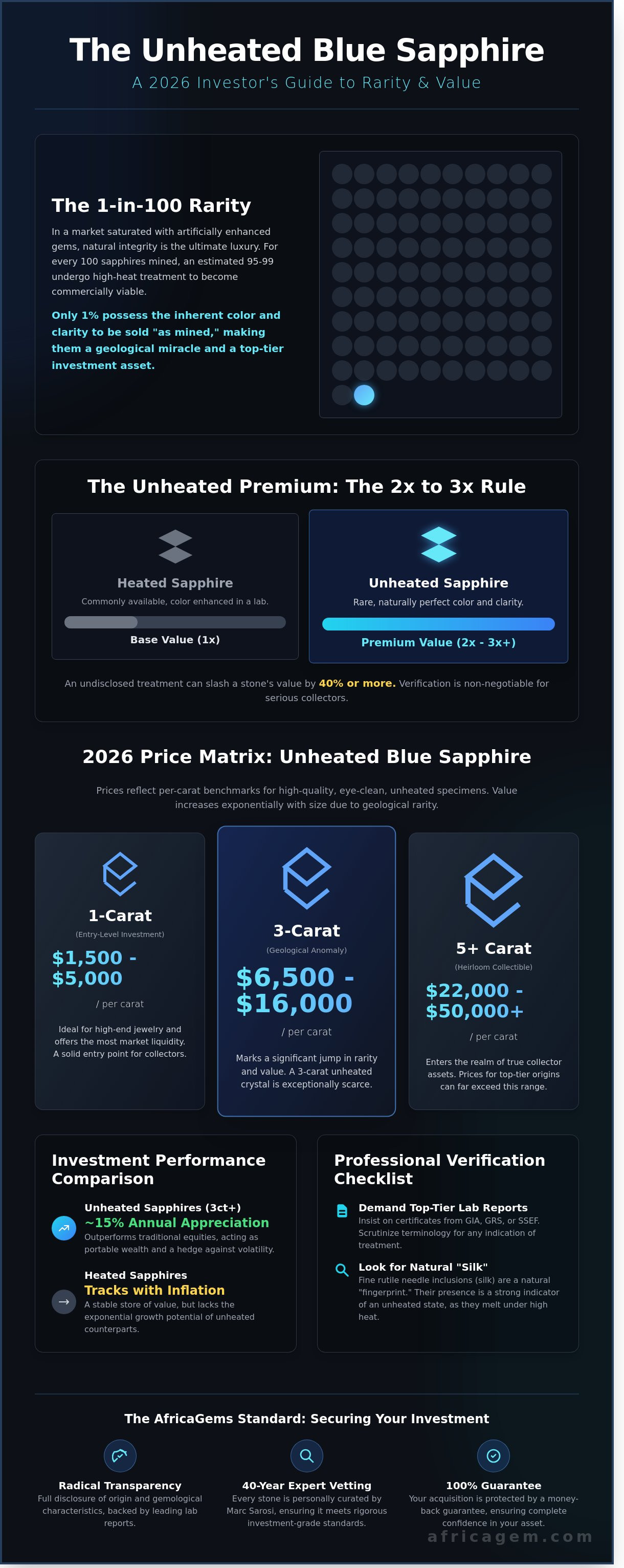
The unheated blue sapphire price reflects a standard of purity that most gemstones simply cannot meet. An unheated sapphire is a miracle of geology. It reached its peak saturation and clarity while still deep within the earth, requiring no human intervention to enhance its beauty. In the current 2026 market, this natural integrity is the primary driver of value. While 99% of sapphires arriving at cutting centers require thermal enhancement to be commercially viable, only 1% possess the inherent quality to remain "as mined." This 1-in-100 rarity creates a massive valuation gap. While heated stones have a predictable price floor based on supply, unheated specimens enjoy an exponential ceiling. Collectors now treat "standard heat" as a compromise, favoring the raw, untouched brilliance of a stone that survived the earth's pressures without a laboratory's help.
This preference isn't just about aesthetics; it's about scarcity. When you purchase an untreated gem, you're securing a piece of history that hasn't been altered by temperatures reaching 1,800 degrees Celsius. The market has shifted decisively. Buyers in 2026 are more educated than ever, often demanding laboratory reports from GIA or SSEF before even discussing a purchase. This transparency has solidified the unheated blue sapphire price as the benchmark for high-end colored stone investments. A stone that is naturally vibrant is a far more secure asset than one that has been "cooked" to achieve its color.
The Science of the No-Heat Premium
Heat treatment typically targets "silk," the fine rutile needles that can make a stone look sleepy. While 20th-century jewelers viewed silk as a flaw, 2026 connoisseurs recognize it as a "fingerprint" of origin and proof of natural state. These delicate structures melt when heated, leaving behind a "pitted" appearance under a microscope. High-end unheated specimens are also guaranteed to be free from invasive treatments like beryllium diffusion or lead-glass filling, which degrade the stone's long-term durability. Unheated status represents the ultimate gold standard for gemstone provenance and long-term value retention.
Investment Value vs. Jewelry Utility
Unheated sapphires function as portable wealth. Data from the last decade shows that while heated sapphires generally track with inflation, unheated stones of 3 carats or more have seen a 15% annual appreciation in resale value. During the economic volatility of 2024 and 2025, these gems held their ground better than traditional equities. The AfricaGems Difference lies in our refusal to compromise. We source only ethically documented, untreated specimens that meet rigorous loupe-clean standards. This ensures your acquisition is both a breathtaking piece of jewelry and a secure asset. Our commitment to full disclosure means every stone comes with a pedigree of natural excellence and the direct accountability of our expert curation.
Decoding the 2026 Price Matrix: Carat, Color, and Origin
The unheated blue sapphire price does not follow a linear path. Instead, it operates on a sliding scale where rarity and demand intersect to create exponential jumps. As we look at the 2026 market, the distinction between a heated stone and an unheated specimen has never been wider. Collectors today prioritize "nature's perfection," meaning they are willing to pay a heavy premium for stones that reached their color saturation without human intervention.
To understand the current market, we must look at the price-per-carat tiers for investment-grade stones. While prices vary based on clarity, these 2026 benchmarks represent high-quality, eye-clean specimens:
- 1-Carat Stones: Expect to pay between $1,500 and $5,000 per carat. These are ideal for engagement rings and offer the most liquidity.
- 3-Carat Stones: The price jumps significantly to $6,500–$16,000 per carat. Finding a 3-carat crystal that remains vibrant without heat is a geological anomaly.
- 5-Carat+ Stones: These enter the realm of true collectibles. Prices frequently start at $22,000 per carat and can exceed $50,000 for top-tier origins.
A common question from new collectors is why a 2-carat unheated sapphire costs significantly more than twice the price of a 1-carat stone. This is due to the scarcity of large, gem-quality corundum crystals. Nature rarely produces large stones that maintain a "loupe-clean" interior. When a stone doubles in weight, its rarity quadruples. This makes the unheated blue sapphire price for larger stones a reflection of their sheer statistical impossibility.
Origin Impact: Ceylon, Madagascar, and the Kashmir Legend
Origin remains the most powerful "invisible" price driver. A stone from the legendary Kashmir mines, which ceased significant production in 1887, carries a historical prestige that overrides almost all other factors. These stones are famous for their "velvet" blue caused by tiny rutile inclusions. Unheated Kashmir specimens start at $20,000 per carat and often reach six figures at auction. Ceylon (Sri Lanka) remains the market standard for brilliance and "open" colors. These stones are the most sought-after for fine jewelry because they perform exceptionally well under various lighting conditions. Madagascar has emerged as a rising star in the last decade. It produces stones that often rival Ceylon quality, yet they typically trade at a 15% to 20% discount, offering savvy collectors a window for value.
The Color Scale: Cornflower vs. Royal Blue
Color saturation is the heartbeat of sapphire valuation. "Cornflower Blue" refers to a medium-toned, vivid blue that feels bright and electric. In contrast, "Royal Blue" is a deeper, more authoritative tone that retains its vividness without turning "inky" or black in low light. If a stone exhibits secondary hues, such as green or gray, the value can be slashed by as much as 30%. Conversely, a slight violet secondary hue is often prized, as it can boost the perceived richness of the blue. For a deeper look at how these nuances impact your investment, see our Ultimate Guide to Blue Sapphires. If you are ready to find a stone that matches your specific criteria, you can explore our hand-selected inventory to find the perfect balance of color and origin.
Market Analysis: Comparing Unheated vs. Heated Sapphire Value
Understanding the unheated blue sapphire price requires a direct look at the premium placed on rarity. If you place two 3.00-carat Royal Blue Sri Lankan sapphires side by side, they might appear identical to the naked eye. However, the price tag tells a different story. In the 2026 market, a high-quality heated specimen might retail for $5,500 per carat. Its unheated counterpart, possessing the same "loupe-clean" clarity and saturation, easily commands $13,000 to $15,000 per carat. This isn't just a minor markup; it's the "2x to 3x Rule" in action.
This multiplier exists because unheated status is a testament to Nature's Perfection. While heat treatment is an accepted industry standard to dissolve silk and improve color, it's essentially a shortcut. An unheated stone achieved its beauty over millions of years without human intervention. For the serious collector, this psychological value is immeasurable. You aren't just buying a gemstone; you're buying a finite miracle of geology that hasn't been "cooked" to meet a commercial standard.
By 2026, the proliferation of lab-created sapphires has reached its peak. These synthetic stones have become so inexpensive to manufacture that they've separated entirely from the natural market. They don't impact the unheated blue sapphire price because they offer zero "store of value." Collectors view lab stones as fashion accessories, while natural, unheated sapphires remain a hard asset class, much like fine art or rare vintage watches.
Resale and Liquidity Factors
Liquidity is the lifeblood of any investment. Auction houses like Sotheby’s and Christie’s report that over 95% of their top-tier sapphire lots are unheated. This preference creates a robust secondary market that heated stones simply can't match. If you're looking for a lower-entry point into this world of "no-heat" gems, loose yellow sapphires provide an excellent alternative. They offer the same "untouched" prestige but often at a fraction of the blue sapphire's cost, making them a smart choice for diversifying a gem portfolio.
The Role of Rarity in Price Stability
Supply constraints are the primary driver of the current 2026 price hikes. Traditional mines in the Ratnapura and Elahera regions of Sri Lanka are yielding fewer unheated stones every year. Recent geological surveys indicate that the "easy" deposits are nearly exhausted. Because "no-heat" status is a finite resource that technology cannot replicate or increase, the scarcity is absolute. Every time an unheated stone is sold into a private collection, the available global supply shrinks, providing a natural floor for price stability and long-term appreciation.
The Buyer’s Checklist: How to Verify Value and Avoid Overpaying
Securing a fair unheated blue sapphire price requires more than just an eye for color. You need a methodical approach to verify that the stone's rarity matches its cost. In a market where 90% of sapphires are heat-treated, the premium for natural, unheated specimens is substantial. Follow these four steps to protect your investment.
- Step 1: Demand a Top-Tier Lab Report. Never finalize a high-value purchase without a certificate from GIA, GRS, or SSEF. The report must explicitly state "No indications of heating." This document is your primary insurance against paying unheated prices for treated stones.
- Step 2: Inspect for "Silk." Use a 10x loupe to look for fine, needle-like rutile inclusions. These delicate structures melt at high temperatures, so their presence is a primary indicator that the stone is unheated.
- Step 3: Evaluate the Cut Geometry. Cutters often leave extra weight on the bottom, or pavilion, of unheated stones to maximize carat weight. While this preserves weight, it can ruin the stone's brilliance. A well-proportioned cut reflects light evenly back to the eye.
- Step 4: Check for Windowing. Look straight down through the table. If you see a "hole" or a pale area where you can see right through the stone, it's windowed. This flaw can reduce the price by 25% or more because it indicates poor light return.
Understanding Lab Reports
A GIA report provides the most conservative and trusted assessment in the industry. If a report says "Heated," the stone's value drops by roughly 40% compared to an unheated counterpart. GRS reports are highly valued for their color branding; a GRS "Platinum Award" or a "Royal Blue" designation can add a 20% premium to the unheated blue sapphire price. For more security tips, read our guide on how to buy gemstones online.
Visual Inspection for the Connoisseur
High-quality unheated sapphires exhibit strong pleochroism. This means you'll see different shades of blue and violet-blue when viewing the stone from different angles. While "loupe clean" stones are the rarest, most collectors accept "eye clean" specimens that appear flawless to the naked eye. Inclusions in an unheated stone are often fingerprints of nature that prove authenticity. These tiny internal features tell the story of the stone's formation over millions of years. At AfricaGems, we call this the AfricaGems Difference, prioritizing radical transparency so you know exactly what you're buying.
Securing Your Investment with AfricaGems: The Marc Sarosi Standard
Marc Sarosi established AfricaGems in 1984, bringing a level of personal accountability to the gemstone trade that remains rare today. For over 40 years, he has personally vetted every gemstone in our inventory, applying a rigorous standard of selection that favors natural beauty and internal integrity. When you analyze an unheated blue sapphire price, you're investing in more than just a mineral; you're acquiring a piece of earth's history that has been curated by a master gemologist. Marc's deep-rooted connections in mining hubs like Sri Lanka and Madagascar ensure that every stone meets his exacting criteria for color saturation and cut quality.
The AfricaGems guarantee is built on a foundation of radical transparency. We provide full disclosure on every gemstone treatment, though our unheated collection remains the pinnacle of our offerings. Every purchase is backed by a 100% money-back policy, allowing you to inspect the gem in your own lighting conditions without risk. This security is essential for high-value transactions where subtle differences in tone or clarity can influence the unheated blue sapphire price by thousands of dollars. We believe that an informed buyer is a confident collector.
Beyond sourcing loose stones, we offer a comprehensive custom jewelry design service. Our artisans specialize in transforming rare, unheated sapphires into bespoke heirloom pieces. Whether you're seeking a classic platinum setting or a modern rose gold design, we ensure the mounting protects and highlights the stone's natural brilliance. This transition from a loose investment to a wearable masterpiece is handled with the same precision that Marc applies to his initial stone selection.
Ethical Sourcing and Transparency
AfricaGems maintains a strict commitment to conflict-free and fair-trade sourcing. Since our founding, we've prioritized partnerships with suppliers who respect both human rights and environmental regulations. To ensure you see exactly what you're buying, we provide high-resolution 360-degree videos for every unheated stone. These videos capture the pleochroism and natural silk inclusions that verify a stone's untreated status. For collectors looking to diversify their portfolios, we also offer rare padparadscha sapphires, which provide a unique alternative to the traditional blue palette.
Your Next Steps: Consultation and Purchase
Our proprietary "Compare" tool allows you to evaluate up to four stones side-by-side, analyzing price differences and gemological specs in real-time. This is particularly useful for those selecting loose stones for custom engagement rings, as it helps you balance carat weight against color intensity. By purchasing a loose gem, you avoid the retail markups typically associated with pre-set jewelry and gain total control over the final design. We invite you to browse our exclusive collection of GIA Certified Unheated Blue Sapphires and find a stone that meets the Marc Sarosi standard of excellence.
Securing Your Legacy in the 2026 Sapphire Market
Navigating the unheated blue sapphire price landscape requires more than an eye for color; it demands a commitment to natural integrity. As we move through 2026, the scarcity of untreated stones continues to drive a 30% to 50% price premium over traditional heat-treated gems. Serious collectors understand that documented origin and GIA or GRS certification are the only ways to verify a stone's true market standing. You're looking for more than just a beautiful gem; you're seeking a tangible asset that reflects the Earth's raw artistry.
AfricaGems brings 40 years of gemological expertise to your search, providing a curated selection where radical transparency is the standard. Every stone in our collection is conflict-free and ethically sourced, backed by the personal guarantee of Marc Sarosi. We don't just sell minerals; we provide the technical data and provenance required to make an informed investment. By choosing a stone that has remained untouched by human heat, you're securing a rarity that less than 1% of the world's sapphires can claim.
Invest in Rarity: Shop Our Certified Unheated Blue Sapphires
Your journey into the world of elite gemstones starts with a single, exquisite choice that will endure for generations.
Frequently Asked Questions
How much does a 1-carat unheated blue sapphire cost in 2026?
In 2026, a fine 1-carat unheated blue sapphire typically ranges from $2,500 to $6,000 depending on its saturation and clarity. Top-tier Cornflower or Royal Blue specimens from reputable sources often command a premium beyond these figures. This unheated blue sapphire price reflects a 15% increase from 2024 market averages. Collectors prioritize these stones because less than 1% of gem-quality sapphires remain completely untreated by heat.
Is an unheated blue sapphire worth the extra price compared to a heated one?
Yes, unheated blue sapphires are worth the 30% to 100% price premium because they represent true geological rarity. While heat treatment improves color, an unheated stone possesses natural brilliance and crystal integrity that hasn't been altered by man. At AfricaGems, we believe the intrinsic value of a "Nature Only" stone provides better long-term security. It's an investment in a piece of Earth's history that remains exactly as it was found.
Which origin produces the most expensive unheated blue sapphires?
Kashmir produces the most expensive unheated blue sapphires, with auction prices often exceeding $200,000 per carat for historic stones. Mogok, Myanmar follows closely, typically commanding a 50% premium over Sri Lankan counterparts. While Madagascar produces breathtaking Royal Blue gems, the historical prestige of Kashmir and Burma continues to drive the highest market valuations in 2026. This origin-based pricing reflects the unique "velvety" luster found in these legendary locations.
Can you tell if a sapphire is unheated without a lab report?
You cannot definitively confirm a sapphire is unheated without a professional lab report from GIA, SSEF, or Gübelin. Expert gemologists look for intact rutile needles, known as silk, which melt at high temperatures. If these delicate inclusions are pristine, the stone is likely untreated. However, modern heating techniques are so sophisticated that even seasoned dealers rely on microscopic analysis and spectroscopic data to ensure the unheated blue sapphire price is justified.
Does the price of unheated blue sapphire go up every year?
Unheated blue sapphire prices have seen a steady annual appreciation of 8% to 12% over the last decade. Supply from traditional mines like those in Sri Lanka has decreased by 20% since 2021, while global demand for untreated gems continues to surge. This scarcity ensures that high-quality, loupe-clean stones maintain their value. It's a trend that Marc Sarosi has monitored closely to ensure our clients receive stones with strong growth potential.
What is the best color for an unheated blue sapphire investment?
The Royal Blue hue is currently the best color for investment, specifically those with a vivid, deep saturation and no secondary gray masks. This specific color profile has outperformed Cornflower Blue by 18% in recent 2025 auction results. A stone with strong pleochroism that displays a rich violet-blue face-up will always be the most sought-after. These exquisite gems represent the pinnacle of connoisseurship and typically retain the highest resale value over time.
Are unheated sapphires more fragile than heated ones?
Unheated sapphires aren't more fragile than heated ones and both sit at a 9 on the Mohs scale. In fact, some argue that unheated stones are more durable because they haven't been subjected to the internal stress of 1,800-degree Celsius temperatures. This thermal shock can sometimes expand microscopic inclusions and create internal tension. Choosing an untreated stone means you're getting a gem with its original crystal structure intact and uncompromised by extreme laboratory conditions.
How does carat weight affect the price-per-carat of unheated stones?
The price-per-carat for unheated blue sapphires increases exponentially rather than linearly as weight climbs. A 5-carat stone isn't just five times the price of a 1-carat stone; it can be 10 to 15 times more expensive. For example, while a 1-carat stone might cost $4,000, a comparable 5-carat gem could easily reach $60,000. This happens because large, clean, unheated crystals are exceptionally rare finds in the natural world.