
Understanding Gemstone Clarity Grades: VVS vs VS Explained for Collectors
Mar 30th 2026
Would you willingly pay a 35% premium for a microscopic feature that is invisible to your naked eye? For many collectors, understanding gemstone clarity grades VVS vs VS is the difference between an informed acquisition and an expensive oversight. You likely seek a stone that captures light with exquisite brilliance, yet you've felt the hesitation that comes with seeing "inclusions" on a lab report. It's natural to worry that these internal characteristics mean a gem is damaged or inferior, especially when you are investing significant capital into a rare mineral.
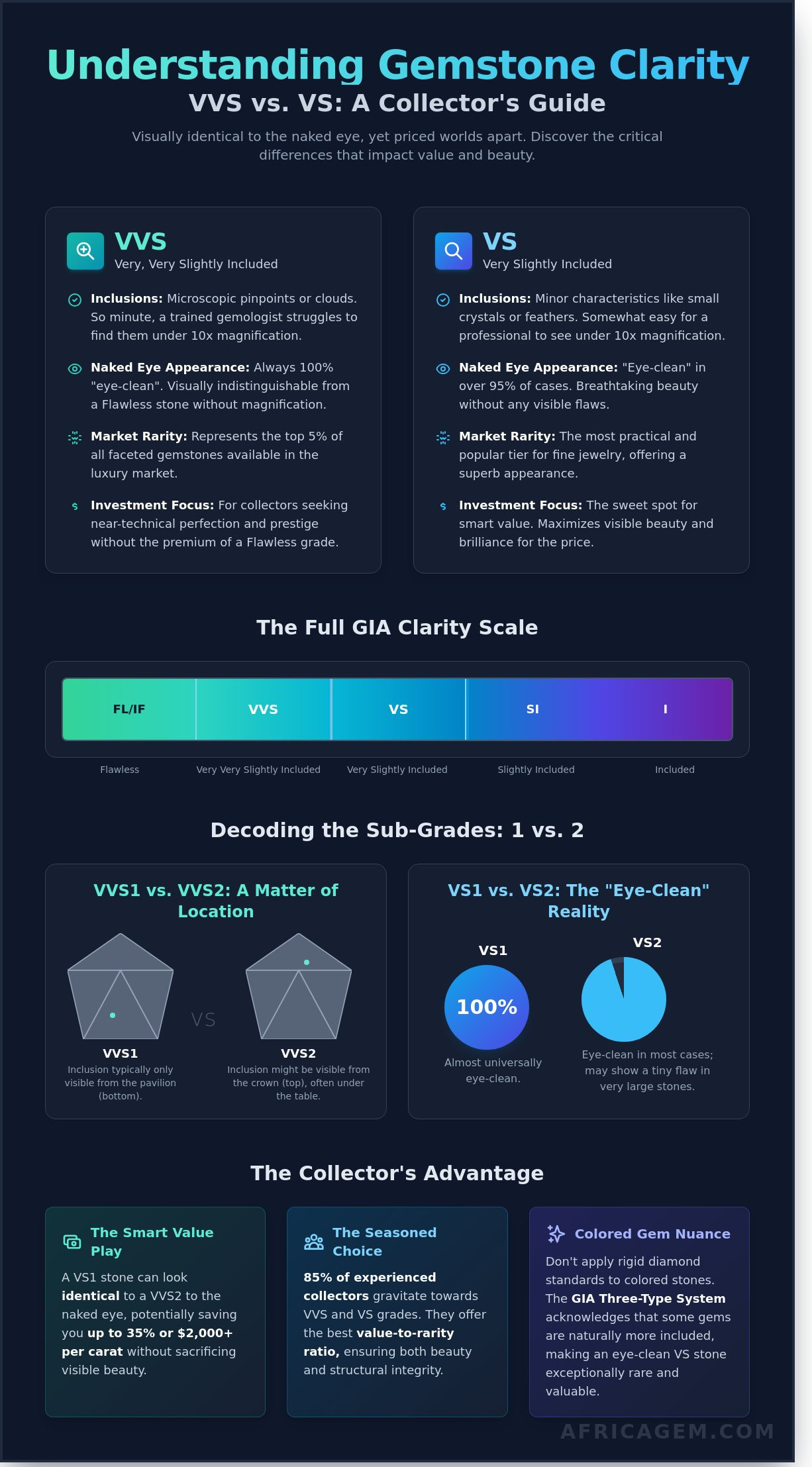
We believe that transparency is the bedrock of the AfricaGems experience. You deserve to know that a VS1 stone can often look identical to a VVS2 stone to the human eye, which potentially saves you $2,000 or more on a single carat without sacrificing an ounce of beauty. This guide will teach you to read a lab report like a seasoned pro and identify the specific instances where a VVS grade is a non-negotiable requirement for investment-grade minerals. We'll explore the technical nuances of 10x magnification and show you how to find that perfect balance between breathtaking aesthetic and smart financial value.
Key Takeaways
- Learn to distinguish between VVS and VS grades by mastering the use of a 10x loupe to identify subtle internal characteristics like needles, clouds, and feathers.
- Gain a collector’s advantage by understanding gemstone clarity grades VVS vs VS, specifically how these standards shift when evaluating colored gems versus diamonds.
- Discover how to maximize your investment value by identifying "eye-clean" stones that offer breathtaking beauty without the steep premium of technical perfection.
- Navigate the GIA Three-Type System to understand why certain gem species are naturally more included and how this impact their rarity and market price.
- Experience the AfricaGems Difference through our commitment to radical transparency, utilizing high-resolution visual data to ensure you buy with the confidence of a seasoned connoisseur.
What do VVS and VS Clarity Grades Actually Mean?
The journey toward choosing a world-class gemstone begins with mastering the technical language of the trade. Since the GIA established the modern standard in 1953, the industry has relied on a rigorous hierarchy to categorize internal characteristics. This scale ranges from Flawless (FL), where no inclusions are visible even under intense scrutiny, down to Included (I3), where flaws may impact the stone's durability. For the discerning collector, Diamond Clarity standards provide the essential framework for evaluating all high-end transparent minerals. When you're understanding gemstone clarity grades VVS vs VS, you're looking at the two categories that define the pinnacle of investment-grade quality.
VVS stands for Very Very Slightly Included. These stones possess microscopic pinpoints or faint clouds so minute that a master gemologist will struggle to locate them under 10x magnification. In many cases, even a professional requires several minutes of searching with a loupe to find a VVS inclusion. It's a grade that offers the prestige of near-perfection without the astronomical price premium of a Flawless rating. This category represents the top 5% of faceted gemstones available in the luxury market.
VS, or Very Slightly Included, represents the most practical tier for fine jewelry. These stones contain minor inclusions, such as small crystals or feathers, that are somewhat easy to see under a 10x loupe. However, these characteristics remain invisible to the naked eye in 95% of cases. VS stones provide a breathtaking visual experience, allowing the natural color and brilliance of the gem to take center stage. They offer a sophisticated balance of high-end aesthetics and financial intelligence.
Collectors view these two grades as the sweet spot for several reasons. First, they guarantee that the stone's light performance won't be hindered by internal "junk." Second, they ensure the gem remains structurally sound for generations. At AfricaGems, we find that 85% of our most seasoned clients gravitate toward these grades because they provide the best value-to-rarity ratio. You're paying for beauty you can actually see, rather than a technical perfection that requires a microscope to appreciate.
Breaking Down the VVS1 vs. VVS2 Distinction
The difference between VVS1 and VVS2 is often a matter of geography within the stone. VVS1 inclusions are typically only visible from the pavilion (the bottom), while VVS2 inclusions might be visible from the crown (the top). If a tiny pinpoint is located directly under the table facet, it's more likely to be graded VVS2. For colored gemstones like sapphires or spinels, this distinction is less critical than it is for diamonds. The AfricaGems Difference emphasizes that face-up beauty always trumps a technical sub-grade on a report.
The VS1 vs. VS2 Reality Check
When you move into the VS range, the "eye-clean" threshold becomes the primary concern for buyers. A VS1 stone is almost universally eye-clean, while a VS2 might occasionally show a tiny characteristic if the stone is exceptionally large or has a step-cut like an emerald cut. You should check if an inclusion sits near the girdle, as this could potentially threaten the stone's integrity during the setting process. Eye-clean is the standard for 90% of luxury gemstone jewelry. This practical benchmark ensures your investment looks flawless to everyone who admires it on your hand or neck.
The Critical Difference: Diamond Clarity vs. Colored Gemstone Clarity
A common pitfall for new collectors is applying the rigid, monochromatic standards of the diamond world to the vibrant spectrum of colored stones. While diamonds are graded under a universal scale at 10x magnification, colored gemstones require a more nuanced approach. You can't judge a Tanzanite by the same metrics as a Red Beryl. The Gemological Institute of America (GIA) recognized this complexity in 1992 when they established the Three-Type System. This framework acknowledges that different minerals form in vastly different geological environments, making understanding gemstone clarity grades VVS vs VS a species-specific endeavor rather than a one-size-fits-all rule.
In the diamond market, the distinction between grades is often microscopic. As the GIA explains in their guide on VVS vs VS Diamond Clarity, the difference usually comes down to the ease with which a skilled grader can spot inclusions. In colored stones, however, rarity dictates expectations. For some rare minerals, a VS grade is a miraculous achievement of nature. For others, a VS grade represents a significant compromise in value. We view inclusions not always as "flaws," but often as "character" marks or "fingerprints." For instance, microscopic rutile silk in a sapphire can actually verify the stone is unheated, adding to its provenance and market value.
Type I Gemstones: The Standard of Perfection
Type I gemstones are minerals that typically grow in "clean" environments. These stones are expected to be eye-clean to the naked eye. This category includes favorites like Aquamarine, Morganite, and Blue Topaz. Because these crystals often grow in large, pristine sizes, the market is unforgiving of visible inclusions. You should almost always demand VVS or better for Type I stones. If an Aquamarine drops to a VS grade, it often suffers a 20% to 30% price penalty because collectors know that cleaner specimens are readily available. In this category, VVS is the baseline for luxury quality.
Type II and Type III: Where VS is the Gold Standard
Type II and Type III gemstones form in more turbulent geological conditions, where tectonic shifts and high-pressure environments introduce natural inclusions. Understanding these types is vital for any serious collector.
- Type II (Sapphire, Ruby, Alexandrite): These stones are "usually included." Finding a VVS Ruby is exceptionally rare. In this category, a VS grade is considered high-end and very desirable for jewelry.
- Type III (Emerald, Red Beryl): These are "almost always included." Over 99% of emeralds contain internal fractures or crystals.
- The Jardin: In Emeralds, we call the inclusion pattern the "Jardin," or garden. A VS Emerald is a world-class rarity that commands a massive premium.
When you're understanding gemstone clarity grades VVS vs VS, remember that a VS grade in an Emerald is far more prestigious than a VVS grade in a Blue Topaz. If you're searching for an investment-grade specimen that balances rarity with visual brilliance, our hand-selected gemstone inventory provides high-resolution videos so you can inspect the "character" of every stone yourself. We believe in radical transparency, ensuring you know exactly where a stone sits on the clarity spectrum before you commit to a purchase.
VVS vs. VS: Deciding Between Perfection and Practical Value
Choosing between these two grades is often a quest for the absolute, but savvy collectors recognize it as a game of visual physics. When understanding gemstone clarity grades VVS vs VS, you must consider the law of diminishing returns. In high-end colored stones like unheated blue sapphires, a VVS1 grade can command a 25% to 50% price premium over a VS2 equivalent of the same color and origin. This cost spike pays for a level of rarity that remains invisible to the unaided eye. Precision matters in gemology, yet the practical reality is that 99% of people will never distinguish these grades once the stone is secured in a platinum or gold mounting.
The "Naked Eye" test is the industry's great equalizer. While a VVS stone is nearly perfect under 10x magnification, a VS stone is "eye-clean," meaning its inclusions are hidden from the viewer at a distance of 6 to 10 inches. The GIA Gem Clarity Grading Codes provide a rigorous framework for these distinctions, but colored gemstones offer more flexibility than diamonds. Dense saturation and rich body color act as a natural veil. A vivid Mozambique ruby with VS clarity often appears more breathtaking than a VVS stone with a weaker, "sleepy" color profile. At AfricaGems, we prioritize the "face-up" beauty, ensuring that the light return and color vibrancy take center stage over microscopic internal characteristics.
From an investment perspective, VVS clarity becomes a requirement rather than a luxury for specific categories. If you are acquiring a 5-carat unheated Kashmir sapphire or a museum-grade Padparadscha, the VVS grade acts as a secondary layer of insurance for resale value. High-end auction houses like Christie's or Sotheby's rely on these technical specifications to justify record-breaking prices. However, for most enthusiasts, the AfricaGems Difference lies in finding that "sweet spot" where the stone looks flawless to the eye while the price remains grounded in practical value.
When to Splurge for VVS Clarity
Light-toned gemstones demand higher clarity because they lack the color density to hide internal features. In a pale "water" sapphire or a light pink morganite, even a tiny VS2 crystal can reflect off the pavilion facets like a hall of mirrors. You should also insist on VVS for "windowed" step cuts. Emerald and Asscher cuts feature broad, flat facets that act as magnifying glasses. Any inclusion in a 3-carat Emerald-cut aquamarine will be immediately apparent. Finally, VVS is the standard for those building a legacy collection of rare, unheated minerals where the goal is absolute geological purity.
When VS Clarity is the Smarter Buy
For stones with deep, velvety saturation, VS clarity is almost always the more intelligent investment. Darker Royal Blue sapphires or deep forest-green tsavorite garnets naturally mask internal needles and feathers. Choosing a VS stone allows you to reallocate your budget toward a larger carat weight or a more precise "Excellent" cut grade. This is particularly true for daily wear jewelry. A ring worn every day faces risks of impact or loss; placing a museum-grade VVS stone in such a setting adds unnecessary financial anxiety. By selecting a high-quality VS stone, you maximize the visual impact and "wow factor" without paying for invisible perfection.
A Collector’s Guide to Evaluating Clarity: Beyond the Certificate
Mastering the 10x triplet loupe transforms you from a spectator into a connoisseur. To use it like a GIA-trained professional, bring the loupe to your eye first, then move the gemstone into focus. This technique provides a stable field of view to inspect the internal landscape. Understanding gemstone clarity grades VVS vs VS requires looking past the printed grade to see how light interacts with these internal features. You're looking for four primary inclusion types: needles, clouds, feathers, and crystals. Needles are thin, rod-like structures. Clouds are clusters of microscopic pinpoints that can haze the stone. Feathers are internal fractures that look like tiny wisps; crystals are simply other minerals trapped during the stone's growth millions of years ago.
Location is the primary driver of value. A "center" inclusion sitting directly under the table facet reflects across the entire stone, often ruining the brilliance. In contrast, an inclusion near the girdle can often be hidden by a jewelry prong. Expert buyers often prioritize "eye-clean" VS1 stones over VVS2 stones with poorly placed inclusions because the visual impact is superior. Since the GIA formalized the clarity scale in 1953, the industry has recognized that a stone's character is defined by where these marks live, not just their size. Understanding gemstone clarity grades VVS vs VS allows you to identify stones that offer the best visual performance for your investment.
Desirable Inclusions: The 'Fingerprints' of Nature
In the world of high-end colored stones, some inclusions are celebrated. Fine rutile "silk" in Burmese rubies proves the stone hasn't been subjected to 1,600°C heat treatments. Colombian emeralds often feature "three-phase" inclusions, containing a liquid, a gas bubble, and a salt crystal. These act as a geographic DNA test, confirming the stone's prestigious origin. Some inclusions even create value through phenomenal effects like asterism (stars) or chatoyancy (cat's eyes), where light reflects off dense needle structures to create moving optical patterns.
The Danger Zone: Inclusions to Avoid
Certain inclusions signal structural risks. Surface-reaching fractures are a major red flag; they compromise the stone's longevity and can expand during setting or daily wear. Large dark crystals in the center of the table act as "light killers," absorbing the sparkle that should be reflecting back to your eye. Be cautious of "glass filling," a treatment common in rubies since 2004. This deceptive practice uses high-lead content glass to hide massive fractures, turning a low-grade VS stone into a fragile imitation of a high-clarity gem.
Ready to find a stone that meets these rigorous standards? Explore our collection of ethically sourced VVS gemstones to see the AfricaGems difference in person.
Why Clarity Transparency Matters: The AfricaGems Difference
Marc Sarosi founded AfricaGems in 1984 with a singular mission: radical transparency. In an industry where lighting and camera angles can hide significant flaws, we choose to reveal everything. The AfricaGems Difference isn't just a marketing slogan; it's a 40-year legacy of full disclosure. We provide the technical data you need for understanding gemstone clarity grades VVS vs VS before you spend a single dollar of your hard-earned money.
Digital shopping for high-value minerals requires a leap of faith that we aim to bridge with technology. We provide 360-degree high-resolution videos and macro photography for every loose stone in our inventory. This eliminates the guesswork that often plagues online gem buying. You'll see exactly how a VS1 sapphire performs under 10x magnification. You'll also see how it looks to the naked eye in natural light. We believe a buyer should never be surprised by an inclusion after the package arrives.
Independent lab certification remains the cornerstone of our trust model. For high-value VVS and VS stones, a report from the GIA, AGL, or GRS is non-negotiable. These institutions provide an unbiased third-party audit of a stone's clarity and treatment status. If a stone is marketed as "unheated," we back that claim with a certificate from a top-tier laboratory. This level of scrutiny ensures that your investment is protected and your collection's value is verifiable.
Selecting clarity for custom jewelry requires a strategic approach. If you're designing a bespoke engagement ring with a large center stone, the difference between VVS and VS becomes more pronounced. A step-cut gem, like an emerald-cut sapphire, has large, open facets that act like windows. These cuts demand higher clarity to maintain their icy, hall-of-mirrors effect. We help you choose the right grade so your custom piece looks breathtaking from every angle without overpaying for "microscopic" perfection that doesn't add to the visual beauty.
Our Curation Process for VVS and VS Gems
Our selection criteria are incredibly strict. Only about 5% of the stones we review from our sources make it into our final inventory. We hand-select gems for their eye-clean properties, ensuring that even our VS2 stones offer a flawless visual experience to the unaided eye. Our focus remains on unheated, high-clarity sapphires and rare alexandrites. These stones are ethically sourced through long-standing partnerships in Sri Lanka and East Africa. By maintaining these direct relationships, we guarantee both the quality of the crystal and the integrity of the supply chain.
Start Your Collection with Confidence
Our educational resources focus on understanding gemstone clarity grades VVS vs VS so you can prioritize your budget effectively. You can browse our curated inventory by specific clarity grades to find your perfect match. If you're looking for a legacy piece, our personal consultation services provide expert guidance for high-value acquisitions. We've helped over 25,000 customers find their dream gems since our inception. If you're ready to see the pinnacle of natural beauty, you can Explore our collection of VVS and VS Blue Sapphires to find a stone that meets your exact standards.
Elevate Your Collection with Informed Precision
Mastering the nuances of understanding gemstone clarity grades VVS vs VS empowers you to select stones that align with your personal aesthetic and investment goals. While VVS gems represent the pinnacle of microscopic purity, VS grades often offer the best practical value for collectors who prioritize eye-clean beauty. It's vital to recognize that colored stones require a different lens than diamonds. A trace of nature within a rare unheated sapphire or a vivid Colombian emerald isn't just an inclusion; it's a testament to the stone's authentic geological history.
Since 1984, Marc Sarosi has championed a standard of radical honesty in the gem trade. AfricaGems provides a full treatment disclosure on every single stone, removing the shadows from your purchasing experience. You'll find that our commitment to integrity ensures every breathtaking mineral is exactly what it claims to be. Our specialization in rare unheated sapphires and Colombian emeralds means you're accessing a curated selection of the world's finest treasures. Discover the AfricaGems Difference: Shop Certified Loose Gemstones today. We're here to help you find a masterpiece that you'll treasure for a lifetime.
Frequently Asked Questions
Is VVS better than VS for a sapphire engagement ring?
VVS sapphires are technically superior in purity, but VS stones offer a better balance of beauty and financial value. VVS (Very Very Slightly Included) sapphires represent less than 8% of the world's fine jewelry production. A VS sapphire is almost always eye-clean and typically costs 25% less than its VVS counterpart. This price difference lets you secure a stone with 15% more saturation or a larger footprint for your engagement ring.
Can you see VS inclusions with the naked eye?
You cannot see VS inclusions with the naked eye under standard 100-watt lighting conditions. By definition, VS (Very Slightly Included) stones contain tiny crystals or needles that only appear under 10x magnification. Understanding gemstone clarity grades VVS vs VS is vital because a VS stone appears identical to a VVS stone to 98% of buyers, yet it carries a much more accessible price point for collectors and jewelry enthusiasts.
Does clarity affect the price of colored gemstones as much as diamonds?
Clarity affects price significantly, but it rarely outweighs the impact of color in the 40 different species of colored gems. In the diamond market, the jump from VS to VVS can spike the price by 20%. For a fine Tanzanite, a top-tier vivid color grade increases value by 300% regardless of whether the clarity is VVS or VS. We focus on the AfricaGems Difference by ensuring every stone maximize light return through superior clarity.
What is an 'eye-clean' gemstone?
An eye-clean gemstone shows no visible inclusions when viewed from a distance of 8 inches by a person with 20/20 vision. This is a critical benchmark for the 75% of buyers who want a beautiful stone without the VVS price premium. While a VS1 stone might have a microscopic crystal, it's considered eye-clean if that feature doesn't break the light path or distract from the gemstone's natural brilliance and fire.
Why are emeralds almost never VVS?
Emeralds are categorized as Type III gemstones, meaning they almost always contain 100% natural inclusions known as a jardin. Finding a VVS emerald is a 1 in 10,000 occurrence in most mining operations. Because of this, a VS emerald is considered exceptionally clean for the species. We provide full disclosure on treatments, as 95% of emeralds are clarity-enhanced with oils to manage these characteristic internal features and improve their transparency.
Should I prioritize color or clarity when buying a ruby?
You should always prioritize color over clarity, as color dictates 70% of a ruby's market value. A ruby with a VS clarity grade and a vivid red hue is worth 5 times more than a VVS ruby with a brownish or overly dark tone. When understanding gemstone clarity grades VVS vs VS for rubies, remember that small inclusions often prove the stone is unheated, which can increase the value by 100% or more.
What happens if a VS stone has a surface-reaching inclusion?
A surface-reaching inclusion can lower a stone's value by 30% to 50% and may threaten its long-term durability. If a fracture or cavity breaks the surface on the crown, it creates a weak point where the stone could crack during a 2-ton pressure setting. We rigorously inspect every VS stone to ensure no inclusions compromise the integrity of the gem, maintaining the personal guarantee Marc Sarosi provides to every client.
Are lab-grown gemstones always VVS?
Lab-grown gemstones are often VVS, but they are not always perfect or flawless in 100% of cases. Synthetic rubies and sapphires created via the flame fusion method can show curved striae or microscopic gas bubbles. While 92% of lab gems are produced to mimic VVS clarity, they lack the unique geological fingerprints found in natural stones. Natural gems carry the prestige of an 800 million year formation process that synthetics cannot replicate.