
Tsavorite Garnet vs. Emerald: The Connoisseur’s Guide to Green Gemstones
May 13th 2026
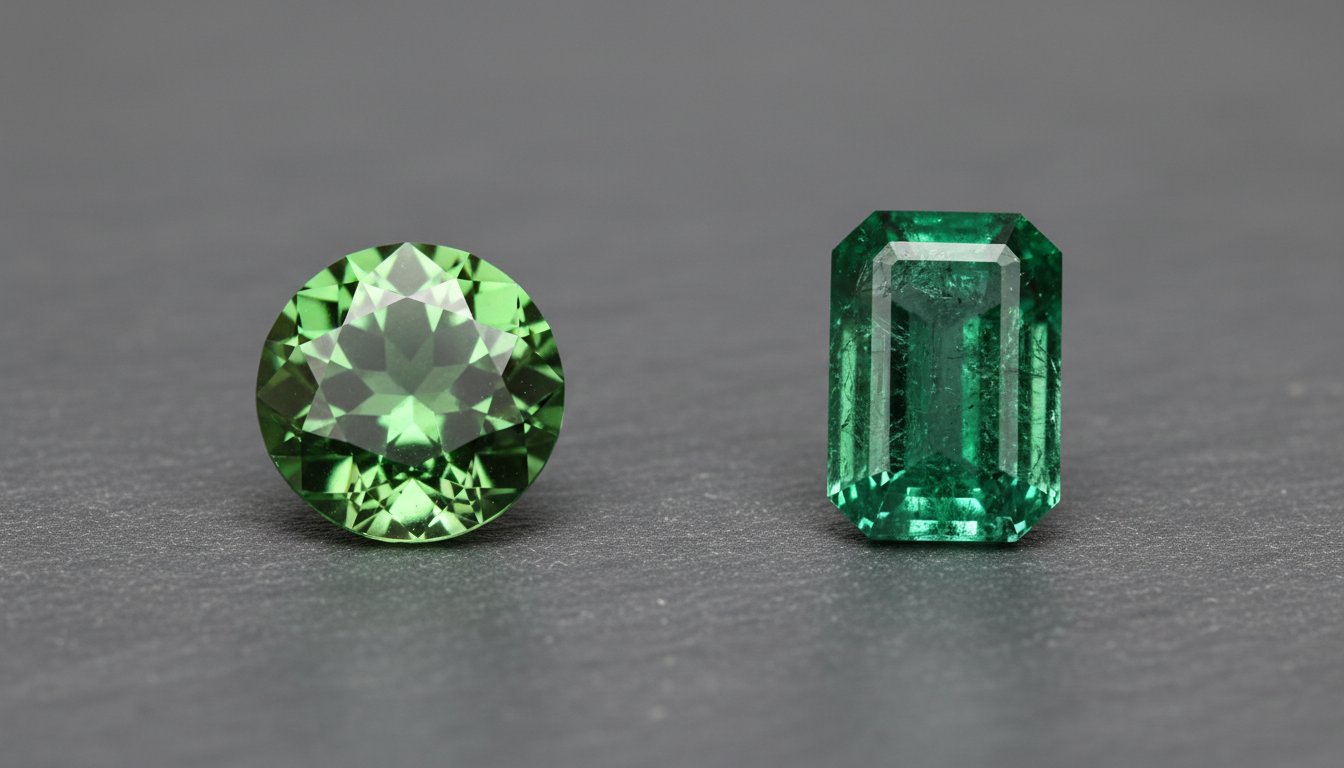
What if the most vibrant, durable green gemstone for your collection isn't actually an emerald? While the emerald has reigned as the "King of Green" for centuries, many savvy collectors are shifting their gaze toward a rare challenger. When comparing tsavorite garnet vs emerald, the decision often comes down to a choice between historical prestige and modern performance. You might assume the "precious" label on an emerald makes it the superior investment, but the technical reality tells a far more nuanced story.
It's natural to feel hesitant when choosing between these two green giants, especially if you're worried about the legendary fragility of emeralds or how to judge saturation through a screen. This guide will help you decode the technical and aesthetic differences so you can make a confident investment. We'll explore why tsavorite offers superior brilliance due to its higher refractive index and why the "No Oil" emerald market has reached a boiling point in 2026. From durability ratings to the rise of "Muzo Green" standards, you'll gain the insider knowledge needed to select a stone that truly glows.
Key Takeaways
- Evaluate the optical performance of each gem, focusing on how tsavorite’s higher refractive index produces a brilliance that often surpasses the traditional emerald.
- Navigate the durability debate by understanding why an emerald’s "jardin" affects its structural integrity differently than the naturally cleaner, tougher tsavorite garnet.
- Gain insight into the 2026 market where rarity and origin drive value, making certain untreated green stones essential legacy assets for serious collectors.
- Learn to distinguish between the "prestige buy" and the "performance buy" when weighing tsavorite garnet vs emerald for your next custom jewelry project.
The Great Green Rivalry: Tsavorite Garnet vs. Emerald
For over 4,000 years, the emerald has stood as the undisputed titan of the green gemstone world. Its lush, verdant hue defined luxury long before the modern concept of "high jewelry" even existed. However, the discovery of a rare grossular garnet in 1967 changed the landscape forever. This sparked a debate that continues to intrigue collectors and investors alike: tsavorite garnet vs emerald. While one stone relies on millennia of royal heritage, the other wins hearts through raw optical performance and geological scarcity.
To see these stones side-by-side and understand their visual impact, watch this expert comparison:
In the high-end market of 2026, the archaic distinction between "precious" and "semi-precious" has largely vanished. Serious connoisseurs know that rarity, optical properties, and provenance matter far more than Victorian-era labels. A top-tier tsavorite can be significantly harder to find than a commercial-grade emerald, yet it often provides better "fire" for the investment. This head-to-head isn't just about a preference for green; it's a deep dive into how light interacts with crystal structures and how these minerals survive the rigors of daily wear. We're setting the stage for a technical showdown where heritage meets high performance.
The Emerald Legacy: 4,000 Years of Prestige
Cleopatra famously claimed the emerald mines of Egypt as her own, cementing the stone's link to royalty and divine power. From the legendary Spanish galleons carrying Colombian treasures to the modern red carpets of Cannes, the emerald's prestige is unmatched. This heritage is exactly why the name "Emerald" still commands the highest market premiums in the industry. It's a stone of history, long associated with the heart chakra and a sense of timeless elegance. Even with its known inclusions, the "jardin" of a fine emerald is often viewed as a thumbprint of nature rather than a flaw.
The Tsavorite Ascent: The Modern Collector’s Darling
While emeralds have millennia of history, the Tsavorite garnet is a relatively new arrival to the world stage. Discovered by British geologist Campbell Bridges in Tanzania and later Kenya, this stone was championed by Tiffany & Co. in the 1970s as a vibrant alternative to the classic beryl. Its geological rarity is staggering. It's found only in a specific geological belt in East Africa, making it one of the few stones that remains completely untreated. Modern designers are increasingly choosing tsavorite for high-jewelry because it offers a clarity and brilliance that emeralds rarely achieve. It's the "insider's" choice for those who value natural purity over historical labels.
Optical Performance: Refractive Index and the Green Fire
When you hold these two gems side by side under professional lighting, the visual contrast is immediate. The emerald offers a soft, internal glow that has captivated collectors for millennia. Conversely, the tsavorite garnet provides a high-energy sparkle that rivals even the finest diamonds. This difference isn't just a matter of opinion; it's rooted in the fundamental physics of how light interacts with their distinct crystal structures. To see a detailed technical breakdown of these properties, you can consult this comparative factsheet which highlights their divergent mineral compositions.
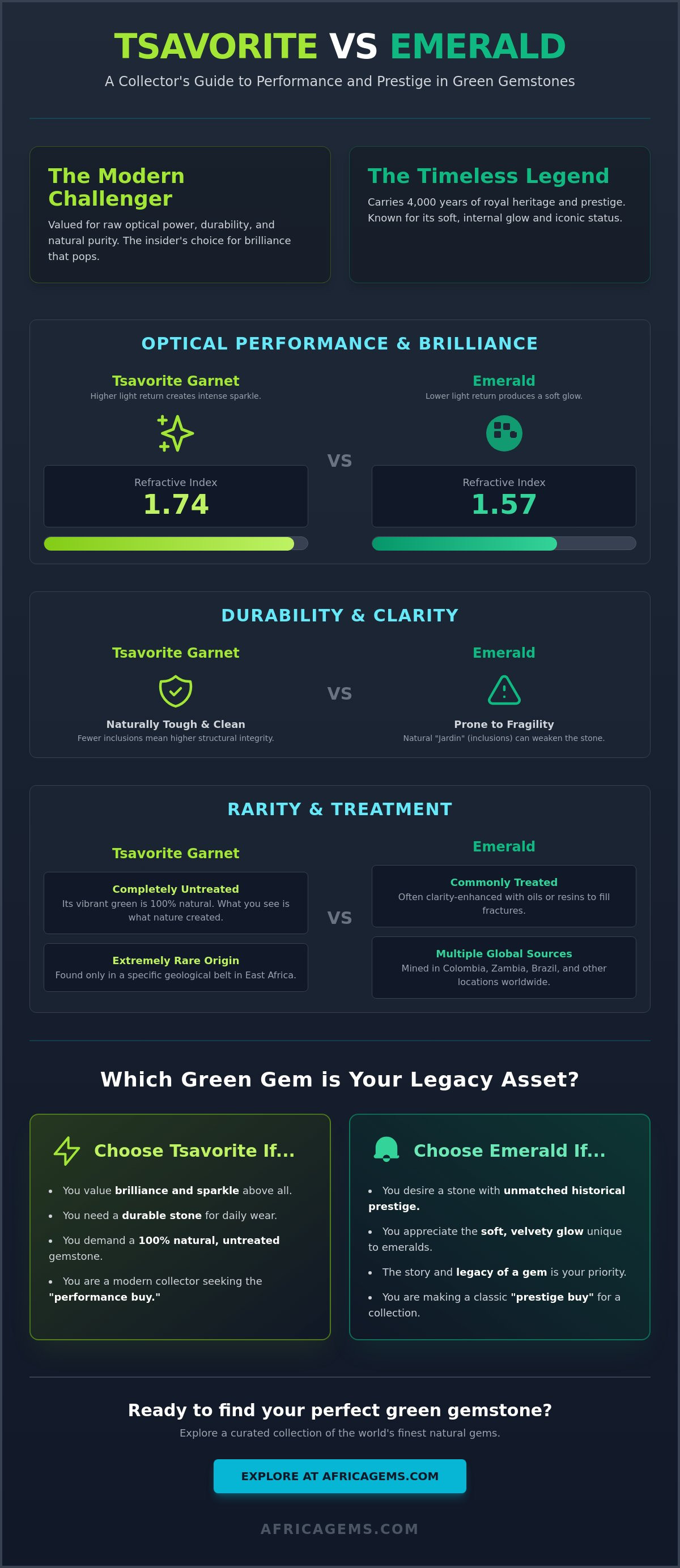
The primary driver of this visual gap is the refractive index. Refractive index is the speed of light through the gem. While an emerald carries a refractive index of approximately 1.57, the tsavorite garnet reaches a much higher 1.74. Because light bends more sharply within the garnet, it's reflected back to the viewer's eye with significantly more intensity. This higher light return minimizes "dead spots" within the stone, ensuring the gem remains lively even in low-light environments. If you are looking for a centerpiece that maintains its brilliance from across a room, exploring loose green gemstones with high refractive indices is a prudent first step.
Brilliance and Light Return
Tsavorite's superior brilliance is complemented by its dispersion, which is nearly double that of an emerald. In gemstone terminology, dispersion refers to the "fire" or the flashes of spectral color you see when the stone moves. While emeralds are prized for their "velvety" depth, they often require specific step cuts to maximize their color saturation at the expense of sparkle. Tsavorites, thanks to their cubic crystal system, naturally return more light. This allows for a wider variety of brilliant cuts that showcase a "neon" zing that most emeralds simply cannot match.
Color Saturation and Consistency
Both gemstones owe their vivid green hues to the presence of chromium and vanadium. However, the way these elements manifest in the tsavorite garnet vs emerald debate differs significantly. Tsavorites are typically "eye-clean," meaning they lack the visible inclusions that characterize almost all emeralds. This clarity allows for a more consistent, saturated color across the entire stone. While an emerald's beauty often relies on its "jardin" or garden like inclusions to soften its appearance, the tsavorite relies on pure, uninterrupted transparency to deliver its signature electric green punch.
Durability and Clarity: The Jardin vs. The Clean Garnet
Selecting a gemstone for a high-wear piece like an engagement ring requires a hard look at the physical realities of mineralogy. Hardness is merely a surface-level metric. On the Mohs scale, the emerald appears superior with a rating of 7.5 to 8.0, while the tsavorite garnet sits slightly lower at 7.0 to 7.5. However, hardness only measures resistance to scratching. Toughness, or tenacity, describes how a crystal lattice resists breaking under impact. In the tsavorite garnet vs emerald comparison, the garnet often wins on sheer resilience. Because emeralds are almost always heavily included, they possess internal cleavage planes that act like fault lines when struck. A tsavorite, typically free of these structural stress points, is far less likely to chip or shatter during a sudden impact.
Inclusions and the Oiling Process
The market reality is that 99% of emeralds undergo some form of treatment to improve their appearance before they reach a showroom. Most are filled with cedar oil or artificial resins to hide surface-reaching fissures, a process that requires periodic maintenance. You can explore these nuances further in our Emerald Gemstone: The Connoisseur’s Guide. Conversely, the tsavorite garnet is a miracle of nature that is almost never enhanced. According to the International Colored Gemstone Association's guide to tsavorite, this stone's natural clarity is one of its most compelling attributes for collectors who demand radical transparency. At AfricaGems, we maintain a strict policy of full disclosure, ensuring you understand the exact treatment status of every stone in our vault.
Practical Wearability in Engagement Rings
If you're designing a piece for daily wear, the risk of a stone cracking during the setting process is a serious consideration. Emeralds are notoriously temperamental. They cannot withstand the vibrations of ultrasonic cleaners or the intense heat of a jeweler's torch without risking the expulsion of their oils or a complete fracture. Tsavorite's lack of significant inclusions makes it a far safer choice for modern jewelry settings, including tension or channel mounts that apply pressure to the stone's girdle. While you should still treat any fine gem with care, the tsavorite offers a level of security that the more fragile emerald simply cannot provide. It's a stone built for the rigors of a legacy, not just the safety of a display case.
Market Value and Rarity: Investment Dynamics in 2026
The financial landscape of green gemstones has shifted dramatically as we move through 2026. While the emerald remains the undisputed "prestige buy" for many legacy collectors, the investment potential of tsavorite garnet has captured the attention of the modern "Expert Enthusiast." When evaluating tsavorite garnet vs emerald, the primary driver of value is often a paradox of rarity versus recognition. Tsavorite is geologically scarcer than emerald, sourced exclusively from a single geological belt stretching between Kenya and Tanzania. Some industry estimates suggest it's nearly 200 times rarer than its beryl counterpart, yet its price point remains more accessible for the performance it delivers.
Origin plays a pivotal role in these investment dynamics. For emeralds, Colombian stones from the Muzo or Chivor mines command the highest premiums, especially "No Oil" specimens which are increasingly treated as legacy assets. As of 2026, fine-quality emerald prices have climbed 12 to 15 percent year-over-year. For a three-carat investment-grade emerald with no oil, prices can easily exceed $50,000 per carat. In contrast, a top-tier two-carat tsavorite remains a "smart buy" at an estimated $4,000 to $8,000 per carat. This price gap allows collectors to acquire a flawless, vivid tsavorite for a fraction of the cost of a comparable high-end emerald.
The Size Factor in Pricing
The availability of large specimens creates a stark divide in the market. Emerald crystals can grow to massive proportions, but tsavorite is rarely found in clean crystals exceeding five carats. As a result, the price per carat for a top-tier tsavorite doesn't just increase with size; it skyrockets. A vivid stone over three carats is an exceptional find, often harder to source than a comparable emerald. You can learn more about these scarcity patterns in our Rare Gemstones: A Connoisseur’s Guide. While you can find emeralds in 10-carat sizes at high-end auctions, finding a clean tsavorite of that magnitude is a once-in-a-decade event.
Collector Demand and Liquidity
Liquidity varies between these two green giants. Emeralds are "blue chip" assets with global recognition, making them easy to trade at major auction houses. Tsavorite remains a niche gem, though its liquidity is rising as more luxury houses adopt it for high-jewelry collections. For those looking to secure an investment-grade stone, vetting quality through a trusted source is essential. We recommend consulting our AfricaGems expert guide to buying online to ensure you're making a secure, ethical choice. Whether you're chasing the "Muzo Green" standard or the electric zing of a Kenyan garnet, the 2026 market rewards those who prioritize transparency and origin.
Ready to add a rare green masterpiece to your vault? Explore our curated collection of investment-grade loose gemstones to find your next centerpiece.
Making the Choice: Selecting the Perfect Green Centerpiece
The final decision in the tsavorite garnet vs emerald debate rests on your lifestyle and your aesthetic priorities. Emeralds remain the ultimate choice for those who value heritage and that specific, velvety depth of color. If you're looking for a stone with a historical pedigree that can reach impressive sizes, a Colombian emerald is your blue-chip asset. It's a gem of tradition, perfect for pieces intended for occasional elegance or formal galas where its soft glow can be fully appreciated.
If you prioritize optical performance and daily resilience, the tsavorite garnet is the clear winner. Its ability to sparkle in low light and its natural resistance to chipping make it a superior choice for the modern, active collector. You get a stone that's geologically rarer than an emerald and almost always untreated, offering a level of purity that's increasingly hard to find in the 2026 market. It's the "insider's" gem, combining high-jewelry prestige with the practical durability of a garnet.
Design Considerations for Green Gems
Custom jewelry design provides the perfect opportunity to protect and enhance your chosen stone. For emeralds, we strongly recommend a bezel setting. This surrounding metal acts as a protective "insurance policy" for the stone's vulnerable girdle, shielding it from the accidental knocks of daily life. When it comes to metals, 18k yellow gold provides a classic warmth that complements the mossy depth of an emerald. Conversely, platinum or white gold can make the "neon" pop of a tsavorite garnet appear even more electric. Adding colorless side stones, such as diamonds or white sapphires, can also help to isolate and intensify the green saturation of your center stone.
Final Expert Recommendation
Our final verdict depends on the "test" your jewelry must pass. If you're facing the "Engagement Ring Test," tsavorite is the technical champion. Its toughness and lack of oil-filled fissures mean it will survive decades of daily wear and professional cleanings without losing its luster. However, if you're looking for the "Heirloom Test," a top-tier Colombian emerald remains the ultimate legacy. Its status as one of the "big three" precious stones ensures it will always be a cornerstone of any serious collection.
At AfricaGems, we stand behind every stone with a guarantee of ethical sourcing and radical transparency. Whether you're drawn to the ancient allure of beryl or the modern brilliance of garnet, we're here to ensure your investment is secure. Explore our curated collection of Loose Tsavorite Garnets today to find a stone that matches your standard for excellence.
Secure Your Green Masterpiece
Deciding between the ancient allure of the beryl family and the high-performance fire of the grossular garnet requires a balance of historical appreciation and technical scrutiny. By weighing the factors of tsavorite garnet vs emerald, you've moved beyond surface-level aesthetics to understand how refractive index, structural integrity, and geological scarcity define true value. You now know that while the emerald offers an unmatched historical pedigree, the tsavorite provides a level of brilliance and daily wearability that is increasingly prized by modern connoisseurs. Whether you're drawn to the "Muzo Green" of a Colombian legacy or the electric brilliance of a Kenyan treasure, your choice now rests on a foundation of expert knowledge.
Since 1984, founder Marc Sarosi has built AfricaGems on a pillar of radical transparency and professional integrity. We provide full disclosure on all gemstone treatments and offer only the finest expertly vetted, ethically sourced gems. This commitment ensures that every piece in your collection is a secure investment that reflects your standards for quality. Browse the AfricaGems Collection of Fine Loose Emeralds & Tsavorites today to find the green masterpiece that will define your collection for generations. Trust your instincts and celebrate the natural beauty of these rare earth treasures.
Frequently Asked Questions
Is tsavorite garnet more expensive than emerald?
Emeralds typically command higher market premiums, especially for "No Oil" Colombian specimens. While a fine emerald can reach astronomical per-carat prices, a top-tier tsavorite remains a high-performance alternative that offers more brilliance for a lower price point. The exception occurs in sizes over five carats, where the extreme scarcity of tsavorite can lead to significant price spikes.
Can you use a tsavorite garnet for an engagement ring?
Tsavorite is an excellent choice for an engagement ring because it lacks the internal cleavage planes that make emeralds fragile. It possesses a higher resistance to impact, meaning it won't chip or shatter as easily during daily activities. While emeralds require careful maintenance and avoid ultrasonic cleaners, tsavorite is a durable, low-maintenance centerpiece built for a lifetime of wear.
How can I tell the difference between a tsavorite and an emerald?
The easiest way to distinguish them is by looking at the light return and clarity. A tsavorite garnet will exhibit sharp, colorful flashes of fire and is generally free of visible inclusions. An emerald has a softer, velvety glow and almost always contains a "jardin" of internal fractures. If the stone looks like a neon green diamond, it's likely a tsavorite.
Do tsavorite garnets have inclusions like emeralds?
Tsavorites are naturally much cleaner than emeralds and are typically eye-clean. While they may contain microscopic mineral crystals or liquid feathers, they don't possess the dense, mossy inclusions found in beryl. This lack of structural flaws is why tsavorites don't need the oil treatments that are standard for 99% of the world's emerald supply.
Which green gemstone has the most sparkle?
Tsavorite garnet is the clear winner when it comes to brilliance and sparkle. Its refractive index of 1.74 is substantially higher than the 1.57 found in emeralds, allowing it to reflect more light back to the eye. When comparing tsavorite garnet vs emerald in natural sunlight, the garnet will show vibrant "fire" while the emerald maintains a deep, steady color saturation.
Are tsavorite garnets treated or enhanced?
Tsavorite garnets are one of the few gemstones on the market that are almost never treated or enhanced. They aren't heated, oiled, or irradiated to improve their color or clarity. Their vivid green hue is a pure result of Tanzanian and Kenyan geology. This natural state provides a level of security for investors who prioritize unenhanced, ethically sourced materials.
What is the best cut for a tsavorite garnet vs. an emerald?
Brilliant cuts like the round or cushion are best for tsavorite to maximize its high refractive index and fire. Emeralds are traditionally shaped into the "emerald cut," a rectangular step cut designed to protect the stone's fragile corners and emphasize its deep color. Choosing the right cut ensures that the specific optical strengths of each mineral species are highlighted.
Why are emeralds considered "precious" and tsavorites "semi-precious"?
These terms are outdated historical classifications that don't reflect the modern market's reality. Emeralds earned the "precious" label through centuries of royal use, while tsavorite was only discovered in 1967. In 2026, connoisseurs focus on rarity and optical quality. A rare, five-carat tsavorite is often more difficult to source than a commercial-grade emerald, making it equally precious to a serious collector.