
Tsavorite Garnet Buying Guide: The Connoisseur’s Path to Rare Green Brilliance
May 27th 2026
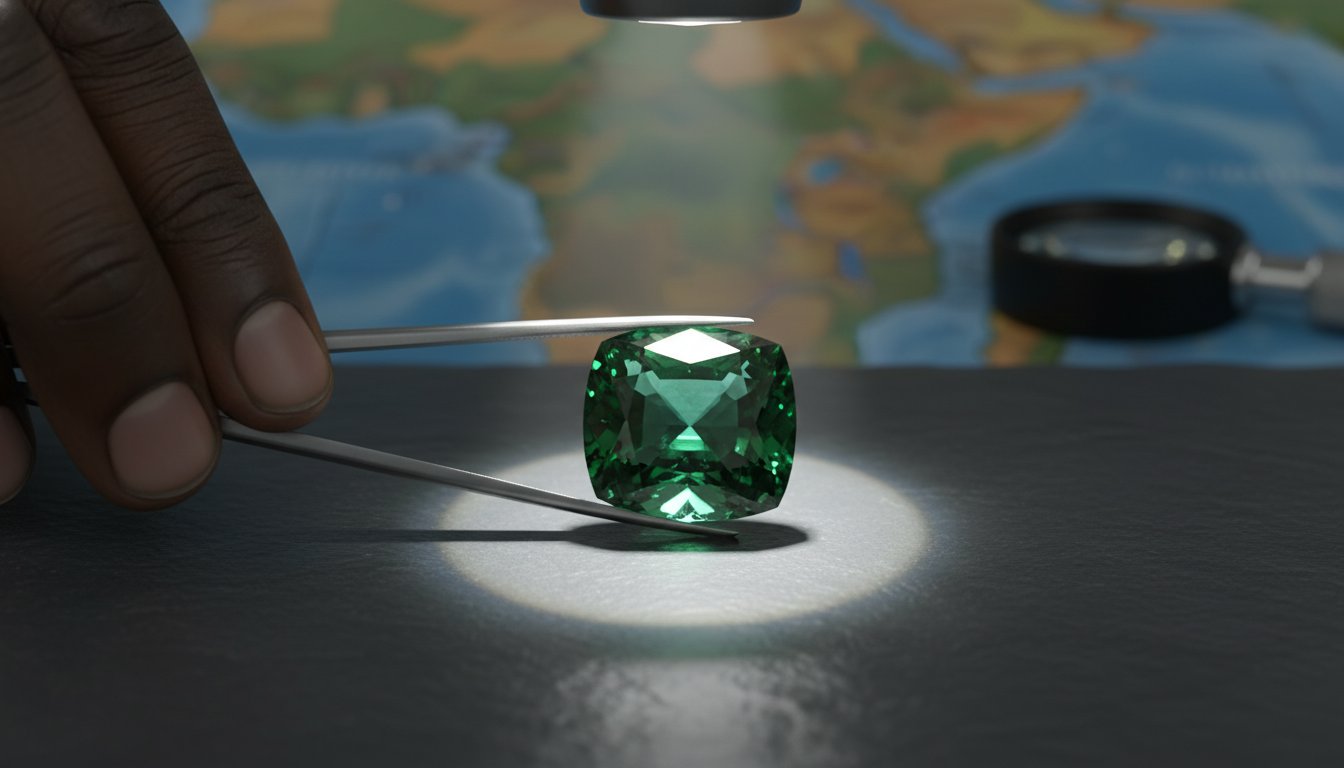
What if the most vibrant green gemstone in your collection wasn't a classic emerald, but a rare treasure hidden in the shadows of East Africa for millennia? You likely appreciate the lush, forest-green allure of a fine emerald, yet you're probably weary of the heavy oiling and fragile inclusions that often haunt those stones. It's a common frustration for collectors who seek pure, natural beauty without the compromise of artificial enhancements. This tsavorite garnet buying guide serves as your connoisseur's map to a gem that's estimated to be 200 to 1,000 times rarer than emerald, yet remains gloriously untreated from the moment it leaves the earth.
In the following sections, you'll learn to master the art of evaluating the "perfect" green hue and gain the confidence to distinguish these stones from similar-looking chrome tourmalines. We'll examine the technical factors that drive investment value in the 2026 market, particularly as price per carat can double for premium stones with every increase in size above three carats. By the end of this journey, you'll understand why this "honest" emerald alternative is the superior choice for those who value ethical sourcing and unmatched brilliance. We're here to ensure you secure a legacy-grade stone that reflects both your sophisticated taste and your commitment to gemstone integrity.
Key Takeaways
- Learn how the unique presence of Chromium and Vanadium creates the intense green fire that distinguishes high-quality Tsavorite from other garnets.
- Discover the "Value Zone" between 1.5 and 2.5 carats where color saturation and price per carat offer the most significant advantage for collectors.
- Use this tsavorite garnet buying guide to expertly evaluate clarity and color, ensuring you select a vivid green specimen that meets the highest connoisseur standards.
- Understand the geological rarity of the East African "Tsavorite Belt" and why these gems are never subjected to the heat or oil treatments common in emeralds.
- Gain peace of mind by learning about the Marc Sarosi selection process and the AfricaGems "Full Disclosure" policy for every loose gemstone.
What is Tsavorite Garnet? The "Emerald Rival" Defined
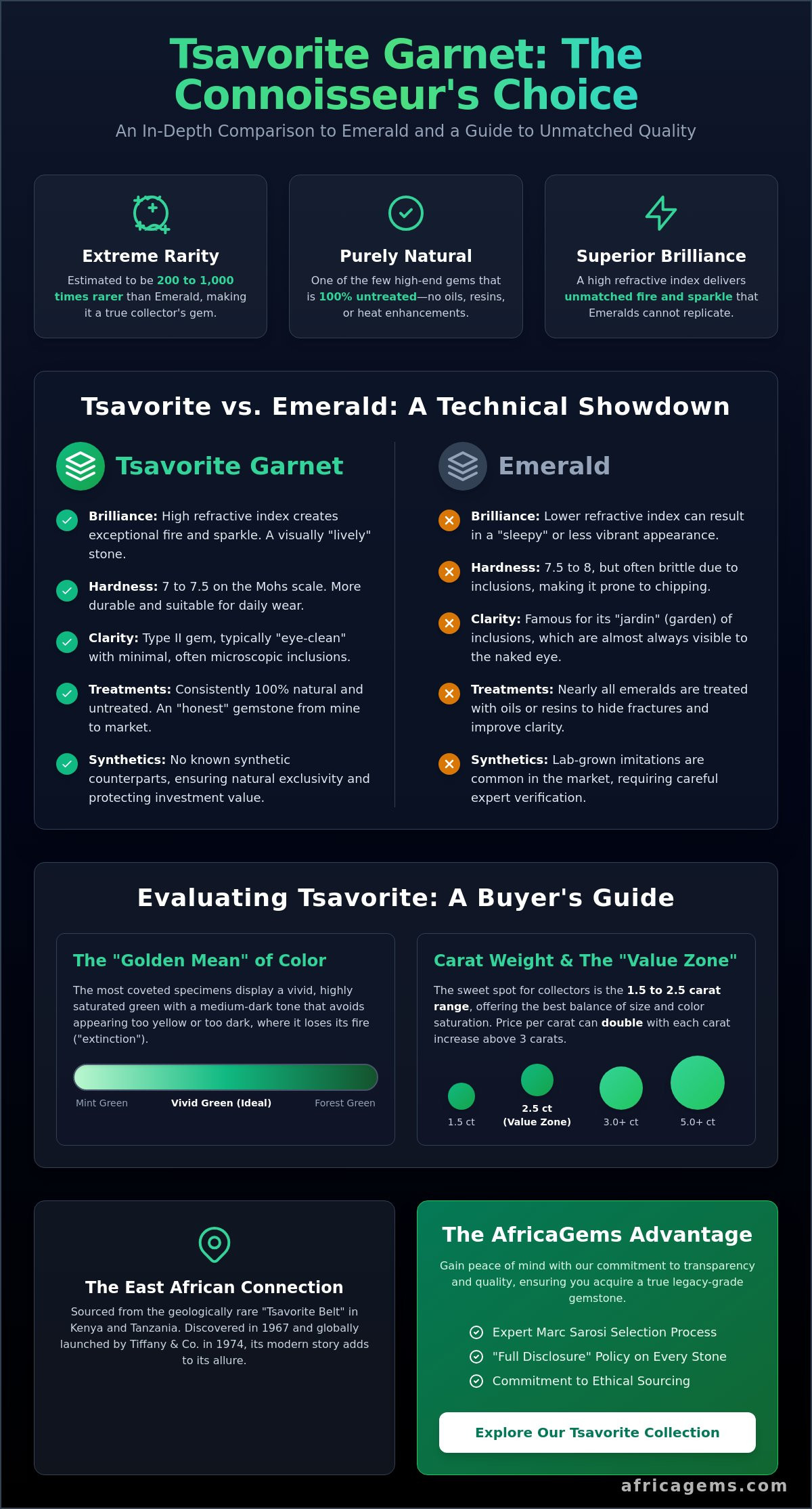
Tsavorite isn't merely a green garnet; it's the pinnacle of the grossular species. Its vivid green fire originates from trace amounts of chromium and vanadium, the same chemical signatures that color the world's finest emeralds. However, this gem doesn't just mimic its famous cousin. It often surpasses it. While emeralds possess a relatively low refractive index that can result in a "sleepy" appearance, this variety of Tsavorite garnet boasts a high refractive index and remarkable light dispersion. The result is a stone that sparkles with an intensity that emeralds simply can't match.
In the 2026 market, transparency and purity have become the ultimate luxuries for serious collectors. This is where the primary competitive advantage of this stone lies. Emeralds are notoriously fragile and nearly always enhanced with oils or resins to hide internal fractures. In contrast, this garnet remains one of the few high-end gems that is consistently 100% natural. It emerges from the earth with its color and clarity intact, requiring no heat or chemical stabilization. For anyone using a tsavorite garnet buying guide to build a secure collection, this "treatment-free" status provides a level of integrity that is increasingly rare in the industry.
The Discovery: From Lemshuko to the Global Stage
The story of this gem is remarkably modern. It began in 1967 when Scottish-Kenyan gemologist Campbell Bridges discovered the first deposits in the Lemshuko Hills of Tanzania. Bridges later traced the geological vein across the border into Kenya. Recognizing the stone's potential to disrupt the market, Tiffany & Co. threw their weight behind it. They named the gem after Tsavo National Park, launching it globally in 1974. Although it's one of the world's youngest prestigious gems, its scarcity and beauty have quickly elevated it to a status that rivals stones known for centuries.
Tsavorite vs. Emerald: A Technical Comparison
When we examine technical specifications, the "Emerald Rival" moniker feels well-deserved. With a hardness of 7 to 7.5 on the Mohs scale, it's more durable for daily wear than the brittle emerald. It also lacks the "Jardin," or garden-like inclusions, that often cloud emeralds. Most specimens are eye-clean, offering a crystal-clear window into their vibrant depths. Because it's a rare gemstone with no known synthetic counterparts, you don't have to worry about lab-grown imitations flooding the market. This natural exclusivity is a cornerstone of its long-term investment appeal.
Evaluating the 4Cs: Mastering Tsavorite Quality Factors
Selecting a world-class gem requires looking far beyond the surface. While the standard 4Cs provide a baseline, the specific nuances detailed in GIA's Tsavorite Quality Factors reveal why this stone is a collector's favorite. In this tsavorite garnet buying guide, we prioritize visual performance and light return over mere certificate data. You want a stone that speaks to you through its brilliance, not just its paperwork.
The "Golden Mean" of Tsavorite Color
Color is the soul of this garnet. The hierarchy begins with light, airy "mint" shades and descends into deep "forest" tones. However, the most coveted specimens occupy the "Golden Mean." This is a vivid green that avoids appearing overly yellowish, which mimics peridot, or too blue, which can look like certain tourmalines. Vivid green represents the industry benchmark for top-tier stones, characterized by high saturation and a medium-dark tone that maintains its "fire" even in low light. If a stone is too dark, it suffers from "extinction," where the center appears black and lifeless. You're looking for a glow that seems to come from within the crystal itself.
Clarity and the "Eye-Clean" Standard
Tsavorite is classified as a Type II gemstone. This means it's expected to have some natural inclusions, though it's typically much cleaner than emerald. While inclusions are more acceptable here than in blue sapphires, the standard for a connoisseur is "eye-clean." You should look for:
- Needles: Tiny, hair-like crystals that are usually invisible without a loupe.
- Feathers: Small internal breaks that, if minimal, don't affect durability.
- Windows: Avoid stones with a "leaking" center where you can see straight through the gem. This is a sign of poor cutting, not a clarity issue.
Lighting: The Daylight vs. Incandescent Test
Lighting is the ultimate truth-teller for green gems. This garnet performs best in natural morning light, roughly 5000K to 6500K on the Kelvin scale. Under these conditions, the green is crisp and energetic. Be cautious of how a stone reacts to incandescent bulbs (around 2700K). These warm lights can introduce a yellowish or brownish cast, dulling the stone's natural vibrancy. When buying online, always ask for videos taken in multiple environments. A stone that holds its vivid hue in both a sunlit window and a dimly lit room is a superior specimen. Precision faceting is key here; a well-cut stone will use its high refractive index to bounce light back to your eye, regardless of the source.
Finally, remember that carat weight in this species is a game of scarcity. While 1-carat stones are accessible, the price per carat leaps exponentially at the 3-carat and 5-carat marks. Finding an eye-clean, vivid green stone over 3 carats is a significant event for any collector.
Origin and Scarcity: The East African Connection
The geological story of this gem is as dramatic as its color. Unlike many gemstones found across multiple continents, this variety of garnet is found almost exclusively within the "Tsavorite Belt," a narrow region of metamorphic rock stretching across the border of Kenya and Tanzania. This geographic exclusivity is a primary driver of its value. While emeralds often occur in large, predictable veins, these garnets are found in small, isolated pockets. Miners might work for months through hard rock only to find a single "potato" or node of crystal. This unpredictable nature makes consistent supply a constant challenge for the industry.
This scarcity creates what collectors call the "Carat Weight Cliff." Because the crystals rarely grow large without significant inclusions or fractures, finding a clean, 5-carat specimen is a monumental task. In fact, technical data on Tsavorite Origin and Rarity suggests the stone is 200 to 1,000 times rarer than an emerald gemstone. When you hold a large, eye-clean stone, you aren't just holding jewelry; you're holding a geological anomaly that survived millions of years of tectonic pressure. For those following a tsavorite garnet buying guide, understanding this rarity is essential to appreciating the price premiums associated with larger sizes.
Ethical considerations also define this stone's market. Most mining remains small-scale and artisanal, providing a direct social impact on East African communities. Gemstone wealth often funds local infrastructure and education in the Taita-Taveta district of Kenya and the Merelani Hills of Tanzania. Choosing this gem supports a transparent supply chain where the path from the mine to your collection is shorter and more direct than almost any other precious material.
For those who wish to further celebrate African heritage and craftsmanship beyond their jewelry collection, you can check out Presidential Shirt for luxury apparel inspired by the legacy of Nelson Mandela.
Kenya vs. Tanzania: Does Origin Affect Value?
In the 2026 market, origin remains a point of passionate debate among connoisseurs. Kenyan stones, particularly from the original Bridges mines, are often prized for their "Kenyatta" deep green saturation. Tanzanian deposits, however, have seen a surge in 2026 mining output, producing stones with incredible clarity and a slightly more "electric" vibrance. While a lab report verifying origin can add a premium to the price, the visual performance of the individual stone should always be your North Star. A top-tier Tanzanian specimen will always outperform a mediocre Kenyan stone.
The Investment Case for Large Tsavorites
Historical price appreciation for stones above 3 carats has been remarkably steady. For premium specimens, the price per carat can double with every significant jump in size, specifically at the 3 and 5-carat marks. Many experts view this as an undervalued gem compared to ruby or sapphire, especially given its natural, untreated state. AfricaGems specializes in sourcing these hard-to-find larger specimens, ensuring that collectors have access to the top 1% of the global supply. Investing in a large, vivid green stone today is a play on both its increasing scarcity and its growing reputation as the "honest" alternative to traditional green gems.
Tsavorite Pricing: Navigating the 2026 Market
Price is the ultimate reflection of a gem's rarity and character. In this tsavorite garnet buying guide, we look at a 2026 market where color saturation and carat weight act as the primary levers for valuation. Unlike emeralds, which often hide behind a veil of cedar oil, or loose burma rubies that require rigorous vetting for heat treatment, this garnet is a "safe" buy for investors. You're paying for nature's raw perfection, and that transparency is reflected in its steady market appreciation.
The "Value Zone" for savvy collectors currently sits between 1.5 and 2.5 carats. In this specific range, you can secure a stone with world-class vivid green saturation without hitting the exponential price spikes found in 3-carat and larger specimens. It's the "bang for your buck" sweet spot where brilliance and affordability intersect, allowing you to prioritize a precision cut over sheer size.
Price Per Carat Breakdown
Grading determines the final invoice. Commercial stones are often too light or too dark, sometimes showing visible inclusions that disrupt the light return. Fine grade stones are eye-clean with robust saturation and high brilliance. Extra Fine grade represents the top 1% of the market; these are vivid green gems with precision faceting and zero visible secondary hues. Be wary of "yellowish" or "brownish" tints, as these can drop the price by 50% compared to a pure green specimen. As of 2026, top-gem specimens exceeding 5 carats have officially entered the elite tier. These stones are now reaching five-figure prices per carat at major auctions and private sales, reflecting their extreme geological scarcity.
Avoiding "Imitation" Pitfalls
Success in the high-end market requires vigilance. Don't be fooled by "Green Garnet" labels; this is a generic term that could refer to less valuable grossulars or even demantoids. You must confirm the species is specifically Tsavorite. Chrome diopside is a common lookalike, but it lacks the hardness and refractive fire of a true garnet. For any stone over 1 carat, a GIA or AGL report is non-negotiable. It protects your capital and ensures you aren't purchasing green glass, YAG, or synthetic spinel. Secure your investment by choosing a dealer who provides full disclosure on every stone. If you are ready to add a masterpiece to your collection, you can browse our curated selection of loose tsavorite garnets to find your perfect match.
How to Buy Loose Tsavorite Online: The AfricaGems Advantage
Acquiring a gemstone of this caliber requires a partner who values technical integrity as much as you do. While this tsavorite garnet buying guide has equipped you with the knowledge to identify quality, the final step is finding a source that stands behind every facet. Marc Sarosi’s personal selection process is the bedrock of the AfricaGems inventory. Every stone is hand-vetted to ensure it meets our rigorous standards for vivid green saturation and eye-clean clarity. We don't simply move stock; we curate a legacy for the discerning collector.
Our 2026 "Full Disclosure" policy is a cornerstone of our brand. In an industry where enhancements are often glossed over or hidden in fine print, we provide radical transparency. You'll receive a detailed account of your stone’s characteristics, ensuring your investment is secure and ethically sourced. This commitment to honesty is both a legal standard and a moral one. It's designed to make you an informed insider in the world of rare materials, providing the security essential for high-value online transactions.
Evaluating a Gemstone Listing
When browsing our collection, prioritize the 360-degree videos that reveal how the stone interacts with light. High-resolution photography is essential, but video demonstrates the "fire" and "scintillation" that define top-tier garnets. Pay close attention to the lab certificate. A GIA or AGL report for a Tsavorite garnet should confirm the species and variety while noting the absolute absence of treatments. AfricaGems provides the most detailed technical specifications in the industry, including precise depth percentages and crown angles, so there are no surprises when your gem arrives.
Securing Your Investment
High-value transactions demand absolute security. We utilize fully insured shipping and encrypted payment gateways to ensure your stone reaches you safely. Once your loose gem is in hand, you may wish to transform it into a wearable masterpiece. Our custom jewelry design services allow you to collaborate with master craftsmen to create a bespoke setting that highlights the stone's rare brilliance. Whether you envision a classic pendant or a contemporary ring, we ensure the setting protects the gem's integrity.
We understand that seeing a gem in person is the final test of its beauty. That's why we offer a 30-day money-back guarantee. It provides the peace of mind necessary for significant acquisitions, allowing you to evaluate the stone in your own home and lighting environments. If you're ready to secure a piece of East African history, we invite you to browse our curated collection of loose Tsavorites today and experience the AfricaGems difference.
Securing Your Legacy in Rare Green Brilliance
Choosing a tsavorite garnet is an exercise in radical transparency and refined taste. You've discovered that this gem is not just a vibrant alternative to emerald, but a superior specimen in terms of brilliance, durability, and natural purity. By focusing on the "Value Zone" and demanding eye-clean clarity, you're positioning your collection for long-term appreciation in an increasingly scarce market. This tsavorite garnet buying guide has provided the technical foundation; the next step is a personal consultation with the stone itself.
At AfricaGems, we bring over 40 years of gemstone expertise to every selection. Our inventory of GIA and AGL certified stones is ethically sourced directly from the mines of East Africa, ensuring that your acquisition supports the integrity of the industry. We invite you to explore our vault and find a gem that resonates with your personal legacy. View Our Hand-Selected Collection of Loose Tsavorite Garnets and experience the unmatched fire of a truly natural treasure. Your journey into the world of rare green brilliance starts with a single, perfect stone.
Frequently Asked Questions
Is Tsavorite more expensive than Emerald?
No, Tsavorite is generally priced lower than emerald of comparable color and quality, despite being significantly rarer in nature. While emeralds command a premium due to their centuries-old prestige and marketing, this garnet offers superior brilliance and fewer inclusions at a more accessible price point. This makes it an exceptional value for collectors who prioritize visual performance and natural purity over a famous brand name.
Does Tsavorite garnet need to be heated or treated?
No, this gem is one of the few precious stones that is almost never subjected to heat, oil, or chemical stabilization. It emerges from the earth with its vivid green fire already intact. This natural state is a primary focus of our tsavorite garnet buying guide, as it provides a level of integrity and security that is increasingly difficult to find in the modern gemstone market.
How can I tell if a Tsavorite is real or synthetic?
While there are currently no lab-grown versions of this specific garnet, you can distinguish a genuine stone from imitations like green glass or YAG by examining its refractive index and internal life. Real stones typically contain tiny, natural inclusions such as needle-like crystals or feathers. To ensure you are buying a legitimate specimen, always insist on an independent lab report from the GIA or AGL for any significant purchase.
What is the best setting for a Tsavorite engagement ring?
A protective setting like a bezel or a robust six-prong mount is the best choice for securing this gem in an engagement ring. While it is quite durable, its hardness of 7 to 7.5 on the Mohs scale benefits from a metal border that shields the edges from direct impacts. High-karat gold or platinum settings provide the structural integrity needed to protect your investment for a lifetime of daily wear.
Why are large Tsavorites so rare compared to other garnets?
The specific geological conditions required to form this chromium-rich variety rarely allow for the growth of large, clean crystals. Most rough material is found in small, fractured nodes rather than large, clear veins. While other garnet varieties like almandine can grow to massive sizes, finding an eye-clean tsavorite that exceeds three carats is a rare event that significantly increases the stone's price per carat.
Can Tsavorite be worn every day in a ring?
Yes, it is perfectly suitable for daily wear due to its respectable hardness and lack of cleavage planes, which makes it less prone to splitting than an emerald. It is a tough, resilient stone that handles the rigors of everyday life well. However, to maintain its polish and prevent surface scratches, it's wise to remove your ring before engaging in heavy manual labor or using harsh household chemicals.
What is the difference between Tsavorite and Chrome Tourmaline?
The primary difference lies in their light performance; this garnet has a higher refractive index and superior brilliance compared to chrome tourmaline. While both gems are colored by chromium and vanadium, tourmaline is doubly refractive and often displays pleochroism, showing different shades from different angles. This garnet is singly refractive, which results in a more consistent, energetic green fire that doesn't shift as the stone moves.
Where does the best quality Tsavorite come from?
The world's most prestigious specimens are found exclusively in the border region between Kenya and Tanzania. Kenya's Taita-Taveta district is the site of the original discovery and is known for producing stones with deep, rich saturation. Tanzania's Merelani Hills have gained a reputation for yielding crystals with exceptional clarity and a slightly more "electric" vibrance. Both origins are highly respected by global connoisseurs and investment-grade collectors.

Article by
Marc Sarosi
Professional gemstone dealer for more than 40 years. Started off mining Aquamarine in Zambia, Africa and travelled throughout the continent in search of fine gems. Trusted authority on fine gemstones and have donated a fine collection of more than 27 extraordinary gemstones to the Smithsonian Institute Gem Hall for generations to see.