
The Truth About Chatham Lab Created Gemstones: Busting the "Fake" Myth
Mar 29th 2026
What if the only difference between a $10,000 Colombian emerald and its $1,000 counterpart was the location of its birth, rather than its molecular DNA? It's natural to feel hesitant when you encounter terms like synthetic or simulated, especially when you're investing in a piece meant to last a lifetime. You've probably heard the whispers that anything grown in a lab is merely a high-end piece of glass, but that's a common misconception. Since Carroll Chatham first perfected his emerald growth process in 1938, Chatham lab created gemstones have challenged the traditional boundaries of the jewelry trade by offering the same refractive index and hardness as mined minerals.
We believe you deserve total transparency before making such a significant purchase. You'll discover why these stones are chemically, physically, and optically identical to their earth-mined cousins, effectively ending the social stigma of the non-mined gem. We'll explore the intricate flux-growth method that mimics the earth's natural heat and pressure over a period of up to 12 months. This deep dive provides the technical validation and connoisseur's confidence you need to choose a Chatham stone for an engagement ring or a breathtaking heirloom.
Key Takeaways
- Master the gemological distinction between identical lab-grown crystals and mere simulations to ensure your purchase holds true value.
- Explore the proprietary flux growth process that allows chatham lab created gemstones to mirror the exact chemical and optical properties of earth-mined treasures.
- Uncover the critical differences between the year-long growth cycle of premium stones and the inferior, rapid-production methods used in low-end markets.
- Gain insights into how precision artistry and expert faceting imbue lab-grown rough with the same vibrant life and fire found in rare natural minerals.
- Identify whether your next acquisition should be a technological marvel or a traditional natural rarity using our transparent buyer’s guide.
Defining Chatham Lab Created Gemstones: Science vs. Simulation
In 1938, a young chemist named Carroll Chatham achieved what alchemists had chased for centuries. He successfully grew a vibrant emerald crystal in a San Francisco laboratory, marking the birth of a new era in jewelry. This wasn't a clever imitation or a piece of colored glass. It was a scientific triumph that launched the legacy of chatham lab created gemstones as we know them today. While the industry often uses the technical term "synthetic" to describe these stones, consumers frequently mistake that word for "artificial." In the world of gemology, synthetic means the stone possesses the exact same lattice structure and mineral composition as its earth-mined counterpart.
The distinction between "created" and "simulated" is the most vital lesson for any serious collector. These stones are physically, optically, and chemically identical to those pulled from the ground. They aren't "fake" because they share the same crystalline DNA as nature's finest specimens. When you choose a Chatham gem, you're investing in a stone that grew under controlled conditions mirroring the intense heat and pressure of the earth's mantle, rather than being manufactured from unrelated materials like plastic or leaded glass.
The Chemical Identity Crisis: Why It Matters
A Chatham ruby isn't just a red stone; it's aluminum oxide (Al2O3) crystallized over a period of roughly 12 months. Because they share this chemical blueprint, these gems rank a 9 on the Mohs scale of mineral hardness. This ensures they survive the rigors of daily wear just as well as a Burmese ruby. Per the FTC Jewelry Guides revised in 2018, the term "lab-created" describes a product that has essentially the same optical, physical, and chemical properties as the stone named. This transparency is the cornerstone of the AfricaGems philosophy, ensuring you know exactly what's sitting in your setting.
Chatham vs. Simulants: Know the Difference
Don't confuse these high-performance masterpieces with simulants like cubic zirconia (CZ) or glass. Simulants merely mimic a look and often fail within months. They lack the high refractive index (RI) of 1.76 to 1.77 found in real corundum, meaning they'll never display the same deep, saturated fire found in chatham lab created gemstones. To avoid common traps, keep these facts in mind:
- Durability: CZ has a Mohs hardness of 8.5, but it's brittle and prone to "chipping" at the facet edges, unlike Chatham's durable crystal structure.
- Refractive Index: Glass has an RI of approximately 1.50, while Chatham emeralds sit at a much higher 1.57, providing that unmistakable "real" sparkle.
- Marketplace Deception: Many listings on Etsy or eBay use the term "simulated" to hide the fact that the stone is actually inexpensive plastic or glass with a coating.
Choosing a Chatham gem means you're opting for a stone with the same integrity and longevity as a mined jewel, backed by decades of Carroll Chatham's original flux-growth research.
Myth #1: "Lab-Grown Gemstones are Just Expensive Glass"
One of the most persistent hurdles for new collectors is the belief that lab-grown signifies a cheap imitation like plastic or glass. This couldn't be further from the truth. While glass is amorphous and lacks a repeating internal structure, chatham lab created gemstones possess the exact same chemical, physical, and optical properties as their mined counterparts. A Chatham ruby isn't "ruby-colored glass"; it's genuine corundum grown over a period of about 12 months. This growth occurs in a controlled environment that mimics the high-pressure, high-heat conditions found deep within the Earth's crust.
The scientific reality is found in the melting points and crystal habits. Common glass melts at roughly 1,400°C and has no defined crystal structure. In contrast, a Chatham sapphire has a melting point of 2,044°C and forms in a trigonal crystal system. Because these stones grow as real crystals, they require the same level of master-cutter expertise as a natural stone. You can't simply mold them. Every facet must be hand-cut to maximize light return and color saturation. This is why Chatham gems exhibit the same breathtaking "fire" that defines the world's most famous minerals.
The complexity of this creation is best understood through the flux-growth process, a method Chatham has refined since Carroll Chatham grew his first emerald in 1938. This process allows the nutrients to dissolve in a liquid medium, where they slowly crystallize on a seed plate. This results in a natural crystal habit that reflects the stone's true identity, ensuring the final gem is a molecular twin to one found in a mine.
Physical and Optical Property Comparison
- Hardness: A Chatham emerald ranks 7.5 to 8 on the Mohs scale. It will easily scratch glass (hardness 5.5), whereas a glass simulant would simply slide off or sustain damage.
- Refractive Index: Chatham sapphires maintain a refractive index of 1.76 to 1.77, identical to natural sapphire, providing that deep, velvety brilliance glass can't replicate.
- The AfricaGems Difference: We apply a rigorous selection process, choosing only the top 15% of Chatham rough to ensure your stone is loupe-clean and free of the structural tensions common in lower-grade synthetics.
The Durability Factor for Engagement Rings
Because chatham lab created gemstones are chemically identical to natural stones, they're perfectly suited for 24/7 wear. A ruby or sapphire has a Mohs hardness of 9, making it the second hardest gemstone used in jewelry. Unlike "cubic zirconia" or "crystal" which can become dull or "cloudy" over time due to surface scratches and chemical reactions, a lab-grown corundum or beryl will never lose its luster. It's chemically stable and won't fade if exposed to sunlight or household cleaners. Maintenance is simple; a quick soak in warm, soapy water and a soft brush will restore its original glow. If you're ready to see this brilliance firsthand, you can explore our curated Chatham collection to find a stone that matches your standards for both beauty and resilience.
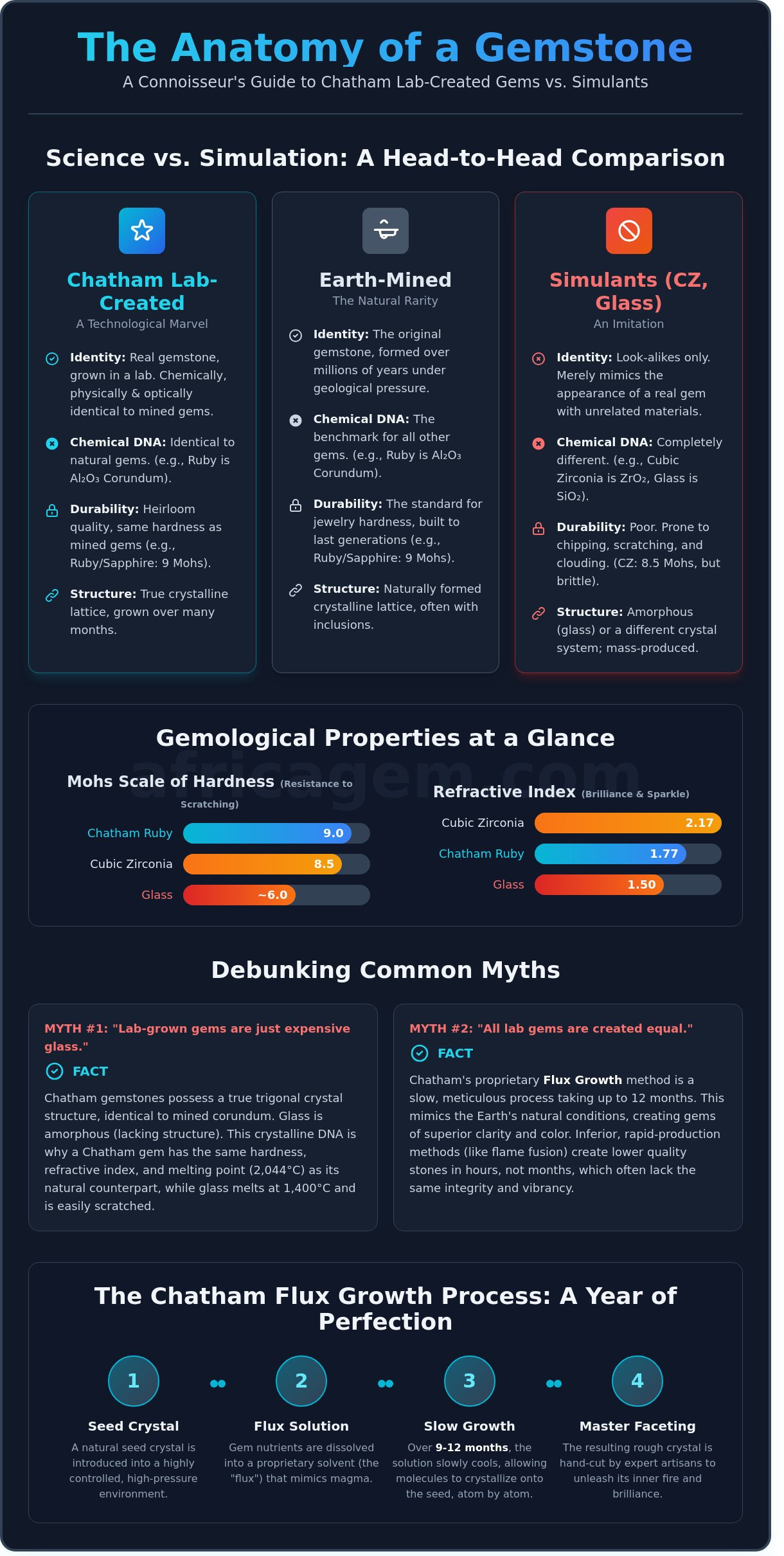
Myth #2: "All Lab Gems are Created Equal (The Flux Growth Process)"
A significant portion of first-time collectors assume every lab stone originates from the same rapid assembly line. This misconception ignores the vast technical chasm between industrial synthetics and fine gem cultivation. While approximately 90% of the synthetic market relies on the Verneuil "Flame Fusion" method, which flash-melts powder into a crystal in just a few hours, Chatham utilizes the painstaking flux growth process. Carroll Chatham pioneered this complex chemistry in 1938; it remains the gold standard for creating stones with true soul.
The flux method doesn't just produce a stone. It recreates the environment of the Earth's crust. By dissolving mineral components in a liquid medium at temperatures exceeding 1,100 degrees Celsius, Chatham allows crystals to form naturally over a period of up to 365 days. This 12-month commitment to a single growth cycle is why chatham lab created gemstones possess the same physical and optical density as their mined counterparts. It is a slow, expensive, and volatile process that results in a fraction of the yield seen in industrial labs.
The Slow-Growth Advantage
Chatham starts each cycle with a natural "seed crystal" to guide the molecular structure. Because the growth happens one layer at a time over months, the trace elements have time to settle into the crystal lattice properly. This deliberate pace is the only way to achieve the deep pleochroism and saturation required for "pigeon blood" rubies. Without this time, the color would appear flat or "watery," a common flaw in cheap, mass-produced alternatives.
Internal Characteristics: The Fingerprints of Growth
In the world of high-end gemology, "too perfect" is a red flag. Cheap flame-fusion stones often look like sterile glass under a 10x loupe. In contrast, chatham lab created gemstones feature delicate internal characteristics known as flux inclusions. These tiny, veil-like "fingerprints" are proof of a sophisticated growth environment. They mimic the natural inclusions found in earth-mined stones, giving each gem a unique internal landscape. When a gemologist peers through a microscope, these markers confirm the stone grew slowly in a molten solution, rather than being forced into existence in a matter of hours.
Myth #3: "Lab-Created Gemstones Lack the Soul and Beauty of Natural Stones"
Critics often label chatham lab created gemstones as sterile or robotic. This perspective ignores the reality of the lapidary arts. A gemstone's beauty doesn't emerge from the dirt; it's released by the master cutter. Every Chatham crystal is hand-faceted by skilled artisans who apply the same precision used for the world's finest natural rubies and sapphires. This human touch ensures the stone dances with light. It's the cutter's eye that determines the final brilliance, not the geological environment of the rough crystal. By removing the "muddy" inclusions common in low-grade natural stones, Chatham provides a pure canvas for these master craftsmen.
Color Consistency and Saturation
Chatham achieves a level of saturation that's vanishingly rare in nature. To find a natural pigeon-blood ruby with the same vividness as a Chatham creation, a collector would expect to pay over $50,000 per carat at a 2024 auction. We don't just sell everything the lab produces. The AfricaGems curation process involves hand-selecting the top 12% of the production run. This ensures our clients receive stones with zero distracting color-zoning. These gems offer the "ideal" hue that nature produces in less than 1% of all mined material. You get the color of a museum-grade specimen without the astronomical price tag.
The Ethical and Environmental Argument
The soul of a gemstone also resides in its history. Traditional open-pit mining can involve moving 250 tons of earth to find a single carat of gem-quality material. In contrast, chatham lab created gemstones are grown in controlled environments with a significantly lower carbon footprint. This provides 100% origin transparency. You'll never have to worry about the ethical compromises often found in opaque supply chains. Since 1984, AfricaGems has advocated for this level of integrity. We support both responsibly mined stones and high-tech creations. We believe beauty shouldn't come at a human or environmental cost. Choosing a lab-grown stone is a conscious decision to value both aesthetics and the planet.
Is a Chatham Gemstone Right for You? A Buyer’s Framework
Deciding between a natural mineral and chatham lab created gemstones depends entirely on your goals for the piece. The budget-conscious romantic often chooses Chatham to maximize visual impact without compromising on chemical purity. You can achieve a 3-carat look for the price of a 0.5-carat natural stone of similar quality. Tech-enthusiasts also gravitate toward these stones, fascinated by the sophisticated flux-growth process Carroll Chatham pioneered in 1938. If you're a traditionalist or a high-end investor seeking geological rarity that may appreciate in value over decades, natural stones remains your best path.
The "Value Gap" is perhaps the most compelling practical factor. A top-tier, 2-carat natural emerald with vivid saturation can easily command $20,000 or more in today's market. A Chatham equivalent, possessing the same crystalline structure and breathtaking glow, typically costs around $1,000. This represents a 95% cost reduction. It allows you to shift your budget toward a more intricate platinum setting or other significant life investments.
Investment vs. Adornment
I believe in radical transparency regarding resale value. Lab gems are for wearing and enjoying, not for financial speculation. While a rare, unheated sapphire might act as a portable store of wealth, a lab-grown stone lacks that same secondary market liquidity. Buying a Chatham gem is an investment in your personal style. Consider the opportunity cost: spending $1,500 on a stunning lab-grown center stone instead of $15,000 on a natural one leaves $13,500 available for a home down payment or a retirement account. You're buying a masterpiece of science to celebrate a masterpiece of a relationship.
Selecting Your Chatham Gem at AfricaGems
We curate our collection with the same scrutiny we apply to our rarest natural specimens. We don't simply list every stone available; we select only those that meet our rigorous standards for precision cutting and internal clarity. Our process ensures you receive a stone that is truly loupe-clean and vibrant. When you shop with us, you aren't just a customer; you're a connoisseur making an informed choice.
- Curated Selection: Browse our inventory of hand-picked stones chosen for their exceptional pleochroism and brilliance.
- Bespoke Design: Work with our team to turn a loose Chatham stone into a custom-designed heirloom.
- The AfricaGems Guarantee: Every purchase includes a lifetime trade-in policy and a certificate of authenticity.
My commitment to the integrity of the gemstone trade means you'll always receive full disclosure. We provide the technical data and the historical context you need to feel secure in your purchase. This is the AfricaGems Difference. I stand behind every stone we ship, ensuring that your jewelry reflects both your taste and your intelligence. Explore our hand-selected Chatham Lab Created Gemstones today and find the perfect centerpiece for your next story.
— Marc Sarosi
Embrace the Scientific Brilliance of Your Next Heirloom
Choosing chatham lab created gemstones means you're investing in a stone that's chemically, physically, and optically identical to its mined counterpart. You've discovered that these aren't mere glass imitations. Instead, they're the result of a sophisticated flux growth process that replicates nature's own high-pressure environment over a period of up to 12 months. This technology delivers the breathtaking color and clarity once reserved for only the most elite private collections. At AfricaGems, we bring over 40 years of gemstone expertise to your selection process. Our A+ rating from the Better Business Bureau and thousands of satisfied collectors worldwide stand as a testament to our professional integrity. Every stone is backed by a direct personal guarantee from Marc Sarosi, providing the security you need for a high-value online transaction. It's time to own a piece of ethical luxury that doesn't compromise on soul or beauty. Browse the Exquisite Chatham Collection at AfricaGems and find a masterpiece that perfectly reflects your unique story.
Frequently Asked Questions
Do Chatham lab-created gemstones pass a diamond tester?
Chatham lab-grown diamonds pass a standard thermal diamond tester because they possess the identical thermal and electrical conductivity of mined diamonds. However, Chatham colored gemstones like emeralds or rubies won't pass a diamond tester since they aren't made of carbon. Modern devices like the Yehuda Sherlock Holmes 4.0 can distinguish lab diamonds from natural ones with 100% accuracy by analyzing UV light absorption patterns.
Can a jeweler tell if a gemstone is lab-created?
A trained GIA Graduate Gemologist can identify a Chatham stone by examining its internal growth characteristics under 10x magnification. While the chemical composition is identical to natural stones, lab-grown gems lack the specific mineral inclusions like silk or liquid feathers found in earth-mined crystals. Instead, they often show distinct flux-growth patterns or platinum platelets that reveal their high-tech origins to a professional eye.
Do Chatham gemstones fade or change color over time?
Chatham gemstones will never fade, blur, or change color because they share the same atomic lattice and light-absorption properties as natural minerals. Unlike "simulants" like cubic zirconia which often cloud after 24 months of wear, Chatham's flux-growth process ensures permanent color stability. These stones maintain their 100% saturation even when exposed to intense UV rays or common household cleaning chemicals during daily use.
Is a Chatham emerald as hard as a natural emerald?
Every Chatham emerald possesses a Mohs scale hardness of 7.5 to 8.0, which is exactly the same as a natural Beryl crystal. Because they share the chemical formula Be3Al2(SiO3)6, they offer the same durability for daily wear in engagement rings. In fact, Chatham stones often have 20% fewer internal fractures than mined emeralds, which makes them slightly more resistant to structural chipping over time.
Why are Chatham gems more expensive than other lab-grown stones?
Chatham lab created gemstones cost more because the company utilizes the flux-growth method, a sophisticated process that takes up to 12 months to grow a single crystal. Most competitors use the "flame fusion" method which creates stones in just 5 hours but lacks a natural crystal structure. This year-long investment results in a superior gem that mirrors the slow, geological growth of the earth's finest minerals.
Does GIA certify Chatham lab-created gemstones?
The Gemological Institute of America (GIA) provides "Laboratory-Grown Diamond Reports" and identification reports for colored stones, though they don't use the same grading scale as natural gems. Since 2007, GIA has officially recognized these as authentic synthetic gemstones rather than fakes. While Chatham provides its own lifetime warranty, you can submit any stone over 0.50 carats to GIA for independent verification of its lab-grown origin.
Are Chatham gems considered "real" birthstones?
Chatham gems are chemically and physically identical to their mined counterparts, so they're considered authentic birthstones by the American Gem Trade Association. An emerald grown by Chatham is 100% beryl, just like a stone from the Muzo mine in Colombia. They offer a conflict-free way to celebrate May birthdays without sacrificing the mineral's essential properties or its breathtaking 520nm green hue.
What is the resale value of a Chatham created gemstone?
The resale value of a Chatham gemstone typically ranges from 20% to 40% of its original retail price on the secondary market. While they don't appreciate like a rare, unheated 5-carat Ceylon sapphire, they hold value better than generic lab stones due to brand recognition. Collectors often seek out vintage Chatham pieces from the 1960s because of Carroll Chatham’s historical significance in the evolution of modern gemology.