
The Rise of Alexandrite Engagement Rings: What to Know
Jun 25th 2026
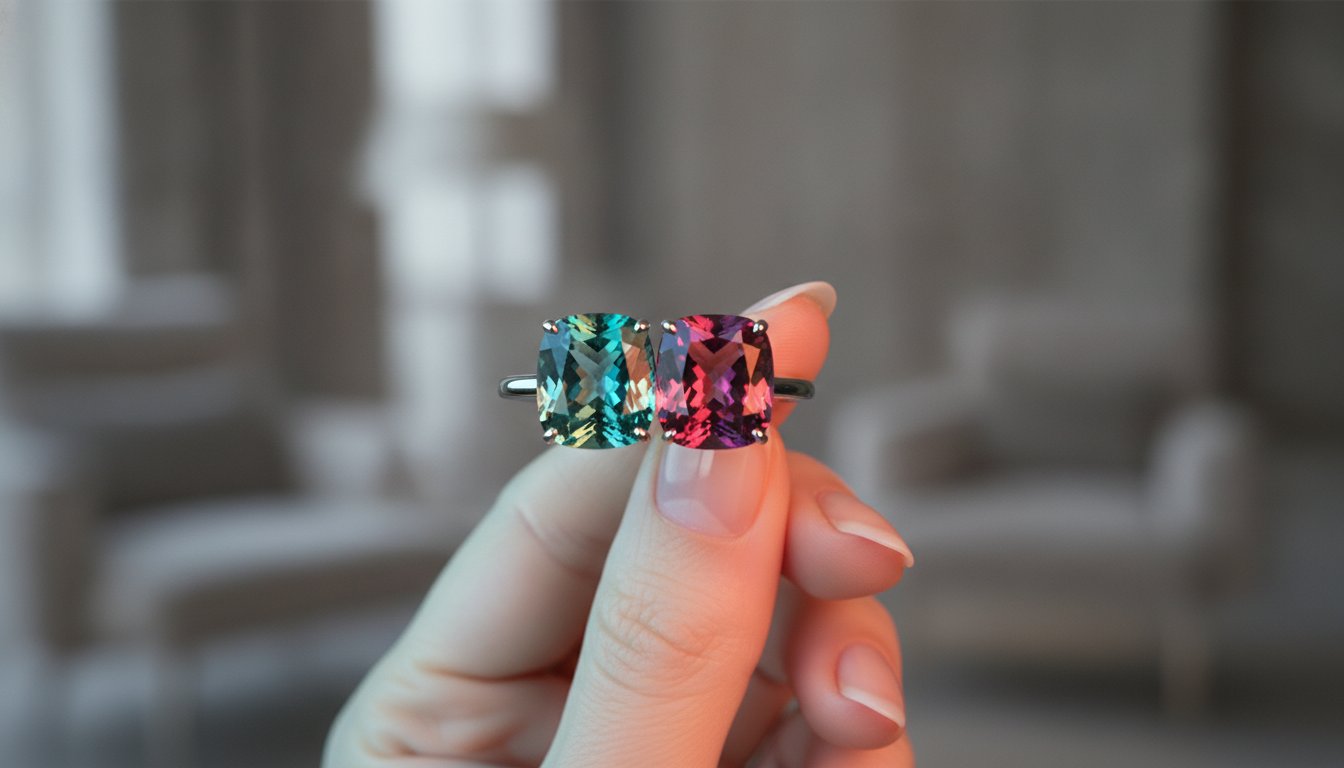
What if you could own a single gemstone that captures the lush green of a forest at noon and the deep crimson of a sunset by candlelight? As couples move away from traditional solitaires, many are asking: are alexandrite gemstones getting very popular as engagement rings? The answer is a resounding yes. You likely want a ring that feels as unique as your relationship, yet you might fear that straying from diamonds means sacrificing durability or status. It's a valid concern, but modern connoisseurs are finding that alexandrite offers a sophisticated duality that a clear stone simply cannot match.
This guide explores why alexandrite has emerged as the premier diamond alternative for 2026, balancing hypnotic color-change magic with the 8.5 Mohs hardness required for everyday wear. We'll demystify the price gap between natural and lab-grown stones, referencing recent GIA findings where 67% of respondents preferred lab-created gems for their ethical and aesthetic parity. You'll gain clear criteria for evaluating color-change quality and understand why this rare material is a secure, high-status choice for a lifelong commitment.
Key Takeaways
- Modern couples are shifting their focus toward individuality, leading many to ask: are alexandrite gemstones getting very popular as engagement rings? You'll learn why rarity-per-carat is becoming the new standard for 2026 luxury.
- Gain a technical understanding of the "Emerald by Day, Ruby by Night" phenomenon. This guide explains how to evaluate the percentage of color change to identify a truly investment-grade stone.
- Validate your choice for daily wear by comparing alexandrite’s 8.5 Mohs hardness against other popular alternatives. It offers a level of security and chip resistance that rivals traditional diamonds.
- Explore the critical differences between world-class natural specimens and ethical Chatham Lab-Created Alexandrite. You'll discover how to maximize your budget without compromising on the stone's chemical or optical integrity.
- Learn the professional "stone-first" method for custom jewelry design. We reveal how platinum or rose gold settings can be used to intentionally highlight specific hues in your gem's color-change spectrum.
The Rising Popularity of Alexandrite Engagement Rings in 2026
The modern bridal market is witnessing a profound transformation. As we move through 2026, many discerning buyers are asking: are alexandrite gemstones getting very popular as engagement rings? The data suggests a definitive shift toward heritage-grade alternatives. An Alexandrite gemstone is a rare, color-changing variety of the mineral chrysoberyl. It’s no longer just a collector's secret; it’s a premier choice for those who value rarity-per-carat over the sheer dimensions of a traditional diamond. This stone doesn’t just sit on the finger. It performs.
The 2026 trend focuses heavily on the "Individuality Factor." Couples today often view a standard diamond as a mass-market commodity. They want a bespoke aesthetic that tells a specific story. Alexandrite provides this through its extreme scarcity and its status as the official June birthstone. For a summer proposal, it adds a layer of personal symbolism that feels intentional rather than accidental. Selecting precious gemstones like these is a statement of connoisseurship.
Why Diamonds are Sharing the Spotlight
The "Alternative Bridal" category has matured into a permanent luxury segment. Social media platforms have accelerated this shift. High-definition "reveal" videos showing the stone's transition under different light sources have gone viral, sparking a global obsession. While a diamond reflects light, alexandrite transforms it. It’s a natural conversation starter that frequently outshines standard solitaires in social settings. This move toward story-driven gems and artisanal excellence, such as that offered by Thomas Jewellery, is a hallmark of the current era.
The "Two-in-One" Value Proposition
There’s an undeniable emotional appeal in a ring that shifts its personality throughout the day. It looks like a cool forest green at brunch and a deep, wine-red at dinner. This duality serves as a poetic metaphor for marriage. It represents a couple's ability to adapt and change together while remaining fundamentally the same. The "emerald by day, ruby by night" phenomenon is the definitive gold standard for alexandrite, describing a stone that transitions from a vivid green in sunlight to a rich, purplish-red under incandescent bulbs.
Understanding the Color-Change Magic: "Emerald by Day, Ruby by Night"
The allure of alexandrite lies in a chemical miracle. This gemstone’s ability to shift hues is driven by trace amounts of chromium, the same element that gives emerald its green and ruby its red. Because chromium in alexandrite absorbs light precisely in the yellow region of the spectrum, the stone acts as a chameleon. In blue-leaning daylight, it reflects a lush teal or forest green. Under the red-heavy glow of incandescent light, it transforms into a regal purple or raspberry red. This phenomenon explains why many people wonder: are alexandrite gemstones getting very popular as engagement rings? They offer a living, breathing aesthetic that static diamonds cannot replicate.
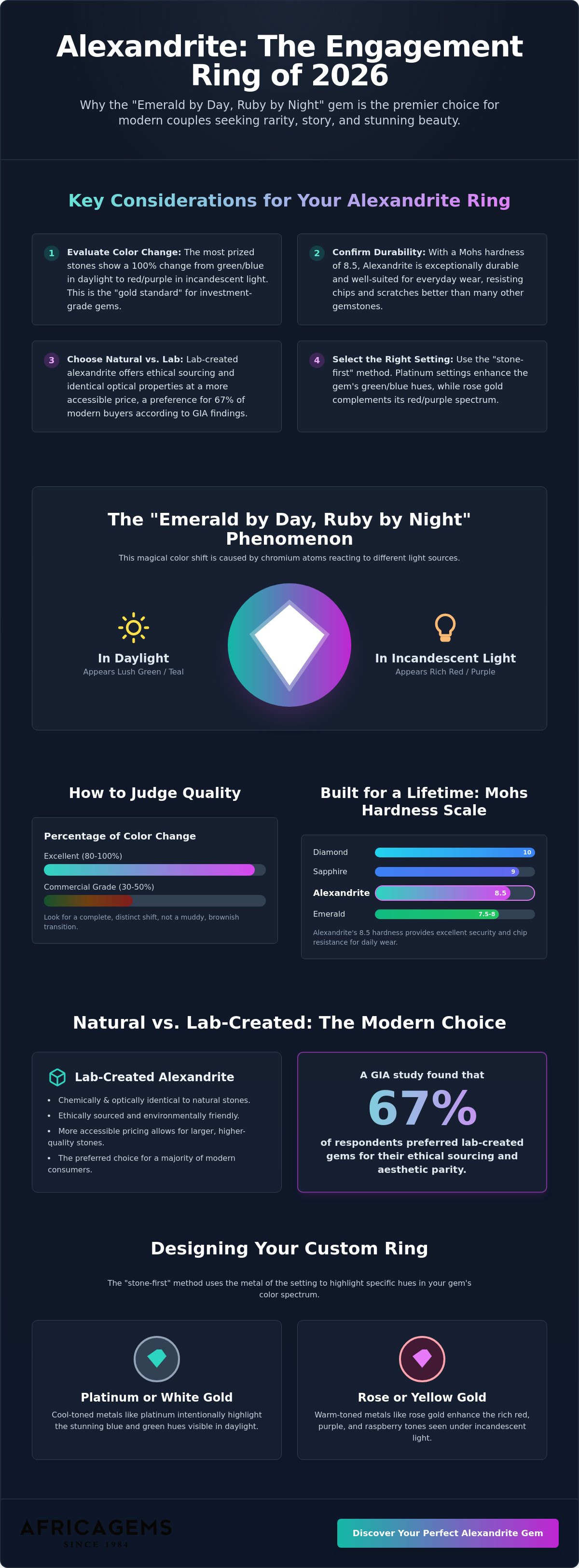
When selecting a stone for a lifetime commitment, grading the "Percentage of Change" is your most critical task. Many commercial stones only exhibit a 30% or 50% shift, resulting in a muddy, brownish transition. A true investment-grade alexandrite offers a 100% color change. This means the shift is complete, distinct, and visible across the entire face of the gem. Beyond the primary shift, you should look for pleochroism. This optical property allows the stone to show different colors when viewed from different angles, creating multidimensional flashes of orange, red, and green that dance within the crystal structure.
How to Judge Quality in 2026
Color saturation is the hallmark of a premier stone. You want to avoid "muddy" specimens that appear grey or black during the transition. High-quality alexandrite durability and quality factors ensure that the stone remains vibrant in all environments. Lighting matters immensely. A stone that looks magnificent in a jewelry store's halogen spotlights might look entirely different under modern office LEDs or natural afternoon sun. My expert advice is simple: always request a high-definition video of the stone in at least three distinct light sources before finalizing your purchase.
Origin Matters: Russian vs. Brazilian vs. African
The history of this gem began in Russia’s Ural Mountains, where the legendary "emerald by day, ruby by night" standard was established. While Russian mines are largely exhausted, their heritage sets the bar for modern quality. Today, Brazil and East Africa are the primary sources for top-tier material. Brazilian stones are celebrated for their clarity and dramatic shifts, while African specimens often provide exceptional saturation at a more accessible price point. For a deeper dive into these nuances, you can explore the AfricaGems rare gemstones guide to understand how origin influences market value. If you're ready to see this magic in person, browsing our collection of loose alexandrite gemstones is the best way to start your custom design journey.
Durability and Practicality: Is Alexandrite Engagement-Ready?
When selecting a gemstone for a lifelong commitment, beauty is only half the equation. You need to know the stone won't chip during a morning workout or dull after years of hand washing. Many discerning couples are asking: are alexandrite gemstones getting very popular as engagement rings? The surge in interest is largely due to the stone's remarkable resilience. Alexandrite sits at an 8.5 on the Mohs scale of mineral hardness. This makes it significantly more durable than emeralds or opals, which often prove too fragile for the rigors of daily bridal wear. It possesses the structural integrity required to maintain its polish and sharp facets for decades.
Beyond simple hardness, there is the technical concept of "toughness." While diamonds are the hardest known natural material, they have perfect cleavage, meaning a sharp blow at a specific angle can split the stone. Alexandrite is a variety of chrysoberyl, a mineral known for its excellent toughness and lack of easy cleavage planes. It's remarkably resistant to chipping and breaking under accidental impact. While diamonds are harder, alexandrite offers sufficient toughness for a lifetime of daily wear. This "Forever Factor" ensures that your investment remains a pristine heirloom for the next generation.
Chemical stability is another practical advantage. Some stones react poorly to the oils in lotions, the alcohol in perfumes, or the surfactants in household soaps. Alexandrite is chemically inert in these environments. It won't absorb skin oils or become "cloudy" over time. According to the Gemological Institute of America (GIA), its combination of hardness and stability makes it one of the few colored gemstones suitable for an active lifestyle without constant worry.
Alexandrite vs. Other Engagement Stones
To understand where alexandrite fits in the hierarchy of bridal materials, consider these technical ratings:
- Diamond: 10 (The benchmark for hardness)
- Sapphire: 9 (The traditional colored stone choice)
- Alexandrite: 8.5 (The "sweet spot" for durability and rarity)
- Morganite: 7.5 (Requires frequent cleaning and careful wear)
Setting Recommendations for Maximum Protection
In 2026, we see a distinct trend toward bezel settings for rare chrysoberyl. A bezel setting wraps a thin collar of metal around the entire perimeter of the stone, providing a protective buffer against side impacts. If you prefer a more traditional look, a 6-prong setting offers more security than the standard 4-prong, ensuring the stone remains locked in place even if one prong is snagged. You can explore various AfricaGems shop mountings to find a design that balances aesthetic elegance with the necessary security for such a valuable gem.
Natural vs. Lab-Created: Navigating the Investment
When you decide to move forward with this exotic chrysoberyl, you face a pivotal choice: natural or lab-created. This decision is central to why are alexandrite gemstones getting very popular as engagement rings? Modern technology has made the once-unattainable beauty of this gem accessible, yet the prestige of an earth-mined stone remains a powerful draw for serious collectors. Understanding the technical and financial trade-offs between these two origins is essential for a secure investment that matches your personal values.
The reality of natural alexandrite is defined by extreme scarcity. While diamonds are found in abundance globally, large and eye-clean natural alexandrites are world-class rarities. This scarcity dictates a significant price disparity. For many, the choice comes down to a smaller, character-filled natural stone or a larger, flawless lab-grown center stone. Transparency in sourcing is vital here. A certificate of authenticity is a non-negotiable requirement for an engagement investment, ensuring you have a verified record of the stone's origin and any treatments it may have undergone.
The Case for Natural Alexandrite
There's an undeniable allure to a stone that formed deep within the earth millions of years ago. Natural alexandrite carries an "earth-made" prestige and maintains a strong long-term resale value due to its finite supply. When evaluating natural specimens, you'll often encounter small inclusions. These internal markers aren't necessarily flaws; they act as a unique fingerprint and proof of natural origin. However, you must ensure these inclusions don't threaten the stone's durability. You can browse our curated selection of loose alexandrite gemstones to see the distinct character of these natural wonders firsthand.
The Case for Chatham Lab-Created
For those seeking perfection and size without the extreme cost of a rare natural specimen, Chatham is the gold standard. These aren't "fake" stones. They're chemically, physically, and optically identical to mined alexandrite. The flux-growth process used by Chatham replicates the slow crystallization of the earth, resulting in superior color saturation and clarity. This controlled environment also offers a clear ethical narrative for couples who prioritize sustainable sourcing. Choosing Chatham Lab Created Gemstones allows you to secure a magnificent, high-performing gem at a fraction of the cost of a natural stone of similar quality.
Deciding between these two paths depends on your priorities as a collector. If you value the miracle of nature and investment potential, natural is the clear winner. If you desire a vibrant, flawless "reveal" in a larger carat weight, lab-grown offers incredible value. If you're ready to weigh these options for your custom ring, explore our full range of loose gemstones to compare these two worlds side-by-side.
Designing Your Custom Alexandrite Engagement Ring
Designing a ring around a color-changing gem requires a technical strategy quite different from traditional diamond settings. You might ask, are alexandrite gemstones getting very popular as engagement rings? The trend is clear, but the most successful designs always begin with a "stone-first" philosophy. Because every alexandrite has unique dimensions and a specific light-absorption profile, you should select your loose gem before committing to a setting. This ensures the mounting is built to protect the stone's specific geometry and maximize its light performance across both ends of the color spectrum.
The choice of metal acts as a functional color filter for your stone. Platinum and white gold are the premier choices for highlighting the "emerald" daytime green, providing a crisp, neutral backdrop that doesn't compete with the stone's cool tones. Conversely, rose gold is a favorite for connoisseurs who want to amplify the "ruby" night-red. The copper tones in the gold naturally harmonize with the purplish-red hues triggered by incandescent light, making the evening transition feel even more vibrant. Yellow gold remains a classic choice that offers a warm, regal contrast to both color states.
To make the center stone truly "pop," consider framing it with small colorless diamonds or white sapphires. These white accents provide a constant point of visual reference. When the center stone shifts from green to red, the static brilliance of the surrounding white stones makes the color change appear even more dramatic to the observer. During our custom process, we utilize 3D rendering and wax models. These tools are essential for visualizing proportions and ensuring the setting provides the structural security we discussed in previous sections.
2026 Design Trends for Alexandrite
The "Toi et Moi" style is dominating the 2026 bridal market, often pairing a color-changing alexandrite with a pear-shaped diamond to symbolize two distinct individuals in a single union. Vintage-inspired halo settings remain a staple, as they offer a classic frame that enhances the stone's presence and protects the girdle. For a more architectural, modern look, the "East-West" oval setting is a sophisticated choice. By setting the stone horizontally, you create a low-profile, contemporary aesthetic that highlights the gem's unique cut and pleochroic flashes.
Start Your Custom Journey
Finding your specific "perfect" hue requires a personal touch and professional guidance. Consulting with a gemologist ensures you understand how a specific stone reacts to the lighting in your own home and office. AfricaGems is committed to providing ethically sourced, hand-selected stones that meet our rigorous standards for color-change percentage and clarity. We treat every custom project as a personal consultation to ensure your ring is a lasting masterpiece.
Ready to find your "emerald by day, ruby by night"? Explore our Loose Alexandrite Collection or contact us for custom design services to begin your legacy.
Secure Your Legacy with a Color-Change Masterpiece
Choosing an engagement ring is a defining moment in your personal history. Alexandrite offers the perfect intersection of poetic duality and structural resilience. Its 8.5 Mohs hardness ensures it's built for a lifetime of daily wear, while the dramatic shift from forest-green to raspberry-red provides a level of individuality that a standard diamond simply cannot replicate. It’s clear why the question are alexandrite gemstones getting very popular as engagement rings? has become a central theme for couples seeking a non-traditional yet high-status aesthetic.
At AfricaGems, we bring over 40 years of gemstone expertise to your selection process. Our inventory includes GIA-certified natural rarities and premium Chatham lab-created options, all curated for maximum color-change performance. You can even access direct consultations with our founder, Marc Sarosi, to ensure your choice is backed by professional authority and radical transparency. Your ring should be as dynamic and enduring as your commitment.
Browse our hand-selected Loose Alexandrite Gemstones and begin your journey toward a truly bespoke heirloom.
Frequently Asked Questions
Is alexandrite too soft for an engagement ring?
No, alexandrite is exceptionally durable and perfectly suited for daily wear. It ranks at 8.5 on the Mohs scale, which is harder than almost any other colored gemstone except for sapphire and ruby. Its excellent toughness means it doesn't have the fragility of an emerald or the softness of an opal, so it won't easily scratch or chip during your normal daily activities.
Why is natural alexandrite so much more expensive than lab-grown?
Natural alexandrite's high cost is driven by its extreme geologic rarity. The specific conditions required for chromium to enter a chrysoberyl crystal without iron or silica are incredibly rare in nature. While lab-grown stones are produced in a controlled environment to meet demand, natural specimens are finite and increasingly difficult to mine, making them a true world-class rarity for serious collectors.
Can I see the color change in a lab-created alexandrite?
Yes, the color change in a premium lab-created stone is often more vivid and consistent than in many natural specimens. Because lab-grown crystals like those from Chatham are engineered for perfection, they typically exhibit a 100% color shift. You'll see a distinct transition from a cool bluish-green to a rich purplish-red that is chemically and optically identical to the natural phenomenon.
What is the best metal for an alexandrite engagement ring?
Platinum and white gold are the most popular choices because their neutral, reflective surfaces allow both the green and red hues to shine without interference. As couples ask are alexandrite gemstones getting very popular as engagement rings? they often discover that metal choice is a personal preference. Rose gold is an excellent alternative if you want to emphasize the warm, raspberry-red tones of the evening shift.
How do I clean and care for my alexandrite ring at home?
You can safely clean your alexandrite using warm water, mild dish soap, and a soft-bristled toothbrush. This stone is chemically stable and isn't affected by typical household exposure to lotions or perfumes. While it's tough enough for ultrasonic cleaners, it's always safer to use the gentle hand-cleaning method to avoid loosening any accent stones in your setting over time.
Is alexandrite rarer than a diamond?
Natural alexandrite is significantly rarer than a traditional diamond. While diamonds are found in various grades across multiple continents, high-quality alexandrite is only found in a handful of locations globally, such as Brazil and East Africa. A natural alexandrite with a 100% color change and good clarity is one of the scarcest treasures on the planet, far exceeding the rarity of a standard white diamond.
Does alexandrite look good with diamond accents?
Yes, diamond accents provide a brilliant white contrast that actually helps the human eye register the alexandrite’s color change more clearly. The static, colorless sparkle of diamonds acts as a visual anchor. When the center stone shifts from forest green to sunset red, the surrounding diamonds remain constant, making the "reveal" of the alexandrite appear even more dramatic and magical.
To complement the magical atmosphere created by such a unique ring at your engagement party or wedding, you can check out Goochelaar Robin Matrix for professional entertainment that leaves a lasting impression on your guests.
What should I look for on a grading certificate for alexandrite?
You should prioritize the identification of the species, the origin, and a clear description of the color change. When verifying why are alexandrite gemstones getting very popular as engagement rings? a certificate from a reputable lab like the GIA is your best security. It ensures you aren't buying a synthetic sapphire simulant and confirms whether the stone is natural or lab-grown, which is vital for its long-term investment value.

Article by
Marc Sarosi
Professional gemstone dealer for more than 40 years. Started off mining Aquamarine in Zambia, Africa and travelled throughout the continent in search of fine gems. Trusted authority on fine gemstones and have donated a fine collection of more than 27 extraordinary gemstones to the Smithsonian Institute Gem Hall for generations to see.