
The Magic of Star Sapphires: A Connoisseur’s Guide to Loose Asteriated Gems
Sep 8th 2026
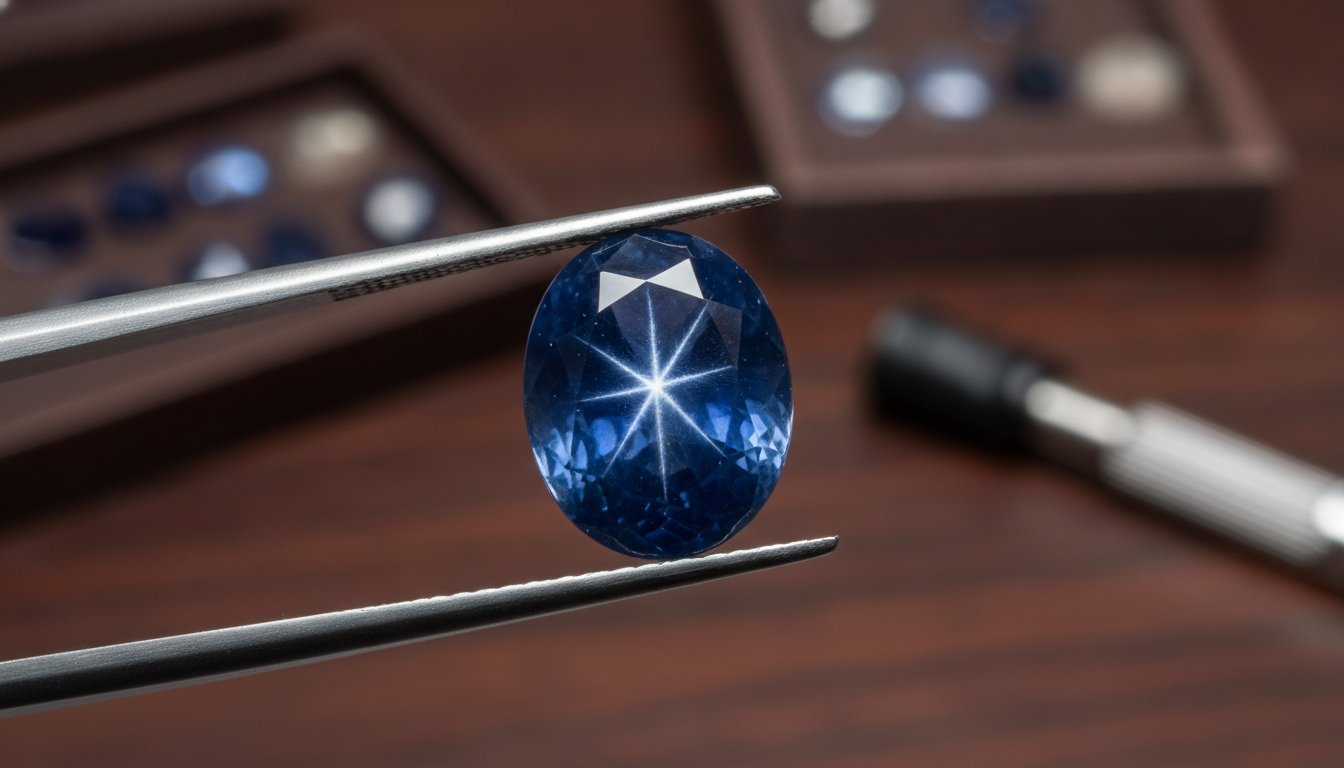
The most mesmerizing star in the night sky isn't found through a telescope; it's captured within the silken depths of a gemstone. While many collectors are drawn to the celestial dance of loose star sapphires, the fear of purchasing a synthetic or diffusion-treated imitation often creates a barrier to entry. You might find yourself questioning why some stars look suspiciously perfect or why prices fluctuate so wildly between a vivid blue and a delicate lavender. It's a natural hesitation in a market where the line between a lab-created stone and a geological miracle can seem dangerously thin.
We believe that true connoisseurship requires more than just an eye for beauty; it demands technical validation and radical transparency. This guide will empower you with the specific criteria used by elite dealers to evaluate asterism, from the precise alignment of rutile needles to the impact of the 2026 GIA origin report updates. You'll learn why unheated stones currently command a 30% to 50% premium and how to identify the "smart buy" opportunities in a global market now valued at $34.92 billion. We'll conclude by showing you how to safely set these cabochon treasures using the custom jewelry design services at https://www.africagems.com/ to ensure your investment is both secure and stunning.
Key Takeaways
- Understand the precise optical phenomenon of asterism and why it requires a specialized cabochon cut to reveal its beauty.
- Discover how to assess the internal silk of loose star sapphires to distinguish between authentic natural treasures and synthetic alternatives.
- Master the six pillars of value to evaluate ray sharpness, symmetry, and color saturation like a professional gemologist.
- Identify the specific visual red flags of surface diffusion and other enhancements that compromise a gemstone's long-term value.
- Gain expert advice on selecting investment-grade stones for custom jewelry designs that showcase the gem's natural brilliance.
What are Loose Star Sapphires? Defining the Asterism Phenomenon
A star sapphire isn't merely a gemstone; it's a structural masterpiece of light. Belonging to the corundum family, these rare specimens display a star-like phenomenon known as asterism when viewed under a single, direct light source. This ethereal effect occurs when light reflects off microscopic, needle-like inclusions of rutile, often called "silk," which are oriented in specific directions within the crystal lattice. While a standard sapphire is prized for its transparency, the star variety relies on these internal inclusions to create its value.
To better understand how these gems differ from their imitations, watch this helpful video:
The visual presentation of these stones requires a specific lapidary approach. Unlike traditional faceted stones that rely on internal reflection, star gems require a smooth, domed cabochon cut. This shape acts like a lens to gather light and focus it across the surface. Faceting a star sapphire would likely destroy the visual continuity of the rays, turning a phenomenal gem into a cluttered, opaque stone. For the serious collector, loose star sapphires offer a distinct advantage over pre-set jewelry. Buying loose allows you to inspect the "belly" or back of the stone for excessive weight or unevenness, which settings often hide. It also provides the freedom to utilize custom jewelry design services to ensure the mounting is perfectly aligned with the star's centering.
History is rich with tales of these celestial gems. The 563-carat Star of India, housed in the American Museum of Natural History, remains one of the most famous examples of nature's capability. These historical giants prove that while body color is vital, the symmetry and strength of the star define a true masterpiece of nature. For enthusiasts who find a deeper spiritual resonance in these celestial patterns, you can learn more about Starseed Essence Shoppe and their work with gemstone-infused remedies.
Asterism vs. Chatoyancy: Understanding the Difference
It's easy to confuse different optical phenomena, but the distinction is found in the crystal's geometry. Chatoyancy, or the "cat's eye" effect, consists of a single band of light reflecting off parallel inclusions. Asterism is multi-directional. Because sapphire belongs to the hexagonal crystal system, its rutile needles intersect at 60-degree angles. This specific geometric arrangement results in the classic six-rayed star. Occasionally, 12-rayed stars appear when two different types of inclusions intersect, though these are exceptionally rare.
Common Colors of Star Sapphires
Blue remains the most coveted and classic choice, ranging from cornflower to deep royal shades. However, the world of loose star sapphires extends far beyond blue. Black star sapphires are popular for their sharp, silvery stars and affordability, while pink and lavender varieties offer a softer, romantic aesthetic. White or colorless star sapphires are also found, though they require a very sharp star to remain visually striking. The key is the contrast; the body color must be saturated enough to provide a backdrop that makes the white star pop.
The Science of Silk: How Nature Creates the Six-Rayed Star
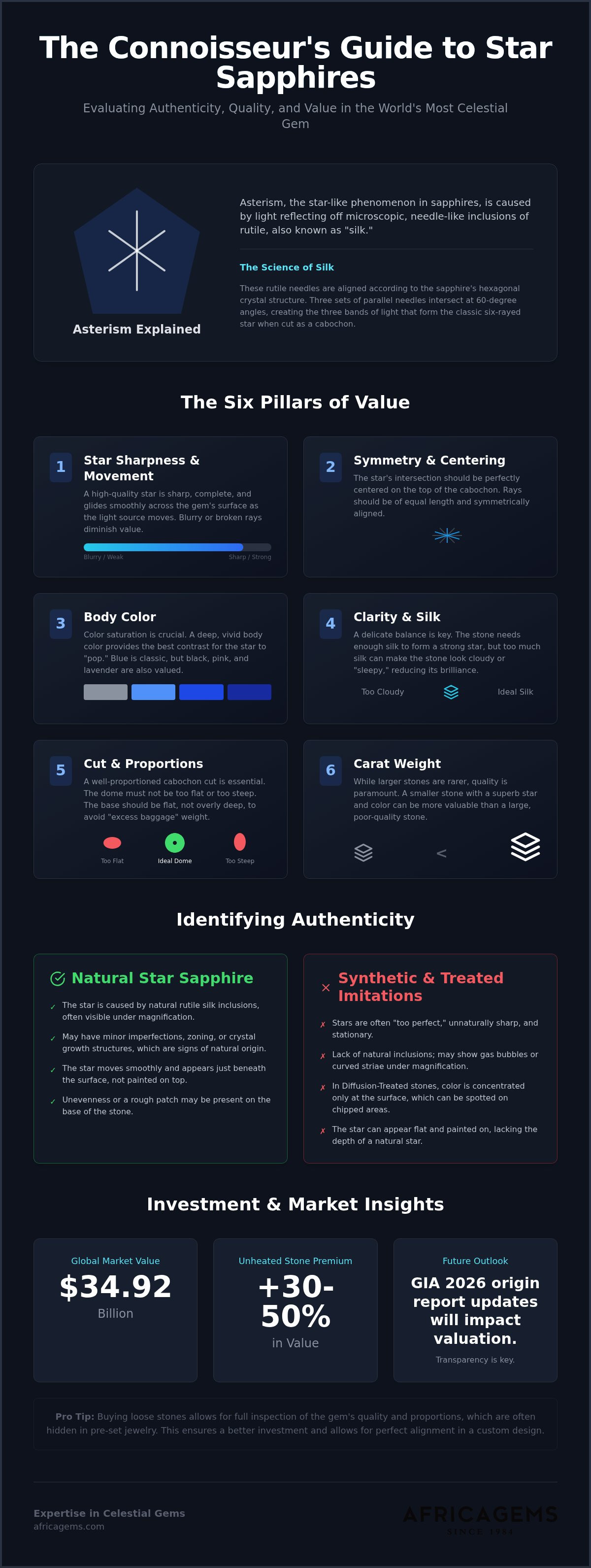
The breathtaking geometry of a star sapphire isn't an accident of light; it's the result of a precise geological alignment. At the heart of this phenomenon are three sets of microscopic rutile needles that intersect at 60-degree angles. When light hits these inclusions, it reflects perpendicularly to the needles, creating the three crossing bands of light that form a six-rayed star. This specific arrangement is dictated by the hexagonal crystal system of corundum, which provides the internal "blueprint" for the star's construction. For collectors evaluating loose star sapphires, understanding this architecture is the first step in identifying a stone that transcends the ordinary.
A common misconception in the gem world is that inclusions always detract from value. In the case of asterism, these inclusions are the value. However, there's a delicate trade-off between the density of the silk and the stone's overall beauty. If the needles are too sparse, the star appears weak or "ghost-like," lacking the sharp definition required for investment-grade gems. Conversely, if the silk is too dense, the sapphire becomes opaque and "muddy," losing the rich body color that characterizes the finest specimens. The most sought-after masterpieces of nature possess enough silk to create a razor-sharp star while maintaining a degree of translucency that lets the sapphire's primary color glow from within.
The Formation of Rutile Needles
Silk refers to the microscopic, needle-like inclusions of rutile responsible for the optical phenomenon of asterism. These needles form through a process called exsolution, where titanium dioxide is trapped within the sapphire crystal as it cools deep within the earth. For these needles to remain intact, the stone must stay in its natural state. This is why loose star sapphires are almost always unheated; the high temperatures used in traditional sapphire treatments would dissolve the rutile back into the crystal lattice, permanently destroying the star. Given that unheated sapphires have seen price increases of 15% to 20% in early 2026, the presence of intact silk is a hallmark of both authenticity and significant market value.
Light Sources and the Star's Movement
One of the most captivating traits of a star sapphire is its "dancing" nature. Unlike a faceted gem that sparkles from fixed points, the rays of a star sapphire follow the light source. If you move the stone or your head, the star glides across the dome of the cabochon. To truly evaluate the quality of this movement, sunlight is the gold standard. A single-point light source, like the sun or a focused LED, will reveal the star's true sharpness. In contrast, diffused office lighting or multiple overhead lamps can cause the rays to blur or appear as multiple overlapping stars, which obscures the gem's true quality. Before making a final selection, you might want to browse our collection of natural gemstones to see how different lighting environments affect the visual depth of these phenomenal stones.
Evaluating Quality: The Six Pillars of Star Sapphire Value
Selecting loose star sapphires involves a rigorous assessment of six specific pillars that define a masterpiece. While color is the primary driver for faceted stones, phenomenal gems require a more nuanced evaluation. The first pillar is star sharpness. A high-quality star should be continuous, extending from the base of the stone to the apex without breaking. The rays should be silvery-white and razor-thin; a fuzzy or blurry star significantly diminishes the stone's prestige.
Color quality acts as the second pillar. The most desirable stones possess a vivid, saturated body color that provides a high-contrast background for the star. Symmetry is the third pillar. The star must be perfectly centered on the dome. If the star is "tilted" or off-kilter, it indicates poor orientation during the cutting process. Finally, the finish and polish must be flawless. Any surface-reaching pits or scratches will disrupt the light's path and distract from the celestial display. Connoisseurs also look for the "movement" of the star, ensuring it glides smoothly across the surface without jumping or disappearing.
The Anatomy of the Cabochon Cut
The dome height of a cabochon is critical for light concentration. A dome that is too flat won't allow the rutile needles to focus the light into a sharp star, resulting in a weak, spread-out effect. Conversely, an overly tall dome can hide unnecessary weight in the "belly" of the stone. Proportions matter because they dictate how the stone will sit in a mounting. While many dealers leave the base of the stone rough to preserve carat weight, a polished bottom is often preferred by connoisseurs as it demonstrates a commitment to total lapidary excellence and transparency. This same dedication to sourcing authentic, high-quality natural treasures is a hallmark of a reputable crystal shop Brighton, making it a great resource for collectors who value integrity in their mineral specimens.
In the hierarchy of loose star sapphires, transparency is the ultimate differentiator. Most stones are opaque, but a translucent sapphire that allows light to pass through while still maintaining a sharp star is a geological rarity. Collectors should also look for secondary hues. While a pure blue is ideal, many stones show violet or grey overtones. Greyish tints often dull the overall appearance, whereas a slight violet secondary hue can sometimes enhance the richness of the blue. You can Explore our collection of natural precious gemstones to compare these subtle color variations and transparency levels firsthand.
Identifying Authenticity: Natural vs. Synthetic and Diffusion Treated Stars
The allure of loose star sapphires often attracts sophisticated counterfeiters who exploit the collector's desire for perfection. For a connoisseur, the primary defense against deception is the "Too Perfect" rule. Natural gems are geological miracles formed over millions of years; they rarely display the sterile, razor-sharp perfection found in a laboratory. If a star looks like it was drawn with a fine-point pen and lacks any internal "fingerprints" or color zoning, you're likely looking at a synthetic. Natural stones possess character in their inclusions, which act as a birth certificate of their earthly origin.
In the mid-20th century, the 'Lindy' star became the standard for synthetic star sapphires. These stones are created using the Verneuil process, resulting in a gem that is chemically corundum but structurally lacking the soul of a natural stone. Unlike natural stars that appear to float within the gem, synthetic stars often look flat and stay sharp even in low light. They lack the "silk" depth that characterizes an authentic masterpiece.
Surface diffusion is another deceptive practice that buyers must recognize. In this process, a natural but low-grade sapphire is heated with chemicals like titanium to create a thin layer of asterism on the surface. These are particularly treacherous because the stone itself is natural, but the star is artificial. If the stone is ever re-polished, the star will disappear completely. AfricaGems maintains a policy of radical transparency regarding such enhancements, ensuring every client understands the exact nature of their purchase.
Visual Red Flags for Synthetic Stones
Identifying these treatments requires a keen eye. Look for a "painted on" appearance where the star seems to sit on top of the dome rather than emerging from the depths of the crystal. In natural stones, you'll often see "silk" or tiny mineral crystals throughout the body, whereas synthetics are suspiciously clean or contain microscopic gas bubbles. Check the star's behavior on the side of the cabochon. In a natural gem, the rays often fade gracefully toward the girdle; in many synthetics, they remain unnaturally sharp all the way down the sides.
The Importance of Gemological Certification
For any significant investment, a report from the GIA or AGTA is non-negotiable. As of January 1, 2026, the GIA expanded its "Country of Origin" services, and a post-2026 report is the only way to verify that a stone hasn't been subjected to sophisticated new lattice-filling or diffusion treatments. You can learn about our non-genuine and lab-created gemstone options to understand the technical differences between these categories. For more on secure purchasing, read our guide on How to Buy Gemstones Online: The Expert Guide. Marc Sarosi's 40 years of industry standing ensures that every stone in our inventory is ethically sourced and accurately represented. If you're ready to secure an authentic, unheated treasure, we invite you to view our certified loose star sapphires today.
Selecting Your Loose Star Sapphire: Design and Investment Considerations
The acquisition of loose star sapphires represents a sophisticated convergence of aesthetic appreciation and strategic asset allocation. As the global gemstone market is projected to reach $44.25 billion by 2030, high-quality, unheated specimens are increasingly viewed as "blue chip" collectibles. These stones aren't just jewelry components; they're finite geological assets. When you buy loose, you gain the tactical advantage of selecting a stone for its specific ray sharpness and centering before committing to a final design. Working with an expert like Marc Sarosi, who has navigated the trade for over 40 years, ensures that your selection meets the rigorous standards of both the laboratory and the legacy collector.
Selecting the right setting depends on the intended use and the stone's individual character. Because star sapphires possess a 9.0 Mohs hardness, they're exceptionally durable, but their cabochon cut presents unique design opportunities compared to faceted gems. A ring allows the wearer to observe the star's movement throughout the day, which is the primary joy of owning a phenomenal stone. Pendants, however, offer a more protected environment for larger, high-value investment stones. Regardless of the choice, the goal is to ensure the light source can hit the dome directly to activate the asterism.
Designing Around a Cabochon
The choice of metal can dramatically influence the star's visibility. White metals like platinum or 18k white gold are ideal for blue star sapphires. They provide a cool, clean backdrop that doesn't compete with the silvery rays. Conversely, yellow gold can add a regal warmth to black or rare pink varieties, making the star appear more vibrant. To enhance the "fire" of the piece, consider surrounding the cabochon with high-clarity accent diamonds to provide a sparkling contrast to the smooth dome. You can Browse our custom shop mountings for your loose stone to find a foundation that honors the gem's specific proportions.
Caring for Your Star Sapphire
Maintaining the luster of a phenomenal gem requires a gentle touch. While corundum is incredibly hard, the rutile needles that create the star can be sensitive to extreme vibrations. Avoid using ultrasonic cleaners, especially if the stone has surface-reaching fractures or dense "silk" that reaches the exterior. Instead, use warm, soapy water and a soft brush to remove oils that can dull the star's sharpness. Thanks to their 9.0 Mohs hardness, star sapphires are perfectly suited for daily wear in rings or bracelets as long as they're cleaned regularly to maintain their optical clarity.
Secure Your Celestial Legacy
Owning a phenomenal gemstone is a journey that begins with understanding the rare science of asterism and ends with the security of a verified investment. You've learned how to distinguish the sharp, six-rayed symmetry of a natural stone from the sterile perfection of lab-grown imitations. By prioritizing unheated silk and centered proportions, you ensure that your gem remains a valuable asset in a growing global market. Finding the perfect specimen among our loose star sapphires is more than a purchase; it's an entry into a world of geological wonders curated with radical transparency.
With over 40 years of expertise, Marc Sarosi provides the professional authority needed to navigate high-value transactions with complete confidence. Every stone we offer is guaranteed natural and ethically sourced, reflecting our legacy-oriented commitment to the integrity of the industry. If you're ready to find a masterpiece of nature that will be cherished for generations, we invite you to reach out for a personal consultation. Discover Your Rare Masterpiece: Shop Loose Star Sapphires at AfricaGems. Your next heirloom is waiting to be uncovered.
Frequently Asked Questions
Are star sapphires more expensive than regular sapphires?
Faceted sapphires typically command higher prices for transparency, but high-quality loose star sapphires with sharp, centered rays can carry a 25% price premium in 2026. The value depends heavily on the rarity of the color and the sharpness of the asterism. While standard heated sapphires are more common, unheated star varieties aren't just rare; they're often priced 30% to 50% higher than their treated counterparts because nature's silk remains intact.
Can a star sapphire have more than six rays?
A star sapphire can occasionally display twelve rays, though this is a geological rarity. While the standard six-ray pattern comes from rutile needles intersecting at 60-degree angles, 12-rayed stars occur when two different types of inclusions, typically rutile and hematite, coexist within the same crystal. These stones are highly prized by collectors for their complexity. Most gems you'll encounter in the market feature the classic, elegant six-ray configuration dictated by the hexagonal crystal system.
How can I tell if my star sapphire is natural at home?
Natural stones rarely exhibit the sterile perfection found in laboratory creations. You can identify a natural gem by looking for internal inclusions like color zoning or fingerprints using a 10x loupe. Synthetic stars often look painted on and stay unnaturally sharp even in low light. A natural star will glide smoothly across the surface as you move the stone. It's best to get a GIA report to verify authenticity and identify sophisticated diffusion treatments.
Why do some star sapphires look blurry or fuzzy?
A blurry or fuzzy star usually results from sparse rutile density or an improperly cut cabochon. If the internal silk isn't dense enough to reflect light into a concentrated band, the rays will appear weak and spread out. Additionally, a dome that is too flat fails to focus light effectively, while a dome that is too tall might hide weight without improving the star. The finest loose star sapphires balance silk density with a perfectly proportioned dome.
Are black star sapphires actually sapphires?
Black star sapphires are genuine varieties of corundum, sharing the same chemical composition as blue sapphires. Their dark, opaque appearance is caused by high concentrations of iron and titanium inclusions, often featuring hematite needles instead of just rutile. While they're usually more affordable than vivid blue stones, they're prized for their exceptionally sharp, silvery stars. These gems' 9.0 Mohs hardness makes them excellent for daily wear in rings due to their striking visual contrast.
What is the best light source to see the star in a sapphire?
The best light source for evaluating a star sapphire is a single, direct point of light, such as natural sunlight. Multiple light sources, like overhead office fluorescent tubes, will cause the rays to appear blurry or create multiple overlapping stars that obscure the gem's quality. A focused LED penlight is a great tool for indoor viewing. It's the easiest way to see the true sharpness and centering of the rays across the cabochon.
Do star sapphires require special care compared to faceted gems?
Star sapphires require more cautious handling than faceted gems because their internal rutile needles can be sensitive to intense vibrations. You should never use ultrasonic or steam cleaners, as these can damage stones with dense silk or surface-reaching inclusions. Cleaning with warm, soapy water and a soft brush is the safest method. Although they're hard at 9.0 on the Mohs scale, protecting the polished surface from scratches ensures the star remains vivid and clear.
What does 'unheated' mean in the context of a star sapphire?
Unheated means the gemstone hasn't been subjected to high-temperature treatments to artificially enhance its color or clarity. In the case of star sapphires, this is critical because extreme heat dissolves the rutile needles, permanently destroying the asterism effect. As of early 2026, unheated sapphires are trading at a 30% to 50% premium over heated stones. Buying unheated gems from a transparent dealer like AfricaGems ensures you're investing in a completely natural, geological miracle.

Article by
Marc Sarosi
Professional gemstone dealer for more than 40 years. Started off mining Aquamarine in Zambia, Africa and travelled throughout the continent in search of fine gems. Trusted authority on fine gemstones and have donated a fine collection of more than 27 extraordinary gemstones to the Smithsonian Institute Gem Hall for generations to see.