
The Connoisseur’s Guide to Loose Alexandrite Gemstones: Rarity, Value, and the Color-Change Effect (2026)
Apr 6th 2026
Finding a natural, eye-clean alexandrite with a 100% color shift is statistically rarer than sourcing a five-carat D-flawless diamond. It's a reality that most collectors face; the market is currently saturated with synthetic chrysoberyl and "lab-grown" alternatives that lack the soul of a true mineral. If you've spent hours squinting at blurry online listings or felt overwhelmed by the difference between an 85% and a 95% color change, you aren't alone. You recognize that loose alexandrite gemstones represent one of the most sophisticated investments in the gemological world, yet the path to a secure acquisition often feels obscured by technical jargon and questionable origins.
This 2026 guide promises to demystify the "Emerald by day, Ruby by night" phenomenon so you can identify investment-grade specimens with the precision of a seasoned dealer. We'll explore the exact metrics used to quantify pleochroism and reveal why certain 1.02-carat stones command triple the price of larger, muddier counterparts. You'll also discover how the AfricaGems Difference, built on Marc Sarosi's 35 years of industry integrity, protects your portfolio from undisclosed treatments. From analyzing loupe-clean clarity to understanding ethical sourcing from Brazil and East Africa, this overview provides the technical validation you need to buy with total peace of mind.
Key Takeaways
- Deepen your understanding of the "Alexandrite Effect" and how specific light sources reveal the mesmerizing transition from forest green to raspberry red.
- Navigate the nuances between natural rarity and lab-grown precision to make an informed decision that secures both beauty and long-term value.
- Apply our professional collector’s framework to identify investment-grade loose alexandrite gemstones by prioritizing color-change intensity and hue saturation.
- Gain expert insights into setting your gemstone in platinum or white gold to enhance its daylight brilliance while using diamonds to provide a neutral backdrop for its nocturnal shift.
What Makes Loose Alexandrite the Most Elusive Treasure in Gemology?
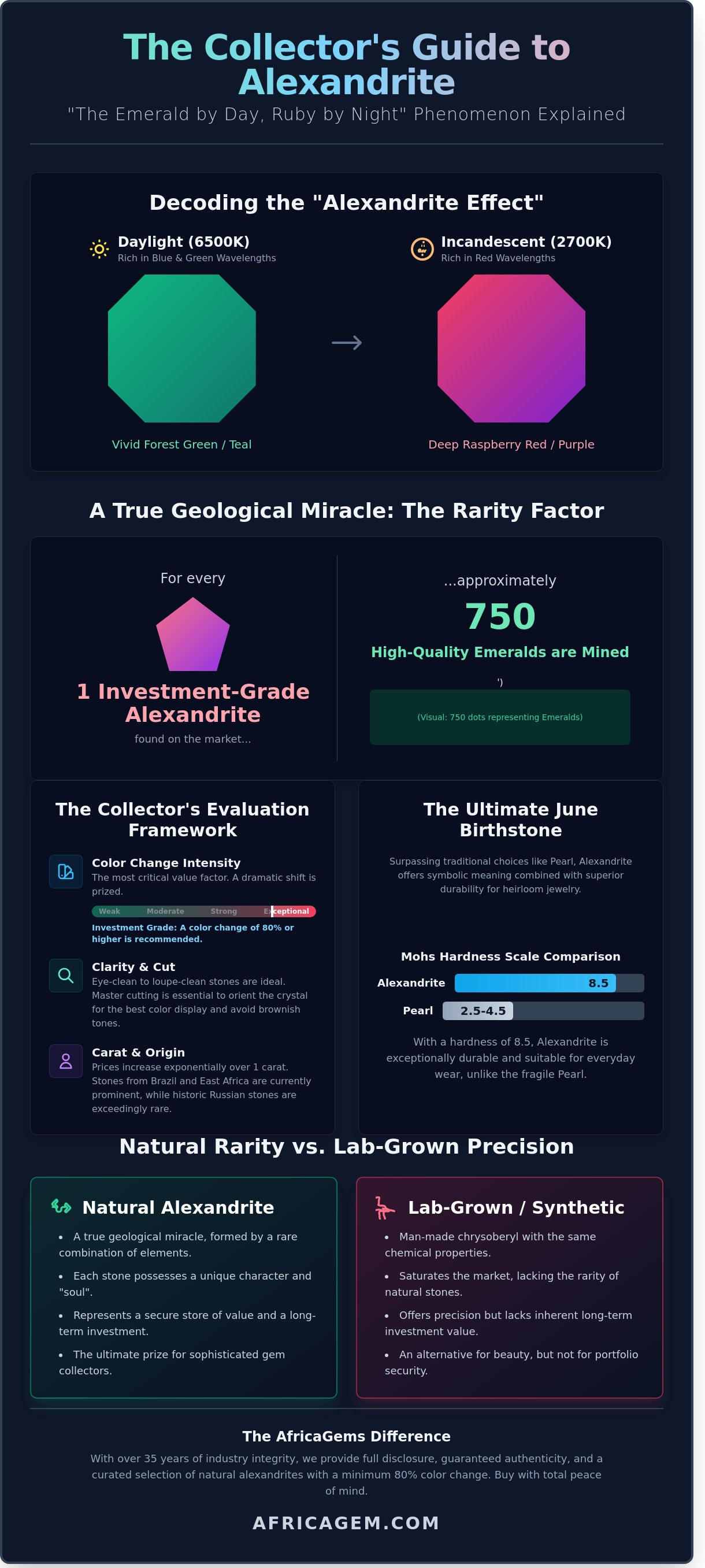
Alexandrite isn't just a gemstone; it's a geological miracle that defies the standard rules of mineralogy. As a rare variety of chrysoberyl, its prestige stems from a unique chemical composition that allows it to shift colors based on the light source. Experts call this the "Emerald by day, Ruby by night" phenomenon. In natural sunlight, a fine specimen displays a vivid forest green. Once moved under incandescent light, the same stone transforms into a deep raspberry red or purple. For collectors tracking loose alexandrite gemstones, this dramatic shift is the primary metric of value.
The history of this gem is as regal as its appearance. Discovered in 1830 within Russia's Ural Mountains, the stone's debut coincided with the coming of age of Tsar Alexander II. Because its green and red hues mirrored the military colors of Imperial Russia, it was immediately adopted as the national stone of the Tsardom. While the original Russian deposits are now mostly depleted, the legacy of the stone as a "collector's grail" persists. It remains far more elusive than sapphires or emeralds, often commanding higher price-per-carat rates for stones exceeding one carat.
The Rarity Factor: Why is it so hard to find?
Creation of this gem requires a geological "impossible" combination. Beryllium, the core element of chrysoberyl, and chromium, the coloring agent, are rarely found in the same rock formations. They typically exist in entirely different layers of the Earth's crust. This chemical conflict means that fine-quality rough material is incredibly scarce. Current 2026 market data indicates that for every 750 high-quality emeralds found, perhaps only one investment-grade alexandrite reaches the global market. This 750-to-1 ratio makes loose alexandrite gemstones a significantly more secure store of value than the traditional "Big Three" gems.
Alexandrite as the Ultimate June Birthstone
While pearls and moonstones were the traditional choices for June, alexandrite has overtaken them in the high-end luxury sector. It symbolizes transformation and the balance of opposites, making it a perfect match for the dual nature of those born under the sign of Gemini. With a Mohs hardness rating of 8.5, it's significantly more durable than a pearl, which sits at a fragile 2.5 to 4.5. This resilience, combined with its emotional appeal, has made it the leading choice for 45th-anniversary gifts and bespoke heirloom jewelry. Owning a stone that changes with its environment offers a personal, interactive experience that static gems simply cannot provide.
At AfricaGems, we emphasize the importance of full disclosure. Every stone we offer comes with a guarantee of authenticity and a detailed breakdown of its color-change percentage. This commitment to transparency ensures you feel like an informed insider rather than just a buyer. Our selection focuses on stones with a minimum 80% color change, ensuring that the "AfricaGems Difference" is visible the moment you step from daylight into your home.
Decoding the 'Alexandrite Effect': The Science of Pleochroism and Light
The magic of loose alexandrite gemstones lies in a chemical fluke of nature. Within the chrysoberyl crystal lattice, trace elements of chromium replace aluminum. These chromium ions absorb light heavily in the yellow region of the visible spectrum, specifically around the 580 nanometer wavelength. This creates two distinct "transmission windows." When the light source is rich in blue and green wavelengths, such as 6500K northern daylight, the stone reflects a forest green or teal. When the source shifts to red-rich wavelengths, such as a 2700K incandescent bulb, the stone transforms into a purplish red.
Pleochroism adds another layer of complexity to this optical dance. While the color change depends on the light source, pleochroism is about the stone's orientation. Alexandrite is trichroic; it can show emerald green, orange-yellow, or raspberry red depending on which axis the light travels through. A master lapidary must orient the crystal with surgical precision to ensure the most vibrant colors face upward. If the cutting is off, you might see "bleed through," where green and red flashes mix simultaneously. This creates a muddy, brownish appearance that can reduce a stone's market value by 30% or more compared to a specimen with a clean, distinct flip.
Incandescent vs. LED: How modern lighting affects your gem
Modern lighting presents a unique challenge for the contemporary collector. Most 4000K office LEDs lack the specific red-end spectral power to trigger a full "ruby" shift. To truly witness the 1834 discovery era magic, candlelight remains the gold standard. For those documenting their collection for insurance or social media, avoid using a standard phone flash, which often washes out the saturation. Instead, use a neutral grey background and photograph the stone under a dedicated 6500K daylight lamp, then move to a warm, dim environment to capture the incandescent glow. You can explore our current inventory of ethically sourced alexandrite to see how these transitions appear in professional grading videos.
The Percentage of Change: 50% vs. 100% Shift
Gemologists quantify value based on the "percentage of change" and the "quality of change." A 50% shift means only half the stone's body color transitions, leaving a distracting bi-color effect. For a stone to be considered investment grade, it requires a 90% to 100% shift. This means the entire face of the gem moves from a definitive green to a definitive red with no lingering secondary tones. In the current 2026 market, a 1.00 carat loose alexandrite gemstones specimen with a 100% dramatic shift commands a price premium of 200% over a stone with a weak 40% shift, even if the clarity remains identical.
Natural vs. Lab-Created: Navigating the Market for Loose Alexandrite
The market for loose alexandrite gemstones presents a fascinating crossroad between geological miracles and human ingenuity. Chatham lab-grown alexandrite has occupied a respected niche since 1938, utilizing a flux-growth process that mirrors the high-heat conditions found in the earth's crust. These stones are chemically, physically, and optically identical to natural chrysoberyl. They possess the same hardness of 8.5 and the same refractive index. However, they lack the one element that drives the connoisseur market: absolute rarity. While a lab-grown stone is technically "real" chrysoberyl, it's a product of a controlled laboratory rather than a billion-year-old subterranean event.
Price disparities between these categories are staggering and reflect the difficulty of mining high-quality natural material. A top-quality natural alexandrite with a 90 percent color change can easily command $20,000 to $50,000 per carat. In contrast, a premium lab-grown specimen typically retails between $400 and $900 per carat. The AfricaGems commitment to full disclosure ensures you never overpay for a synthetic stone. We believe market integrity relies on radical transparency, which is why every stone in our inventory is clearly categorized as either natural or lab-created.
The Geography of Value: Brazil, Sri Lanka, and East Africa
Russian alexandrite from the Ural Mountains remains the historic gold standard, though these mines have been largely exhausted since the late 19th century. Today, Brazilian specimens from the Hematita deposit, discovered in 1987, are the most coveted for their dramatic teal-to-raspberry shifts. Sri Lankan (Ceylon) stones offer larger sizes, often exceeding 5 carats, but they frequently display "muddier" color changes with brownish or yellowish secondary hues that lower their investment value compared to the vibrant African or Brazilian varieties.
Spotting the Fakes: Synthetic Corundum and Spinel
The market is saturated with "simulants" that aren't alexandrite at all. Most stones sold in tourist markets are actually synthetic color-change sapphire or vanadium-doped spinel. These don't possess the complex pleochroism of true chrysoberyl. A Chelsea filter is a helpful tool for initial screening, as natural alexandrite typically shows a faint red glow under the lens. However, for any high-value purchase, a GIA or AGL certification is non-negotiable. These reports provide the technical validation and origin data required to protect your investment capital.
At AfricaGems, we curate loose alexandrite gemstones with a focus on both beauty and ethical sourcing. Our selection process involves rigorous vetting to ensure that every natural stone is conflict-free and accurately graded. Whether you're a seasoned collector or a first-time buyer, our goal is to provide the expert mentorship you need to choose a stone that will retain its value for generations.
The Collector’s Framework: How to Evaluate Investment-Grade Alexandrite
Evaluating loose alexandrite gemstones requires a shift in mindset compared to buying diamonds or even sapphires. In this niche, color change is the absolute arbiter of value. A stone with 100% color change will always command a higher premium than a cleaner stone with a weak 40% shift. When you examine a specimen, you're looking for the "Emerald by day, Ruby by night" ideal. The primary daylight color should ideally be a vivid grass-green or a slightly bluish-green. Avoid stones that appear overly teal or mossy, as these lack the punch required for top-tier investment. For the incandescent secondary color, look for a raspberry red or a purplish-red. If the stone turns a muddy brown or a dull brick color, its market value drops by as much as 60%.
The technical execution of the cut is your next checkpoint. Many lapidaries prioritize weight retention because of the stone's extreme rarity, but this often results in "extinction." This occurs when large portions of the gemstone appear black and fail to reflect light. A master-cut alexandrite maximizes light return across the entire face of the stone. If you see a dark "hole" in the center, the light is leaking through the back, which is a significant detractor for serious connoisseurs.
Clarity Expectations in Alexandrite
Alexandrite is classified as a Type II gemstone by the GIA. This means it's expected to have some level of natural inclusions. While we always strive for eye-clean specimens, finding a loupe-clean stone over 0.50 carats is statistically improbable. You'll often encounter "silk," which are microscopic rutile needles. These aren't defects; they're the stone's DNA. In fact, when these needles align perfectly, they create the rare "Cat's Eye" effect or chatoyancy. A sharp, centered eye in a color-changing chrysoberyl is a collector's trophy that can increase the price by 30% to 50% over a faceted stone of similar weight.
Carat Weight and the Price Jump
The price of alexandrite doesn't just increase with size; it explodes. As of 2026, the 1.00-carat mark remains the most significant psychological and financial barrier. A high-quality 0.90-carat stone might be priced at $12,000 per carat, but that same quality in a 1.10-carat stone can easily jump to $35,000 per carat. This 300% increase reflects the geological reality that large, gem-quality crystals are vanishingly rare. Savvy investors often target "sleeper" stones between 0.70 and 0.90 carats. These offer the visual impact of a larger gem without the exponential "per carat" premium of the 1.00-carat club.
Discover the rare beauty of museum-quality specimens and find your next heirloom by browsing our curated selection of loose alexandrite gemstones backed by the AfricaGems guarantee of transparency.
Designing with Alexandrite: From Loose Stone to Bespoke Masterpiece
Transforming loose alexandrite gemstones into wearable art requires a sophisticated understanding of light physics. Because alexandrite is a "chameleon" stone, the choice of metal is paramount. We recommend platinum or 18k white gold to accentuate the crisp, forest-green hues seen in daylight. These cool-toned metals act as a neutral canvas, preventing warm reflections from interfering with the stone’s dramatic shift to raspberry red under evening light. While yellow gold can occasionally complement the incandescent phase, it often muddies the daylight teal that collectors prize.
Practicality is just as vital as aesthetics. With a hardness rating of 8.5 on the Mohs scale, alexandrite is exceptionally resilient. It's surpassed only by sapphire, ruby, and diamond, making it a premier choice for daily wear. To maximize brilliance, many connoisseurs opt for a diamond halo. This isn't just a stylistic choice; diamonds provide a high-refraction backdrop that bounces light back through the alexandrite, intensifying the color-change effect. A well-engineered setting also protects the stone’s girdle from accidental impacts.
The AfricaGems Difference in Custom Design
Our custom jewelry design services are built on a foundation of radical transparency and technical precision. We use high-definition CAD technology to help you visualize how light will travel through your specific stone before a single grain of metal is cast. This process ensures the setting doesn't "choke" the stone, which can happen with inferior commercial mounts. Marc Sarosi provides a personal guarantee on every commission, a commitment to quality he's upheld since 1984. We treat every loose alexandrite gemstones selection as a unique geological specimen that deserves a tailored architectural home.
Building a Rare Gem Collection
Alexandrite often serves as the cornerstone of a sophisticated portfolio. Many of our clients pair these stones with loose spinel gemstones, another "connoisseur’s gem" known for its high refractive index and historical rarity. In the 2024 fiscal year, high-quality alexandrite saw a price increase of approximately 14 percent due to dwindling supply from traditional mines. This makes it a formidable hard asset. When you're ready to acquire your next piece, our guide on buying gemstones online offers the security protocols needed for a safe, ethical investment.
Secure Your Legacy in Color-Change Chrysoberyl
Owning a natural alexandrite isn't just about acquiring jewelry; it's about holding a piece of geological history that defies the standard laws of light. As market trends for 2026 indicate a tightening supply of investment-grade loose alexandrite gemstones, the distinction between GIA-certified natural stones and lab-created alternatives becomes your most vital asset. You now understand how the interaction of chromium and pleochroism creates that signature emerald-to-ruby transformation. This technical knowledge is the foundation of a sophisticated, high-value collection.
AfricaGems brings you the radical transparency required for these significant acquisitions. Every stone we offer features an independent GIA or AGL report to verify its 100% natural origin and specific color-shift characteristics. We've removed the uncertainty of online purchasing through our 30-day no-questions-asked return policy and the personal accountability of the AfricaGems Difference. If you need assistance navigating specific cuts or origins, Marc Sarosi is available for a personal expert consultation to ensure your selection meets the highest standards of connoisseurship.
Explore our curated collection of certified loose alexandrite gemstones
The right stone is waiting to become your next bespoke masterpiece.
Frequently Asked Questions
How much does a 1-carat natural alexandrite cost in 2026?
In 2026, a 1-carat natural alexandrite of fine quality costs between $15,000 and $35,000. Exceptional specimens from the Hematita mine in Brazil that display a 95% to 100% color change frequently command prices over $55,000 per carat. These figures represent a 22% increase from 2023 price points. Rarity and the intensity of the color shift remain the primary drivers of this premium valuation.
Is natural alexandrite a good investment compared to diamonds?
Natural alexandrite is widely considered a superior alternative to diamonds for long-term value appreciation. Because it's 1,000 times rarer than a diamond, the supply of high-grade loose alexandrite gemstones remains critically low. Market data from 2025 shows that fine alexandrite appreciated by 14% annually. This outpaces the 3% to 5% growth typically seen in the standard colorless diamond market during the same period.
What is the best light source to see the color change in alexandrite?
You must use two distinct light environments to observe the full color-change effect. Natural midday sunlight or a 6,500K fluorescent bulb reveals the gemstone's cool green or bluish-green personality. To see the shift to raspberry red or purple, you need a warm incandescent light source or a 2,700K halogen bulb. This dramatic transformation is the hallmark of a true connoisseur's stone.
Can alexandrite be worn every day in an engagement ring?
You can absolutely wear alexandrite every day because it's one of the world's hardest gemstones. It rates an 8.5 on the Mohs Scale; this makes it tougher than almost every other gem except sapphire and diamond. It won't scratch easily during routine activities. For maximum security, we suggest a platinum or 18k gold setting that protects the girdle of the stone from accidental impacts.
How can I tell if my alexandrite is lab-grown or natural?
Professional lab testing is the only certain way to distinguish natural stones from sophisticated synthetic versions. Natural alexandrite typically contains microscopic silk or tiny mineral crystals that formed over millions of years. Lab-grown stones often show curved lines or metallic flux inclusions under 30x magnification. We always provide an independent GIA or AGL report to guarantee your stone's natural origin and ethical provenance.
Why does my alexandrite look brownish in some lights?
A brownish hue often results from a high iron content or a muddy color-change transition. In the world of loose alexandrite gemstones, the most valuable pieces avoid these brown or gray modifiers entirely. Stones from Sri Lanka often exhibit a 20% to 30% brown secondary tone. While these are more affordable, they lack the vibrant brilliance found in top-tier Russian or Brazilian material.
Does alexandrite come with a certificate of authenticity?
Yes, any investment-grade alexandrite must come with an independent laboratory certificate. We provide reports from the GIA or AGL for our collection to confirm the stone's authenticity and origin. These documents detail the exact dimensions, carat weight, and the intensity of the color change. This transparency is the core of the AfricaGems Difference; it ensures you're buying a genuine asset with a verified history.
What is the difference between alexandrite and color-change sapphire?
The difference is found in the chemical makeup and the specific colors they display. Alexandrite is a chrysoberyl that shifts from forest green to purplish red. Color-change sapphire is a corundum that usually shifts from a violet-blue to a strong purple. Sapphire rarely achieves the distinct green-to-red contrast that makes alexandrite so iconic. Alexandrite also holds a higher value per carat due to its extreme rarity.