
The Connoisseur’s Guide to Gemstone Engagement Rings: Color, Integrity, and Design
Mar 30th 2026
What if the most enduring symbol of your commitment wasn't found in a mass-market diamond, but in the vivid, 9-out-of-10 Mohs hardness of a rare sapphire or the mesmerizing pleochroism of a loupe-clean Tanzanite? You likely recognize that a ring should be more than a simple purchase; it's a legacy piece that must survive decades of daily life without scratching or losing its luster. Choosing gemstone engagement rings requires a discerning eye, especially when fewer than 2% of colored stones on the market meet the rigorous standards of being both unheated and ethically documented.
I promise that by the end of this guide, you'll possess the connoisseur's toolkit to select a rare, durable, and conflict-free stone that transcends the ordinary. We'll examine the technical AfricaGems Difference, from identifying stable crystal structures to understanding the true investment value of unheated specimens. You'll move from feeling overwhelmed by gemstone treatments to possessing the confidence of a seasoned collector who understands the deep integrity of the natural world. This journey ensures your bespoke piece tells a story as breathtaking and uncompromising as the love it represents.
Key Takeaways
- Discover why vibrant color has reclaimed its place as the premier choice for modern betrothals, moving beyond the "alternative" label to embrace royal tradition.
- Learn the critical distinction between hardness and toughness to ensure your center stone possesses the gemological integrity required for a lifetime of daily wear.
- Master the nuances of saturation, tone, and hue to select gemstone engagement rings that exhibit maximum fire and breathtaking brilliance.
- Gain an insider’s perspective on ethical sourcing and the importance of full disclosure, ensuring your heirloom is as conflict-free as it is exquisite.
- Understand the "Gemstone-First" design philosophy where the unique characteristics of a rare mineral dictate the bespoke architecture of your legacy piece.
The Evolution of the Engagement Ring: Why Color is the Modern Standard
The term "alternative" no longer accurately describes gemstone engagement rings. By 2026, these vibrant pieces have transitioned from the periphery to the center of the fine jewelry market. For centuries, the history of engagement rings was defined by color, not the absence of it. Royal houses across Europe favored rubies for passion and sapphires for fidelity long before the 1947 De Beers marketing campaign standardized the colorless diamond. Modern couples are reclaiming this heritage. They're moving away from the "four Cs" of mass-produced stones toward a more personal narrative. Choosing a stone isn't just a transaction; it's an investment in a unique geological story that reflects a specific partnership.
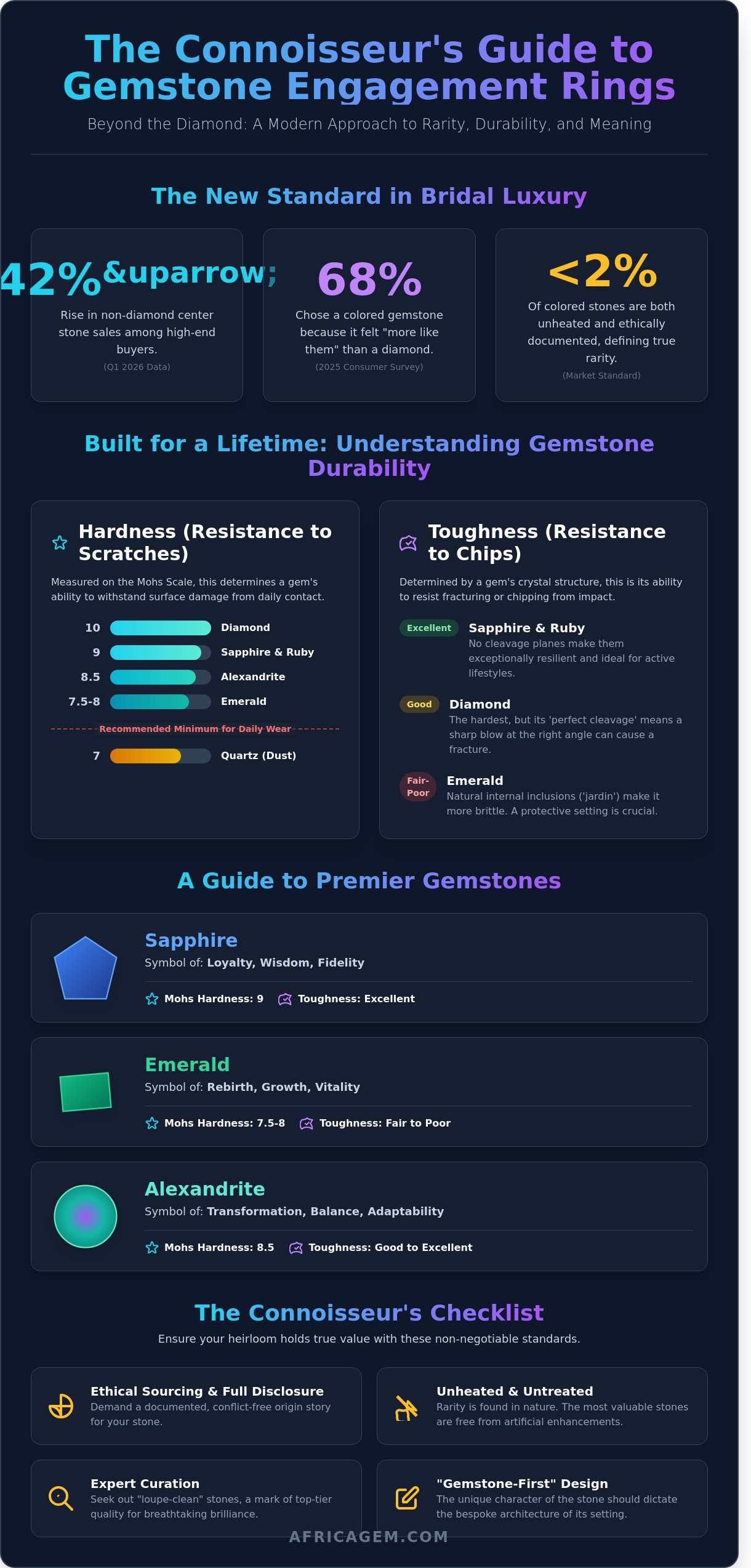
Psychology plays a massive role in this shift. Color isn't just an aesthetic choice. It's a visual language. A deep blue sapphire or a fiery red ruby communicates a mood that a white diamond simply cannot. In a 2025 consumer survey, 68% of respondents stated they chose a colored gemstone because it felt "more like them" than a traditional diamond. This desire for authenticity is the hallmark of the current era. Buyers want a stone that looks as if it was plucked from a private collection, not a mall showroom. At AfricaGems, we see this as a return to connoisseurship, where the rarity of a stone’s hue and its unheated, natural state are the true markers of luxury.
The "Non-Diamond" Movement in 2026
Market data from the first quarter of 2026 shows a 42% rise in non-diamond center stone sales among high-end buyers. This isn't a trend driven by budget constraints. It's driven by rarity. A top-tier, unheated Ceylon sapphire or a vivid green Tsavorite garnet is significantly rarer than a standard commercial diamond. The myth that gemstones are less durable is fading as buyers learn that sapphires and rubies rank 9 on the Mohs scale. Value in this market is now driven by supply-side scarcity. While lab-grown diamonds have become a commodity, the finite supply of earth-mined, ethically sourced colored gems ensures long-term prestige. We prioritize radical transparency in this process, ensuring every loupe-clean stone is accompanied by a full disclosure of its origin and treatment history.
Symbolism and Meaning Behind the Stones
Color acts as a psychological anchor for a relationship. Each stone carries a legacy that adds weight to the proposal. Consider these primary choices for gemstone engagement rings:
- Sapphires: These stones are the gold standard for loyalty and wisdom. Their deep blues offer a sense of calm and permanence that has appealed to aristocrats for over 500 years.
- Emeralds: Signifying rebirth and growth, emeralds are ideal for couples starting a new chapter. Their lush green hues are synonymous with the vitality of nature.
- Alexandrite: For those seeking something truly extraordinary, Alexandrite is the ultimate stone of transformation. It shifts from teal to purple under different lighting. This pleochroism represents balance and the ability to adapt together through life's inevitable changes.
Selecting a stone based on these attributes creates a deeper connection to the jewelry. It's no longer about following a prescribed social rule; it's about finding a rare mineral that resonates with your specific journey. The AfricaGems Difference lies in our commitment to finding these breathtaking specimens that offer both technical perfection and emotional resonance.
Durability and Integrity: The Technical Reality of Daily Wear
A gemstone engagement ring isn't a museum piece; it's a daily companion that faces constant contact with granite countertops, steel door handles, and abrasive surfaces. Selecting a stone requires looking beyond color to the technical reality of mineralogy. The Mohs Scale of Hardness, established in 1812, remains the primary metric for evaluating a stone's resistance to surface scratches. For a ring worn 365 days a year, minerals ranking below a 7 are generally considered high-risk. However, hardness only measures surface resistance. You must also consider "toughness," which refers to a stone's resistance to fracturing or chipping along its atomic structure. A diamond is a 10 on the Mohs scale, yet it possesses perfect cleavage, meaning a sharp blow at a specific angle can still cause it to shatter.
Daily activities exert varied pressures on different gemstone families. For those researching the broader industrial and geological context of these minerals, the USGS Gemstones Statistics and Information provides essential data on global mineral production and classification standards. When evaluating a stone for a permanent setting, the distinction between loupe-clean and eye-clean is vital. A loupe-clean stone lacks internal inclusions even under 10x magnification, which significantly reduces the risk of structural failure. In contrast, an eye-clean stone may have microscopic "feathers" that are invisible to the naked eye but could potentially expand if the stone is subjected to extreme temperature shifts or heavy impact during jewelry repairs.
The Durability Leaderboard for Engagement Rings
Corundum, the family comprising Sapphires and Rubies, sits at a 9 on the Mohs scale and lacks significant cleavage planes. This makes them the gold standard for daily wear. Alexandrite follows closely at 8.5. This rare color-change chrysoberyl is a hidden champion, offering a blend of extreme rarity and rugged durability that resists chipping better than most stones. Beryls like Emerald and Morganite require more caution. While they rank 7.5 to 8, Emeralds often contain internal "jardins" or inclusions. These natural features can compromise the stone's integrity if it suffers a sharp impact, making a protective bezel setting a wise choice for these specific gemstone engagement rings.
Treatments and Disclosure: The AfricaGems Standard
Integrity involves both physical strength and ethical history. Approximately 95% of sapphires in the current market undergo traditional heat treatment to enhance color and clarity, a stable practice that doesn't compromise the stone. However, diffusion treatments, where chemicals are forced into the crystal lattice at high temperatures, are less desirable because the color is only skin-deep. Unheated gemstones represent the absolute pinnacle of gemstone integrity in 2026, existing exactly as nature intended without any human intervention. We demand full disclosure for every investment to ensure you're an informed insider. When you view our sapphire collection, you'll see a clear breakdown of every treatment, ensuring the long-term value of your gemstone engagement rings remains secure.
The "Big Three" and the New Classics: Choosing Your Center Stone
Selecting the center stone for gemstone engagement rings requires a different mindset than diamond shopping. You aren't just looking for sparkle; you're hunting for soul, depth, and character. Color is the primary driver of value here. It's evaluated through three lenses: hue (the actual color), tone (the lightness or darkness), and saturation (the intensity). A stone with 70% to 80% saturation will always command a premium because it maintains its vividness even in low light. If a stone's saturation is too low, it looks "grayish." If the tone is too dark, the stone looks "inky" and loses its life.
The physics of cutting also differs from diamonds. While diamonds are cut to a mathematical ideal to reflect light, gemstones are often cut to maximize color. This sometimes results in a "window," a clear area in the center where light passes through rather than reflecting. At AfricaGems, we prioritize stones with minimal windowing and excellent "face-up" size. Because gemstones have different densities, a 1-carat sapphire is physically smaller than a 1-carat diamond. A 1.5-carat sapphire typically measures 7mm across, whereas a 1.5-carat diamond measures roughly 7.4mm. Always buy based on millimeter dimensions to ensure the visual impact you desire.
Sapphires: A Kaleidoscope of Possibilities
Sapphires are no longer just about royal blue. For the 2026 bridal season, we're seeing a 25% increase in demand for unheated Ceylon and Madagascar sapphires. These stones are prized for their natural, "earth-mined" purity. Padparadscha sapphires, a rare blend of pink and orange, remain the ultimate prize for collectors. Teal and particolored stones are also trending for their unique bi-color zones. Pair cool blue stones with platinum to keep the color crisp. Use 18k yellow gold for teal or yellow sapphires to pull out their hidden warmth.
Emeralds and Rubies: The Bold Statement
Colombian emeralds are the historical benchmark, famous for their "jardin," the internal inclusions that look like mossy gardens. About 95% of emeralds receive a minor oil treatment to improve clarity; this is a standard 0.5% weight addition that doesn't compromise integrity. For rubies, Mozambique has emerged as the premier ethical source, offering "pigeon blood" reds that rival Burmese stones. Since emeralds are softer at 7.5 on the Mohs scale, we recommend protective bezel or halo settings to shield the edges from daily wear.
Rare Alternatives: Alexandrite, Tsavorite, and Spinel
If you want a conversation piece, Alexandrite is the "Emerald by day, Ruby by night" marvel that changes color under different light sources. It's a rare choice for gemstone engagement rings that appeals to the scientific mind. Tsavorite garnet is another exceptional option. It's 200 times rarer than emerald and has an 8% higher refractive index, meaning it actually outshines most emeralds. Spinel is the "insider's" stone. It's a Mohs 8 on the hardness scale, naturally loupe-clean, and comes in breathtaking "Jedi" pinks and cobalt blues without any heat treatment.
- Durability: Sapphires and Rubies (Mohs 9) are best for active lifestyles.
- Treatment: Always ask for a lab report to confirm if a stone is unheated or "minor oil" only.
- Origin: Madagascar and Mozambique currently offer the best balance of ethical sourcing and visual quality.
The AfricaGems Difference: Ethical Sourcing and Expert Curation
Marc Sarosi founded AfricaGems in 1984 with a commitment to boots-on-the-ground expertise that remains rare in the digital marketplace. He doesn't just source stones from anonymous wholesalers; he travels directly to mining hubs in East Africa and Sri Lanka to ensure every gem meets his rigorous standards. This 39-year legacy of personal involvement means you aren't just buying a rock. You're benefiting from a lifetime of gemological connoisseurship and a deep understanding of the mineral's journey from the earth to your hand.
Every single gem undergoes a meticulous technical vetting process before it earns a place in our inventory. Marc personally inspects gems under 10x magnification to evaluate color saturation, silk patterns, and pleochroism. We maintain a policy of 100% disclosure regarding treatments. Choosing gemstone engagement rings requires this level of radical transparency; you deserve to know if a sapphire is unheated or if an emerald has been clarity-enhanced. We prioritize natural stones because their rarity and geological history provide a lasting value that synthetic mass-production cannot replicate.
While our heart lies with natural treasures, we recognize that some couples seek specific aesthetic or budgetary targets. In these cases, we offer Chatham lab-grown gems. Chatham has set the global benchmark for lab-grown quality since 1938. We only stock them because they align with our standards for crystalline integrity and brilliance; they provide a reliable alternative without compromising on the visual soul of the jewelry.
Transparency in the Digital Age
Buying high-value gems online can feel daunting, so we've removed the guesswork through high-definition visual data. Every one of our gemstone engagement rings features 4K video and professional photography that captures the stone's true personality. We don't hide inclusions; we show them. For gems exceeding specific carats or price points, we provide independent certifications from the GIA, AGL, or GRS. To ensure your complete peace of mind, we offer a 30-day inspection period. This allows you to view the stone in your own lighting and consult with local experts before making a final commitment.
Ethical Integrity and Environmental Impact
Ethical sourcing isn't a marketing buzzword at AfricaGems; it's our foundational pillar. We trace our stones from the primary mines in Tanzania and Madagascar directly to our headquarters in Mill Valley, California. By maintaining these direct relationships, we ensure that the local mining communities receive fair-trade compensation and work in safe conditions. Natural gemstones are a sustainable luxury choice because they possess an infinite lifespan. Unlike disposable fashion, a natural gem is a piece of the earth's history that can be passed down for generations. This longevity reduces the environmental footprint associated with constant consumer replacement and industrial manufacturing.
Designing Your Legacy: The Custom Engagement Ring Process
At AfricaGems, we operate under a Gemstone-First philosophy. Most commercial jewelers select a pre-made mounting and find a stone that "mostly" fits, but we believe the stone must dictate the architecture of the piece. A 4.25-carat unheated sapphire or a precision-cut emerald possesses unique dimensions and optical properties that require a tailored home. When you start with the gem, you ensure the proportions are balanced and the light return is maximized. This approach treats gemstone engagement rings as works of art rather than mass-produced accessories.
Collaborating with our design team allows you to step into the role of a connoisseur. You aren't just buying jewelry; you're engineering a bespoke masterpiece. Our process begins with a personal consultation to discuss your aesthetic preferences and functional needs. We then move into the visualization phase using advanced 3D CAD renderings. These digital models allow you to see your ring from every conceivable angle, ensuring the height of the setting and the placement of accent stones meet your exact specifications. During this stage, we help you select the ideal metal, whether it's the icy durability of 950 Platinum or the classic warmth of 18k yellow gold.
The AfricaGems Difference is rooted in 39 years of gemological expertise. We don't cut corners on structural integrity. Every custom piece is a collaboration between our master bench jewelers and our lead gemologists to ensure the final product is as durable as it is breathtaking. This synergy between technical data and creative vision results in a legacy piece that can be passed down through generations.
From Loose Stone to Finished Ring
Your journey begins with our curated inventory of over 2,500 loose sapphires, emeralds, and rubies. You can filter by origin, such as ethically sourced Ceylon sapphires or vivid Zambian emeralds, to find a stone that resonates with your personal story. Once you've selected your center stone, you'll choose from a variety of foundational styles:
- Solitaire: A timeless choice that keeps the focus entirely on the gemstone's clarity and color.
- Halo: Surrounding the center stone with a perimeter of diamonds to enhance its perceived size and brilliance.
- Vintage: Featuring intricate milgrain and filigree work inspired by Edwardian or Art Deco eras.
- Toi et Moi: A sophisticated "you and me" design featuring two primary stones that represent a shared bond.
A custom-engineered setting represents the only viable method to guarantee the long-term security of a rare gemstone, as it's built to accommodate the stone's specific depth and girdle thickness rather than forcing it into a generic mount.
The Final Reveal: Quality Control and Shipping
Before any of our gemstone engagement rings leave our Mill Valley studio, they must pass a rigorous 12-point quality control inspection. We examine the piece under 10x magnification to verify prong tension, stone stability, and the mirror-finish of the polish. We leave nothing to chance. This commitment to excellence is why every piece we create is backed by the AfricaGems lifetime guarantee against manufacturing defects.
Once the final inspection is complete, we provide fully insured global shipping. We understand the gravity of your investment, so we use secure, discreet packaging to bring our expertise directly to your doorstep, no matter where you're located. You'll receive a tracking number and a personal confirmation from our team, ensuring you're informed at every step of the delivery process. Start your journey by exploring our loose sapphire collection today.
Begin Your Legacy with a Masterpiece
Choosing a symbol of your commitment requires more than just an appreciation for beauty; it demands an understanding of geological integrity and ethical provenance. Today’s shift toward vibrant color reflects a modern desire for individuality, yet the technical reality of daily wear remains paramount. Whether you select a "Big Three" classic or a rare unheated sapphire, your choice should stand the test of time. At AfricaGems, we bridge the gap between raw natural wonder and refined jewelry through the AfricaGems Difference. Founder Marc Sarosi brings over 40 years of gemological mastery to every selection, ensuring each stone meets rigorous standards for brilliance and durability. Our A+ rating with the Better Business Bureau and our 100% conflict-free guarantee provide the security you need for such a significant investment. You aren't just buying a piece of jewelry; you're securing a piece of earth's history. When you invest in gemstone engagement rings from our collection, you're choosing a partner who values transparency as much as you do. Explore our curated collection of rare gemstone engagement rings today. We look forward to helping you find a stone that captures your unique story with elegance and absolute peace of mind.
Frequently Asked Questions
Are gemstone engagement rings cheaper than diamond rings?
Gemstone engagement rings typically offer significantly better value, often costing 30% to 70% less than a diamond of equivalent size and quality. While a fine two carat blue sapphire might retail for $4,500, a colorless diamond of similar weight and clarity can exceed $18,000. Rare exceptions exist for investment grade stones like unheated pigeon blood rubies or Paraiba tourmalines, which command premium prices due to their extreme scarcity in the global market.
Which gemstone is the most durable for an engagement ring?
Sapphires and rubies are the most durable colored gemstones, ranking at a 9 on the Mohs Scale of Mineral Hardness. This makes them nearly as scratch resistant as diamonds, which sit at a 10. For daily wear, these corundum varieties provide the structural integrity needed to withstand 50 years of constant use. They resist chipping and chemical erosion much better than softer alternatives like emeralds or opals.
What is the difference between a natural and a lab-created gemstone?
Natural gemstones formed deep within the earth over 500 million years, while lab-created stones are grown in controlled environments using the Czochralski process or hydrothermal methods. Both possess 100% identical chemical, physical, and optical properties. The AfricaGems Difference lies in our commitment to natural, earth-mined treasures. We believe the intrinsic value and rarity of a stone formed by geological history offer a soul that synthetic alternatives can't replicate.
How do I care for and clean my gemstone engagement ring?
Clean your gemstone engagement rings every 14 days using a bowl of warm water mixed with two drops of mild, phosphate-free dish soap. Gently scrub behind the setting with a soft-bristled toothbrush to remove accumulated oils and debris. Avoid ultrasonic cleaners for stones like emeralds or tanzanites, as the 40,000 Hz vibrations can trigger fractures in stones with natural inclusions. Always rinse with room-temperature water and pat dry with a lint-free microfiber cloth.
Can I use a loose gemstone I bought from AfricaGems in a setting from another jeweler?
You can absolutely take any loose gemstone purchased from us to your preferred local jeweler for a custom setting. We provide precise millimeter measurements to within 0.01mm for every stone, ensuring your goldsmith can craft a perfect mounting. Many clients choose this path to create a bespoke piece while benefiting from our 40 years of expertise in sourcing loupe-clean, unheated specimens. Our 30-day full refund guarantee remains valid until the stone is actually set.
What happens if the gemstone in my engagement ring gets scratched?
Most surface scratches on stones like sapphires or spinels can be removed through professional repolishing by a master lapidary. This process typically results in a negligible weight loss of less than 0.10 carats but restores the stone's original luster and pleochroism. If a stone suffers a deep chip, a jeweler might need to recut a facet. We recommend a professional inspection every 12 months to ensure prongs haven't loosened, which prevents stone movement and potential damage.
How does AfricaGems ensure the ethical sourcing of its gemstones?
We guarantee that 100% of our inventory is ethically sourced through a transparent supply chain that exceeds industry standards. Marc Sarosi personally vets our suppliers in regions like Sri Lanka and East Africa to ensure fair labor practices and environmental stewardship. By maintaining direct relationships with the cutters and miners, we bypass at least three unnecessary middlemen. This radical transparency ensures that every breathtaking gem you purchase supports the communities that unearthed them.
Do all your gemstones come with a certificate?
Every gemstone priced over $1,000 includes an independent grading report from prestigious laboratories such as the GIA, AGL, or GRS. For stones under this threshold, we provide a comprehensive AfricaGems Certificate of Authenticity that details the stone's origin and treatment status. We maintain a policy of full disclosure, meaning we specify if a stone is unheated or has undergone standard heat treatment. This technical validation provides the security you need for a significant lifelong investment.