
The Connoisseur’s Guide to Colombian Emeralds: Why Origin Matters
Mar 30th 2026
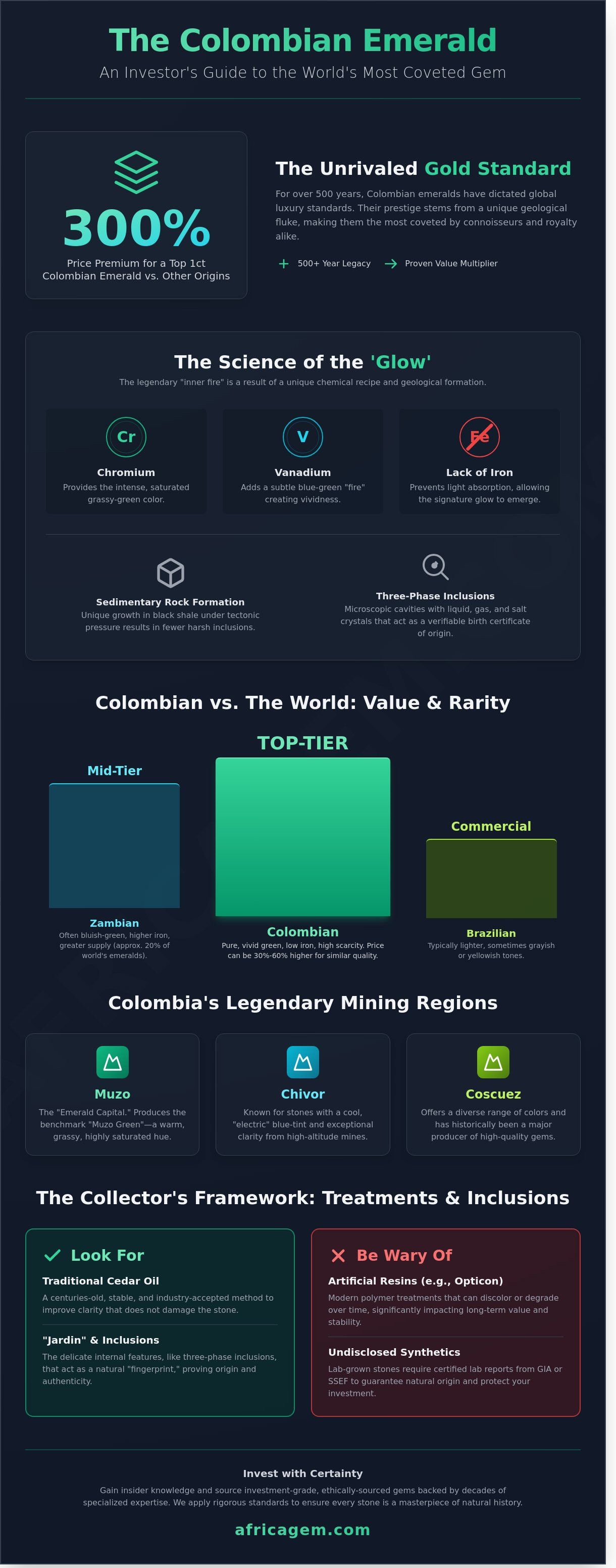
A top-quality 1 carat Colombian emerald often commands a price 300 percent higher than an equivalent stone from any other corner of the globe. This staggering premium exists because these stones possess a unique geological "glow" caused by a rare absence of iron in the sedimentary beds of the Andes Mountains. You likely recognize that colombian emeralds are the undisputed gold standard of the gemstone world, yet the anxiety of encountering undisclosed resins or sophisticated synthetics can make the buying process feel like a gamble. We understand that for a serious collector, the beauty of a stone is only as valuable as the integrity of its documentation.
In this guide, we'll empower you to look past the surface and understand the "fire" that defines an investment-grade gem. You'll learn how to decipher complex lab reports and distinguish between the warm, velvety greens of the Muzo mines and the electric, blue-tinted brilliance of Chivor. We're providing the technical framework and connoisseur’s insight you need to select a breathtaking emerald with absolute certainty. By the end of this article, you'll possess the same rigorous standards we apply at AfricaGems to ensure every stone is a masterpiece of natural history.
Key Takeaways
- Understand the 500-year legacy that has established Colombia as the unrivaled global gold standard for high-end emerald collecting.
- Discover how the unique chemical interplay of chromium and vanadium creates the signature "inner glow" found exclusively in premium colombian emeralds.
- Master the nuances of origin-based pricing and see how Colombian stones compare to Zambian and Brazilian varieties in the 2026 market.
- Learn to navigate the "Jardin" of internal inclusions and the critical importance of selecting traditional cedar oil over artificial resin treatments.
- Gain insider knowledge on sourcing investment-grade, ethically sourced gems backed by Marc Sarosi’s decades of specialized expertise.
The Global Gold Standard: Defining the Colombian Emerald
For over 500 years, the rugged peaks of the Colombian Andes have yielded the world's most coveted green treasures. Since the Spanish first encountered the Chivor mines in 1537, colombian emeralds have dictated the standards of the global luxury market. These gems aren't just minerals; they're historical artifacts that have graced the crowns of royalty and the collections of modern icons. The allure stems from a unique geological fluke: a hydrothermal environment remarkably low in iron. This allows chromium and vanadium to produce a vivid, pure green that lacks the muddy or yellowish undertones often found in stones from other continents.
Every connoisseur recognizes "Muzo Green" as the pinnacle of color grading. It's a deep, grassy saturation that feels alive under any lighting condition. This benchmark doesn't just guide gemological labs; it drives the entire psychological appeal of the stone. Buyers aren't just purchasing a gem. They're acquiring a legacy. The Colombian name on a certificate acts as a silent guarantee of prestige and enduring value that other origins cannot replicate.
The Three Legendary Mining Regions
- Muzo: Often called the emerald capital of the world, this region produces stones with a warm, grassy green glow and exceptional saturation.
- Chivor: These mines sit high in the mountains and are prized for stones with a cool, bluish-green "electric" tint and higher clarity.
- Coscuez: This region offers a diverse range of colors and has historically produced up to 77% of Colombia's high-quality output in peak years.
Why Origin is a Value Multiplier
When a GIA or SSEF report confirms Colombian origin, the price per carat can jump by 30% to 60% compared to stones of similar appearance from other locales. While Zambia produces roughly 20% of the world's emerald supply, the scarcity of top-tier colombian emeralds ensures their status as a premier investment. Understanding the nuances of emerald colors and clarity is vital for any serious collector looking to distinguish between mass-market goods and true connoisseur pieces. The Colombian tag isn't just a label; it's a proven multiplier of long-term asset value and market liquidity.
The Science of the Glow: Chromium, Vanadium, and Iron
The legendary "glow" of colombian emeralds isn't a marketing myth; it's a verifiable gemological phenomenon. While most emeralds absorb light, Colombian material often appears to emit it. This happens because of a specific chemical cocktail found in the Muzo and Chivor mining districts. Chromium is the primary coloring agent here, providing the intense, grassy green that collectors crave. When vanadium is also present, it adds a subtle "fire" or secondary blue-green hue that makes the stone's color appear more three-dimensional. This interaction creates a vividness that remains stable even as you move from natural sunlight into a dimly lit room.
Geological Formation in Sedimentary Rock
Unlike emeralds from other regions that formed in igneous or metamorphic rock, colombian emeralds grew within sedimentary host rocks like black shale. This unique tectonic pressure in the Andes, occurring between 32 and 65 million years ago, allowed crystals to grow with fewer "harsh" mineral inclusions. Instead, we see delicate internal features that serve as a birth certificate for the stone. The most famous indicator is the three-phase inclusion. A three-phase inclusion is a microscopic cavity containing a liquid, a gas bubble, and a salt crystal. These tiny snapshots of the earth's ancient hydrothermal fluids prove a stone's origin under a 10x loupe.
The Visual Impact of Low Iron
Iron is the enemy of the emerald's natural fluorescence. In Zambian or Brazilian deposits, iron content is often high enough to "quench" the stone's ability to glow, resulting in a "closed" or muddy look. Colombian soil is remarkably low in iron. This lack of interference allows light to penetrate the crystal lattice and interact with the chromium without being absorbed. The result is an "open" color where light returns to the eye with breathtaking intensity. This creates a sense of "inner fire" that makes the gemstone look alive. If you're seeking a stone with this level of transparency, you might explore our inventory of untreated stones to see how low iron affects visual brilliance. This clarity is why a 2-carat Colombian stone can often outshine a 5-carat stone from a high-iron deposit.
Colombian vs. The World: A Comparative Analysis
While all emeralds belong to the beryl family, their chemical fingerprints create distinct visual identities. Colombian emeralds owe their legendary status to a rare geological fluke. They're colored primarily by chromium and vanadium with almost no iron. This lack of iron results in a pure green glow that doesn't extinguish in low light. In contrast, stones from other regions often contain significant iron, which can dampen the stone's natural fluorescence.
Visual differences are stark when you place these origins side-by-side. You'll notice a specific color spectrum across the major mining hubs:
- Colombia: Pure, vivid green to slightly yellowish-green with a high-transparency "glow."
- Zambia: Cooler, bluish-green tones with higher levels of clarity.
- Brazil: Often displays a yellowish-green or "mossy" hue, frequently used in commercial jewelry.
- Ethiopia: Saturated grass-green that can occasionally mimic high-end South American material.
Clarity expectations also shift based on origin. In the gem trade, we embrace the "jardin," or internal garden, within colombian emeralds. These three-phase inclusions are a hallmark of authenticity and rarely detract from the stone's value if the color remains intense. However, for Zambian or Brazilian stones, the market is less forgiving. Collectors expect higher clarity from these origins because their geological formation typically allows for fewer internal fractures.
Price remains the ultimate differentiator. Looking ahead to 2026, the price per carat for fine-quality 3-carat specimens reflects the enduring prestige of the Andes. Current market trajectories suggest the following benchmarks:
- Colombia (Muzo/Chivor): $18,500 to $42,000 per carat.
- Zambia (Kagem): $6,200 to $14,500 per carat.
- Ethiopia (Shakiso): $4,800 to $11,000 per carat.
- Brazil (Belmont): $2,500 to $7,500 per carat.
Zambian Emeralds: The Modern Challenger
Zambia has emerged as a formidable rival since the 1970s. These stones are typically more "clean" to the naked eye and offer a higher degree of transparency for the price. However, many connoisseurs find them "cold" due to their high iron content. The AfricaGems Difference lies in recognizing that while a Zambian stone provides exceptional value, it lacks the velvety fire found in the low-iron deposits of the Andes. It's a choice between clinical perfection and soulful warmth.
Brazilian and Ethiopian Varieties
Brazil remains the backbone of the commercial market. It has provided a steady supply for mid-market jewelry since the discovery of the Belmont mine in 1978. Ethiopia is the new frontier. Since 2016, the Shakiso region has produced stones that rival top-tier material in color. They lack the 500 year history of the Spanish Colonial mines, making them a smart play for investors who prioritize aesthetics over historical prestige.
The Collector’s Framework: Evaluating Quality and Treatments
In the world of fine gems, perfection is a relative term. Unlike diamonds, where clarity is often paramount, colombian emeralds are defined by their internal landscapes. These intricate patterns are the stone's autobiography, telling a story of intense geological pressure and rare mineral crystallization.
Understanding Emerald Clarity and "Jardin"
Gemologists refer to the internal inclusions of an emerald as the "jardin," the French word for garden. These aren't flaws in the traditional sense; they're fingerprints of nature that prove a stone's organic origin. You'll rarely find a loupe-clean emerald. Instead, look for delicate veils and three-phase inclusions that characterize the finest stones from the Muzo or Chivor mines. It's vital to distinguish between internal veils and surface-reaching fissures. While internal patterns add character, fissures that reach the surface can impact the gem's durability and are the primary targets for traditional oiling.
Treatment Transparency
Treatment transparency is the cornerstone of the AfricaGems Difference. Statistics show that nearly 99% of all emeralds undergo some form of clarity enhancement. The industry gold standard involves colorless cedar oil, a natural substance that mirrors the light refraction of the emerald itself. We categorize these enhancements on a strict scale:
- Insignificant: Only trace amounts of oil in a few fissures.
- Minor: Light oiling that improves clarity without altering the stone's character.
- Moderate: More noticeable oiling to stabilize several surface-reaching inclusions.
- Significant: Heavy oiling that fundamentally changes the appearance of the stone.
A GIA, GRS, or AGL report is your most valuable asset when buying. These documents don't just confirm origin; they specify the level of oiling with scientific precision. When building a collection, the choice between size and purity is a strategic one. A 1.5-carat "No Oil" stone often commands a 50% to 100% price premium over a 3-carat stone with "Minor" oiling. For the serious investor, a smaller, untreated stone offers higher liquidity and historical price appreciation. If your goal is visual impact for jewelry, an "Insignificant" or "Minor" oil stone provides a larger footprint with the same breathtaking color found in top-tier colombian emeralds.
To secure a stone with a verified pedigree and full laboratory backing, view our investment-grade Colombian emerald collection today.
The AfricaGems Difference: Sourcing the Finest Colombian Gems
Marc Sarosi has spent over 39 years cultivating direct relationships at the source to bring collectors the world's most exceptional stones. Every one of our colombian emeralds must pass a rigorous physical inspection before entering the vault. While the broader industry often accepts heavy inclusions in the Beryl family, Marc prioritizes "loupe-clean" clarity and investment-grade saturation. This means selecting stones with a vivid primary green and minimal secondary hues.
We don't just sell gems; we curate them. Every stone is hand-selected for its "life," a term gemologists use to describe the internal fire and brilliance that defies a static photograph. Our ethical sourcing standards are non-negotiable. We provide a 100% conflict-free guarantee and maintain a strict policy of full disclosure regarding clarity enhancements. Typically, we only select stones treated with colorless oil, ensuring the enhancement remains stable and the stone's value stays protected over generations.
- Expert selection focused on "loupe-clean" investment quality.
- Ethical sourcing with 100% conflict-free guarantees.
- Personal curation for maximum brilliance and "life."
- Custom design services to create bespoke legacy jewelry.
Radical Transparency in the Trade
Buying high-value colombian emeralds online requires absolute trust. We eliminate the guesswork by providing 4K high-resolution videos and 360-degree views for every loose stone in our inventory. You see the pleochroism and internal structure exactly as it appears under a 10x jeweler's loupe. This security is bolstered by our 30-day money-back guarantee and third-party certifications from the GIA or AGL, ensuring your peace of mind matches the quality of your gem.
Start Your Journey with AfricaGems
A rare emerald deserves a setting that matches its pedigree. Our master jewelers specialize in transforming loose stones into legacy pieces, such as custom engagement rings or anniversary pendants. You can consult directly with our experts to choose the perfect mounting that highlights the stone's unique dimensions. Browse our current selection of hand-picked Colombian emeralds today to find a stone that speaks to you.
Elevate Your Private Collection with Colombian Brilliance
Investing in a fine gemstone is a significant milestone for any serious collector. Colombian emeralds represent the pinnacle of this pursuit, offering a distinct vividness driven by high chromium content that other regions simply cannot match. You've seen how the absence of iron allows for that legendary glow and why meticulous sourcing is the only way to ensure lasting value. At AfricaGems, we remove the uncertainty from high-value acquisitions. Our founder, Marc Sarosi, personally inspects 100% of the stones in our inventory to guarantee their quality and authenticity. We support your investment with a 30-Day Money-Back Guarantee and hold an A+ Rating with the Better Business Bureau to ensure your total peace of mind. Every gem tells a story of millions of years of geological history; we're here to help you find the perfect chapter for your legacy. You can browse our curated selection with the confidence of a true gemological insider.
View Our Exclusive Collection of Certified Colombian Emeralds
Your journey into the heart of the world's finest green gems starts today.
Frequently Asked Questions
Are Colombian emeralds the most expensive in the world?
Yes, top-tier Colombian emeralds typically command the highest prices globally, often 30% to 50% more than stones of similar quality from Zambia or Brazil. In 2023, high-grade stones from the Muzo mine reached prices exceeding $100,000 per carat at major auction houses. This premium reflects their unique chromium-rich chemical profile and historical prestige. While rare gems from the Panjshir Valley are competitive, Colombia remains the gold standard for market value.
How can I tell if a Colombian emerald is real or lab-created?
You can identify a natural Colombian emerald by examining its internal jardin under 10x magnification for three-phase inclusions. These microscopic cavities contain a salt crystal, a gas bubble, and liquid; it's a combination that occurs in 95% of natural Colombian stones. Lab-created alternatives often display uniform chevron growth lines or flux-grown veils that lack these natural complexities. We recommend a GIA or AGL report to confirm a stone's natural origin with 100% certainty.
What is "Muzo Green" and why does it matter for pricing?
"Muzo Green" describes a highly saturated, slightly yellowish-green hue that mimics the lush vegetation of the Muzo mining region. This specific color profile can increase a gemstone's value by 25% to 40% compared to lighter or more bluish stones. It's the most coveted color in the trade. Collectors prioritize this vivid saturation because it maintains its brilliance even in low-light environments, making it a hallmark of true connoisseurship.
Do all Colombian emeralds have oil treatments?
Roughly 99% of all Colombian emeralds are treated with colorless cedar oil to fill surface-reaching fissures and improve clarity. This is a standard industry practice that dates back over 400 years. At AfricaGems, we provide full disclosure on whether a stone has minor, moderate, or significant oil. Finding a completely no oil stone is exceptionally rare, representing less than 0.5% of the total market production.
Is a Colombian emerald a good investment for 2026?
Colombian emeralds remain a robust tangible asset for 2026, as high-quality stones have shown a 12% average annual price increase since 2014. Supply from the primary mines like Muzo and Chivor has decreased by nearly 20% over the last five years, driving scarcity. As global demand for ethically sourced, rare minerals grows, these gems offer a hedge against inflation. Investing in stones with minor oil or better ensures the best long-term liquidity.
What is the difference between an emerald from Muzo and one from Chivor?
The primary difference lies in the trace elements; Muzo stones are famous for their warm, grass green saturation, while Chivor emeralds often show a cooler, bluish-green tint. Chivor gems are frequently more transparent and possess fewer inclusions; it's a result of their distinct geological formation in sedimentary rock. While Muzo is more famous, a top-grade Chivor stone can be just as valuable. Both regions produce world-class colombian emeralds that define the peak of gemological beauty.
How should I care for my Colombian emerald jewelry?
You should clean your jewelry using only lukewarm water, mild dish soap, and a soft-bristled toothbrush. Never place these gems in an ultrasonic or steam cleaner; these devices can remove the cedar oil and cause the stone to look dull or even crack. About 80% of emerald damage occurs during improper cleaning. We suggest a professional check-up every 12 months to ensure the prongs are secure and the stone remains protected.
Can I get a GIA certificate for a loose emerald from AfricaGems?
Yes, AfricaGems provides a GIA or AGL laboratory report for any loose colombian emeralds priced above $2,500. These documents are essential for verifying the stone’s geographic origin and the exact level of clarity enhancement. We believe in 100% transparency, so you'll know exactly what you're buying. This rigorous documentation is part of the AfricaGems Difference, ensuring your investment is backed by the world's most respected gemological authorities.