
The Collector's Guide to Loose Paraiba Tourmalines (2026)
Mar 30th 2026
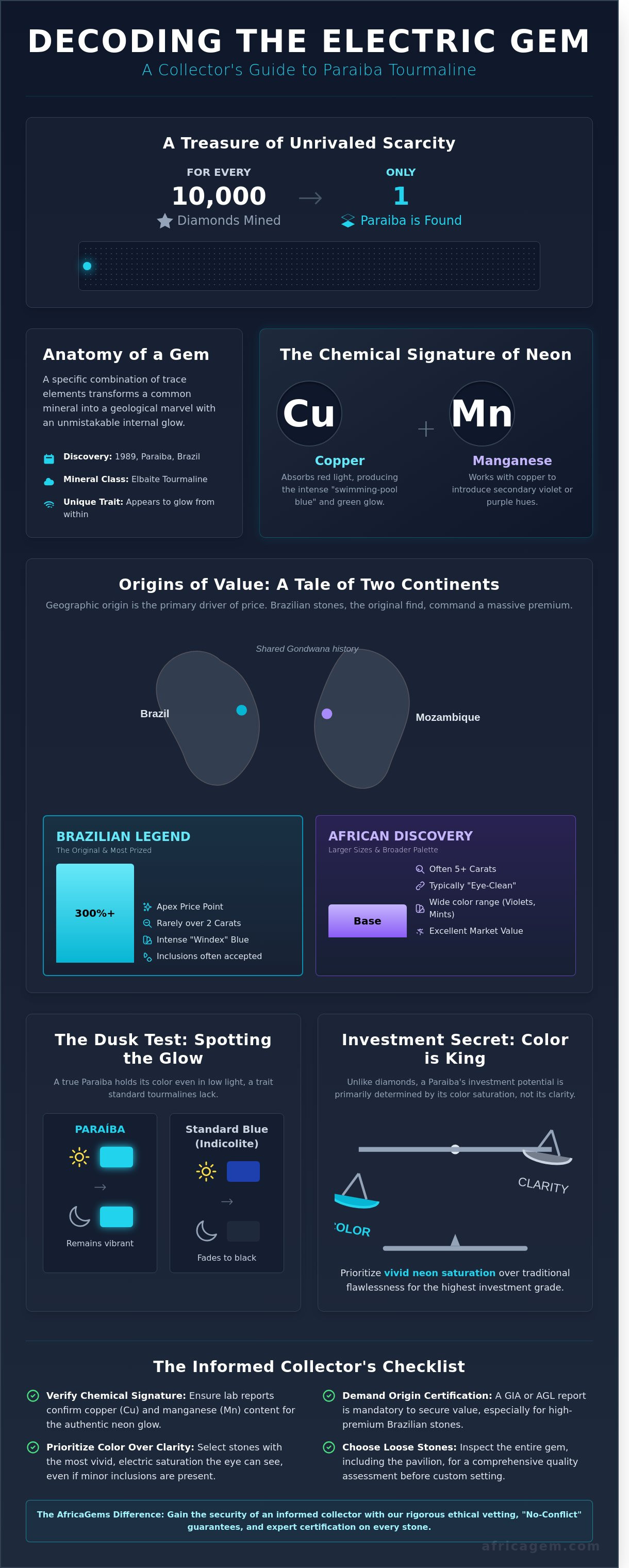
A single milligram of copper is the only thing standing between a common mineral and a six figure investment. Since the initial 1989 discovery in the hills of Paraiba, loose paraiba tourmalines have remained so rare that for every 10,000 carats of diamond mined, only one carat of this neon treasure reaches the surface. You recognize that that unmistakable electric glow is the pinnacle of any collection, but you're likely wary of the "cuprian" labels and undisclosed heat treatments that often cloud the high end market.
This guide delivers the technical secrets and origin data you need to distinguish a world class investment from a mediocre imitation. We'll examine the 35 percent price variance between Brazilian and Mozambique specimens and provide the chemical benchmarks for elite neon saturation. By the end of this deep dive, you'll have the confidence to select a certified, ethically sourced stone that meets the rigorous AfricaGems standard of excellence.
Key Takeaways
- Identify the specific chemical signatures of copper and manganese that produce the legendary "neon" glow unique to authentic Paraiba specimens.
- Navigate the price hierarchy between Brazilian and African origins to understand how geological rarity influences the value of loose paraiba tourmalines.
- Learn why prioritizing vivid color saturation over traditional clarity is the essential secret to selecting a high-investment-grade gemstone.
- Discover the scarcity factors and historical price trends that make these electric treasures significantly rarer—and potentially more lucrative—than diamonds.
- Gain the security of an informed collector by understanding the rigorous ethical vetting and "No-Conflict" guarantees that define the AfricaGems Difference.
What Defines a Loose Paraiba Tourmaline?
Heitor Dimas Barbosa spent eight years tunneling through the Batalha hills of Paraiba, Brazil, before he finally unearthed the first specimens of this extraordinary gem in 1989. His discovery introduced the world to an elbaite tourmaline unlike any seen before, defined by its high concentrations of copper and manganese. While most gemstones rely on light reflection, these stones appear to possess an internal light source. This phenomenon is why the terms "neon" and "electric" are essential gemological descriptors rather than mere marketing fluff. They accurately describe the vivid saturation that remains constant across all lighting conditions.
Choosing loose paraiba tourmalines over pre-set jewelry offers a distinct advantage for the serious connoisseur. A loose stone allows you to inspect the pavilion and girdle for hidden inclusions or "windowing" that a heavy gold setting might obscure. It also grants you the freedom to commission a custom design that prioritizes the stone's unique dimensions and pleochroism. You aren't just buying a rock; you're securing a piece of geological history that hasn't been compromised by a generic, mass-produced mount.
- Discovery Year: 1989
- Primary Location: Batalha hills, Paraiba, Brazil
- Key Elements: Copper (Cu) and Manganese (Mn)
- Mineral Class: Elbaite Tourmaline
The Chemistry of the Neon Glow
The secret behind the "swimming-pool blue" lies in the copper ions trapped within the crystal lattice. These ions absorb the red end of the light spectrum with incredible efficiency, leaving only the most intense blues and greens for the eye to perceive. Manganese works in tandem with the copper, often introducing violet or purple secondary hues that can be modified through gentle heating to achieve a pure turquoise. Cuprian Tourmaline is the scientific umbrella term for any elbaite tourmaline that contains trace amounts of copper, regardless of its geographic origin.
Paraiba vs. Standard Blue Tourmaline
Distinguishing a Paraiba from a standard blue tourmaline, such as Indicolite, is a matter of light physics. Standard tourmalines absorb light, often appearing "inky" or overly dark in larger carats. Paraiba tourmalines exhibit a "glow-from-within" that persists even in deep shadows. You can verify this using the "dusk test" by placing the gem in a dimly lit room. A true Paraiba will remain vibrant and visible, while a standard blue stone will quickly fade into a dull, blackish hue. Indicolite simply lacks the copper required to achieve this level of luminosity. When you evaluate loose paraiba tourmalines, you're looking for that refusal to go dark, a trait that makes them one of the most coveted treasures in the AfricaGems collection.
Origins and Varieties: Brazil, Nigeria, and Mozambique
The story of loose paraiba tourmalines begins 150 million years ago within the Gondwana supercontinent. Before South America and Africa drifted apart, the specific geological conditions required to fuse copper and manganese into tourmaline crystals were concentrated in a single landmass. This shared history explains why we find chemically similar gems 4,000 miles apart today. In the 2026 market, origin remains the primary driver of the price hierarchy. Brazilian stones sit at the apex, often commanding a 300% premium over African varieties of similar size. Because of this massive valuation gap, obtaining an origin certification from a top-tier lab like GIA or AGL is a mandatory step for any collector. These reports verify the "cuprian" nature of the stone and provide the geographic fingerprint that secures your investment's future resale value.
The Brazilian Legend: Batalha and Rio Grande do Norte
The 1989 discovery by Heitor Dimas Barbosa in Paraiba state changed gemology forever. These original stones from the Batalha mine set the global standard for "electric" blue and "neon" green. You'll rarely find a Brazilian stone over 2 carats in the 2026 market. Most current inventory consists of recycled gems from private collections because active mining in Rio Grande do Norte has slowed to a trickle. These stones are famous for high saturation and frequent inclusions; collectors typically accept these internal characteristics because the color is so intensely concentrated. The "Windex" blue found here is a result of a specific copper-to-manganese ratio that is almost impossible to replicate elsewhere.
The African Discovery: Mozambique and Nigeria
Nigeria first produced copper-bearing tourmalines in 2001, followed by a massive find in Mozambique’s Alto Ligonha region in 2005. These African deposits revolutionized the trade by providing larger, "eye-clean" crystals that the Brazilian mines rarely produced. While Brazilian stones lean toward a dense, saturated glow, Mozambique offers a broader palette including soft violets, turquoises, and mint greens. The industry-wide adoption of the "Paraiba" trade name for all copper-bearing tourmalines remains a point of contention for purists, but it's now the standard for major labs. For those seeking a 5-carat statement piece with spectacular clarity, African loose paraiba tourmalines offer the most compelling value proposition. You can explore our curated selection of ethically sourced cuprian tourmalines to see these distinct color variations firsthand.
- Brazil: Highest prestige, smaller sizes (under 1ct), intense "neon" saturation.
- Mozambique: Exceptional clarity, larger sizes (5ct+), diverse pastel to vivid hues.
- Nigeria: Often requires heat treatment to achieve blue tones, currently limited production.
How to Evaluate Quality in Loose Paraiba Gemstones
Assessing loose paraiba tourmalines requires a shift in the traditional gemological mindset. While the Four Cs provide a foundation, the presence of copper and manganese creates a unique neon glow that defies standard grading. Color saturation stands as the primary value driver. A stone with a lower clarity grade but superior saturation often commands a price 40% higher than a paler, cleaner counterpart. Professional cutting acts as the engine behind this glow. A master lapidary must align the facets to maximize the electric return of light, ensuring the stone doesn't appear dead in low-light conditions. Precision-cut pavilions are essential to prevent light leakage, which can drain the stone's vibrancy.
The Paraiba Color Spectrum
Collectors rank hues based on their intensity and rarity. The hierarchy typically places Electric Blue and Turquoise at the peak, followed by Mint Green and Violet. You must watch for extinction, which occurs when light fails to reflect back to the eye. This results in dark, lifeless patches that can reduce a stone's market value by 25% or more. The most valuable color is a vivid, medium-toned 'neon' blue. This specific hue captures the essence of the copper content that makes these gems world-famous.
Clarity and the 'Eye-Clean' Standard
The GIA classifies tourmaline as a Type III gemstone, which means they're almost always found with natural inclusions. A loupe-clean Paraiba over 2.00 carats is a statistical anomaly. Instead, experts look for eye-clean stones where inclusions don't obstruct the glow. You'll often see liquid-filled tubes or fine silk. While heavy fractures block light, fine silk can actually diffuse it, enhancing the neon effect. We prioritize stones where the internal features don't compromise the structural integrity or the brilliance of the loose paraiba tourmalines in our collection.
Heat Treatment: The Industry Standard
Nearly 95% of all Paraiba undergoes low-heat treatment to eliminate reddish or purple manganese tones. This process is stable and permanent. It doesn't change the gemstone's natural status because it simply completes what nature started. This heat is typically applied at 500 to 600 degrees Celsius and doesn't damage the stone. AfricaGems' commitment to full disclosure of all gemstone enhancements remains a pillar of our business. Every stone comes with a guarantee of transparency, ensuring you're an informed insider before you make a purchase.
Investment Value: Why Paraiba is a Premier Choice for 2026
The financial trajectory of Paraiba tourmaline since its 1989 discovery in Brazil's Batalha mine remains unparalleled in the gemstone world. Initial prices sat at a few hundred dollars per carat; today, top-tier specimens command over $50,000 per carat. This 10,000% increase isn't merely a trend. It's a reflection of geological reality. Loose paraiba tourmalines are approximately 10,000 times rarer than diamonds, making them a cornerstone for the modern alternative investment portfolio. While gold and stocks fluctuate, the finite supply of copper-bearing tourmaline provides a tangible hedge against market volatility.
Global demand has shifted significantly over the last 24 months. Emerging markets in East Asia and the Middle East now represent 38% of the annual acquisition volume for investment-grade stones. This surge, coupled with the near-total depletion of original Brazilian shafts, has created a supply squeeze that experts project will intensify through the end of 2026. Savvy collectors recognize that these stones aren't just jewelry. They're portable, high-density wealth.
Price Per Carat Breakdown
In the 2026 market, pricing for loose paraiba tourmalines follows an exponential curve rather than a linear one. You'll find that a 1-carat stone of fine quality typically ranges from $8,000 to $20,000. Once a stone crosses the 2-carat threshold, the price per carat often doubles because the survival rate of large, clean crystals is remarkably low. For 5-carat specimens, prices frequently exceed $65,000 per carat. Remember, color saturation is the ultimate arbiter of value. A 1.5-carat stone with "Electric Neon" saturation will consistently outprice a 5-carat stone with a pale, washed-out hue.
Future Market Outlook
The next decade of appreciation lies in the "Mozambique Gap." Currently, high-quality African cuprian tourmalines trade at a 30% to 50% discount compared to Brazilian stones. However, as the industry accepts the chemical parity of these gems, that price gap is closing fast. Collectors are aggressively targeting Mozambique stones that exhibit the signature neon glow. To protect your capital, you must prioritize transparency. Every investment-grade purchase requires a report from a top-tier lab like GIA, Gubelin, or SSEF to verify copper content and origin. This documentation is your primary insurance policy for future resale liquidity.
Secure your legacy with a hand-selected specimen from our private vault. Explore our investment-grade loose paraiba tourmalines today.
Finding Your Stone: The AfricaGems Difference
Selecting a gemstone of this caliber requires more than a casual transaction; it demands a partnership built on decades of expertise. Since 1984, Marc Sarosi has personally vetted every stone in our inventory, ensuring that each of our loose paraiba tourmalines meets a rigorous standard for neon saturation and copper-bearing clarity. We reject approximately 95% of the stones we inspect to maintain this elite level of quality. Our commitment extends beyond beauty to a strict "No-Conflict" guarantee. Every purchase supports ethical mining practices that prioritize environmental stewardship and fair labor standards in regions like Brazil and Mozambique.
Radical Transparency in Gemstone Selection
We believe you should see exactly what you're buying without the guesswork of traditional retail. AfricaGems provides 4K high-resolution videos and 360-degree views for every gem in our vault. This level of detail reveals the internal life and "electric" glow of the stone better than any static photo could. We only stock stones accompanied by reputable third-party certifications from labs like GIA, AGL, or Gubelin. If you're considering a high-value acquisition, you have direct access to Marc Sarosi for a personal consultation to discuss the stone's investment potential and specific gemological nuances.
From Loose Stone to Bespoke Masterpiece
A Paraiba tourmaline typically ranks between 7 and 7.5 on the Mohs scale, which means it needs a thoughtful setting to protect its edges while maximizing light return. Our design team specializes in creating heirloom-quality jewelry that highlights the unique neon hues of these rare gems. Whether you prefer a minimalist platinum solitaire or a diamond-haloed cocktail ring, we'll guide you through the CAD design process to ensure the final piece is a one-of-a-kind masterpiece. You're not just buying a stone; you're commissioning a legacy.
Browse our current collection of loose Paraiba tourmalines to find your perfect match.
Buying online should feel secure and permanent. We offer a 30-day money-back guarantee with no restocking fees, giving you ample time to inspect your stone in person. Additionally, our lifetime trade-in policy allows you to apply 100% of your original purchase price toward a future upgrade. It's a risk-free way to enter the world of high-end gemstone collecting with a partner you can trust.
Securing Your Rare Neon Treasure for 2026
Owning a piece of the earth's most electric blue fire is more than a purchase; it's a strategic move for any serious collector. As the market moves into 2026, the scarcity of top-tier copper-bearing stones from the original Brazilian mines and high-quality Mozambique deposits continues to drive global demand. You've seen how to evaluate the signature neon glow and why these stones represent a premier investment class today. Finding the right specimen requires a partner who values integrity as much as beauty.
At AfricaGems, we eliminate the uncertainty of high-value acquisitions through radical transparency. Marc Sarosi personally vets each gem to ensure it meets our uncompromising standards for color and saturation. With over 40 years of expertise in rare minerals and an A+ rating from the Better Business Bureau, we provide the security you need to buy loose paraiba tourmalines with total confidence. It's time to find the vivid specimen that speaks to your unique aesthetic and portfolio goals.
Explore the Exquisite Collection of Loose Paraiba Tourmalines at AfricaGems
Your journey into the world of neon-bright gemstones starts with a single, breathtaking choice that will last for generations.
Frequently Asked Questions
Is Paraiba tourmaline more expensive than a diamond?
Yes, high-quality Paraiba often exceeds the price of a standard white diamond. Top-tier stones can reach $20,000 to $50,000 per carat, whereas a G-color, VS1 clarity 1-carat diamond typically lists around $6,000 to $9,000 in 2024 pricing. Their extreme rarity is the primary driver; miners find only one Paraiba for every 10,000 diamonds extracted from the earth.
How can I tell if a loose Paraiba tourmaline is real?
You must verify the presence of copper and manganese through professional laboratory testing. While a 10x loupe helps identify natural inclusions, only a spectrometer can confirm the "neon" glow caused by copper. For loose paraiba tourmalines, always demand a certificate from a reputable lab like GIA or GRS. These reports use quantitative chemical analysis to differentiate genuine specimens from glass or synthetic doublets.
What is the difference between Paraiba and 'Cuprian' tourmaline?
The difference lies in the specific concentration of copper and the naming conventions used by major labs. GIA defines Paraiba tourmaline as an elbaite variety containing copper and manganese, regardless of its source. Some trade professionals use "Cuprian" for African stones with lower copper levels, often below 1.0% by weight. True Paraiba must exhibit that signature electric hue derived from these specific trace elements.
Do loose Paraiba tourmalines require special care?
Yes, Paraiba tourmalines rank 7 to 7.5 on the Mohs scale and require gentle handling. You should avoid ultrasonic cleaners and steam machines because they can trigger fractures in stones with liquid inclusions. Instead, use warm, soapy water and a soft brush for cleaning. This protocol protects the stone's integrity, especially since 90% of these gems undergo low-temperature heating to enhance their exquisite color.
Is Brazilian Paraiba always better than Mozambique Paraiba?
No, quality depends on individual color saturation and clarity rather than just the mine location. While 1989-era Brazilian stones from the Batalha mine set the gold standard for "electric" blue, Mozambique deposits discovered in 2001 produce much larger, cleaner crystals. A 5-carat Mozambique stone with high copper content often outshines a tiny, heavily included Brazilian specimen in both beauty and investment value.
Why is my Paraiba tourmaline green instead of blue?
The specific ratio of copper to manganese determines whether the stone appears mint green, turquoise, or electric blue. Higher manganese levels often result in violet or green tones, while copper produces the coveted blue. In 2026, many collectors seek out the "Paraiba Green" because it represents a distinct, vibrant neon shade that's rarer than traditional forest-green tourmalines found in other regions.
What should I look for on a GIA report for Paraiba?
You should prioritize the "Species" and "Geographic Origin" sections on the report. Look for the explicit mention of "Copper and Manganese bearing" in the comments to ensure it's a true loose paraiba tourmaline. The report will also list "Heating," which is a standard industry practice for 95% of these stones. Always verify the report number on the GIA online database to prevent fraud.
Can I use a Paraiba tourmaline for an engagement ring?
You can use it, but you must choose a protective setting like a bezel or halo to shield the edges. Since tourmaline is softer than sapphire or diamond, it's susceptible to surface scratches over decades of daily wear. Selecting a stone with a 7.5 Mohs hardness rating ensures better longevity. It's a breathtaking choice for a bride seeking a unique, ethically sourced centerpiece that stands out.