
The Collector’s Guide to Loose Gemstones Under $500, $1000, and $5000
May 7th 2026
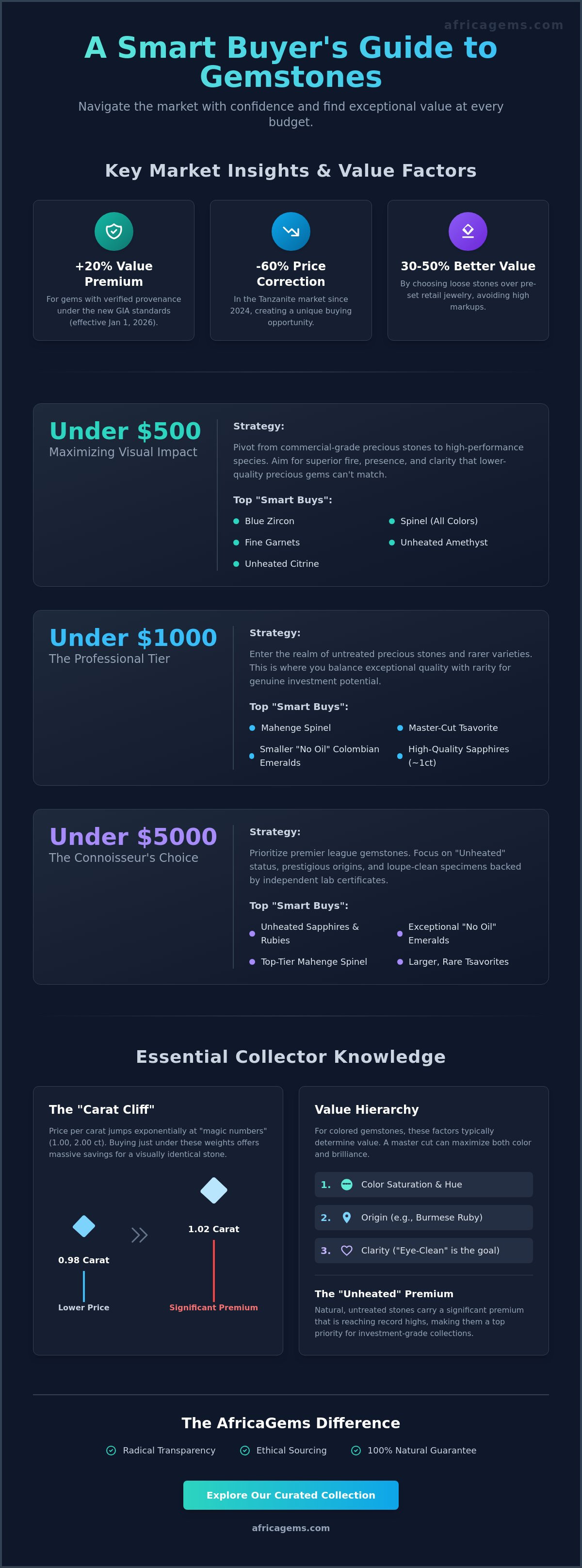
Did you know that a gemstone's verified provenance can now add a 20% value premium following the GIA's January 1, 2026 grading standards update? It's a common misconception that a higher price tag always equals a better stone. In reality, a masterfully cut Tsavorite Garnet often possesses more fire and rarity than a commercial-grade sapphire at twice the cost. We understand the hesitation you feel when browsing loose gemstones under $500 / $1000 / $5000. You want to avoid the trap of overpaying for undisclosed treatments while ensuring your investment holds its allure for decades.
You likely believe that securing a truly rare mineral requires an unlimited budget, but the right selection strategy turns that assumption on its head. This guide shows you exactly how to maximize your investment by identifying "smart buys" like Mahenge Spinel and taking advantage of the 60% price correction in the Tanzanite market since 2024. We'll explore the specific opportunities within each price tier, from securing "No Oil" Colombian Emeralds to finding breathtaking, loupe-clean specimens with independent lab certificates. You'll gain the confidence to build a collection that reflects both refined elegance and sound financial logic.
Key Takeaways
- Understand the "Carat Cliff" and how to balance weight against rarity to ensure you aren't overpaying for size at the expense of saturation and clarity.
- Explore the market for loose gemstones under $500 / $1000 / $5000 to find high-performance stones like Blue Zircon and Spinel that offer elite brilliance within a fixed budget.
- Learn why the "Unheated" premium is reaching record highs and how to prioritize natural, untreated stones for a collection with genuine investment potential.
- Gain the tools to evaluate online listings through technical data and visual validation, ensuring every purchase is backed by a reputable lab certificate and a transparent guarantee.
Navigating the Gemstone Market: Why Budget Tiers Matter
The market for fine minerals isn't a flat landscape; it's a series of plateaus where rarity and demand dictate the climb. While the "Big Three" (Ruby, Sapphire, and Emerald) remain the traditional pillars of value, their pricing behaves differently than semi-precious alternatives. For a collector, understanding gemstone value requires looking beyond the surface sparkle to the geological scarcity that drives the market. By categorizing your search into loose gemstones under $500 / $1000 / $5000, you align your expectations with the realistic availability of specific species and qualities.
To better understand how market transparency affects your buying experience and protects you from common pitfalls, watch this helpful video:
One of the most misunderstood concepts in gemology is the "Carat Cliff." Price doesn't move in a straight line as weight increases. Instead, it jumps exponentially at "magic numbers" like 1.00, 2.00, and 3.00 carats. A 0.98-carat sapphire might cost significantly less than a 1.02-carat stone of identical quality simply because it sits below that psychological threshold. Smart collectors often target these "under-weights" to secure a visual impact that rivals larger stones without the premium. Choosing loose stones over pre-set retail jewelry typically offers 30% to 50% better value because you aren't paying for the high overhead of a traditional storefront or the inflated margins of mass-produced settings.
The 'AfricaGems Difference' in Every Price Bracket
For over 40 years, Marc Sarosi has championed a philosophy of radical transparency. This commitment ensures that full treatment disclosure isn't a luxury reserved for high-end auctions. Whether you're spending $400 or $4,000, the AfricaGems Difference means every stone is hand-selected for its integrity. Ethical sourcing remains a core pillar; we believe that conflict-free and fair-trade practices should be the standard for every mineral extracted from the earth. You receive the same level of professional accountability and a 100% natural guarantee regardless of the price tier you choose.
How to Read a Gemstone Price Tag
When evaluating a stone, color saturation usually takes precedence over clarity, especially in colored gems where "eye-clean" is often the goal rather than "loupe-clean." However, the origin can shift the price tag dramatically. A Mozambique ruby and a Burmese ruby might look similar to the naked eye, but the historical prestige of certain locales can double or triple the cost. Pleochroism is the optical phenomenon where a gemstone shows different colors when viewed from different angles, and a master cutter will orient the stone to showcase the most valuable hue face-up. By understanding these dynamics, you can confidently navigate our curated selection of loose gemstones under $500 / $1000 / $5000 to find your next treasure.
Loose Gemstones Under $500: Maximizing Visual Impact
At the $500 threshold, the most successful collectors pivot away from commercial-grade precious stones to embrace high-performance species. It's a strategic move. Choosing a magnificent, loupe-clean Blue Zircon over a tiny, included sapphire allows you to own a stone with double the fire and presence. While Navigating the Gemstone Market, buyers often realize that "fine" grade semi-precious stones offer a purity that "poor" grade precious stones simply cannot match. This tier is the perfect entry point for those seeking loose gemstones under $500 / $1000 / $5000 without sacrificing the AfricaGems standard of excellence.
Species like Spinel and fine Garnets are the unsung heroes here. Spinel, often mistaken for ruby or sapphire in antiquity, offers exceptional hardness and a refractive index that creates an exquisite, vitreous luster. If you prefer the cool brilliance of the beryl family, sourcing unheated Amethyst or Citrine at this price point ensures you can demand "loupe-clean" clarity. These stones aren't just budget-friendly; they're breathtaking specimens that stand up to professional scrutiny. You can explore our curated garnet selection to see these high-impact colors firsthand.
The Best Value Species at the $500 Mark
Tsavorite and Spessartite garnets represent vibrant alternatives to Emerald and Mandarin Orange. They're naturally unheated and possess a higher refractive index than the stones they replace. For those who prioritize size, Morganite and Aquamarine offer the "Beryl" look in much larger carat weights than you'd find in the precious market. A 2.0-carat fine Topaz will always outperform a 0.5-carat muddy, heavily included sapphire in terms of light return and beauty. Focusing on "Fine" grade specimens ensures your collection looks expensive because the material is intrinsically superior.
Chatham Lab-Created: The Ethical Size Play
When your heart is set on the "Big Three" but your budget is firm, Chatham Lab-Created gemstones offer an ethical size play. These stones are chemically, physically, and optically identical to mined gems. They're grown in a laboratory environment that mimics the earth's natural heat and pressure. This is a scientific process, not a "simulant" or glass imitation. AfricaGems does not sell simulants. Choosing a Chatham Emerald or Ruby allows you to secure an eye-clean, vibrant stone that would cost five times as much if mined. It's an intelligent way to create a high-end jewelry piece while maintaining a modest investment.
Loose Gemstones Under $1000: The Professional Tier
Stepping into the professional tier of loose gemstones under $500 / $1000 / $5000 represents a significant shift in a collector's strategy. While the lower tier focuses on maximizing size through semi-precious species, the $1000 mark is the gateway to the "Precious" market. Here, you can secure small Sapphires and Emeralds that possess genuine character and verifiable quality. Price matters. But quality dictates value. The key is to prioritize cut. A poorly faceted stone will leak light, whereas an "Excellent" cut ensures the brilliance and saturation you're paying for are fully realized face-up. Consulting an expert guide to gemstones reveals that at this price point, clarity and color grade become the primary drivers of value.
Tourmaline offers incredible diversity in this range. You'll find bi-color wonders and Chrome Green specimens that rival the finest emeralds in hue but offer superior clarity. For those seeking the rare blue of Indicolite or the deep pink-red of Rubellite, $1000 allows for "Eye-Clean" stones that make an immediate impact. While "Loupe-Clean" is the gold standard, "Eye-Clean" is often the professional's choice at this tier to maximize carat weight without visible inclusions. It's about finding the balance between perfection and presence.
Investment Starters: Sapphires and Tanzanite
This budget is the sweet spot for 1-carat Blue Sapphires in coveted "Cornflower" or "Royal" blue hues. These aren't the dark, almost black stones found in commercial mall jewelry; they're vibrant, lively gems with high transparency. It's also a critical threshold for Tanzanite. To achieve the deep, velvety violet-blue saturation that defines the species, you generally need a stone in the 1-2 carat range. Smaller stones often lack the depth of color found in larger crystals. To truly understand why this mineral is so prized, read our Tanzanite: The Connoisseur’s Guide.
Rare Garnets and Fine Tourmalines
Tsavorite Garnet remains one of the most intelligent buys in the professional tier. It's often called "Green Fire" for a reason. Its refractive index is significantly higher than emerald, and it's almost always untreated. At $1000, you can find exquisite specimens that offer a durability emerald lacks. Whether you're choosing a Chrome Tourmaline or a vivid Tsavorite, the AfricaGems commitment to full disclosure ensures you know exactly what you're buying. Navigating loose gemstones under $500 / $1000 / $5000 with this professional mindset ensures your collection begins to take on the character of a true connoisseur's portfolio.
Loose Gemstones Under $5000: The Connoisseur’s Choice
Entering the $5000 tier shifts the collector's objective from visual impact to intrinsic scarcity. In the market for loose gemstones under $500 / $1000 / $5000, this upper limit allows you to prioritize the "Unheated" advantage. As of May 2026, the market premium for untreated stones has reached an all-time high. An unheated ruby can command three times the price of its heated counterpart. Scarcity drives the price. Choosing a stone in its natural state isn't just about aesthetics; it's a commitment to geological purity that preserves value over generations. At this level, savvy connoisseurs prioritize rarity and origin over sheer carat weight. A one-carat stone with verified provenance often outpaces a three-carat commercial stone in long-term appreciation.
The 'Big Three' at the $5000 Level
Colombian Emeralds are the standard-bearers of this tier. While most emeralds contain inclusions, known as "jardin" or garden, the goal at $5000 is to find a stone where these natural features enhance the character without compromising transparency. We focus on stones with "minor oiling" or better, as "No Oil" specimens can double the price of those with minor treatments. Unheated Blue Sapphires represent the pinnacle of our collection. In April 2026, a 3-4 carat unheated sapphire commands between $2,500 and $4,000 per carat, making this tier the ideal entry point for serious investment. For a deep dive into these treasures, explore our Blue Sapphires: The Ultimate Collector’s Guide. Every sapphire in this bracket should be viewed as a heritage piece.
Exotic Rarities: Paraiba and Padparadscha
This budget opens doors to the world's most elusive varieties. Alexandrite is the ultimate color-change marvel, appearing emerald-green in daylight and ruby-red under incandescent light. Paraiba Tourmaline, known for its "neon" glow, remains incredibly rare; even small specimens under one carat reach this price point due to their copper-bearing brilliance. Then there is the Padparadscha Sapphire. This stone captures the elusive "Lotus Flower" hue, a delicate blend of pink and orange. For any purchase at this level, independent lab certification from the GIA, AGL, or GRS is mandatory. These documents verify origin and treatment status, providing the security required for high-value transactions. You can browse our investment-grade loose gemstones to find a certified treasure that meets these rigorous standards.
How to Securely Buy Loose Gemstones Online
Acquiring fine minerals in a digital space requires more than just a keen eye; it demands a partnership with a dealer who prioritizes radical transparency. Whether you're searching for loose gemstones under $500 / $1000 / $5000, the security of your transaction rests on the integrity of the disclosure. At AfricaGems, we bridge the digital gap through the AfricaGems Guarantee. This policy provides a 30-day, no-questions-asked return window, allowing you to inspect your selection in person. You should feel the same confidence sitting at your desk as you would standing at a jeweler's loupe in a private showroom.
Visual validation is the cornerstone of a secure online purchase. Static images often fail to capture the dynamic play of light in a high-quality stone. We provide 360-degree high-definition videos for our inventory to showcase pleochroism and internal "jardin" with absolute clarity. This technical validation is reinforced by third-party lab reports from institutions like the GIA or AGL. These documents are non-negotiable for verifying "Unheated" status or specific origins. They transform a purchase into a documented investment, ensuring the breathtaking beauty you see is backed by rigorous gemological data.
The Checklist for Every Online Purchase
- Step 1: Verify Treatment Disclosure: Ensure the seller explicitly states if the stone has undergone heat, oiling, or diffusion. Transparency is the only way to avoid overpaying for treated material.
- Step 2: Check Return Policy and Shipping Insurance: A reputable dealer always provides fully insured shipping and a clear path for returns. If a seller uses high-pressure "final sale" tactics, it's a significant red flag.
- Step 3: Consult with a Gemologist: Take advantage of personal expertise. Marc Sarosi's 40 years of experience are available to you through direct consultation, turning a digital storefront into a personal mentorship.
For a deeper dive into these safety protocols, read our comprehensive guide on How to Buy Gemstones Online.
Turning Your Loose Stone into Jewelry
Securing a loose gem is often just the first chapter of a larger story. Once you've found a "hidden gem" that looks more expensive than its price tag, the logical next step is a bespoke setting. Choosing a loose stone allows you to control the total fixed cost of your piece while ensuring the center stone is the highest quality possible. Our custom jewelry design services specialize in transforming these investments into exquisite pendants, rings, and bracelets. We work closely with you to create a masterpiece that honors the natural beauty of the mineral. Browse our full collection of loose gemstones and start your custom journey today.
Begin Your Journey into Fine Gemstone Collecting
Building a collection of rare minerals is a pursuit that rewards both the eye and the mind. You now understand that navigating the market for loose gemstones under $500 / $1000 / $5000 isn't about compromising on beauty; it's about choosing the right species for your specific budget. Whether you're selecting a vibrant Tsavorite Garnet or an investment-grade Colombian Emerald, prioritizing unheated status and excellent cut quality ensures your stone remains a timeless treasure.
Since 1984, Marc Sarosi has built AfricaGems on a foundation of radical transparency. Our A+ BBB rating and thousands of 5-star reviews reflect a commitment to the integrity of the trade. We provide industry-leading full treatment disclosure on every single stone, so you never have to guess about a gem's history. You're not just buying a mineral; you're gaining a partner in connoisseurship. The perfect stone doesn't just sparkle. It tells a story of geological wonder and ethical sourcing.
Ready to find your next centerpiece? Shop our curated collection of loose gemstones by price and discover the AfricaGems difference. Your next magnificent acquisition is just a click away.
Frequently Asked Questions
Is it better to buy a loose gemstone or pre-set jewelry for a budget of $1000?
Buying a loose gemstone is superior because it allows you to allocate your entire budget toward the quality of the mineral rather than retail markups. In pre-set jewelry, the setting can mask inclusions or poor cutting along the stone's pavilion. By selecting the gem first, you ensure the centerpiece meets professional standards before it's permanently mounted in a custom design.
What is the most expensive-looking gemstone under $500?
Blue Zircon is the most impressive choice for loose gemstones under $500 / $1000 / $5000 due to its high double refraction. This optical property creates a "doubling" of facet edges, resulting in a brilliance that rivals diamonds. Fine Spinel also offers a high refractive index and vitreous luster that mimics the appearance of much pricier rubies or sapphires for a fraction of the cost.
Do loose gemstones under $5000 come with GIA certificates?
Most high-quality stones in the $5000 tier include independent lab certificates from the GIA, AGL, or GRS. While smaller stones under $500 rarely justify the cost of a full report, professional-grade specimens require this documentation to verify origin and treatment status. We recommend always requesting a third-party certificate for any stone intended as a serious addition to a collection.
Why are unheated sapphires so much more expensive than heated ones?
Unheated sapphires command a premium because approximately 95% of all sapphires on the market undergo heat treatment to improve color and clarity. An untreated stone represents a rare geological occurrence where nature achieved perfection without human intervention. This scarcity creates a value premium that often exceeds 50% compared to heated counterparts of the identical visual grade.
Can I return a loose gemstone if it doesn't look like the picture?
You can return any stone purchased from AfricaGems within 30 days under our no-questions-asked policy. While we use high-resolution 360-degree videos to capture every facet, we understand that seeing a gem in your specific lighting environment is crucial. Our goal is to ensure you feel like an informed insider, which requires the security of a risk-free inspection period.
Which gemstone species offers the best investment value for $5000?
Tsavorite Garnet and unheated Blue Sapphires are currently top contenders for investment value at the $5000 mark. Tsavorite is naturally untreated and significantly rarer than emerald, making it a "smart buy" for savvy collectors. As the market for loose gemstones under $500 / $1000 / $5000 evolves, these species continue to show strong demand due to their limited supply and exceptional durability.
Are lab-created gemstones considered 'real' gemstones?
Lab-created gemstones like those from Chatham are chemically, physically, and optically identical to their mined counterparts. They are "real" in every scientific sense, grown from the same mineral components under similar pressure and heat. However, they lack the geological rarity of a natural stone, which is why they trade at a much lower price point than mined gems.
What does 'loupe-clean' mean when buying gems online?
Loupe-clean indicates that a gemstone shows no visible inclusions when viewed under 10x magnification by a trained eye. This is a higher standard than "eye-clean," which only guarantees that the stone appears flawless to the naked eye. For serious collectors, achieving a loupe-clean grade in species like Spinel or Topaz is a hallmark of exceptional quality and rarity.