
The Best Cut for Alexandrite Stone: Maximizing Color Change & Brilliance
Jul 16th 2026
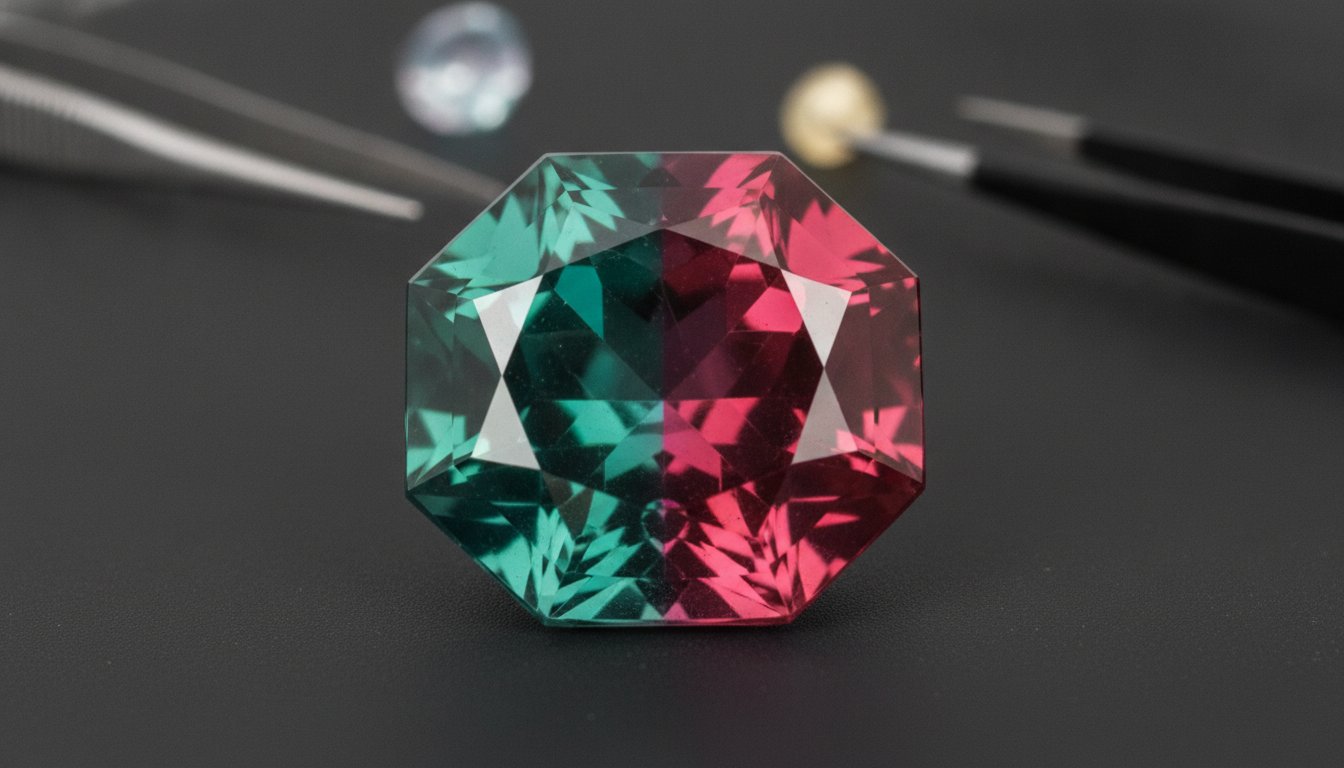
Choosing a gemstone cut based solely on sparkle is a mistake that could cost you the very magic of a fine alexandrite. You likely recognize that the dramatic green-to-red shift is the soul of this rare chrysoberyl, which is estimated to be 8,000 times rarer than a white diamond. It's natural to worry that a poorly executed facet pattern might 'hide' that transition or create a hollow 'window' in a larger specimen. Finding the best cut for alexandrite stone requires a delicate balance between optical physics and the preservation of rare material.
This guide explains how precision faceting transforms raw crystal into a masterpiece of color-changing light. You'll discover the strategic trade-offs between deep color saturation and brilliant light return, giving you the confidence to select a shape that honors the stone's integrity. We'll examine why certain geometric cuts are trending for custom designs and how professional grading standards ensure your investment retains its beauty and value for a lifetime.
Key Takeaways
- Learn how aligning a stone's optical axis is the technical secret to unlocking the most dramatic green-to-red color shift.
- Discover why the best cut for alexandrite stone must balance the preservation of rare carat weight with the pursuit of maximum brilliance.
- Compare the classic fire of round and cushion cuts against the modern, sharp silhouettes of hexagon and kite-shaped gems.
- Understand the crucial differences between native and precision faceting to avoid common pitfalls like 'windowing' in larger stones.
- Gain expert insights into how custom jewelry design can transform a unique cut into a personalized legacy piece.
Why the Cut is Critical for Alexandrite's Color Change
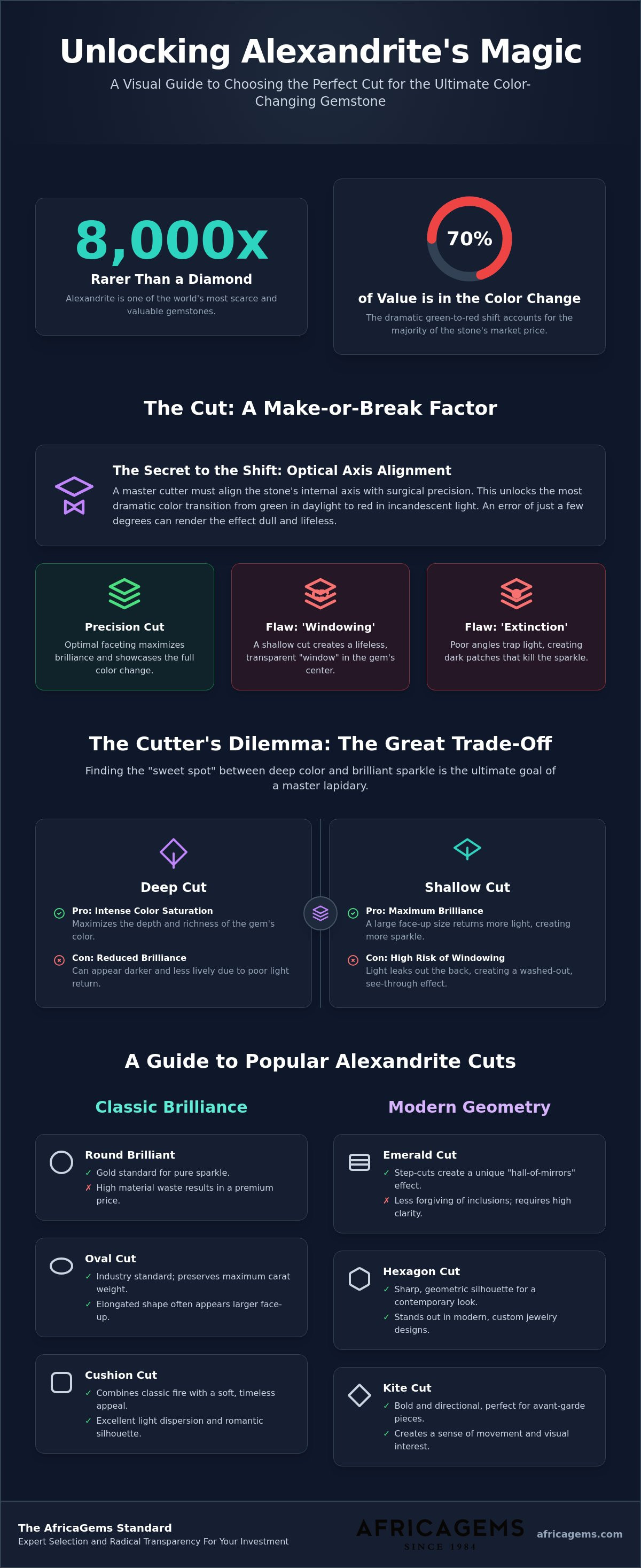
Alexandrite isn't just a gemstone; it's a sophisticated optical phenomenon housed within the Chrysoberyl mineral family. While other gems are prized for a single hue, this rare variety is defined by its pleochroism, a property where the crystal displays different colors depending on the angle of observation. To achieve the best cut for alexandrite stone, a master lapidary must align the stone's optical axis with surgical precision to ensure the most dramatic shift from forest green to raspberry red. If this alignment is off by even a few degrees, the color change may appear dull or uneven. The specific way light rays refract through the internal lattice determines the final percentage of color change, which accounts for nearly 70% of the stone's total market value.
A poorly executed cut does more than just reduce sparkle; it can actively sabotage the stone's value. You might encounter 'extinction,' which creates dark, lifeless patches because light is trapped rather than reflected. Alternatively, 'windowing' occurs when the stone is cut too shallow, creating a transparent center where light passes straight through. This makes the gem look like a piece of glass rather than a rare treasure. In a stone that is 8,000 times rarer than a diamond, these technical flaws are unacceptable for serious collectors.
To better understand how precision faceting brings these properties to life, watch this helpful video:
Understanding Pleochroism and Light Performance
The 'Alexandrite Effect' relies on the interaction between the gem and specific light sources, namely daylight (D65) and incandescent light (A). Facet angles must be calculated to bounce light through the 'color-rich' zones of the crystal. Because natural alexandrite is so scarce, many stones feature 'Native Cuts.' These are shapes designed by local cutters to preserve every possible milligram of carat weight, though they sometimes sacrifice optimal light performance for size.
The Trade-off: Brilliance vs. Color Saturation
Finding the best cut for alexandrite stone requires identifying the 'sweet spot' between fire and depth. Deeply cut stones often boast intense color saturation but can suffer from reduced brilliance. Conversely, shallow cuts might provide a larger face-up appearance, yet they frequently fall victim to significant windowing. For a custom project, the ideal balance involves a cut that maintains enough depth to keep the color saturated while using precision faceting to ensure light returns to the eye as a vivid, shifting dance.
The Trio of Brilliance: Round, Oval, and Cushion Cuts
While many collectors prioritize size, the geometric architecture of a gemstone determines how effectively it broadcasts alexandrite's chameleon-like qualities. The "big three" shapes, including round, oval, and cushion, remain the most sought-after silhouettes for those seeking maximum brilliance. These cuts are mathematically engineered to reflect light back through the crown, ensuring the stone doesn't just change color but dances with life. For a gemstone estimated to be 8,000 times rarer than a white diamond, every facet must serve a technical purpose. Selecting the best cut for alexandrite stone involves understanding how these shapes interact with the specific crystal structure of chrysoberyl.
The round brilliant is often considered the gold standard for pure sparkle. However, finding a natural, high-quality round specimen over one carat is an exercise in extreme patience. Because alexandrite rough typically grows in elongated or flat crystal shapes, cutting a perfect circle results in significant wastage of precious material. This scarcity means that precision-cut rounds often command a significant premium, reflecting the sacrifice of carat weight required to achieve that symmetrical fire. Many collectors find that the intense light return of a round cut can sometimes "wash out" the color change if the facets are too small, making precision a non-negotiable requirement.
The Oval Cut: The Industry Standard for Natural Stones
Ovals are the pragmatic choice for the serious collector. This shape closely mimics the natural habit of the crystal, allowing the lapidary to preserve the maximum possible weight while maintaining exceptional light return. Since alexandrite is a Type II gemstone, it often contains minor inclusions; the elongated facet patterns of an oval are remarkably effective at masking these internal characteristics. If you are browsing our collection of loose alexandrite gemstones, you'll find that the finest Brazilian and Sri Lankan stones are frequently finished in this versatile silhouette to maximize their investment value.
Cushion Cuts: Maximizing the Red and Green Hues
Cushion cuts offer a romantic, vintage aesthetic that excels at showcasing deep color saturation. Unlike the splintered light of a round brilliant, the larger facets of a cushion cut tend to 'hold' the color longer. This creates a more cohesive visual transition as the stone moves from the cool greens of daylight to the warm purples of incandescent light. These stones are a favorite for custom jewelry design services, where the soft, rounded corners can be hugged by delicate prongs. You might choose between a 'crushed ice' cushion for modern sparkle or an antique 'chunky' style to emphasize the stone's historical gravity. If you're unsure which silhouette suits your vision, exploring our curated selection of precious gemstones can provide the visual clarity needed to make a confident decision.
Modern & Geometric Silhouettes: Kite, Hexagon, and Emerald Cuts
The evolution of jewelry design has ushered in a bold era of geometric precision. While ovals and cushions remain timeless, modern silhouettes like the kite and hexagon are increasingly sought after for gemstone engagement rings. These shapes provide a sharp, architectural edge that contrasts beautifully with the organic, fluid color shift of the stone. However, selecting the best cut for alexandrite stone within these geometric families requires a vigilant eye for light leakage. Sharp angles can sometimes create 'dead zones' where the color change appears muted or gray. This technical challenge is one reason why these avant-garde cuts are frequently paired with Chatham lab-created gemstones. Because lab-grown rough is often available in larger, cleaner blocks with superior clarity, it allows lapidaries to push the boundaries of geometric design without the structural constraints found in rare natural specimens.
The Emerald Cut: Sophistication Through Clarity
The emerald cut is a masterclass in transparency. As a step-cut, it features long, parallel facets that act like a hall of mirrors, revealing the 'inner soul' of the gem. For a collector, this is the ultimate test of quality. While a brilliant cut can hide minor inclusions behind a curtain of sparkle, an emerald cut leaves every internal characteristic exposed. It is the ideal choice for high-clarity alexandrite where the purity of the green-to-red transition is the primary focus. You can explore more about these high-stakes selection processes in our Rare Gemstones: A Connoisseur’s Guide. The risk is significant; any weakness in the color shift will be magnified. Only stones with an 85% to 100% color change should be considered for this demanding silhouette to ensure the 'step' facets don't appear dull.
Kite and Hexagon Cuts: The New Engagement Favorites
A Collector's Framework: Matching Cut to Carat and Origin
In the world of rare materials, the rough crystal is the ultimate architect. Natural alexandrite is exceptionally scarce in sizes exceeding 1 carat, and this rarity forces a lapidary to make difficult choices. The best cut for alexandrite stone is often one that follows the natural "habit" or shape of the rough to avoid wasting precious milligrams. Brazil currently dominates 85% of the high-end market, where stones are typically finished with modern precision to appeal to global collectors. In contrast, legendary Russian specimens from the Ural Mountains often carry a 200% price premium and are frequently found in "native" cuts. These older cutting styles prioritize weight retention above all else, sometimes resulting in asymmetrical proportions that a seasoned connoisseur accepts as a badge of authenticity. In natural alexandrite, increasing the carat weight often requires a deeper cut to preserve color saturation, even if it risks creating a smaller face-up appearance.
The debate between a "Native Cut" and a "Precision Cut" is central to investment-grade gems. A native cut may have a heavy "belly" or uneven facets, but it saves the material that drives the stone's value. A precision cut, however, uses mathematical ratios to ensure every ray of light is reflected back to the eye. While the latter is visually superior, the loss of weight can sometimes devalue a natural stone. For those who demand perfection without the astronomical price of large natural rough, we invite you to browse our collection of loose alexandrite gemstones to see these various cutting styles in high-definition detail.
Natural vs. Lab-Created: Different Cutting Priorities
When working with natural rough, the cutter's priority is always weight retention and "saving" the color shift. Every fraction of a carat represents thousands of dollars in value. Lab-grown rough presents a different opportunity. Because the material is more available, lapidaries can focus entirely on perfect symmetry and maximum brilliance. You can learn more about these distinctions in our guide on The Truth About Lab Created Gemstones. In lab-created stones, there is no excuse for a poor cut; symmetry should be near-perfect to highlight the material's superior clarity.
Identifying a High-Quality Cut in the Wild
To evaluate a cut, perform the "Tilt Test." Move the stone slowly under a light source and watch how the color holds up at different angles. A high-quality cut maintains its color saturation even when viewed from the side. While you should check for professional symmetry and polish, remember that a slightly "off" symmetry is often acceptable in a rare natural stone if it achieves a 100% color shift. The goal is to find a stone where the technical finish enhances, rather than distracts from, the natural magic of the chrysoberyl.
The AfricaGems Standard: Expert Selection and Radical Transparency
Since 1984, AfricaGems has operated on a foundation of radical transparency and professional integrity. Marc Sarosi personally oversees the selection of every gem, ensuring that our inventory meets the highest ethical and gemological standards. We believe that choosing the best cut for alexandrite stone shouldn't be a gamble based on a static image. Because the "Alexandrite Effect" is entirely dependent on light interaction, we provide high-definition videos of every stone under both daylight-balanced and incandescent light sources. This allows you to see exactly how the facets perform and how the color transitions before you commit to a purchase. You'll never have to worry about a "hidden" color change or a window that wasn't visible in a photograph.
Our commitment to full disclosure means we share the complete story of a stone's journey. We provide detailed information on gemstone treatments and origin, acting as a knowledgeable mentor rather than a high-pressure salesperson. This level of detail is essential for high-value investments in rare chrysoberyl, where the difference between a standard cut and a precision masterpiece can be significant. We stand behind every stone with a 30-day money-back guarantee, providing the security needed for serious collectors and those embarking on their first custom project.
Why Buy Loose Alexandrite from AfricaGems?
Choosing a loose stone gives you the ultimate control over the final aesthetic of your jewelry. You gain direct access to decades of expertise and a global network of ethical miners who prioritize social responsibility. We provide a level of information density that ensures you're an informed insider throughout the transaction. For a deeper look at how to protect your investment, consult our Expert Guide to Buying Gemstones Online. This resource helps you understand the technical specifications and grading reports that validate a stone's quality.
From Loose Stone to Bespoke Jewelry
Once you've selected your perfect gem, our custom jewelry design services can help you transform it into a legacy piece. The way a stone is set is just as vital as the faceting itself. Our designers understand that the best cut for alexandrite stone is one that is protected by its setting while allowing maximum light entry. We'll help you decide between the cool elegance of Platinum or the warmth of 18k Gold to best complement your stone's specific color shift. Every project is a personal consultation designed to honor the natural beauty of the material while ensuring its durability for daily wear.
Explore our collection of Loose Alexandrite Gemstones today and find the center-piece for your next custom masterpiece.
Secure Your Legacy with the Perfect Color Shift
Since 1984, Marc Sarosi has expertly curated a collection defined by radical transparency and ethical sourcing. We offer both rare natural specimens and Chatham lab-grown options, with full GIA or AGL certification available on request to validate your investment. Your journey toward owning one of the earth's rarest materials deserves the guidance of a specialist who values integrity as much as beauty. We invite you to explore our inventory with the confidence that every stone has been selected for its exceptional performance and character.
Browse the AfricaGems Alexandrite Collection and find the masterpiece that will define your next custom jewelry project. We look forward to helping you secure a gemstone that truly captures the magic of the "Alexandrite Effect."
Frequently Asked Questions
What is the best cut for alexandrite to show color change?
The best cut for alexandrite stone to showcase maximum color change is generally the oval or cushion cut. These silhouettes provide the necessary depth to enhance color saturation while allowing the lapidary to align the facets with the stone's pleochroic axis. This precise alignment ensures the transition from green to red is vivid, cohesive, and complete across the entire gem.
Does the cut of an alexandrite affect its price per carat?
Cut quality directly impacts the price per carat because it determines the stone's final beauty and weight retention. A precision cut that eliminates technical flaws like "extinction" or "windowing" requires sacrificing more of the rare rough material. Since gem-quality alexandrite is roughly 8,000 times rarer than white diamonds, any loss of material during the cutting process must be reflected in the final market valuation.
Are round cut natural alexandrites more expensive than ovals?
Round cut natural alexandrites are almost always more expensive than ovals of similar quality. Because the natural crystal habit of chrysoberyl is rarely circular, cutting a round brilliant results in excessive wastage of precious rough. This scarcity means that a well-proportioned, natural round alexandrite is an exceptional find that commands a significant premium from serious collectors.
What should I look for in an alexandrite cut for an engagement ring?
For an engagement ring, prioritize a cut that balances brilliance with a high degree of color change. Look for a stone with a depth percentage that avoids a central "window," as this transparency can make the gem look lifeless in daily wear. Since alexandrite has a hardness of 8.5 on the Mohs scale, it's durable enough for daily use in most precision-faceted shapes provided the setting is secure.
Is an emerald cut good for a color-changing stone like alexandrite?
An emerald cut is an excellent choice for stones with high clarity and a strong color shift of 85% to 100%. As a step-cut, it emphasizes the purity of the color transition rather than splintered brilliance. However, it's a demanding cut that reveals every internal characteristic, meaning any inclusions or weak spots in the color change will be magnified.
Why do some alexandrite stones have a 'window' in the middle?
A "window" occurs when a stone is cut too shallow, allowing light to pass directly through the center rather than reflecting back to your eye. This technical flaw makes the stone appear transparent and pale in the middle, which is particularly detrimental for color-changing gems. It dilutes the intensity of the "Alexandrite Effect" and significantly reduces the stone's overall value.
How does a 'fancy cut' like kite or hexagon impact the stone's durability?
Fancy cuts like the kite or hexagon don't change the stone's inherent hardness, but their sharp points are more susceptible to chipping. If you choose an avant-garde shape, it's vital to use a protective setting, such as a V-prong, to shield these vulnerable corners. These modern shapes are often more successful with lab-grown rough where perfect symmetry is easier to achieve without wasting rare material.
Can a poor cut hide a high-quality color change?
A poor cut can absolutely obscure even a high-quality color change. If the lapidary fails to align the crystal's optical axis correctly, the stone may show a muddy or incomplete shift regardless of the material's potential. Precision faceting is the only way to ensure the light interacts with the internal structure to reveal the full, dramatic green-to-red spectrum.

Article by
Marc Sarosi
Professional gemstone dealer for more than 40 years. Started off mining Aquamarine in Zambia, Africa and travelled throughout the continent in search of fine gems. Trusted authority on fine gemstones and have donated a fine collection of more than 27 extraordinary gemstones to the Smithsonian Institute Gem Hall for generations to see.