
Tanzanite Quality: The Collector’s Guide to Value
Aug 28th 2026

Did you know that tanzanite is approximately 1,000 times rarer than a diamond, yet many collectors still struggle to distinguish a retail-grade stone from a true heirloom? With the world's only source in the Merelani Hills expected to be depleted within the next 25 years, learning how to judge tanzanite quality is no longer just a hobby for the curious; it's a vital skill for the serious investor. You likely feel the frustration of navigating inconsistent grading scales or the anxiety of trying to spot a vivid red flash in online photographs that might not tell the whole story.
We understand that high-value acquisitions require radical transparency and technical validation. This guide promises to transform you into an informed insider, providing the professional framework needed to identify investment-grade gems with exceptional clarity and saturated hues. We'll demystify the 2026 GIA report formats, explain the exponential price-per-carat curve for stones over five carats, and show you how to evaluate the deep trichroism that defines top-tier material. By the end, you'll have the confidence to select stones that represent the pinnacle of this finite natural resource.
Key Takeaways
- Master the trichroic nature of zoisite to identify the rare burgundy "red flash" and understand why AAAA saturation commands a significant market premium.
- Learn how to judge tanzanite quality by distinguishing between "eye-clean" standards and "internally flawless" ratings for investment-grade gems.
- Discover how axis orientation determines the dominance of blue or violet tones and why precision cutting is vital for maximizing light return.
- Understand the non-linear price-per-carat curve and the specific value barriers that occur at the 1, 3, and 5-carat thresholds.
- Gain confidence in evaluating lab reports and the radical transparency required regarding standard heat treatments and ethical sourcing.
The Color Spectrum: Saturation, Tone, and the 'Red Flash' Phenomenon
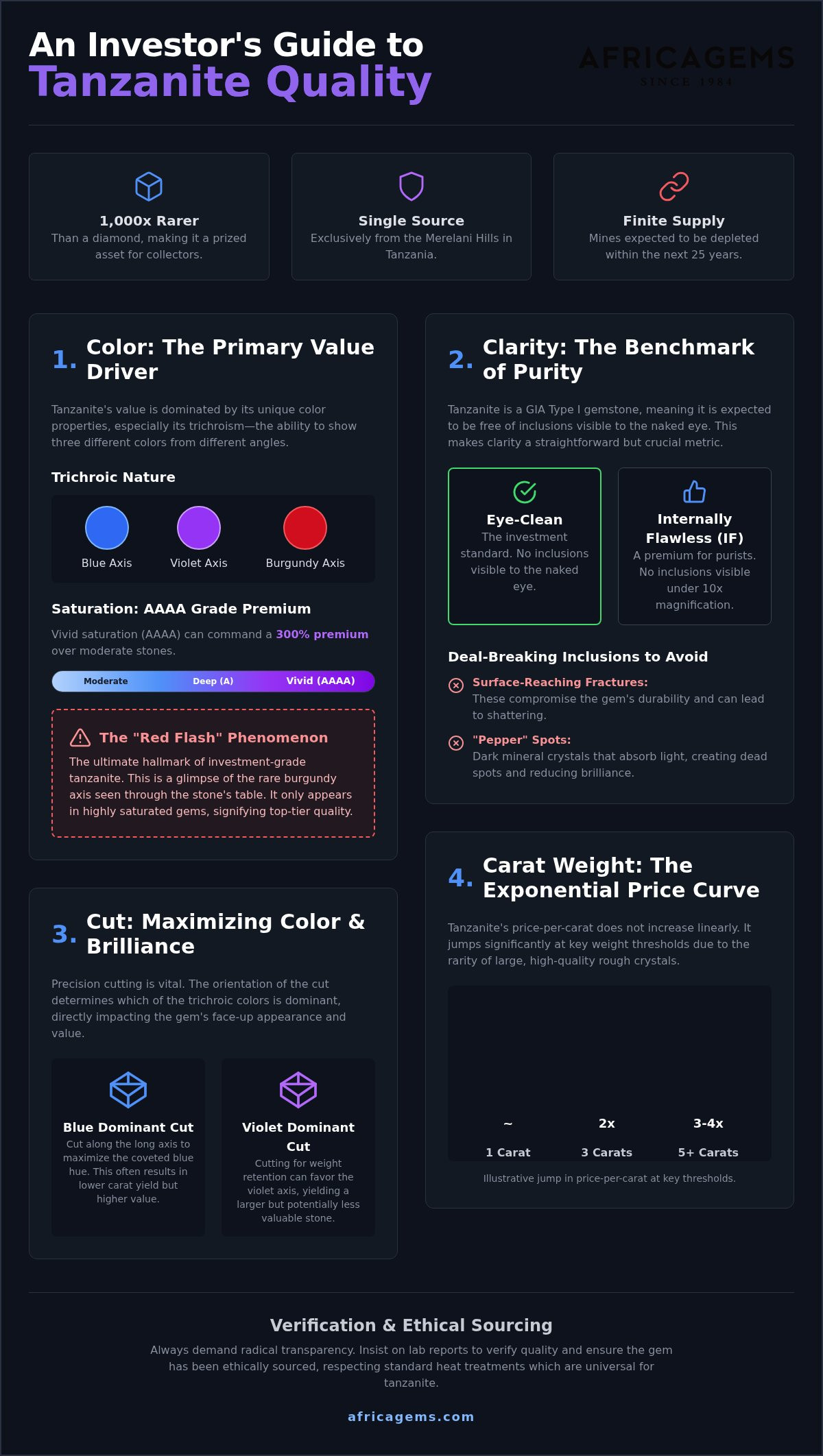
Tanzanite isn't just blue; it's a complex optical masterpiece. To understand how to judge tanzanite quality, you must first master its trichroic nature. Unlike most gems that show one or two colors, zoisite possesses three distinct crystal axes: blue, violet, and a deep burgundy. As light passes through the stone, these colors shift and blend based on the viewing angle. This unique set of Tanzanite properties creates the mesmerizing depth that collectors crave. Tanzanite color quality is the intersection of deep saturation and vivid pleochroic response.
Vivid saturation, often marketed as AAAA grade, commands a 300% premium over stones with moderate tones. This isn't just a marketing label. It represents a physical rarity where the color is so intense it reaches the threshold of visual vibrancy without becoming muddy. At AfricaGems, we prioritize these top-tier selections because they represent the true legacy of the Merelani Hills.
Saturation vs. Tone: The 2026 Quality Benchmark
GIA standards for 2026 differentiate between 'Vivid' (Saturation 6) and 'Deep' (Saturation 5). While both are beautiful, Saturation 6 stones possess an electric quality that seems to glow from within. Be careful with tone, however. If a stone is too dark, reaching Tone 7 or 8, it suffers from extinction. This means the gem absorbs too much light, resulting in dead, black areas that actually decrease the stone's value. Lighting also plays a pivotal role. Your gem will appear more blue in cool daylight, while incandescent light pulls out the regal violets and hidden reds.
The Mystery of the Red Flash
The most sought-after trait in investment-grade material is the "red flash." This isn't a surface reflection but a glimpse of the burgundy pleochroic axis visible through the table of a highly saturated blue stone. It's the ultimate hallmark of the finest material from the mines. When you learn how to judge tanzanite quality, searching for these burgundy hints becomes a priority. This phenomenon is rarely found in commercial-grade precious gemstones, making it a definitive marker of rarity and value. It's a visual signature that proves the stone has the necessary saturation to be considered heirloom quality. We meticulously vet every stone in our inventory to ensure these pleochroic responses meet our uncompromising standards.
Clarity Grading: Why 'Eye-Clean' is the Benchmark for Tanzanite
Tanzanite is categorized as a GIA Type I gemstone. This means that, unlike emeralds or rubies, it's expected to be virtually free of inclusions visible to the naked eye. When learning how to judge tanzanite quality, you should start with the 'eye-clean' benchmark. If you can see a crack or a spot without a loupe, the stone's value drops significantly. While 'Internally Flawless' (IF) stones exist and command a premium from purists, most collectors find that an eye-clean stone offers the best balance of beauty and investment value. Because of the unique geological formation of tanzanite in the Merelani Hills, the material is naturally cleaner than many other colored gems.
Professional graders look for specific internal characteristics like silk, fingerprints, and needles. Silk refers to microscopic fibers that can soften the light, while fingerprints are liquid-filled tubes that resemble a human thumbprint. While these are common, they shouldn't detract from the stone's overall brilliance. If inclusions are too dense, they interfere with the light's path, dulling the very "life" that makes this gem so spectacular. High-quality tanzanite should act like a mirror, reflecting light back to your eye with sharp, crisp flashes.
Identifying Deal-Breaking Inclusions
Not all inclusions are created equal. Surface-reaching fractures are the most dangerous. Since tanzanite has a Mohs hardness of 6.5 to 7, a fracture that touches the surface can expand under pressure or heat, leading to a shattered stone. You should also avoid "pepper" spots. These are dark mineral crystals trapped inside the gem. They act like black holes, absorbing light rather than reflecting it. If you're evaluating a massive stone over 10 carats, a tiny, well-hidden inclusion might be forgivable, as finding completely clean rough at that size is exceptionally rare.
Transparency and the 'Sleepy' Effect
Transparency is just as vital as clarity. Even if a stone has no visible "spots," it can still appear "sleepy" or "milky." This happens when millions of sub-microscopic inclusions scatter light, robbing the stone of its transparency. In the trade, we refer to the best stones as having "high crystal." This means the gem is as clear as a mountain spring, allowing you to see deep into its heart without any haziness. If you're looking for curated, eye-clean material, explore our collection of loose tanzanite gemstones to see the difference that high transparency makes. Understanding how to judge tanzanite quality requires looking beyond the presence of spots to the actual clarity of the crystal itself.
Precision Cutting: Maximizing Pleochroism and Light Return
Cutting tanzanite is a high-stakes calculation. Every lapidary faces a constant dilemma: maximize the carat weight or optimize for that coveted deep blue color. Because tanzanite is trichroic, the direction in which the stone is cut determines its face-up color. If the cutter aligns the table with the blue axis, the stone will appear blue-dominant. If they prioritize saving weight from the rough, the stone often ends up violet-dominant. Understanding this trade-off is essential for anyone learning how to judge tanzanite quality. A master cut can elevate a moderately saturated rough into a brilliant gem by concentrating color and maximizing light return.
You should also watch for "windowing." This occurs when the pavilion facets are cut too shallow, creating a transparent "hole" in the center of the gem where light leaks out instead of reflecting back. When you look through the table of the stone, a windowed gem will show the background behind it rather than a solid wall of color. For a collector-grade stone, windowing is a significant flaw that ruins the visual impact and value. It's a sign that the cutter prioritized size over beauty, which is a red flag for serious collectors.
Evaluating Proportions and Symmetry
Precision-cut tanzanite typically features a depth percentage between 60% and 75%. If a stone is cut too deep, it creates a "bulky" pavilion. You'll end up paying for extra carat weight that's hidden beneath the setting and doesn't contribute to the stone's beauty. Expertly vetted stones show perfect symmetry and crisp facet meet-points. These sharp intersections are indicators of a precision-cut stone, ensuring the light reflects evenly across the entire surface without "dead" spots or dark extinction zones.
The Brilliance Factor: Scintillation and Fire
The quality of the cut directly influences scintillation, which is the play of light and dark flashes you see when the gem moves. Most commercial stones feature "native" cuts, which are often asymmetrical and designed solely to preserve weight. In contrast, precision "custom" cuts are engineered to maximize fire and brilliance. For a deeper dive into these nuances, read Tanzanite: The Connoisseur’s Guide to see how professional lapidaries approach this rare material. When you know how to judge tanzanite quality through the lens of light return, you'll see why a slightly smaller, better-cut stone is often the superior investment.
Size and Scarcity: Understanding the Price-per-Carat Jump
When you learn how to judge tanzanite quality, you quickly realize that pricing is not a linear climb. It's an exponential curve. Unlike many other gemstones where size increases predictably, tanzanite rough rarely yields large, clean, and highly saturated crystals. This creates specific "Value Barriers" at the 1-carat, 3-carat, and 5-carat marks. Crossing these thresholds doesn't just increase the total price; it significantly raises the price-per-carat. A 5-carat stone with top-tier saturation is exponentially rarer than five 1-carat stones of the same quality, and the market reflects this scarcity with a substantial premium.
Investment strategy often points toward the 3 to 5-carat range as the "sweet spot" for collectors. These stones are large enough to showcase the gem's full pleochroic potential while remaining more liquid than massive museum-grade specimens. As you evaluate these gems, remember that the depth of the stone allows for more light absorption, which naturally enhances color saturation. This is why finding a small 1-carat stone with the same vivid "AAAA" saturation as a 10-carat stone is nearly impossible and makes such small gems highly prized by connoisseurs.
The Carat-to-Saturation Correlation
A larger crystal volume naturally traps more color. A 10-carat stone will almost always look more saturated than a 1-carat stone cut from the same piece of rough. This physical reality makes "D-Block" material, historically known for its intense color, a legendary talking point. In 2026, the term is often used more as a marketing label than a geological fact, as the original blocks have largely merged. What matters now is the individual stone's saturation and clarity, regardless of the specific pit it came from. The market typically follows these rarity tiers:
- 1.0 to 2.99 carats: Standard to fine quality material that serves as the baseline for market rates.
- 3.0 to 4.99 carats: Investment-grade stones that often see a 1.5x to 2.0x increase in price-per-carat.
- 5.0 carats and above: Heirloom rarity material where price-per-carat can experience a 3.0x exponential jump.
Investing in Rarity
Tanzanite is a "one-generation" gemstone. Geologists estimate the world's only source in the Merelani Hills has a remaining life expectancy of only 20 to 25 years. This finite lifespan, combined with the increasing difficulty of deep-vein mining, ensures that high-quality material is becoming a vanishing resource. To future-proof your collection, focus on stones that possess the "red flash" and eye-clean clarity mentioned in previous sections. For a broader perspective on where tanzanite sits among the world's most limited finds, see our Rare Gemstones Guide. If you're ready to secure a piece of this dwindling legacy, browse our expertly vetted investment-grade gemstones to find a specimen that meets these rigorous standards. Understanding how to judge tanzanite quality through the lens of scarcity is the final step in making a truly informed acquisition.
Verification and Ethics: Navigating Certifications and Sourcing
High-value acquisitions in the gemstone world rely on two pillars: technical validation and ethical integrity. When you're finalizing a purchase, the most critical step in how to judge tanzanite quality is reviewing a third-party laboratory report. For stones of significant value, a report from the Gemological Institute of America (GIA) or American Gemological Laboratories (AGL) is non-negotiable. These documents provide an objective audit of the gem’s identity and any enhancements it has undergone, ensuring your investment is protected by a global standard of excellence. A certificate doesn't just list facts; it serves as a security blanket for the serious collector.
You should understand that approximately 99% of all tanzanite is heat-treated to transform its natural brownish-gray state into the vivid blues and violets we admire. This is a stable, industry-accepted practice that doesn't diminish value. However, a tiny fraction of material emerges from the earth already blue. These "unheated" specimens are exceptionally rare and command a significant premium. Verifying an unheated claim requires a specialized lab report, as it's impossible to confirm through visual inspection alone. We maintain radical transparency about these treatments, ensuring you know exactly what you're adding to your portfolio.
Ethical sourcing is the final, vital component of a stone’s quality. Every tanzanite in our inventory is ethically sourced, ensuring that the wealth generated by these rare materials supports the local Tanzanian mining communities and the Maasai people who live near the Merelani Hills. By choosing stones with a transparent chain of custody, you contribute to a legacy of social responsibility. This commitment to the integrity of the industry is a pillar of our brand and a personal guarantee from our leadership.
Reading a Tanzanite Lab Report
A standard report identifies the species as Zoisite and the variety as Tanzanite. Look closely at the "Treatment" or "Comments" section. Most reports will state "Indication of heating" or simply "Heated." If you're seeking an investment-grade unheated stone, the report must explicitly state "No indications of heating." This document also confirms the stone's dimensions and weight, which are essential when calculating the price-per-carat barriers we discussed earlier. Always cross-reference the report number with the lab's online database to ensure authenticity.
The Marc Sarosi Vetting Process
Since 1984, AfricaGems has operated with a commitment to radical transparency. Every stone is hand-selected and expertly vetted by Marc Sarosi to meet our uncompromising standards for eye-clean clarity and vivid saturation. This personal guarantee ensures you aren't just buying a stone, but a piece of history that has been scrutinized for its pleochroic response and structural integrity. We invite you to explore our certified loose tanzanite gemstones vetted by experts to see how we apply these rigorous standards to every gem. Mastering how to judge tanzanite quality means trusting the expertise behind the certificate as much as the certificate itself.
Securing Your Piece of the Merelani Legacy
Mastering the nuances of saturation and pleochroism is the first step toward building a collection of lasting value. You now have the professional framework to evaluate eye-clean clarity and the critical role that precision cutting plays in maximizing light return. This knowledge is your most powerful tool when deciding how to judge tanzanite quality in a market where top-tier material is becoming increasingly scarce. With the mines' lifespan finite, selecting a gem that meets these rigorous standards ensures your acquisition is both a visual masterpiece and a sound investment.
At AfricaGems, we simplify this process through radical transparency. Every stone is expertly vetted by Marc Sarosi and comes with the security of full GIA or AGL certification. We've been ethically sourcing from the Merelani Hills since 1984, ensuring that every purchase supports local communities while meeting the highest quality guarantees. Shop the AfricaGems Collection of Natural Tanzanite to find your next heirloom. Your journey into the world of rare materials is a rewarding pursuit, and we're here to ensure you buy with absolute confidence.
Frequently Asked Questions
Is tanzanite more valuable than blue sapphire?
Blue sapphire remains the more valuable gemstone due to its superior hardness and historical prestige. However, tanzanite is geologically 1,000 times rarer. While you might pay more for a top-tier sapphire, tanzanite offers a unique value proposition because of its single-source origin. Collectors often prize tanzanite for its larger sizes and more vibrant pleochroism, which sapphire cannot match. It's a choice between traditional prestige and modern rarity.
What is the most valuable color for a tanzanite stone?
The most valuable color is a deep, vivid blue with strong violet overtones and a visible burgundy pleochroic response, known as the "red flash." In professional grading, this corresponds to Saturation 6. Stones that are too light or overly dark with "extinction" zones are less desirable. The ideal specimen maintains its vibrancy in all lighting conditions, showcasing the full trichroic spectrum that makes this zoisite variety world-famous.
Does heat treatment lower the value of tanzanite?
Heat treatment doesn't lower the value of tanzanite; it's the standard, accepted enhancement that reveals the gem's true beauty. Since 99% of all tanzanite is heated, the market baseline assumes this treatment. However, naturally blue, unheated stones are geological rarities. These specimens command a significant premium if they possess high saturation. If you encounter an unheated claim, ensure it's backed by a reputable lab report to justify the higher cost.
How can I tell if my tanzanite is real or a synthetic imitation?
You can identify natural tanzanite by its distinct trichroism, which shows blue, violet, and burgundy hues when viewed from different angles. Synthetic blue zoisite and imitations like forsterite exist, but they often lack this complex color shift. To be certain, you need a professional refractive index and specific gravity test. A GIA report is the most secure way to verify that your gemstone is a natural product of the Merelani Hills.
Why does my tanzanite look more violet in the evening?
Your tanzanite shifts toward violet in the evening because of the way pleochroic axes react to different light sources. Incandescent and evening lights are rich in warm, red wavelengths, which activate the violet and burgundy axes within the stone. In contrast, cool daylight is heavy in blue wavelengths, making the blue axis more dominant. This dynamic color-change effect is a hallmark of high-quality material and a favorite feature for many collectors.
Is tanzanite durable enough for everyday wear in a ring?
Tanzanite is durable enough for occasional wear, but it requires more care than a diamond or sapphire. With a Mohs hardness of 6.5 to 7, it can be scratched by everyday dust or struck along its cleavage plane. If you choose a tanzanite for a ring, we recommend a protective setting like a bezel or a halo. It's an elegant choice for fine jewelry, provided you treat it with respect.
What is the difference between AAA and AAAA tanzanite grading?
The difference between AAA and AAAA is largely a matter of saturation intensity and clarity. While these aren't official GIA grades, AAAA typically represents the top 1% of stones with vivid saturation and no visible inclusions. Learning how to judge tanzanite quality means looking beyond these commercial labels. You should focus on the actual depth of color and light return, ensuring the stone doesn't have "windows" or "dead" spots.
How much should I expect to pay for a 1-carat investment-grade tanzanite in 2026?
In 2026, the market for investment-grade tanzanite is driven by increasing scarcity as the Merelani mines deepen. While commercial prices remain stable, top-tier heirloom stones have seen a 15% to 25% price increase in the last year. When you learn how to judge tanzanite quality, you'll find that the price-per-carat curve is non-linear. Larger stones with exceptional saturation command a substantial premium as the world's only source approaches its expected depletion.

Article by
Marc Sarosi
Professional gemstone dealer for more than 40 years. Started off mining Aquamarine in Zambia, Africa and travelled throughout the continent in search of fine gems. Trusted authority on fine gemstones and have donated a fine collection of more than 27 extraordinary gemstones to the Smithsonian Institute Gem Hall for generations to see.