
Tanzanite Price Per Carat: 2026 Insider’s Guide to Value and Rarity
Mar 30th 2026
The single source of Tanzanite on earth, a four-kilometer strip in the Merelani Hills, is projected to reach total depletion within the next 20 years. This geological rarity makes every acquisition feel like a race against time. You likely understand that the tanzanite price per carat isn't just a number; it's a reflection of a finite treasure that's becoming scarcer by the day. It's frustrating to watch market volatility or feel confused by vague labels like 'AAA' that don't actually tell you about a stone's light return or ethical journey.
In this 2026 guide, I'll provide you with a precise framework to evaluate investment-grade stones, moving beyond marketing fluff into the realm of professional gemology. You'll discover how the 2025 mining regulations in Tanzania are impacting current costs and how to spot a master-cut stone that retains its value. We'll break down the specific metrics of pleochroism and clarity that define true rarity, ensuring you have the radical transparency needed to buy with absolute confidence.
Key Takeaways
- Understand why the "one-generation" factor and the singular origin of the Merelani Hills create a permanent value floor for this rare gemstone.
- Learn how vivid blue-violet saturation and loupe-clean clarity directly influence the tanzanite price per carat in the 2026 investment market.
- Distinguish between commercial, fine, and investment-grade tiers to ensure your acquisition aligns with your specific collection or jewelry goals.
- Discover how new mining infrastructure and shifting global demand from the Chinese market are tightening the supply of premium stones.
- Gain confidence through radical transparency, utilizing high-resolution video and the expert selection standards of Marc Sarosi to secure ethically sourced gems.
What Determines Tanzanite Price Per Carat in 2026?
Tanzanite pricing represents a sophisticated intersection of geological rarity and market demand. The tanzanite price per carat is the specific value assigned to a stone based on its blue-violet saturation, crystalline purity, and the precision of its cut. In 2026, we see a market that increasingly rewards "vivid" and "exceptional" color grades, as these top-tier stones become harder to extract from the deepening mine shafts of Northern Tanzania.
The "one-generation" factor remains the most significant driver of value. Unlike diamonds or emeralds found across multiple continents, Tanzanite originates from a single location. Geologists estimate the current supply will be exhausted within 20 years. This finite reality creates a permanent price floor. For 2026, the market baseline for commercial grade stones sits between $200 and $350 per carat, while heirloom, investment-grade specimens frequently command $600 to $1,200 per carat depending on their pleochroism and size.
Even though tanzanite is 1,000 times rarer than sapphire, it remains significantly undervalued. A high-quality 5-carat sapphire can easily exceed $15,000 per carat, whereas a tanzanite of comparable visual impact costs a fraction of that. This price gap is a historical anomaly that savvy collectors are currently exploiting. As transparency in the gemstone trade increases, the market is beginning to correct this disparity, leading to a steady 5% to 8% annual appreciation in the tanzanite price per carat for top-quality stones.
The Merelani Hills Monopoly
The entire global supply of this gemstone comes from a 4km strip of land in the Merelani Hills. This geographic limitation means that global supply is entirely at the mercy of local conditions. Since the Tanzanian government completed the 24km perimeter wall around the mining blocks in 2018, illegal smuggling has dropped by 90%. This tight control stabilizes prices but also increases export taxes. At AfricaGems, we emphasize that "at the source" procurement is the only way to ensure the integrity of the value chain and avoid the 30% markup typically added by European or Asian brokers.
Carat Weight vs. Price Exponentiality
Gemstone value does not scale in a straight line. As crystals grow larger in nature, they become exponentially rarer. This creates specific "scarcity jumps" where the price per carat spikes significantly once a stone crosses a certain weight threshold. If you're looking for the best balance of visual impact and cost, the 3-carat mark is often the "sweet spot" for collectors.
- 1.00 - 1.99 Carats: The most common size for engagement rings, showing good color but lacking the deepest saturations.
- 3.00 - 4.99 Carats: A major price jump occurs here because stones in this range begin to exhibit the coveted "vivid" reds and deep violets.
- 5.00 - 9.99 Carats: These are considered investment-grade. The price per carat can be 40% higher than a 1-carat stone of the same quality.
- 10.00+ Carats: Museum-quality specimens where pricing is often negotiated individually based on the unique "fire" and clarity of the specific crystal.
The AfricaGems Difference lies in our radical transparency regarding these price shifts. We provide full disclosure on every stone's origin and treatment, ensuring you receive a laboratory-certified asset that reflects true market value in 2026.
The 4Cs of Tanzanite: Technical Factors Driving Cost
Understanding the tanzanite price per carat requires a deep dive into the technical metrics that separate investment-grade gems from commercial-grade stock. Unlike diamonds, where the 4Cs are standardized for a global market, tanzanite evaluation demands a connoisseur’s eye for saturation and light performance. Because this gemstone is found only in a 7-kilometer strip within the Merelani Hills of Tanzania, its scarcity creates a high-stakes environment where a single technical flaw can slash a stone's value by 50% or more.
Color remains the undisputed king of value. While 85% of the tanzanite sold in high-street jewelry stores falls into the pale lilac or medium-blue categories, the top 1% of production reaches a level of saturation known as "Vivid." These stones possess an internal fire that resists the "washing out" effect seen under fluorescent office lighting. According to GIA's tanzanite quality factors, the depth of color is inextricably linked to the stone's size and cut. Larger stones provide the volume necessary for light to interact with the crystal lattice, often resulting in richer hues that smaller gems simply cannot achieve.
The Color Saturation Scale
The market recognizes Deep Vivid Blue (vB) and Deep Vivid Violet (vV) as the most expensive tiers. These stones exhibit a velvety richness that mimics the finest Kashmir sapphires. A rare phenomenon sought by collectors is the "Red Flash." Under warm, incandescent light, the highest-quality stones display flashes of red or magenta along their facets. This isn't a secondary color but a result of exceptional pleochroism and high-iron content in the crystal. If a stone appears greyish or "sleepy," it trades at a significant discount compared to stones with high transparency and vivid saturation.
Clarity and the 'Eye-Clean' Minimum
Tanzanite is classified as a GIA Type I gemstone. This means the market expects the stone to be eye-clean, showing no visible inclusions to the naked eye. However, for those seeking heirloom quality, "loupe-clean" is the gold standard. Inclusions like graphite or liquid feathers aren't just visual distractions; they can compromise the structural integrity of the stone, which sits at a 6.5 to 7 on the Mohs scale. At AfricaGems, we maintain a strict standard for clarity because even a microscopic internal fracture can lead to a stone chipping during the setting process. You can explore our curated selection of investment-grade tanzanite to see the clarity standards we demand.
The impact of the cut on the tanzanite price per carat is often underestimated by novice buyers. A "native cut" is frequently used by miners to maximize weight retention, but this often results in a "window" or a dead spot in the center of the gem where light leaks through rather than reflecting back. A precision-cut tanzanite, while losing more raw material during the grinding process, can command a 25% to 35% price premium because it eliminates extinction and maximizes the stone's natural brilliance. Every facet must be placed with mathematical precision to ensure the pleochroic colors are balanced correctly, showing the best possible face to the viewer.
- Vivid Saturation: Increases value by 40% over medium tones.
- Precision Cutting: Adds 30% to the final price due to superior light return.
- Eye-Clean Clarity: The baseline for any stone over 2.00 carats.
- Carat Weight: Prices jump significantly at the 3.00, 5.00, and 10.00-carat milestones.
Since the Tanzanian government implemented stricter export regulations in 2018, the availability of large, loupe-clean crystals has tightened. This supply squeeze means that stones exceeding the 5.00-carat threshold with "Vivid" saturation are no longer just jewelry; they're tangible assets. When you're evaluating a potential purchase, always prioritize the harmony of the 4Cs over size alone. A perfectly cut 3-carat stone will always outperform a dull 5-carat stone in both beauty and long-term value retention.
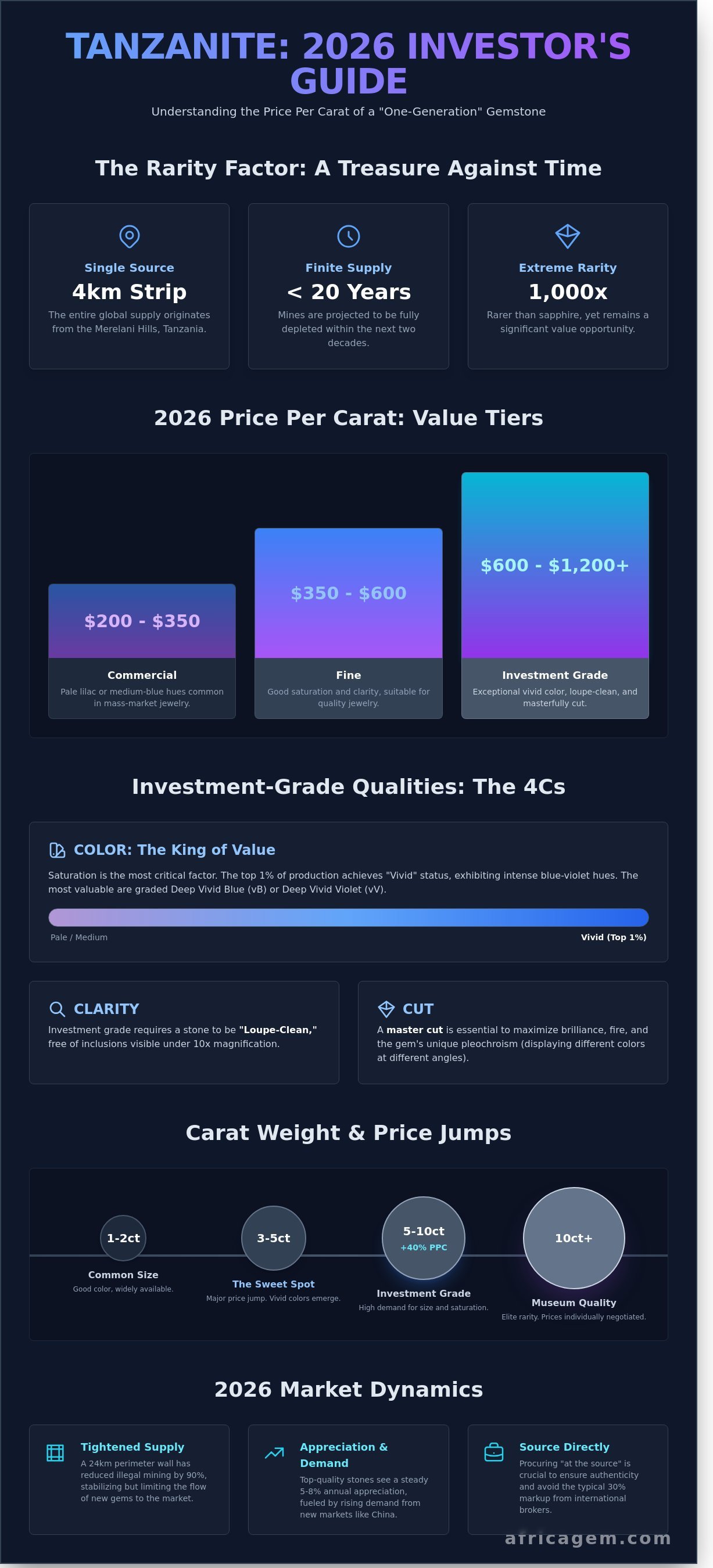
Price Per Carat Comparison: 2026 Value Tiers
Understanding the 2026 market requires looking beyond just color. The tanzanite price per carat reflects a complex interplay of rarity, saturation, and the precision of the lapidary’s hand. While the Merelani Hills remain the sole source, the grading of these stones has become increasingly sophisticated. We categorize the market into three primary tiers: Commercial, Fine, and Investment. Each tier serves a different purpose, from everyday jewelry to high-end portfolio assets.
Commercial grade stones often appear lighter or have a slight brownish tint. These are usually cut for weight retention rather than brilliance. Fine grade tanzanite represents the sweet spot for most collectors, offering the iconic violet-blue balance with high clarity. Investment grade stones, however, are the "top 1%" of production. These possess a deep, vivid saturation that remains intense even in low light. In 2026, the scarcity of these top-tier stones has pushed prices to record levels, particularly as the mine depths increase and extraction costs rise.
2026 Pricing Chart by Quality Tier
Current market data for 2026 shows a clear separation between quality levels. For standard 1 to 3 carat stones, you can expect the following price ranges per carat:
- Commercial Grade (B/A): $100 to $250 per carat. These stones often show "windowing" where light leaks through the center.
- Fine Grade (AA/AAA): $300 to $450 per carat. These offer the vibrant "D-Block" color profile many buyers desire.
- Investment/Heirloom Grade (Vivid): $500 to $800+ per carat. These are loupe-clean stones with exceptional red flash.
Size creates a significant price multiplier. For example, a 10 carat vivid stone is exponentially rarer than ten 1 carat stones. In the 2026 market, these 10ct+ heirloom specimens frequently exceed $1,000 per carat. This reflects the reality that finding a large, clean crystal is a true geological miracle.
The Premium for Fancy Colors
While the world knows tanzanite for its blue, a secondary market has exploded for "Fancy" zoisite. When we examine the geological origins of tanzanite, we see that the presence of vanadium creates the blue hues we love, but rare trace elements can produce green, yellow, or pink zoisite. These fancy colors are incredibly rare; they represent less than 0.5% of the total mine output.
Collectors often pay a massive premium for unheated fancy colors. While 95% of blue tanzanite is heated to remove brown tones, many green and pink specimens are kept in their natural state. A natural, unheated pink tanzanite can command double the tanzanite price per carat of a standard blue stone. Bi-color and tri-color pleochroic stones, which show different colors from different angles, are also seeing a 25% price increase year-over-year in 2026 due to their "fingerprint" uniqueness.
You must be cautious of "deals" that seem too good to be true. Many low-priced stones are "windowed," meaning the bottom of the stone is cut too shallow. This creates a dead spot in the center where you can see right through the gem. A poorly cut stone might save you 30% on the price, but it loses 100% of the beauty. We always recommend prioritizing a "Precision Cut" over raw carat weight. A well-cut 2 carat stone will always outshine a poorly cut 3 carat stone, both in beauty and in future resale value.
Market Trends: Supply Chain and Scarcity in 2026
Tanzanite remains a geological anomaly. It's found only in a four-kilometer strip at the foothills of Mount Kilimanjaro. By 2026, the reality of this "single generation" gemstone has set in for collectors and investors alike. The tanzanite price per carat is no longer dictated by simple retail demand; it's driven by a tightening supply chain and a shrinking subterranean reserve. Geologists from the University of Dar es Salaam estimated in 2018 that the mines had a 25 to 30-year lifespan. We're now deep into that final decade, and the market is reacting to the inevitable "mined out" status that looms on the horizon.
The Wall and Government Regulation
The landscape of Tanzanite mining changed forever in April 2018 when the Tanzanian government completed a 24-kilometer perimeter wall around the Merelani mining site. This physical barrier, coupled with the 2017 Mining Act, successfully eliminated the "bargain" rough market that once thrived on smuggled stones. Today, every gram of rough material passes through centralized government trading hubs. This transparency has stabilized the tanzanite price per carat while ensuring that miners receive fair compensation. Collectors now see a shift toward "Tanzania-cut" stones. Local cutting facilities in Arusha have modernized, challenging the traditional dominance of Jaipur-cut gems. This local beneficiation adds a layer of ethical value, as the economic benefit stays within the community that unearths these treasures.
- Ethical Sourcing: 100% of legal exports now carry government-mandated certificates of origin.
- Supply Squeeze: Demand from the Chinese middle class has grown by 30% since 2021, diverting stones that previously headed to Western markets.
- Quality Control: Centralized trading has standardized the grading of rough, making high-quality "D-Block" material even rarer.
Investment Potential and Liquidity
Top-color Tanzanite has transitioned into a recognized "hard asset" for those looking to hedge against volatile paper economies. Data from the last 10 years shows that investment-grade stones, specifically those in the top 2% of color saturation, have appreciated by an average of 12% annually. This growth isn't just about beauty; it's about liquidity. A stone with a GIA (Gemological Institute of America) or AGTA (American Gem Trade Association) certificate is a global currency. These documents provide the technical validation required for high-value resale, confirming the stone is unheated or has only undergone the standard stable heat treatment. Without these reports, a stone's resale value can drop by 30% or more in a professional setting.
Smart buyers in 2026 are moving away from pre-set mall jewelry. Buying loose stones is the most cost-effective path to ownership. When you purchase a loose gem, you aren't paying the 300% retail markup often applied to gold settings and designer branding. You're paying for the intrinsic value of the mineral itself. This approach allows you to inspect the stone's pleochroism and clarity without the distractions or hidden flaws that a heavy metal setting can mask. It's the strategy of the informed insider. You can find your own high-value specimen by browsing our collection of certified loose Tanzanite today.
The window for acquiring Tanzanite at current rates is narrowing. As the Merelani mines descend deeper, extraction costs rise, and the volume of high-quality rough diminishes. This combination of rising overhead and falling supply creates a permanent floor for pricing. In 2026, the question isn't whether Tanzanite is a good investment, but whether there will be any left to buy in another five years.
The AfricaGems Difference: Radical Transparency
Purchasing a gemstone online requires more than just a transaction; it demands a partnership built on absolute trust. At AfricaGems, we define this as radical transparency. Since 1984, our mission has centered on providing collectors with the technical data and visual proof necessary to make an informed decision. While the market is often clouded by vague descriptions, we provide full disclosure on every treatment and attribute. This commitment ensures that the tanzanite price per carat you pay reflects the true gemological value of the stone, backed by a 40-year reputation and a 100% money-back guarantee.
Trust is the most valuable commodity in the gemstone trade. We provide high-resolution, 360-degree videos for every single stone, allowing you to inspect the pleochroism and clarity from your own home. There's no guesswork. Every shipment is fully insured and backed by a 40-year reputation for excellence. If a stone doesn't meet your expectations upon arrival, our 100% money-back guarantee provides a safety net that commercial jewelers rarely offer. We don't hide behind stock photos; we show you the soul of the specific gem you are considering.
Our commitment to full disclosure includes:
- High-Resolution Video: Interactive 360-degree views of every stone in our inventory.
- Treatment Reports: Full disclosure of heating or any other enhancements.
- Precision Grading: Accurate measurements and weight to two decimal places.
- Expert Vetting: Direct oversight by Marc Sarosi on every acquisition.
Personal Selection by Marc Sarosi
Marc Sarosi leverages 40 years of field experience to hand-select every piece in our inventory. He hunts for 'sleepers', which are stones with exceptional pleochroism and fire that high-volume buyers often miss. His vetting process is rigorous; we reject over 90% of the Tanzanite we are offered. Marc examines each stone under 10x magnification to ensure it meets our standards for eye-clean clarity and precision cutting. This scrutiny ensures the tanzanite price per carat remains a reflection of elite quality.
Your Path to a Custom Masterpiece
Owning a loose stone is the first step toward a bespoke heirloom. Our designers use CAD technology to create digital models with 0.1mm accuracy for every setting. We specialize in matching side stones, like Sapphires or Diamonds, to complement your Tanzanite's specific hue and saturation. This journey from the mines to a finished piece ensures your investment is showcased perfectly. Explore our collection of Investment-Grade Tanzanite to start your custom design journey today.
This methodical approach to curation and design is why serious collectors choose us. We don't just sell gemstones; we provide the expertise and security required to own a piece of geological history. By maintaining these high standards, we ensure that every client feels like an informed insider in the world of rare minerals.
Securing Your Legacy in the Final Frontier of Gemstone Investment
As we navigate the 2026 market, the window for acquiring top-tier specimens is narrowing rapidly. The Merelani Hills remain the only 14-square-kilometer source on Earth. This geological reality means the tanzanite price per carat reflects a rare intersection of extreme scarcity and rising global demand. Vivid saturation and loupe-clean clarity drive the highest valuations in our current price tiers. Technical mastery is vital for any serious collector. Quality defines value.
AfricaGems leverages over 40 years of gemstone expertise to ensure you don't have to navigate these complexities alone. Our direct-from-source model eliminates middleman markups while providing the radical transparency you deserve. We back every stone with a 100% money-back guarantee. Your purchase is always secure. We provide the rigorous GIA data needed to make an informed decision with total confidence. It's time to find a stone that resonates with your personal style and investment goals.
Shop GIA-Graded Loose Tanzanite with Full Transparency
Your journey into the world of rare minerals starts with a single, breathtaking stone that you'll be proud to own for a lifetime.
Frequently Asked Questions
Is tanzanite more expensive than sapphire?
No, tanzanite generally costs significantly less than high-quality blue sapphire. A top-grade 3-carat tanzanite might cost $600 to $800 per carat, while a comparable Royal Blue sapphire often exceeds $5,000 per carat. This price gap makes tanzanite an attractive alternative for collectors seeking deep blue hues without the five-figure investment required for rare corundum.
Does the price of tanzanite go up every year?
Tanzanite prices have shown a steady appreciation of 5% to 10% annually over the last decade. While market fluctuations occur, the finite supply from the Merelani Hills ensures long-term value growth. In 2023, high-grade material saw a 12% increase because of tightening export regulations and decreased production in the Block D mining area.
What is the most valuable color of tanzanite?
The most valuable tanzanite displays a vivid "dblock" blue with intense violet overtones and a distinct red flash. This specific saturation, often referred to as Investment Grade, commands the highest tanzanite price per carat. Stones with a 60/40 blue-to-violet ratio and strong pleochroism are prized by connoisseurs more than the lighter, lavender-leaning varieties found in commercial jewelry.
How can I tell if a tanzanite price is too good to be true?
If you see a top-grade stone priced below $200 per carat, it's likely a synthetic simulant or a glass composite. Authentic, eye-clean tanzanite has a baseline market cost that reputable dealers must follow to remain profitable. Always demand a certificate from a lab like the GIA or AGL to verify the stone isn't a coated imitation or a lab-grown YAG crystal.
Does heating tanzanite lower its price per carat?
No, standard thermal enhancement at 600 degrees Celsius is an industry-accepted practice that doesn't lower the value. Approximately 95% of all tanzanite is heated to transform its natural brownish hue into the iconic blue-violet. While rare, naturally unheated stones with AAA color can command a 25% price premium among specialized collectors who value the stone's untouched state.
Is tanzanite a good gemstone for an engagement ring?
Tanzanite is a beautiful choice but requires more care than a diamond because it ranks 6 to 7 on the Mohs scale. It's softer than sapphire, so it's best suited for protective bezel settings rather than exposed prongs. For daily wear, you'll need to avoid ultrasonic cleaners and harsh chemicals to maintain the stone's integrity over several decades of use.
What happens to the price if the mines run out?
Analysts predict the tanzanite price per carat will skyrocket once the 14-square-kilometer mining area in Merelani is exhausted. Geologists estimate the current supply will last less than 20 years at current extraction rates. When this "Generation Gem" is no longer being pulled from the earth, it will transition from a retail staple to a strictly secondary-market collector's item.
Why is a 10-carat tanzanite much more expensive per carat than a 1-carat stone?
Large tanzanite crystals are geologically rarer and exhibit far deeper color saturation than smaller specimens. A 1-carat stone often looks pale, while a 10-carat gem captures light to reveal intense velvety depths. Because the rarity of loupe-clean crystals increases exponentially with size, the price per carat can double or triple when moving from a 1-carat to a 10-carat stone.