
Selecting Loose Aquamarine Gemstones: A Collector’s Comparison Guide (2026)
Mar 29th 2026
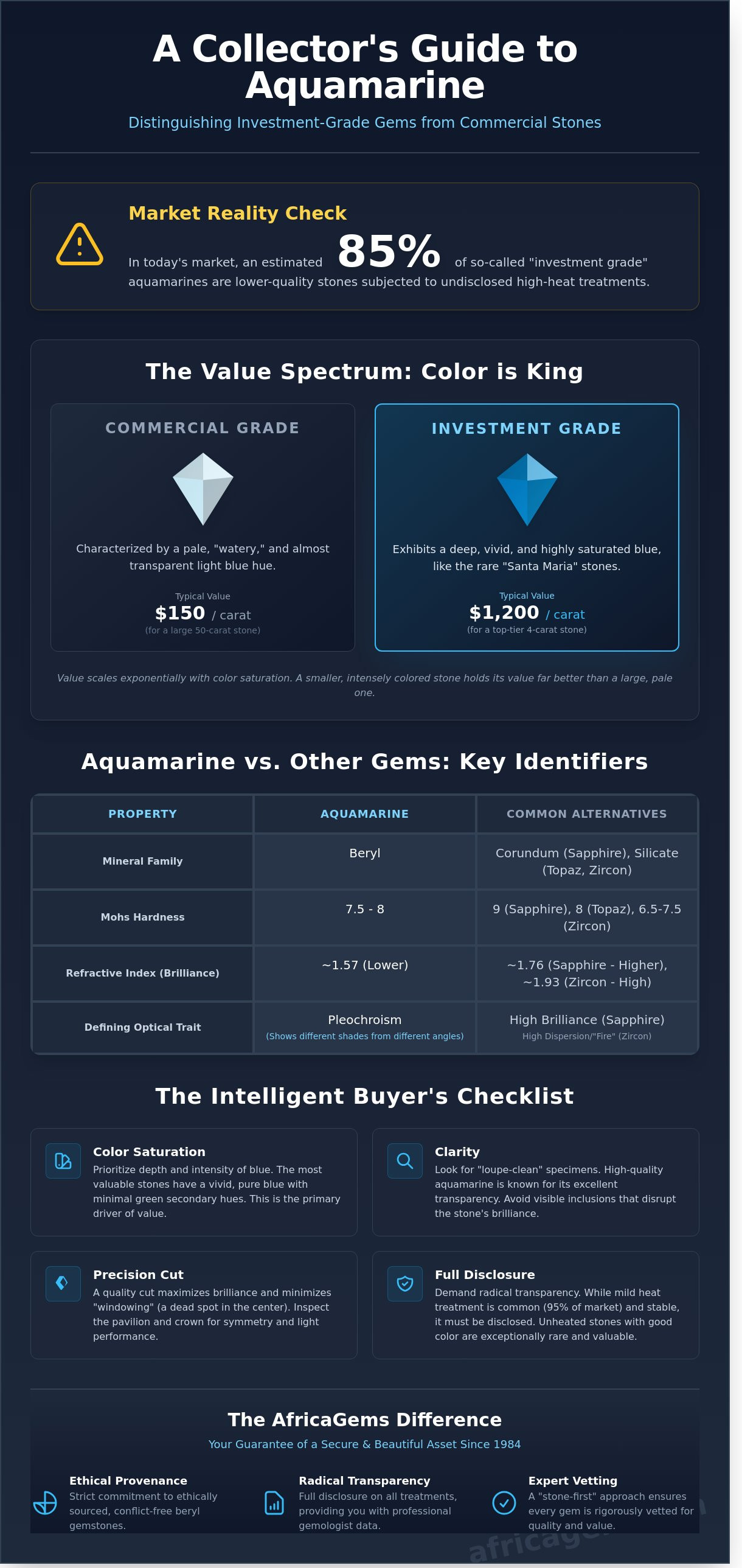
In the 2026 market, nearly 85% of stones marketed as investment grade are actually lower-quality material subjected to undisclosed high-heat cycles. When you search for loose aquamarine gemstones, you aren't just buying a color; you're acquiring a geological legacy that must hold its value over decades. It's understandable to feel a sense of hesitation when a vibrant blue stone online looks suspiciously like a $10 piece of irradiated topaz. You want the breathtaking clarity of a loupe-clean specimen without the nagging doubt of unethical sourcing or hidden treatments.
This guide empowers you to master the nuances of pleochroism and saturation so you can choose a stone that balances investment-grade rarity with incredible beauty. You'll understand the AfricaGems Difference through our rigorous standards for full disclosure and ethical provenance. We'll compare the icy brilliance of Brazilian finds against the deep, velvet blues of African mines to ensure your next acquisition is both a visual masterpiece and a secure asset.
Key Takeaways
- Learn why selecting loose aquamarine gemstones offers superior creative control and quality assurance over pre-set commercial jewelry.
- Discover how to distinguish between common "watery" commercial stones and the deeply saturated, investment-grade pieces sought by serious collectors.
- Master the critical physical properties that differentiate genuine aquamarine from common lookalikes like blue topaz and morganite.
- Identify the non-negotiable standards for clarity and precision cutting that ensure your gemstone remains free of "windowing" and full of life.
- Understand how the AfricaGems legacy of radical transparency and ethical sourcing guarantees the integrity of your rare mineral investment.
Understanding Loose Aquamarine Gemstones: The Serenity of the Beryl Family
Aquamarine is the blue-to-greenish-blue variety of the beryl family of gemstones, a group that also includes the prestigious emerald. Its name derives from the Latin aqua marina, meaning sea water, a tribute to its tranquil, oceanic hues. For the serious collector, loose aquamarine gemstones offer a level of transparency that pre-set jewelry cannot match. Selecting a loose stone allows you to inspect the crown, pavilion, and girdle for any hidden inclusions or "windows" that might diminish the stone's value. Since our founding in 1984, AfricaGems has advocated for this "stone-first" approach, ensuring that every gem is vetted for its 7.5 to 8 Mohs hardness rating, making it durable enough for daily wear in engagement rings or statement pendants.
The historical significance of this gem dates back to at least 480 BC, where it was used as a protective talisman for sailors. Today, the appeal lies in its sophisticated elegance. We maintain a strict commitment to ethically sourced, conflict-free beryls. Every stone in our inventory reflects the AfricaGems Difference, a standard of radical transparency that provides you with the same data used by professional gemologists. This security is backed by the personal guarantee of Marc Sarosi, ensuring your investment is both beautiful and high-integrity.
The Chemistry of Color: Iron and Heat
The signature blue of an aquamarine comes from trace amounts of iron within the crystal structure. Specifically, ferrous iron creates the blue we love, while ferric iron adds yellow overtones that result in a sea-green appearance. To meet market demand for pure blues, miners often apply mild heat, usually between 400 and 450 degrees Celsius. This is a permanent and stable treatment. While 95% of loose aquamarine gemstones on the market are heat-enhanced, we prioritize disclosure. We distinguish between these and our rare, "natural, unheated" specimens, which retain their original greenish-blue "sea foam" character favored by connoisseurs.
Aquamarine vs. Other Blue Gemstones
Aquamarine is often compared to blue sapphire or zircon, but its optical properties are unique. It possesses a refractive index of approximately 1.57, which is lower than sapphire's 1.76. This results in a "cool" and watery brilliance rather than the intense, saturated fire of a sapphire. While a blue zircon might show high dispersion, aquamarine is prized for its pleochroism, showing different shades of blue or even near-colorless depending on the viewing angle. This subtle color play makes it a versatile choice for custom designs that require a gem with a sophisticated, icy presence.
Commercial Grade vs. Investment Grade: The Color Spectrum
Color saturation serves as the ultimate arbiter of value for loose aquamarine gemstones. While commercial-grade stones often possess a pale, almost transparent "watery" appearance, investment-grade specimens exhibit a depth of color that mimics the deep Atlantic. The market price isn't linear; it scales exponentially as the saturation moves from a faint whisper of blue to a vivid, electric hue. This distinction is vital for collectors to understand because a small, intensely colored stone will always retain its value better than a massive, pale one.
The geological formation of aquamarine in granite pegmatites determines these color variations through the presence of iron ions. In high-value collector pieces, the concentration of these elements creates the rare "Santa Maria" effect. Unlike many other gemstones where size is the primary focus, the aquamarine market favors quality above all else. For instance, a 4-carat stone with top-tier saturation can fetch $1,200 per carat, whereas a 50-carat pale stone might only command $150 per carat.
The Allure of Santa Maria Blue
The Santa Maria designation represents the pinnacle of the aquamarine color spectrum, characterized by a deeply saturated blue that remains bright even in low-light conditions. While the name originated from the Santa Maria de Itabira mine in Brazil, modern discoveries in Mozambique and Madagascar have produced "Santa Maria Africana" stones that rival the original Brazilian gems in both depth and clarity. Finding a truly unheated, deeply saturated Santa Maria stone is a rare occurrence that happens in less than 1% of all gem-quality extractions.
Evaluating Tones and Hues
Collectors must distinguish between the primary blue color and any secondary green hues. While the trade generally prefers a pure "Swiss Blue" or "Sky Blue," many unheated stones retain a slight greenish tint that reflects their natural state. Pleochroism, the property where a crystal displays different colors from different angles, is a critical factor during the cutting process. A skilled lapidary will orient the stone to showcase its strongest blue face. While most loose aquamarine gemstones are expected to be eye-clean, the AfricaGems standard focuses on loupe-clean clarity to ensure color perception isn't dampened by internal inclusions. You can explore our curated selection of investment-grade aquamarine to compare these subtle tonal shifts yourself.
Aquamarine vs. Blue Topaz and Morganite: A Strategic Comparison
Discerning collectors often face a dilemma when viewing loose aquamarine gemstones alongside their more affordable lookalikes. While a quick glance might suggest they're interchangeable, the physical and economic realities couldn't be more different. According to data from the Gemological Institute of America, aquamarine's value is driven by its rarity as a natural blue beryl, whereas its common rival, blue topaz, owes its abundance to industrial treatment processes.
Why Aquamarine Commands a Premium Over Topaz
The price delta between these two stones is staggering. You'll find commercial blue topaz retailing for $5 to $15 per carat; meanwhile, investment-grade loose aquamarine gemstones frequently command $400 to $900 per carat for 5-carat specimens with saturated color. This 60-fold price difference reflects a fundamental truth about rarity. Almost all blue topaz starts as colorless material that's bombarded with electrons and heated to achieve its hue. Aquamarine is born blue.
Physical properties also set them apart for the serious bench jeweler or collector:
- Density: Topaz is significantly heavier, with a specific gravity of 3.53 compared to aquamarine's 2.72. A one-carat aquamarine will physically look much larger than a one-carat topaz.
- Refractive Index: Topaz has a higher RI (1.61 to 1.63), giving it a glassier, more "splintery" brilliance. Aquamarine (1.57 to 1.58) offers a softer, more watery glow that defines its elegance.
- Hardness: Topaz sits at 8 on the Mohs scale, while aquamarine is 7.5 to 8. However, topaz has perfect basal cleavage, meaning it can split with a single blow. Aquamarine is more durable for daily wear because it lacks this structural weakness.
The Beryl Sisters: Aquamarine vs. Morganite
If you're seeking a stone with the same pedigree as aquamarine but a warmer aesthetic, look toward loose morganite gemstones. Both belong to the beryl family, sharing an identical crystal structure and a hardness of 7.5 to 8. This makes them the ultimate "sister stones" for custom jewelry sets or matching engagement rings for partners with different palettes.
Choosing between them usually comes down to skin tone and metal preference. Aquamarine’s cool, icy blue excels in white gold or platinum, particularly on cool skin undertones. Morganite offers a "peachy-pink" warmth that's breathtaking in rose gold and complements warmer complexions beautifully. From a collector's standpoint, both stones offer the same "AfricaGems Difference" of high clarity and ethical sourcing, but they serve entirely different moods in a curated collection.
The Buyer’s Checklist: Evaluating Clarity, Cut, and Carat Weight
Evaluating loose aquamarine gemstones requires a different analytical framework than other Beryl varieties. While collectors often accept a "garden" of inclusions in emeralds, aquamarine demands near-perfection. It's a Type I gemstone, meaning it typically grows in clean crystals. For the serious investor, clarity isn't just a preference; it's a non-negotiable benchmark for value.
Clarity Standards for the Discerning Eye
The AfricaGems standard focuses on "loupe-clean" specimens. This means that under 10x magnification, the stone shows no internal flaws to the naked eye. You should be wary of "rain," which refers to fine, hollow tubes aligned parallel to the crystal axis. While these are natural, they can diminish the stone's luster if they're too dense. Every stone in our vault comes with full disclosure. We believe transparency in a gemstone certificate is as vital as the transparency of the stone itself. If a stone has been clarity-enhanced, its value drops by 40% or more, so always insist on seeing the original lab report.
The Art of the Cut
Precision cutting dictates how light interacts with the stone's internal facets. A poorly executed cut results in "windowing," a phenomenon where the center of the gem appears washed out because light leaks through the back. This is common in commercial-grade stones where the cutter prioritizes weight over beauty. The AfricaGems Difference lies in our commitment to symmetry and polish. We favor specific styles for different saturation levels:
- Emerald Cut: This classic step-cut highlights the sophisticated depth of 19th-century style, perfect for stones with high color saturation.
- Radiant and Oval Cuts: These modern brilliant styles use triangular facets to hide "extinction" and maximize light return in paler specimens.
- Deep Pavilions: A pavilion depth of 65% or greater helps concentrate color in lighter blue stones, preventing that "watery" look.
Carat weight milestones for aquamarine differ significantly from rubies or sapphires. Large, high-quality crystals are more common in the pegmatites of Brazil and Pakistan. You'll find that a 10-carat aquamarine is far more accessible than a 10-carat ruby. Because of this availability, the price-per-carat curve remains relatively steady until you hit the 25-carat mark. Beyond this weight, the rarity of finding "Santa Maria" blue shades in such large sizes causes prices to jump by approximately 25% per milestone. Collectors should look for stones in the 5 to 15-carat range for the best balance of impressive size and long-term liquidity.
Finding Your Perfect Gem: The AfricaGems Difference
Marc Sarosi personally inspects every single gem in our inventory. He doesn't rely on third-party brokers or bulk shipments to define our quality standards. Since 1984, this hands-on approach has ensured that every stone meets a level of excellence that mass-market retailers simply cannot replicate. You aren't just purchasing a mineral; you're acquiring a piece of earth history verified by a connoisseur with 40 years of experience in the field.
Selecting loose aquamarine gemstones provides you with the ultimate creative freedom. It allows you to inspect the stone's pavilion, girdle, and crown without the visual obstructions of a metal setting. This level of visibility is vital for clients utilizing our custom jewelry design services. We provide GIA or AGTA grading reports for our premium inventory, ensuring your investment is backed by the world's most rigorous gemological standards. Every purchase includes a 100% money-back guarantee, providing a secure environment for high-value acquisitions.
Ethical Sourcing and Radical Transparency
AfricaGems maintains direct, long-standing relationships with artisanal mines in Brazil and Nigeria. We bypass the opaque layers of traditional supply chains to ensure every stone is 100% conflict-free. Full treatment disclosure is a moral imperative for our brand. If a stone has undergone heat treatment to stabilize its sea-blue hue, we document it clearly. We believe that trust is the only currency that matters in high-end gemology, and we've built our 40-year legacy on that single principle.
Your Next Steps: From Loose Stone to Heirloom
You can use our expert digital filters to sort our collection by carat weight, dimensions, and origin. Once you find a stone that resonates with your vision, our team helps you pair it with a master jeweler to create a legacy piece. If you require a more tailored experience, Marc Sarosi is available for personal consultations to help you find a gem that fits your specific investment or design goals. Your journey from a raw mineral to a finished heirloom starts with a single, perfect stone.
Secure Your Legacy with a Masterpiece of Beryl
Selecting the perfect stone requires more than an eye for color; it demands a commitment to technical precision. You've learned how to distinguish investment-grade saturation from common commercial shades and why GIA or AGTA certification is non-negotiable for a serious collection. Since 1984, Marc Sarosi has championed this level of radical transparency, ensuring every client receives full disclosure on gemstone treatments. When you evaluate loose aquamarine gemstones, remember that a masterfully executed cut and loupe-clean clarity define a beryl's long-term value. AfricaGems provides the rigorous data you need to move from a casual observer to an informed connoisseur. Our 40-year history in the trade serves as your personal guarantee of authenticity. You're now equipped to select a gem that reflects both your aesthetic taste and your uncompromising standards for quality. Your journey into the serene world of high-end minerals is just beginning.
Explore Our Exquisite Collection of Loose Aquamarine Gemstones
Frequently Asked Questions
Is aquamarine a good choice for an engagement ring?
Aquamarine is an excellent choice for daily wear because it ranks 7.5 to 8 on the Mohs scale of mineral hardness. While it isn't as hard as a diamond, its crystalline structure resists scratches from common dust and debris. For a ring worn 365 days a year, we recommend a protective setting like a bezel or six-prong mount to safeguard the stone's edges from impact.
How can I tell the difference between aquamarine and blue topaz?
You can distinguish these gems by checking their refractive index; aquamarine sits at 1.57, while blue topaz is higher at 1.61. Under a 10x loupe, look for pleochroism. Aquamarine shows two distinct colors when turned, whereas blue topaz is often more monochromatic. Most blue topaz is irradiated to achieve its color, but high-quality loose aquamarine gemstones rely on natural or heat-enhanced saturation.
Are most loose aquamarine gemstones heat treated?
Approximately 95% of aquamarines on the market undergo heat treatment at temperatures between 400 and 450 degrees Celsius to remove yellow or green overtones. This process is permanent and stable, making it a standard industry practice. At AfricaGems, we provide full disclosure on every stone, ensuring you know whether your gem is unheated or has been gently refined by heat to reach its peak beauty.
What is the most valuable color for an aquamarine?
The most valuable color is a deep, saturated "Santa Maria" blue, named after the original Santa Maria de Itabira mine in Brazil. These rare specimens command prices 300% higher than pale, pastel alternatives found in standard jewelry stores. Collectors prioritize stones that maintain their blue intensity in low-light environments without showing gray or green secondary flashes that dull the stone's appearance.
Does the origin of an aquamarine affect its price?
Origin significantly impacts price, with Brazilian stones often fetching a 25% premium due to their historical prestige and the famous Santa Maria legacy. However, 21st-century deposits in Mozambique and Madagascar now produce "Santa Maria Africana" stones that rival the best Brazilian material. While a Brazilian pedigree adds collectibility, the individual stone's saturation and clarity dictate 90% of its market value in today's trade.
What does "loupe-clean" mean when buying aquamarine?
A loupe-clean aquamarine shows no visible inclusions or internal flaws when viewed under 10x magnification. Since aquamarine grows in large, clean hexagonal crystals, collectors expect a Type I clarity grade. Any visible veil or "rain" inclusion can drop the price by 40% compared to a loupe-clean specimen. We curate our selection to ensure your gemstone meets these rigorous standards of transparency.
How should I care for and clean my aquamarine gemstone?
Clean your aquamarine using warm water, mild dish soap, and a soft-bristled toothbrush every 30 days to maintain its luster. Avoid ultrasonic cleaners if the stone has liquid inclusions, as the vibrations can cause internal fractures. This 5-minute routine removes skin oils and dust that dull the stone’s natural brilliance, keeping your loose aquamarine gemstones looking breathtaking for decades to come.
Can I get a certificate for my loose aquamarine?
You should always request a certificate from a recognized laboratory like the GIA or AGL for stones weighing over 1.5 carats. These reports verify the species as natural beryl and identify any detectable treatments. AfricaGems includes a professional appraisal and offers third-party certification to ensure your investment is backed by rigorous gemological data and the Marc Sarosi personal guarantee of integrity.