
Ruby Heat Treatment: The Collector’s Guide to Value, Clarity, and Transparency
Mar 30th 2026
Over 95% of the rubies entering the global market today have undergone some form of enhancement to reach their vivid crimson potential. You likely understand that while nature creates the crystal, the human touch of a ruby heat treatment often unlocks its true brilliance. However, the anxiety of accidentally purchasing a lead-glass filled stone instead of a stable, traditionally heated gem is a reality for many collectors. It's unsettling to see technical jargon like "residues in healed fissures" on a GIA report and not know if that stone will retain its value for the next 50 years.
At AfricaGems, we believe transparency is the only way to trade. This guide will empower you to master the nuances of enhancements so you can distinguish between a high-value investment and a fragile, commercial-grade specimen. You'll learn to read a lab report like a professional gemologist and understand exactly how different heat levels impact both price and durability. We're going to demystify the industry standards so you can select a breathtaking ruby that perfectly aligns with your financial goals and your appreciation for rare, natural beauty.
Key Takeaways
- Uncover why the "Earth’s Oven" often leaves corundum unfinished and how thermal enhancements transform raw minerals into breathtaking, investment-grade gems.
- Learn to calculate the "Rarity Premium" to understand why completely unheated rubies command significantly higher prices than their commercially treated counterparts.
- Distinguish between minimal and invasive procedures to ensure your ruby heat treatment represents a stable, lifelong asset rather than a low-value enhancement.
- Master the art of decoding GIA and AGL lab reports to identify subtle comments that can drastically impact the long-term value and pedigree of your stone.
- Understand the AfricaGems standard for radical transparency and why a personal guarantee of integrity is non-negotiable for the discerning gemstone collector.
What is Ruby Heat Treatment? Understanding the Earth’s Oven
Nature is a magnificent artist, but she often leaves her work unfinished. Imagine the Earth's crust as a massive, pressurized kiln where gemstones cook for millions of years. Most rubies emerge from this geological furnace with internal "silk" or distracting purple tints that mask their true potential. A ruby heat treatment is essentially the final stage of this natural process. It's a permanent thermal enhancement of corundum that completes what the Earth started, clarifying the stone's internal structure and refining its color.
Transparency is the cornerstone of the AfricaGems Difference. You should know that between 95% and 99% of all rubies in the global gemstone market have undergone thermal enhancement. This isn't a flaw or a sign of a "fake" stone; it's an industry standard that makes beautiful red gems accessible. Learning about ruby treatments helps you understand the difference between a stone's natural birth and its final polished state. A heated ruby is still a natural gemstone, born in the ground over eons. It's fundamentally different from synthetic or lab-created varieties, which are manufactured in a facility in just a few weeks.
The Science of Thermal Enhancement
In a controlled laboratory setting, technicians subject the stones to temperatures ranging from 1200°C to 1800°C. At these extreme levels, tiny needles of rutile, known as silk, begin to dissolve into the ruby's crystal lattice. This process significantly improves clarity and can remove secondary blue or purple tones. The result is often that coveted "pigeon blood" saturation. Because these changes occur at a molecular level, the treatment is considered stable and permanent. It won't fade if the stone is left in the sun, and it won't wear away during jewelry repairs.
A Brief History of Heating Rubies
The practice of enhancing rubies isn't a modern invention. For over 1,000 years, gem burners in Sri Lanka used charcoal fires and primitive blowpipes to coax better color from "geuda" stones. The technology evolved significantly in the late 1960s and 1970s with the introduction of high-tech electric furnaces. This shift allowed for precise temperature control, which expanded the global market by approximately 80% and brought high-quality red gemstones to a wider audience. While collectors in the early 1900s rarely distinguished between heated and unheated stones, the last 50 years have seen a major shift. Today, unheated stones command a price premium of 50% to 100% due to their extreme rarity, while "Traditional Heat" remains the standard for exquisite jewelry.
The Spectrum of Ruby Treatments: From Minimal to Invasive
Understanding the hierarchy of interventions is vital for any serious collector. Not every ruby heat treatment carries the same weight in a gemological laboratory or on the auction floor. We categorize these processes by their level of intrusion and their subsequent impact on the stone's long term value. A ruby's worth is inextricably linked to its rarity; the more a human hand alters its natural state, the more that rarity diminishes. High-end connoisseurship requires a clear distinction between simple thermal enhancement and invasive clarity modifications that compromise the stone's very soul.
Traditional Heat (Low to High Temperature)
Traditional heating is the industry's gold standard for commercially fine gemstones. This process involves placing the ruby in a furnace at temperatures ranging from 800°C to 1800°C. At the lower end of this scale, the goal is often to dissolve "silk" or rutile needles that cause a hazy appearance. Peer-reviewed research into the Effects of Low-Temperature Heat Treatment confirms that these subtle adjustments can significantly improve transparency in Mong Hsu rubies without introducing foreign chemicals. This method is widely accepted because it mimics natural volcanic processes. It's a stable, permanent change that doesn't jeopardize the gem's structural integrity, making it the standard for breathtaking jewelry pieces intended to last for generations.
Flux Healing and Surface Diffused Rubies
The transition from "Heat Only" to "Clarity Enhanced" occurs when additives enter the furnace. Flux healing involves using borax or other chemicals to lower the melting point of the ruby's surface. This liquid flux flows into internal fractures, essentially "healing" them. While the result is an exquisite, loupe-clean appearance, the process leaves behind microscopic residues of permanent glass. Market values for flux-healed stones typically sit 30% to 50% lower than those of traditionally heated counterparts. Surface diffusion is even more aggressive. It involves adding titanium or beryllium to the heating process to create a thin layer of color on the exterior of a colorless or pale corundum. If you were to re-cut or heavily polish a diffused stone, the color would literally disappear, revealing its artificial nature.
The Red Flag: Lead-Glass Filled Rubies
Lead-glass filled stones, often called "Composite Rubies," represent the most invasive tier of the spectrum. These aren't merely treated; they're essentially gemstone Frankensteins. Starting with low-grade, opaque corundum that resembles common rock, manufacturers use acid to leach out mineral inclusions, leaving a fragile, honeycomb-like structure. They then pressure-inject high-refractive index lead glass into these voids. In some cases, the glass can account for 20% to 40% of the stone's total weight. These composites are dangerously unstable. A simple repair by a jeweler using a torch, or even contact with common household lemon juice, can corrode the glass and cause the stone to crumble into fragments. When you browse our collection of natural rubies, you'll see our commitment to integrity in action. AfricaGems maintains a strict, zero-tolerance policy against selling glass-filled rubies. We believe in providing our clients with the security of a stone that possesses both natural beauty and physical permanence.
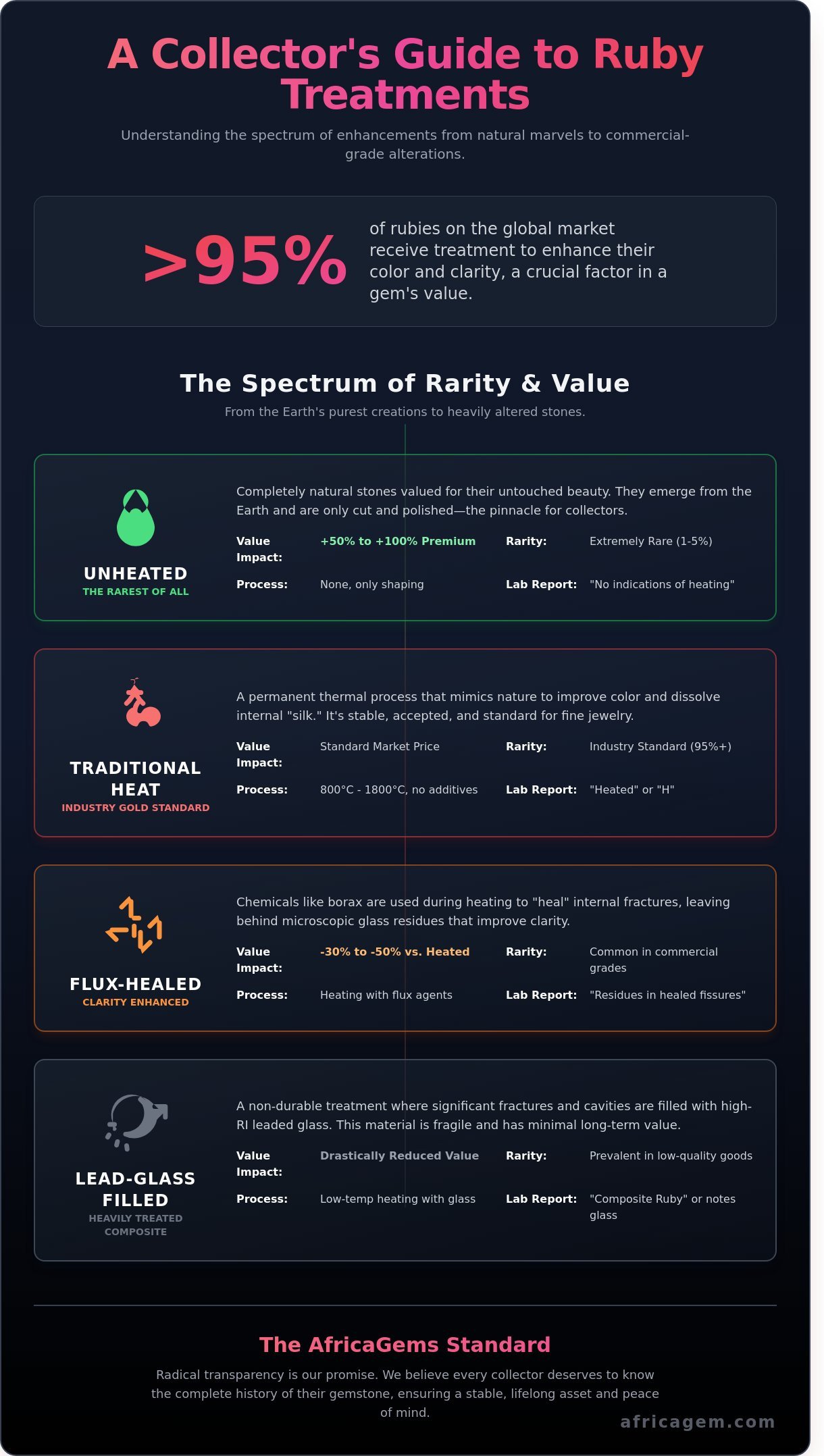
The Financial Impact: Unheated vs. Heated Ruby Value
The market for fine corundum operates on a sliding scale of intervention. While nature produces millions of carats of rough material, less than 1% of rubies possess the color and clarity to bypass the ruby heat treatment process entirely. This scarcity creates a massive valuation gap. For collectors, the lack of thermal enhancement isn't just a technical detail; it's a certification of the stone's pedigree. Nature is rarely perfect. When it is, the market responds with aggressive pricing.
Investors focus on the "Rarity Premium" because supply remains finite. In 2024, a 2-carat unheated ruby from the Mogok valley in Burma commands between $30,000 and $75,000 per carat. By contrast, a Mozambique ruby of similar size and quality from the Montepuez mines might range from $15,000 to $35,000 per carat. These figures represent a 45% increase in baseline prices compared to 2021 data, driven by a global surge in demand for "investment grade" hard assets. The origin remains a critical multiplier in these calculations.
Consider the price per carat hierarchy. A 1.20-carat unheated ruby often costs 50% more than a 3-carat heated stone of the same visual grade. This happens because high-quality, large-scale crystals that don't require ruby heat treatment are geological miracles. When you purchase an unheated stone, you're buying a piece of history that survived millions of years without human interference. Size is secondary to the purity of the stone's formation.
Invasive treatments like lead-glass filling or beryllium diffusion offer diminishing returns on resale. While these stones look vibrant, their market value often collapses to less than 10% of a natural stone's price upon secondary sale. At AfricaGems, we prioritize transparency because we know that "Value" is tied to the stone's intrinsic integrity. We don't sell glass-filled stones because they lack the permanence required for a multi-generational heirloom.
Investing in Unheated Rubies
Collectors view unheated rubies as "True Wealth" assets because they're inflation-resistant and globally portable. The origin remains the primary price driver; a Burma stone still carries a 75% premium over its African counterparts in the current auction climate. Unheated stones often command 50% to 300% more than their heated counterparts. This premium reflects the confidence of knowing the stone's vivid saturation and pleochroism are entirely natural. It's the ultimate badge of connoisseurship.
When to Choose a Heated Ruby
Not every buyer needs an investment-grade specimen. If you want a 2-carat engagement ring with "Visual Punch" for under $12,000, a "Heat Only" ruby is the smartest choice. These stones offer the same durability and chemical stability as unheated versions. You'll find the sweet spot in gems that have undergone traditional heat without foreign additives. They're reliable, breathtaking, and perfect for daily wear. It's a high-value purchase that balances beauty with a realistic budget.
Navigating Lab Reports: Reading GIA and AGL Comments
A reputable lab report is the only way to ensure the integrity of your investment. You shouldn't settle for a local jeweler's appraisal when dealing with a high-value ruby; you need a document from the Gemological Institute of America (GIA) or the American Gemological Laboratories (AGL). These institutions provide a clinical dissection of a stone's history. The "Comments" section is particularly vital. It's where labs disclose the extent of a ruby heat treatment. If a report simply says "Heated," it doesn't tell the full story. You need to look for specific codes like H-a or H-b that indicate the presence of foreign substances left behind during the heating process. Trust but verify remains the golden rule for serious collectors.
In 2023, the market saw a rise in "stealth" treatments where traditional heating is combined with newer, more invasive techniques. Labs like SSEF and AGL updated their criteria to catch these subtle shifts. A report without a comment on residues doesn't mean they aren't there; it means the lab didn't find them at 10x magnification. We've seen prices for unheated stones soar by 25% in the last 18 months, making the distinction between "heated" and "heated with residues" more financially impactful than ever. This transparency is part of the AfricaGems Difference; we believe an informed buyer is a confident buyer.
Decoding Residue Levels: Minor, Moderate, and Significant
When a ruby undergoes thermal enhancement, borax or other fluxes are often used to prevent the stone from cracking. These can leave behind glassy residues. A GIA report will label these as H-a (Minor), H-b (Moderate), or H-c (Significant). An H-a grade means the residues are barely visible and don't affect the stone's structural integrity. However, if you see H-b or H-c, the price should drop by at least 40% compared to a minor residue stone. These residues occupy cavities that would otherwise be empty or filled with natural minerals; their presence significantly lowers the rarity and long-term value. Professional dealers always discount H-b stones because they are far more common in the global supply chain. The AGL uses a unique "Stability" rating from 1 to 5 to further clarify if this ruby heat treatment has affected the stone's long-term durability.
Spotting the "Glass Filling" Disclosure
Some treatments go far beyond simple heating. Lead-glass filling is a process that turns low-grade, opaque corundum into something that looks like a gem. The GIA won't even call these rubies. They classify them as "Manufactured Products" rather than natural gemstones. Look for phrases like "Lead-glass composite," "Clarity enhanced," or "Filled" in the fine print. You can often spot this yourself with a 10x loupe. Tilt the stone under a bright light. If you see a "blue flash" or "orange flash" reflecting off internal fractures, it's a sign of glass filling. These stones are fragile; they can't withstand basic jewelry repairs or even acidic household cleaners. At AfricaGems, we strictly avoid these manufactured products to protect your collection's future value. Marc Sarosi personally vets our inventory to ensure that every stone meets our uncompromising standards for natural beauty.
To ensure you are getting a stone that meets these high standards of transparency and quality, we invite you to view our collection of certified natural rubies today.
The AfricaGems Difference: Our Standards for Ruby Integrity
Marc Sarosi established AfricaGems in 1984 with a singular mission: to provide a level of "Radical Transparency" that was previously non-existent in the gemstone trade. He personally oversees the acquisition of every stone, ensuring that disclosure isn't just a corporate policy but a personal promise. When you examine our collection, you'll find that every ruby heat treatment is documented with clinical precision. We believe that an informed buyer is a confident collector, and we provide the laboratory certifications to prove the exact nature of every enhancement.
Our inventory focuses specifically on unheated and "Heat Only" rubies, primarily from the Montepuez mines in Mozambique. These stones represent the pinnacle of ruby quality, often appearing loupe-clean while retaining their natural fire. We avoid lead-glass filled stones or those with heavy treatments that compromise the mineral's durability. By specializing in these categories, we ensure that your gemstone retains its value and beauty for decades. Understanding the nuances of ruby heat treatment helps you make an informed decision for your collection.
The AfricaGems Guarantee provides the ultimate safety net for your purchase. We offer a 30-day, 100% money-back policy on every loose gemstone, no questions asked. This policy reflects our confidence in the quality and grading of our inventory. We provide full disclosure on every listing, including the presence of any flux residues or heat-related alterations. You'll never find hidden surprises or "marketing names" for treatments here; we use standard gemological terminology that any reputable lab would recognize.
Ethical Sourcing and Quality Control
We maintain direct relationships with mine-level suppliers to ensure treatment-level certainty. Our quality control process is rigorous. We reject any stones displaying moderate (J2) or significant (J3) flux residues, as these can affect the stone's long-term stability. This selectivity ensures that the Loose Mozambique Rubies in our vault meet the highest standards of the international gem trade. We prioritize stones with "minor" or "no" residue to protect your investment's integrity.
Your Next Steps as a Collector
Start your journey by filtering our inventory according to your specific treatment preferences. Whether you seek a rare, completely unheated specimen or a vibrant, traditionally heated stone, our platform makes the technical data easily accessible. Our experts are also available for private consultations to help you design a bespoke ruby engagement ring that highlights the unique character of your chosen gem. Choosing a gemstone is a personal experience, and we're here to guide you through the technical nuances of the trade.
Secure Your Legacy with an Informed Ruby Selection
Navigating the nuances of ruby heat treatment requires a balance of technical knowledge and a keen eye for natural beauty. You now understand how standard thermal enhancement differs from invasive glass filling; this distinction alone protects your investment from significant value loss. While heated stones offer accessible brilliance, unheated rubies remain the ultimate prize for collectors due to their extreme rarity and geological purity. This knowledge transforms you from a casual buyer into a sophisticated connoisseur.
At AfricaGems, Marc Sarosi leverages 30 years of industry expertise to curate a selection that meets the highest standards of transparency. Every major stone in our inventory includes full certification from premier labs like GIA or AGL. We provide a 100% guarantee that our gems are ethically sourced and conflict-free, ensuring your acquisition is as responsible as it is beautiful. You've gained the tools to decode lab reports with confidence, allowing you to focus on the breathtaking fire of the stone itself.
Browse our Investment-Grade Unheated Rubies
Your journey into the world of rare minerals is a rewarding path, and we're honored to guide you toward a gemstone that will be cherished for generations.
Frequently Asked Questions
Is heat treatment permanent, or will my ruby change color over time?
Traditional ruby heat treatment is permanent and stable under all normal wearing conditions. Once a stone undergoes this process at temperatures reaching 1,800°C, the color and clarity improvements are locked into the crystal lattice. You don't have to worry about the gem fading in sunlight or losing its luster during routine ultrasonic cleanings. It's a standard industry practice that mimics the earth's natural thermal energy.
Can a local jeweler tell if my ruby has been heat treated?
Most local jewelers cannot definitively confirm if a stone has undergone ruby heat treatment using only a standard 10x loupe. Identifying the absence of rutile "silk" or the presence of tiny discoid fractures requires a trained gemologist using 40x magnification or higher. For a 100% guarantee, you need a report from a lab like GIA or AGL, as they use advanced spectroscopic analysis to detect thermal alterations.
Does GIA certify unheated rubies differently than heated ones?
GIA issues the same "Identification Report" for both types, but the "Analysis" section will explicitly state "No indications of heating" for natural stones. For heated gems, the report identifies the treatment and often quantifies the level of residue. This distinction is vital because unheated stones represent less than 1% of the world's gem-quality ruby supply, making their certified status a major driver of market value and collectability.
Is a "Lead-Glass Filled" ruby still considered a real ruby?
A lead-glass filled ruby is considered a composite material rather than a natural gemstone. While the base material is corundum, these stones often contain 25% to 40% glass by weight to fill significant surface-reaching fractures. They're extremely fragile and can be damaged by common household acids like lemon juice. At AfricaGems, we don't sell these composites because they lack the enduring integrity of a true, natural ruby.
How much more should I expect to pay for an unheated "Pigeon Blood" ruby?
You should expect to pay a premium of 100% to 300% for an unheated "Pigeon Blood" ruby compared to a heated equivalent. For example, a fine 3-carat heated ruby might retail for $15,000 per carat, whereas an unheated stone of identical color and clarity could easily command $45,000 per carat. This price gap reflects the extreme rarity of stones that achieve that vivid red saturation without human intervention.
What happens to the value of a ruby if it has "minor residues" on the report?
The presence of "minor residues" on a lab report typically reduces a ruby's value by 10% to 15% compared to a stone with no residues. These residues are often tiny bits of borax used during the heating process to prevent the stone from cracking. While they don't impact the stone's structural integrity, collectors prefer "clean" reports. We always disclose these specifics to ensure you understand the exact quality of your investment.
Why are unheated rubies so much rarer than heated ones?
Unheated rubies are rare because the specific geological conditions required to produce deep red saturation and high transparency are incredibly uncommon. In a typical mining lot, over 95% of the stones are too cloudy or purple to be marketable without thermal enhancement. Only 1 in 1,000 gem-quality rubies possesses the natural chemistry to look breathtaking the moment it's pulled from the earth, making them true miracles of nature.
Can heat treatment hide cracks or fractures in the stone?
Heat alone doesn't hide cracks; it actually makes internal fractures more visible by causing fluid inclusions to expand and "halo." However, when chemicals like borax are added during the heating process, they melt into a glass that fills these fissures. This is why a lab report is essential. It distinguishes between simple thermal improvement and "clarity enhancement" that uses foreign substances to mask structural flaws.