
Red Flags for Online Gemstone Dealers: A Collector’s Security Checklist
May 4th 2026

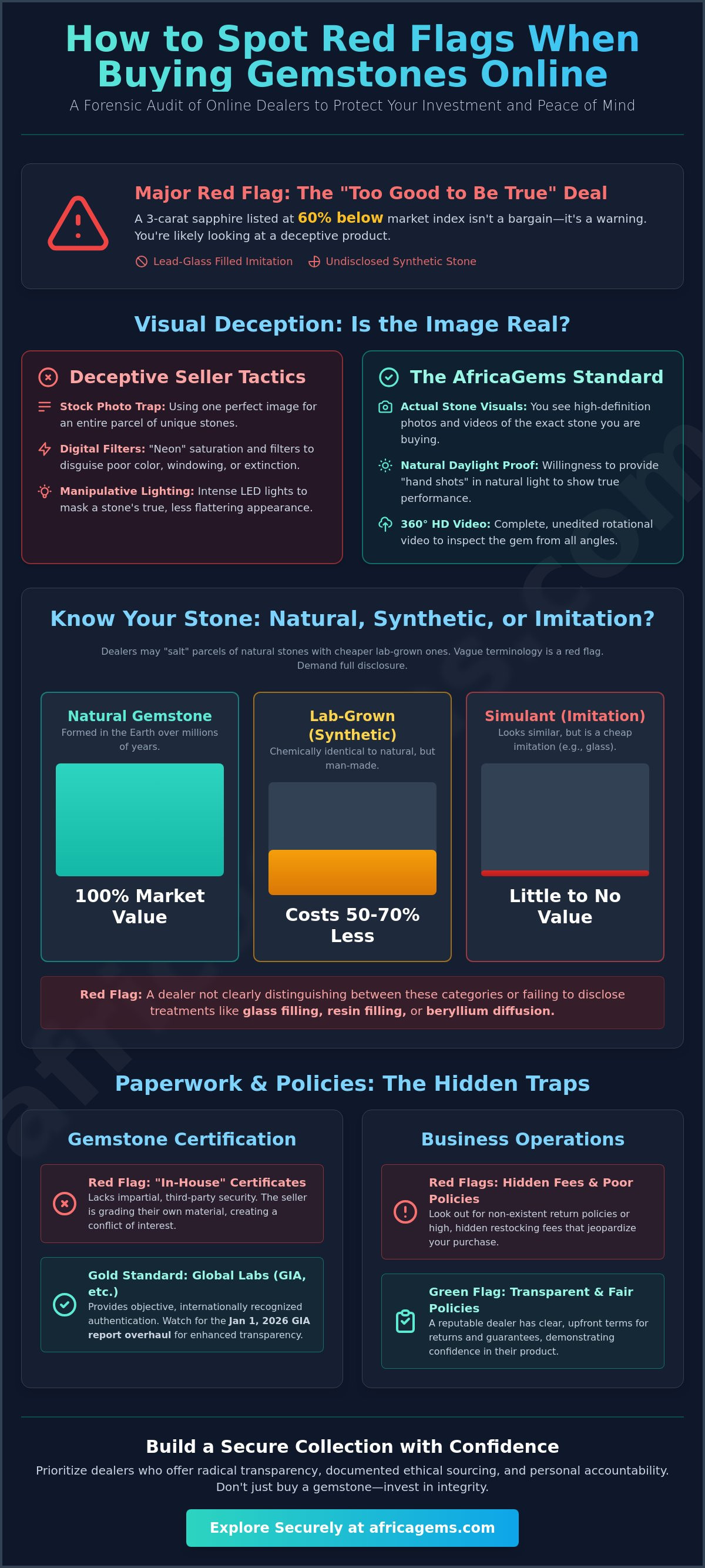
That breathtaking 3-carat sapphire listed at 60% below the RapNet market index isn't a "find of a lifetime." It is a warning sign that you are likely looking at a lead-glass-filled imitation or a synthetic stone masquerading as an exquisite natural treasure. You know that the deep joy of acquiring a rare mineral shouldn't be overshadowed by the anxiety of hidden treatments or the fear of receiving a stone that looks nothing like its photograph. Identifying the specific red flags for online gemstone dealers is a forensic audit of their transparency, not just a casual glance at their digital inventory.
This guide teaches you to vet vendors with the clinical precision of a professional gemologist to protect your investment and your peace of mind. You will learn to master the AfricaGems approach to security, from analyzing the January 1, 2026 GIA report overhaul to spotting the difference between a legitimate "No Oil" emerald and a clever marketing ruse. We will show you how to demand the same radical transparency that Marc Sarosi has championed for decades, giving you the confidence to purchase high-value stones with the security of an informed insider.
Key Takeaways
- Master the art of visual vetting by identifying stock photo traps and digital filters that disguise a gemstone's true color and clarity.
- Protect your investment by recognizing why "in-house" certificates fail to provide security and which global laboratories offer the gold standard for authentication.
- Spot the operational red flags for online gemstone dealers, including hidden restocking fees and non-existent return policies that jeopardize your purchase.
- Navigate the 2026 market with confidence by learning to identify sophisticated deceptive practices like undisclosed glass filling and mislabeled synthetics.
- Build a secure collection by prioritizing dealers who offer personal accountability and documented proof of ethical, conflict-free sourcing.
The Digital Gemstone Frontier: Why Vetting Dealers is Priority One
The digital market for rare minerals has shifted dramatically. In 2026, the sophistication of deceptive practices has reached a peak, moving beyond basic glass filling into high-fidelity synthetics that can fool an untrained eye. Acquiring a loose blue sapphire or an unheated ruby online is no longer just a transaction; it's a test of your ability to identify red flags for online gemstone dealers. Predatory vendors often lean on psychological triggers like "one-time exclusivity" or artificial urgency to bypass your logic. By adopting the "Expert Enthusiast" mindset, you move from being a target to becoming a mentor of your own collection, prioritizing understanding gemstone basics before committing your capital. This approach balances the passion of a connoisseur with the technical validation of a gemologist.
To better understand the nuances of secure sourcing, watch this helpful video:
The Rise of High-Fidelity Synthetics and Deceptive Marketing
The January 1, 2026, GIA report overhaul was a direct response to the "Golden Era of Transparency" required in today's market. Low-tier dealers frequently salt parcels of natural stones with lab-grown counterparts, which typically cost 50-70% less than natural stones of identical quality. It's vital to distinguish between "lab-created" stones, which are chemically identical to natural ones, and "simulated" stones, which are merely cheap imitations. Identifying red flags for online gemstone dealers involves checking for vague terminology; a reputable dealer provides full disclosure on every treatment, whether it's traditional heat or modern beryllium diffusion. True transparency means the vendor narrates the stone's journey from the mine to the loupe, leaving no room for ambiguity.
The Financial and Emotional Cost of a Bad Deal
A bad deal carries a heavy price that extends far beyond the initial invoice. When you purchase a stone under false pretenses, you often invest further in custom platinum settings or intricate gold work, only to discover later that the center stone is worthless. A $5,000 "bargain" emerald that is actually heavily resin-filled can easily result in a $10,000 total loss once you factor in the cost of a custom setting and the eventual realization that the stone has no resale value. This financial sting is often accompanied by the emotional loss of a planned heirloom or a significant anniversary gift. Protecting your peace of mind requires a methodical vetting process that mirrors the standards of established experts. By focusing on the integrity of the trade, you ensure your collection remains a source of pride rather than a costly lesson in deception.
Once you have secured a high-quality gemstone, ensuring it is set or maintained by skilled artisans is vital; for those requiring expert care, Atoz Watch And Jewellery Repairs offers professional servicing for both fine jewelry and luxury timepieces.
Visual Red Flags: Spotting Deception in Images and Pricing
Your eyes are your first line of defense, but digital filters can be incredibly persuasive. A common tactic among low-tier vendors is the "Stock Photo Trap," where a single high-quality image represents an entire parcel of stones. This is one of the most glaring red flags for online gemstone dealers. Natural gemstones are unique; two 2-carat rubies will never share the same inclusion pattern or color zoning. If you see the same breathtaking photo used for multiple listings, the dealer isn't selling you that specific stone. They're selling you a generic idea of it. To avoid these pitfalls, consult GIA's online buying tips, which emphasize the importance of seeing the actual item you intend to purchase.
Video content is equally susceptible to manipulation. Be wary of "neon" saturation levels that look too vivid to be natural. Predatory sellers often use high-intensity LED lighting or digital saturation filters to mask a stone's true windowing or extinction. A legitimate dealer provides 360-degree high-definition video and is happy to provide a "hand shot" taken in natural daylight. This transparency allows you to see how the stone performs outside of a controlled studio environment. When you browse a professionally vetted collection, every stone should be presented with its own unique visual documentation.
Stock Photos vs. Individual Gemstone Documentation
A dealer’s refusal to provide additional photos is a massive warning sign. If a stone is truly loupe-clean or possesses rare pleochroism, the seller should be eager to showcase it from every angle. Requesting a photo of the stone held between fingers is a simple way to verify the vendor actually has the item in their possession. It also provides a better sense of scale and real-world color that "glamour shots" often obscure.
Pricing Logic: Understanding the Value of Rarity
Pricing that defies market logic is a major red flag. According to producer auction data, commercial-grade gemstone prices rose from $4.47 per carat in September 2024 to $7.46 by December 2025. If a dealer offers "wholesale" prices significantly below these benchmarks, the quality is likely compromised. High-value assets like unheated Kashmir or Burmese sapphires command a 10-15% premium when accompanied by an AGL report. Constant "70% off" sales on rare minerals are statistically impossible in a market where supply is shrinking. True rarity has a price floor; anything significantly below it usually indicates a synthetic or heavily treated stone.
Certification Red Flags: The 'In-House' Lab Trap
An 'In-House' certificate is perhaps the most deceptive tool in a dishonest vendor's arsenal. It's a document produced by the seller to validate their own inventory, which effectively removes the third-party objectivity required for a high-value transaction. When you're scouting for red flags for online gemstone dealers, a certificate that bears the same brand name or business address as the storefront should immediately end the conversation. Genuine investment security only comes from recognized, independent authorities like GIA, GRS, AGL, or Gübelin. These institutions have no financial stake in the sale, ensuring their grading remains clinical and unbiased. Always verify a report number directly through the laboratory's online database before transferring funds.
The Hierarchy of Gemological Laboratories
Not all laboratories are created equal. Tier 1 labs like the GIA, which implemented a significant colored stone report overhaul on January 1, 2026, set the global standard for accuracy. In contrast, "commercial" labs often employ loose grading standards to satisfy the dealers who pay for their services. A stone is only as "certified" as the reputation of the lab that inspected it. A 2023 market analysis showed that unheated Kashmir or Burmese sapphires with AGL "Prestige" reports often command a 10-15% price premium over those with standard reports. If a dealer refuses to allow an independent appraisal or pushes an unfamiliar certificate, it is a clear signal to walk away. You can find more details on these standards in the Jewelers of America Gemstone Buying Guide.
Deciphering Vague Treatment Language
Vague terminology is a shield for undisclosed treatments. Be alert for terms like "enhanced" or "improved" that lack specific methodology. These words often mask significant interventions like glass filling or lattice diffusion, which drastically lower a stone's value compared to traditional heat. Identifying red flags for online gemstone dealers involves looking for reports that omit the treatment status entirely. A reputable dealer provides a narrative of transparency, distinguishing clearly between a stone that is unheated and one that has undergone industry-standard heat. At AfricaGems, we believe that the integrity of the trade depends on full disclosure of gemstone treatments. This radical honesty ensures you aren't paying natural, untreated prices for a stone that has been chemically altered in a lab.
Operational Red Flags: Vetting the Business Logistics
Vetting a dealer's operational backbone is as critical as inspecting the stone under a loupe. While technical data provides a stone's profile, a company's logistics reveal its character. One of the most overlooked red flags for online gemstone dealers is the absence of a physical business address. A virtual PO box or a hidden headquarters makes legal accountability nearly impossible if a dispute arises. Professional dealers, however, offer direct access to staff gemologists or the business owner, transforming a digital transaction into a personal consultation. This transparency is reinforced by modern regulations, such as the Florida House Bill 1345 effective July 1, 2026, which tightens reporting requirements for dealers in precious materials to protect consumers.
The Return Policy Forensic Audit
A 30-day return window is the industry gold standard for high-value minerals. This timeframe allows you to conduct an independent appraisal or simply observe the stone's pleochroism in various lighting environments. Beware of "Final Sale" clauses on loose stones; this is a common tactic to offload inventory with undisclosed windowing or poor cut proportions. You should also scrutinize the fine print for restocking fees. A fee exceeding 10% on a multi-thousand-dollar item isn't a service charge; it's a financial penalty designed to discourage you from returning a stone that didn't meet expectations. Always check if the policy requires original security seals to remain intact, as breaking these can sometimes void your right to a refund before you've even had a chance to verify the stone's quality.
Insurance and Shipping Security
The logistics of moving a rare emerald or sapphire require more than a standard courier. A dealer who places the risk of loss on the buyer during transit is showing you a massive red flag. Under the USA Patriot Act, dealers with annual sales over $50,000 must implement anti-money laundering programs, which often include rigorous shipping and identification protocols. For any item over $500, fully insured, signature-required shipping is non-negotiable. If a vendor suggests "low-value" declarations to bypass customs or international tariffs, they're asking you to participate in insurance fraud. This lack of integrity in shipping often mirrors a lack of integrity in the stones themselves. To ensure your next acquisition is backed by a legacy of security, explore our collection of ethically sourced gemstones with a guaranteed 30-day return policy.
The AfricaGems Standard: A Blueprint for Secure Investing
While identifying the red flags for online gemstone dealers shields you from immediate risk, the AfricaGems Standard offers a comprehensive blueprint for secure, long-term investing. We don't merely list inventory; we curate a legacy of natural beauty. Marc Sarosi’s personal guarantee serves as a signature of accountability, ensuring that every transaction feels like a private consultation with a trusted mentor. In 2026, the demand for provenance has never been higher. We meet this demand by ensuring every breathtaking specimen is ethically sourced and conflict-free, upholding the integrity of the trade at every step. This commitment to radical transparency isn't just a policy; it's the cornerstone of our relationship with the global collector community, a standard of integrity also championed by The Ethical Agency for impact-driven organizations worldwide.
Decades of Expertise and Global Reputation
Since 1984, we've prioritized gemological integrity over high-pressure sales tactics. Our collection of loose blue sapphires represents the pinnacle of this commitment, featuring stones that are often unheated and loupe-clean. We provide the technical validation required for investment-grade minerals, moving beyond surface-level beauty to reveal the story of a stone’s origin and treatment status. This level of disclosure ensures you're never left guessing about the value of your acquisition. It's a methodical process that builds buyer confidence through information density rather than marketing fluff. By positioning ourselves as a knowledgeable mentor, we help you navigate the complexities of the rare mineral market with ease.
Your Next Steps for a Secure Purchase
Taking the next step in your collecting journey should be a moment of refined elegance and absolute security. Our digital platform includes a sophisticated 'Compare' tool, allowing you to analyze the saturation and pleochroism of multiple stones side-by-side. This feature helps you spot the subtle differences in cut and color that define a stone's true character. For those pursuing the rarest minerals, we recommend reading our guide to rare gemstones to master the nuances of market scarcity and provenance. If you're ready for a high-value acquisition, schedule a personal consultation to discuss how a specific stone might integrate into a custom jewelry design. By choosing a dealer who rejects the common red flags for online gemstone dealers, you ensure your collection is built on a foundation of truth and exquisite quality.
Building a Legacy of Rare Mineral Security
Acquiring a natural gemstone should be an experience of refined elegance, not a gamble against sophisticated fraud. By mastering the red flags for online gemstone dealers, you've transformed from a casual buyer into an informed insider. You now possess the forensic tools to look past digitally enhanced glamour shots and identify the clinical data required for a secure investment. Whether you're analyzing a 2026 GIA origin report or scrutinizing the fine print of a return policy, your commitment to technical validation protects both your capital and your collector’s peace of mind.
Since 1984, AfricaGems has championed this radical transparency, providing 40 years of expertise to the global market. Our A+ rating with the Better Business Bureau and uncompromising policy of full disclosure on all gemstone treatments ensure you receive exactly what you’ve been promised. Every stone in our collection is a testament to the natural beauty of the earth, backed by the personal accountability and direct guarantee of Marc Sarosi. Expert enthusiasts don't just buy stones; they invest in verified rarity.
Shop Certified Natural Gemstones with the AfricaGems Guarantee and begin building your collection with the absolute security you deserve.
Frequently Asked Questions
What is the #1 red flag when looking at an online gemstone listing?
The most critical red flag is a price that defies market logic by falling significantly below established indices. For instance, commercial-grade gemstone prices reached $7.46 per carat by December 2025. If a dealer offers rare, unheated stones at 50% below these benchmarks, it's a clear signal of undisclosed treatments or synthetic origin. Real rarity has a non-negotiable floor price that legitimate professionals must respect.
Is it safe to buy gemstones from dealers on social media platforms like Instagram?
Buying through social media is high-risk because these platforms lack the consumer protections found on professional storefronts. While some reputable dealers use Instagram for marketing, they should always direct you to a secure website with a physical business address. A dealer operating solely via direct messages without a 30-day return policy is one of the major red flags for online gemstone dealers.
Should I trust a dealer who offers their own 'Certificate of Authenticity'?
You should never rely on a certificate issued by the seller. An "in-house" report is a conflict of interest because the entity grading the stone has a financial stake in its sale. Only trust reports from independent laboratories like GIA, GRS, or AGL. These institutions provide the clinical validation necessary to ensure you're paying for natural quality rather than a dealer's subjective marketing claim.
What should I do if a dealer refuses to send more photos of a stone?
If a vendor declines to provide additional high-definition photos or natural light "hand shots," you must terminate the deal immediately. Refusal often masks significant flaws like windowing or extinction that are hidden by studio lighting. Legitimate experts are eager to showcase a stone's pleochroism and clarity from multiple angles to build your confidence and ensure radical transparency in the transaction.
How can I tell if a gemstone price is too low to be realistic?
Compare the listing against verified benchmarks like the AfricaGems price guides or recent auction results. For example, a 2023 market analysis showed that unheated Kashmir or Burmese sapphires with AGL certification commanded a 10-15% premium over standard stones. If a dealer offers these rarities at the same price as heated commercial-grade stones, the deal is statistically impossible and likely involves deceptive practices.
Why is the return policy so important when buying loose gemstones?
A robust return policy is your ultimate safety net because it allows you to inspect the stone's performance in real-world conditions. A 30-day window is the industry standard for professional transactions. This period is essential for scheduling an independent appraisal or checking for red flags for online gemstone dealers like hidden glass filling that wasn't visible in digital studio renders.
Can I verify a GIA or GRS report number online before buying?
You can and must verify every report number through the laboratory's official online database, such as the GIA Report Check. This step confirms the report is genuine and hasn't been altered to hide treatments. The GIA implemented a significant report overhaul on January 1, 2026; ensure the digital data in the database matches the physical document provided by the dealer exactly.
What questions should I ask a dealer to test their gemological expertise?
Ask the dealer to explain the specific treatment history of the stone, such as whether it has undergone lattice diffusion or traditional heat. Inquire about their compliance with the USA Patriot Act anti-money laundering programs for transactions over $50,000. A knowledgeable mentor will provide detailed, technical answers rather than vague sales pitches, proving they prioritize the integrity of the gemstone trade.