
Pigeon Blood Ruby: The Connoisseur’s Guide to the World’s Most Coveted Gem
Apr 9th 2026
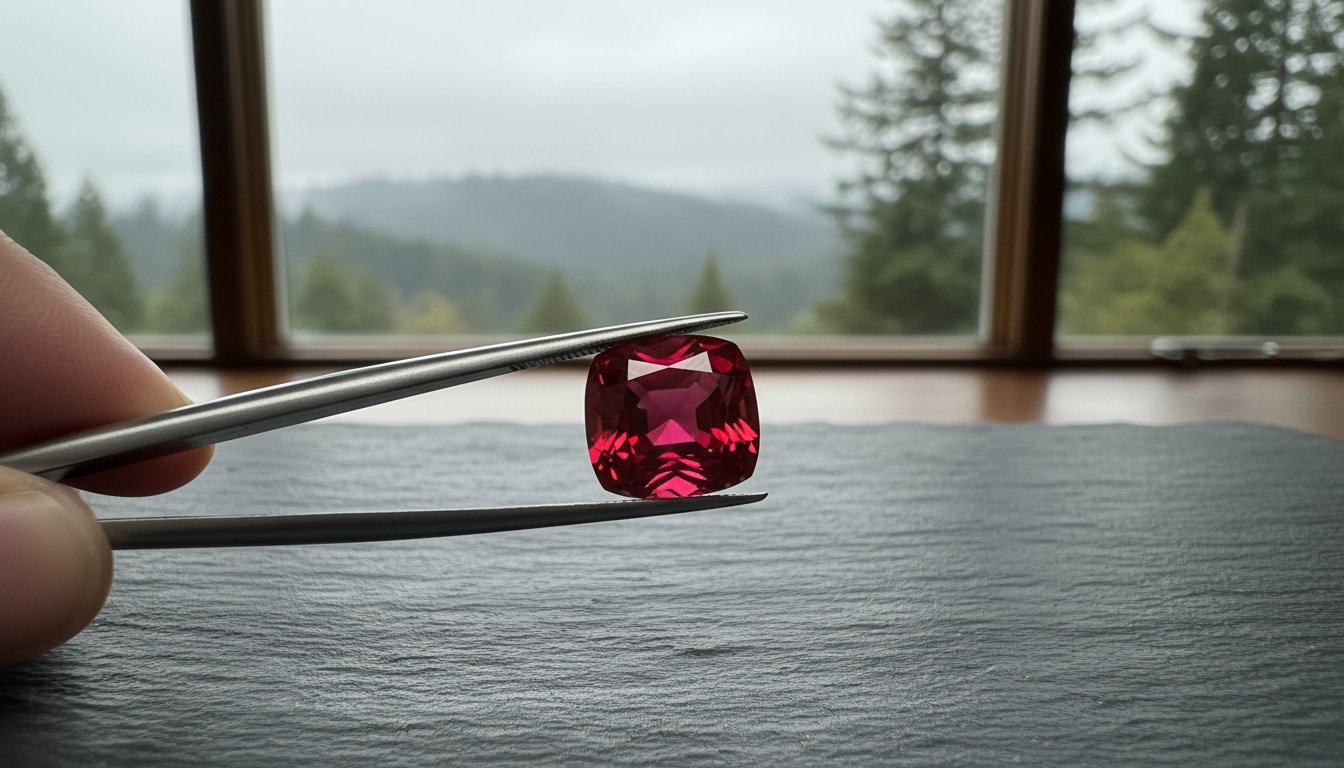
Would you trust a thirty million dollar investment to a single line of text on a lab report that fails to define its own terminology? When the Sunrise Ruby sold for that record-breaking sum in May 2015, it solidified the pigeon blood ruby as the most valuable non-diamond gemstone on the planet. You likely recognize that this specific grade represents the absolute zenith of the corundum family. However, you've probably felt the sting of confusion when two different laboratories provide conflicting opinions on the same stone. It's a common frustration for serious collectors who demand the radical transparency we champion here at AfricaGems.
You deserve to know exactly why a stone earns its pedigree, moving far beyond simple marketing labels. This guide provides the technical clarity you need to master the science and investment secrets of this elusive grade. You'll learn to interpret the rigorous standards of Gübelin and SSEF reports with the confidence of a seasoned dealer. We'll also compare the geological signatures of Burmese and Mozambique deposits; this ensures you can decide which origin fits your specific portfolio goals and secures a genuine masterpiece for your collection.
Key Takeaways
- Master the science behind the "internal glow" and learn why the rare interplay of chromium and iron defines the most breathtaking specimens.
- Distinguish between the historic prestige of Burma and the rising prominence of Mozambique to make an informed decision on provenance and market value.
- Decode high-tier gemological reports to ensure your pigeon blood ruby possesses the "No Heat" certification essential for true connoisseur-level acquisitions.
- Uncover the strategic investment trends that allow these rare gems to outpace traditional assets, focusing on the specific carat weights that offer the best liquidity.
The Legend and Definition of Pigeon Blood Rubies
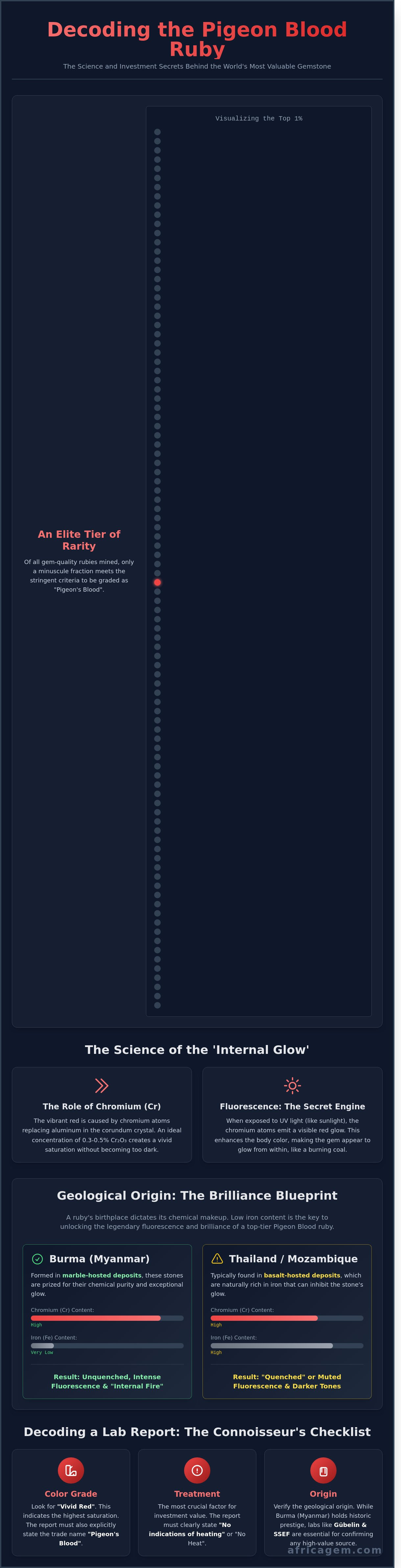
The term pigeon blood ruby isn't just a poetic descriptor; it's the absolute pinnacle of gemological grading. It refers to a ruby that exhibits a high-intensity vivid red hue, often complemented by a subtle blue undertone. This specific color profile creates a glowing effect that distinguishes it from standard stones. While thousands of carats are mined annually, the rarity of this grade is staggering. Less than 1% of all gem-quality rubies possess the precise saturation and tone required to earn this title from a major laboratory.
At AfricaGems, we recognize that the allure of these stones often leads to inflated marketing claims. We lean into the AfricaGems Difference by prioritizing rigorous lab certification over romanticized sales talk. When you browse our loose burma rubies, you're seeing stones vetted for technical excellence. We believe transparency is the only way to honor a gem this rare, ensuring that the technical data matches the visual beauty.
The Origins of the Name
The terminology traces back to the 19th-century mines of the Mogok Valley in Burma. Local miners described the ideal color by comparing it to the first two drops of blood from a freshly killed pigeon. While the imagery is visceral, it accurately captures the deep, warm center and the high-fluorescence characteristic of the finest stones. Ancient Sanskrit texts previously dubbed the ruby "Ratnaraj," meaning King of Gems. Today, major laboratories have moved beyond folklore, transforming this legendary description into a standardized grade that collectors rely on for valuation.
The 'Vivid Red' Standard
Modern gemological labs like GRS (Gemresearch Swisslab) and Gübelin have established strict criteria for what qualifies as "pigeon blood." The stone must show an "electric" level of saturation that doesn't shift into pink or orange. A standard red ruby might look flat in certain lighting, but a true pigeon blood ruby maintains its intensity through strong fluorescence, even in low light. Consistency is vital. The color must be distributed evenly across the entire crown of the stone without visible zoning or dull patches. This uniformity ensures the gem retains its fire from every viewing angle.
- Color Tone: Vivid red with a secondary blue modifier.
- Fluorescence: Strong reaction to UV light, enhancing the "inner glow."
- Distribution: Even saturation with no significant color zoning.
- Rarity: Representing the top 1% of global ruby production.
The Science of the Glow: Why Pigeon Blood Rubies Are Unique
The legendary status of the pigeon blood ruby isn't just a marketing myth. It's a result of precise chemical conditions that rarely occur in nature. Most rubies appear red because chromium replaces aluminum in the corundum crystal lattice. However, the pigeon blood ruby reaches a specific technical threshold, usually between 0.3 and 0.5 weight-percent of chromium oxide. This concentration allows the stone to achieve a vivid saturation without becoming overly dark. It's this chemical balance that creates the "Internal Fire," a phenomenon where the gem seems to generate light from its core. This effect remains visible even in low-light environments, setting these stones apart from standard commercial rubies.
Chromium vs. Iron Content
The geological origin of a stone dictates its beauty. In the Mogok Valley of Myanmar, rubies formed in marble-hosted deposits. These environments are naturally low in iron, which is the primary enemy of a ruby's brilliance. In contrast, basalt-hosted deposits like those found in Thailand or Cambodia contain high levels of iron. Iron acts as a natural filter that dulls the stone's appearance and "quenches" its ability to glow. Chromium concentration directly dictates how much green and violet light the corundum absorbs, leaving only the purest red wavelengths to reach your eye. This chemical purity is why a Burmese stone often looks vibrant while a Thai stone can appear brownish or overly dark.
Fluorescence: The Secret to the Glow
Fluorescence is the hidden engine behind the pigeon blood ruby's visual impact. When ultraviolet light from the sun hits the chromium atoms, they react by emitting a visible red glow. This adds an extra layer of color intensity that sits on top of the stone's body color. It's the reason why a top-tier ruby looks like a burning coal in direct sunlight. While many gems rely on external light to show their color, the chromium in a high-quality ruby acts like a tiny battery, storing and then releasing energy as visible light. The absence of iron in marble-hosted deposits ensures that this energy isn't wasted or absorbed.
- Optical Masking: The red fluorescence masks extinction, which are the dark areas inside a stone caused by light leakage.
- Pleochroism: Rubies are doubly refractive, showing different shades of red from different angles.
- Blue Undertone: A subtle blue secondary hue, often seen in the crystal's orientation, provides the deep "blood" saturation required for the top grade.
Understanding these technical nuances helps collectors appreciate why certain stones command record-breaking prices at auction. If you're looking to start your own collection, you can view our curated selection of natural rubies to see these optical properties in person. Experts look for that specific interplay between high chromium and low iron to guarantee a stone's long-term investment potential and aesthetic superiority.
Beyond Burma: Understanding Origin and Its Impact on Value
Origin isn't just a line on a lab report; it's the primary driver of a gemstone's market personality and its ultimate price tag. While the term pigeon blood ruby originated in the marbles of Upper Myanmar, the global trade now looks toward East Africa for stones of equal intensity and often superior clarity. Understanding the nuance between these locales is essential for any serious collector.
The Mogok Valley Legacy
For over 800 years, the Mogok Valley has remained the epicenter of ruby lore. Burmese stones are prized for their high chromium content and low iron, which produces a natural fluorescence. This makes the gem appear to glow from within, even in low-light environments. The presence of rutile silk is a hallmark of Mogok. These microscopic needles scatter light into the darker areas of the stone, ensuring a vibrant red across every facet. This historical prestige creates an "Origin Premium" where Burmese rubies command prices 300% to 500% higher than those from other regions. A prime example is the 25.59-carat Sunrise Ruby, which fetched over $30 million at a 2015 Sotheby’s auction, cementing the Mogok legacy.
The Rise of Mozambique Rubies
The 2009 discovery in Montepuez, Mozambique, fundamentally changed the high-end market. Mozambique rubies often boast superior transparency and larger crystal sizes than their Burmese counterparts. They typically lack the heavy silk of Burmese stones, resulting in a glassier, more brilliant appearance that many modern jewelry designers prefer. For the savvy investor, this represents a "smart buy" opportunity. You can often acquire a 5-carat Mozambique pigeon blood ruby for a fraction of the cost of a 2-carat Burmese stone, without sacrificing the vivid red saturation required for the grade.
Beyond the price advantage, AfricaGems prioritizes these African sources because of the industry-wide shift toward transparent, ethical mining. We ensure our rare gemstones come from mines that respect both the environment and the local labor force. This ethical framework is a pillar of our brand, providing the security you need when purchasing high-value minerals.
- Burmese Rubies: Famous for "silk" inclusions and velvet-like fluorescence.
- Mozambique Rubies: Known for exceptional clarity, larger sizes, and ethical traceability.
- Price Disparity: Burma rubies carry a significant premium due to scarcity and historical demand.
Choosing between these origins depends on your goals. If you seek historical provenance and the classic "glow," Burma is the standard. If you value clarity, size, and a conflict-free supply chain, Mozambique offers an incredible alternative for a world-class collection.
Evaluating Quality: How to Read a Pigeon Blood Ruby Lab Report
A pigeon blood ruby is only as certain as the paper that backs it. In the world of high-end gems, three names stand alone: the Swiss Gemmological Institute (SSEF), Gübelin Gem Lab, and the Gemological Institute of America (GIA). These institutions maintain the strict colorimetry and chemical analysis required to issue this specific trade name. While smaller labs might use the term loosely, global auction houses like Christie's and Sotheby's rely almost exclusively on these three. If a certificate doesn't come from a top-tier lab, the "pigeon blood" claim is merely an opinion, not a valuation standard.
Clarity is another critical factor. Rubies are "Type II" gemstones, which means they almost always contain inclusions. While we look for "eye-clean" stones where inclusions don't distract from the light return, "loupe-clean" rubies are statistically non-existent in nature. If a report for a large stone claims no inclusions, you should exercise extreme caution. These internal "fingerprints" often prove the stone's natural origin and geographic birthright.
Decoding SSEF and Gübelin Certificates
The "Origin" field is your first checkpoint. For a pigeon blood ruby, Burmese (Myanmar) origin usually commands the highest premium, though exceptional Mozambican stones now earn the grade too. In 2015, SSEF and Gübelin harmonized their standards to ensure the label only applies to stones with high brilliance and no dominant windowing. You must look at the "Comments" or "Appendix" section. This is where the lab specifically notes if the color reaches the "vivid red" saturation required for the append. Always verify the certificate number on the lab's official website to ensure the digital record matches the physical document in your hand.
The Impact of Heat Treatments
Heat is the most common variable in ruby pricing. An unheated pigeon blood ruby is 20 to 50 times rarer than its heated counterpart. While ruby heat treatment can improve clarity and remove purple secondary tones, it significantly lowers investment potential. At AfricaGems, we practice "radical transparency." This means every stone comes with a full disclosure of any enhancements. We believe you deserve to know exactly what you're buying. Heat can fix a stone's appearance, but it can't replicate the geological miracle of a natural, vivid red crystal.
Ready to find a stone with ironclad credentials? Browse our collection of certified natural rubies
Investing in a Legend: Buying and Designing with Pigeon Blood Rubies
A pigeon blood ruby isn't just a gemstone; it's a portable asset class with a proven track record of value retention. Over the last 20 years, top-tier rubies have consistently outperformed colorless diamonds in price appreciation. For instance, the 25.59-carat Sunrise Ruby set a world record at a 2015 Sotheby’s auction by selling for over $30 million. This represents more than $1 million per carat, a benchmark that stunned the jewelry world. This price resilience stems from a simple mathematical reality: the supply of unheated, vivid red corundum is finite, while global demand from private collectors continues to climb.
Pricing Trends and Investment Potential
While massive stones capture headlines, the most liquid segment of the market resides in the 2 to 5-carat range. These stones are rare enough to command premium prices yet accessible enough to find ready buyers in the secondary market. When you're buying for long-term value, prioritize color saturation and internal "glow" over absolute clarity. To ensure the highest possible return on investment, collectors must prioritize "No Heat" certificates from reputable labs like GRS or GIA. This documentation proves the stone's color is a natural miracle rather than a laboratory enhancement, which can double the stone's market value compared to heated counterparts.
Bespoke Jewelry Design
Owning a loose pigeon blood ruby is the first step toward creating a legacy piece. At AfricaGems, we specialize in transforming these rare minerals into custom pendants, rings, and bracelets through a collaborative design process. The choice of metal is vital for maximizing the stone's visual impact. Platinum provides a neutral, secure setting that allows the ruby's natural fluorescence to pop without interference. Alternatively, 18k yellow gold can enhance the warmth of stones with slightly orange undertones. You can view our current inventory of loose rubies to begin your journey toward a bespoke heirloom.
Every high-value transaction at AfricaGems is backed by the Marc Sarosi Guarantee. With over 39 years of experience in the gemstone trade, Marc provides a level of personal accountability that large corporations cannot match. We operate on a policy of radical transparency, disclosing every detail of a stone's origin and treatment status. This commitment ensures you aren't just buying a gem; you're securing a verified piece of Earth's history with the full confidence of an expert mentor by your side. Our goal is to make you an informed insider, providing the data and security necessary for such a significant acquisition.
Secure Your Legacy in Crimson
Owning a pigeon blood ruby is a journey into the heart of geological rarity. You've learned that the true value of these gems lies in their high chromium content, which creates that signature fluorescent glow. While historical sources like Burma's Mogok Valley remain legendary, modern connoisseurs now look to high-quality deposits in Mozambique as viable alternatives. Navigating this market requires technical precision. Every serious acquisition must be backed by rigorous documentation from labs like the GIA, Gübelin, or SSEF to verify its status.
At AfricaGems, we uphold the highest standards of the AfricaGems Difference. Our founder, Marc Sarosi, personally inspects and vets every stone to ensure it meets our exacting criteria for color saturation and clarity. We provide full transparency with GIA, Gübelin, or SSEF certification for our investment-grade pieces. You can shop with absolute confidence thanks to our 30-day no-questions-asked return policy. It's your time to find a gemstone that resonates with your personal legacy and brings a lifetime of brilliance to your collection.
Explore Our Curated Collection of Investment-Grade Pigeon Blood Rubies
Frequently Asked Questions
What is the price per carat for a pigeon blood ruby in 2026?
Market analysts expect prices to follow the 15% annual growth trend seen in the Knight Frank Luxury Investment Index over the last decade. High-quality unheated stones from Myanmar currently command between $10,000 and $50,000 per carat for 1 to 2-carat gems. Exceptional specimens over 5 carats often exceed $1,000,000 per carat at auction, as evidenced by the $34.8 million sale of the Estrela de Fura in 2023.
Is a Mozambique pigeon blood ruby as good as a Burmese one?
Mozambique rubies offer incredible clarity and size, but they possess a different chemical signature than Burmese stones. GemResearch Swisslab began awarding the "pigeon blood" designation to Mozambique gems in 2012 due to their vivid saturation. While they're visually comparable, Burmese stones still carry a 30% to 50% price premium because their low iron content creates a stronger fluorescent glow under UV light.
Can a lab-created ruby be classified as pigeon blood?
A lab-created stone can match the visual color coordinates of a pigeon blood ruby, but it won't hold the same investment value. Synthetic gems grown via the Czochralski process replicate the 600nm spectral peak of natural stones. However, they lack the microscopic "silk" inclusions found in the Mogok Stone Tract. These stones trade for less than 1% of the price of an ethically sourced natural gemstone.
How can I tell if a pigeon blood ruby is real at home?
You can't definitively verify a stone's origin at home, but a 10x jeweler’s loupe helps identify natural growth markers. Look for tiny mineral crystals or "silk" needles; if the stone's perfectly flawless, it's likely a synthetic. You can also perform a breath test where a real ruby clears fog in about 2 seconds, while glass takes 5 seconds. Professional certification from GIA or SSEF remains the only 100% reliable method.
Why are pigeon blood rubies so much more expensive than other rubies?
Extreme scarcity drives the cost, as fewer than 1% of gem-quality rubies meet the strict color criteria set by international labs. These stones feature a high chromium content and low iron, which produces a natural internal fire. This rare chemical balance, combined with a 9 on the Mohs scale, makes them more durable and significantly rarer than colorless diamonds of comparable weight.
Do pigeon blood rubies always have a blue undertone?
The term traditionally describes a vivid red hue with a subtle, purplish-blue secondary undertone. This isn't a distinct color you'll see clearly, but a depth that prevents the stone from appearing too orange or pink. Gemologists at the Gubelin Gem Lab look for this specific saturation to ensure the stone mimics the "glowing coal" effect. It's this precise balance that gives the gem its legendary intensity in natural daylight.
What is the best cut for a pigeon blood ruby to show its color?
The oval or cushion cut is the industry standard for maximizing the vividness of a pigeon blood ruby. Since ruby crystals are typically tabular, these shapes allow the cutter to retain 60% of the rough weight while enhancing pleochroism. A well-executed cushion cut minimizes "extinction," which are the dark areas inside the stone. This ensures the red hue remains consistent across the entire surface of the gem.
Are all Burmese rubies considered pigeon blood?
Only a small fraction of rubies mined in Myanmar earn this prestigious color grade. While the Mogok Valley is the historical home of these gems, many stones found there are too dark, too pink, or heavily included. Industry reports from 2023 suggest that fewer than 5% of Burmese production meets the saturation and tone requirements for a "pigeon blood" certificate. Each stone must undergo rigorous testing for color consistency to qualify.