
Oval Cut Alexandrite Price: The Connoisseur’s Guide to Value and Quality
Jul 20th 2026
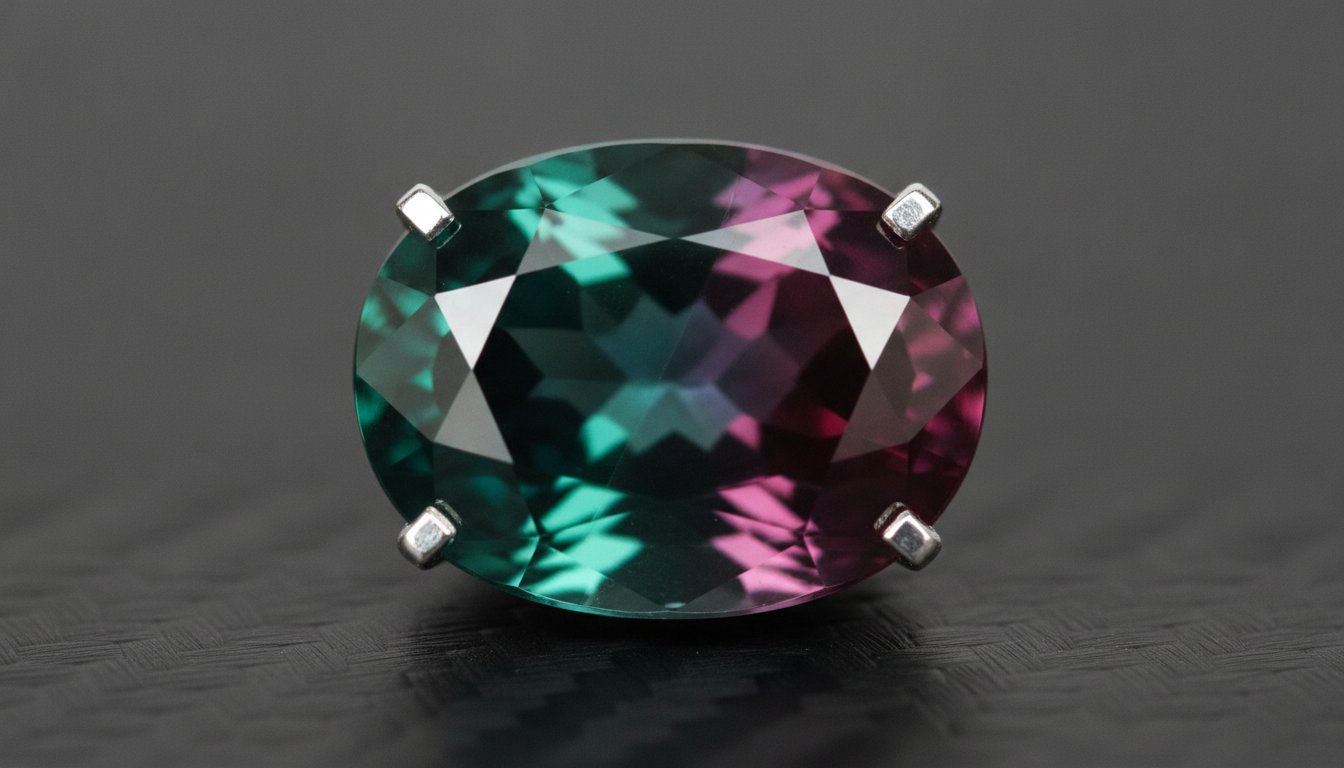
Did you know that the intensity of a gemstone's color change can account for up to 70% of its total market value? For many collectors, determining a fair oval cut alexandrite price feels like chasing a phantom, especially when two stones of similar weight carry wildly different valuations. You're likely here because you've seen how "face-up" size can be deceptive, or perhaps you're concerned about the rise of synthetic stones being misrepresented as natural. It's a high-stakes environment where a shift from 50% to 85% color change can mean the difference between a modest accessory and a world-class investment.
This guide provides the technical clarity you need to evaluate the "emerald by day, ruby by night" phenomenon with the eyes of a professional. You'll learn why the oval cut is the preferred shape for balancing color-change visibility with carat retention, ensuring your stone looks as impressive as its certificate suggests. We'll explore the specific factors driving the oval cut alexandrite price, including GIA identification standards and the critical importance of ethical sourcing. By the end, you'll have a clear framework to source a certified natural stone with the security and sophistication of a true connoisseur.
Key Takeaways
- Learn how color-change percentage acts as the definitive driver for the oval cut alexandrite price, representing the most significant portion of a stone's market value.
- Understand why the oval cut is the preferred choice for connoisseurs, offering the ideal balance between maximizing carat weight and showcasing the "alexandrite effect."
- Identify the "magic weight" thresholds at one and two carats where scarcity multipliers cause exponential price escalations for natural specimens.
- Evaluate the distinct value propositions of rare natural stones versus premium Chatham lab-grown options to align with your personal collection goals.
- Gain total security in your purchase by mastering the verification process, from interpreting GIA reports to performing the essential multi-light source video test.
Why Oval Cut Alexandrite is the Preferred Choice for Collectors
Alexandrite isn't just another gemstone; it's a phenomenon. Scientifically categorized as the color-changing variety of the mineral chrysoberyl, its value lies in its remarkable ability to shift from mossy green in daylight to a raspberry red under incandescent light. To understand Alexandrite gemstone properties, one must look at how light interacts with its specific crystal structure. The oval cut has emerged as the premier choice for serious collectors because it honors the natural geometry of the rough while providing a superior canvas for this "alexandrite effect."
Unlike diamonds, where round brilliants dominate the market, alexandrite is almost always cut into ovals or cushions. This isn't just a matter of style; it's a strategic decision regarding yield. Natural alexandrite rough is notoriously flat or elongated. If a lapidary attempted to cut a perfect round, they would likely lose 60% or more of the precious material. By choosing an oval, they can retain a higher carat weight, which significantly impacts the final oval cut alexandrite price. Additionally, the elongated facets of an oval better showcase the stone’s pleochroism, allowing different colors to flash from different angles as the stone moves through space.
To witness the mesmerizing dance of light in a high-quality specimen, watch this helpful video:
Beyond weight retention, ovals offer a distinct visual advantage. Because of their elongated shape, an oval alexandrite often appears larger to the eye than a round cut of the exact same carat weight. This "face-up" size makes the stone feel more substantial in a ring setting. When sourcing precious gemstones like alexandrite, this visual presence allows a collector to achieve a grander look without the exponential cost of moving into a significantly higher carat bracket.
The Physics of Color Change in Oval Geometry
The pavilion of an oval cut is specifically designed to bounce light through the stone's body, maximizing the color saturation you see. However, this geometry is highly sensitive. If the pavilion is too shallow, you get "windowing," an area where light passes straight through rather than reflecting back to your eye. A windowed stone looks "leaky" or hollow in the center and carries a lower oval cut alexandrite price. Symmetry is equally vital; an off-center oval will cause uneven color distribution, muddling the transition between daylight and incandescent tones and reducing the stone's overall investment appeal.
Yield vs. Beauty: The Lapidary’s Dilemma
In the world of rare gems, there's a constant tension between weight and aesthetics. You'll often encounter "native cuts" in the market. These are stones cut in the country of origin to keep as much weight as possible, sometimes resulting in lopsided bellies or poor proportions that hide the stone's true fire. While these native cuts might be heavier, precision-cut ovals command a massive premium. A master lapidary will sacrifice a bit of weight to ensure perfect light return and symmetry. This balance of technical skill and raw material rarity is what separates a common stone from a true legacy-grade investment.
Primary Drivers of Oval Cut Alexandrite Price
Determining the oval cut alexandrite price requires a nuanced understanding of how different quality factors intersect. Unlike diamonds, where a standardized 4C system provides a rigid framework, alexandrite valuation is a more fluid art. The primary driver of value is the rarity of the material itself, but within that scarcity, specific technical attributes dictate whether a stone is a beautiful curiosity or a museum-grade investment. Collectors must look beyond the surface to understand how color-change intensity, clarity, and saturation define the market's hierarchy.
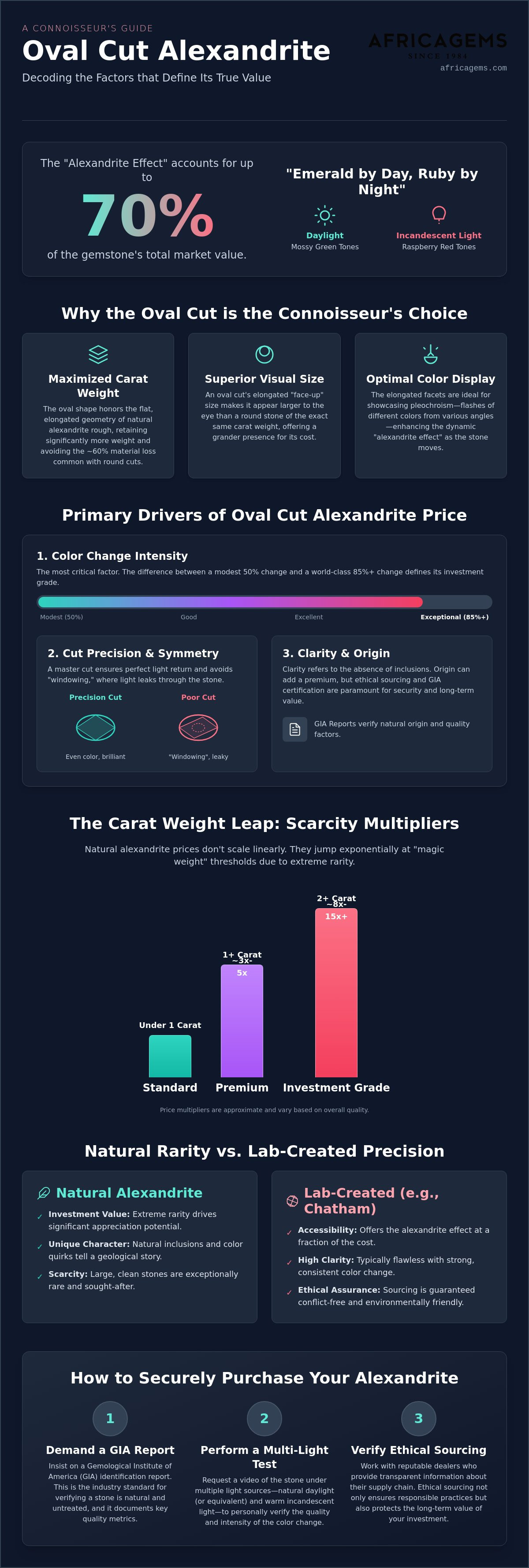
The color change phenomenon is the heartbeat of this gemstone's value, often accounting for as much as 70% of its total worth. A stone that transitions from a dull brownish-green to a muddy purple will never command the same respect as a specimen showing a vibrant teal in daylight and a rich raspberry red under incandescent light. When you evaluate natural alexandrite specimens, you're looking for a "clean" shift where no trace of the previous color remains. For those researching How to Securely Purchase an Oval Alexandrite, recognizing these technical markers is the first step toward a sound acquisition.
Evaluating the 100% Color Change Premium
In the trade, we talk about the "percentage" of color change. Investment-grade stones typically exhibit a change of 85% to 100%. This purity in the shift is what drives the oval cut alexandrite price into the highest tiers. If the stone retains a "bleed" of green while under incandescent light, its value drops significantly. Color-change saturation is the intensity of the hue in both lighting conditions. High saturation ensures the colors remain vivid and don't wash out into grey or brown, which is a common flaw in lower-quality material.
The Origin Factor: Brazil vs. East Africa
Origin remains a powerful psychological and financial factor in the market. While the historic Russian Ural mountain mines are nearly extinct, stones with verified Russian provenance still command the highest premiums due to their legacy. However, Brazil has become the modern gold standard for high-quality ovals. Brazilian stones are prized for their exceptional clarity and deep, saturated color changes. In contrast, emerging sources in East Africa, specifically Tanzania and Madagascar, are producing stones that offer incredible value. These African specimens often rival Brazilian quality but can sometimes be acquired at a more approachable price point, making them an excellent choice for new collectors entering the market.
Clarity also plays a vital role. The GIA classifies alexandrite as a Type II gemstone, meaning some minor inclusions are expected. However, "eye-clean" stones, where no inclusions are visible to the naked eye, carry a significant premium. Because the oval cut has a large table facet, inclusions are harder to hide than in other shapes, making clarity a non-negotiable factor for top-tier pricing.
Carat Weight Brackets and Scarcity Multipliers
In the world of Precious Gemstones, size isn't just about measurement; it's about the statistical impossibility of nature. For alexandrite, the relationship between size and cost is exponential rather than linear. While a two-carat sapphire might cost double its one-carat counterpart, a two-carat alexandrite can command four or five times the price per carat. The oval cut alexandrite price is heavily influenced by these psychological and physical thresholds, where even a fraction of a carat can trigger a massive jump in valuation.
Experienced collectors often look for "underweight" ovals to find hidden value. A stone weighing 0.95 carats might look virtually identical to a 1.05-carat stone once set in a ring, yet it can be significantly more affordable because it sits just below a major price bracket. However, as scarcity increases, these opportunities become rarer. The market value of top-tier one-carat alexandrites surged by as much as 300% in the decade leading up to 2024, reflecting a global scramble for high-quality rough. This makes understanding the oval cut alexandrite price a matter of timing as much as technical evaluation.
The 1-Carat Threshold for Ovals
The one-carat mark is the most significant hurdle in the alexandrite market. Because this size is the standard for high-end center stones in engagement rings, demand is relentless. Nature rarely produces clean alexandrite crystals that can yield a finished one-carat oval. When a stone crosses this threshold while maintaining an 85% or better color change, it moves out of the category of "jewelry" and into the category of "rarity." Collectors should expect a sharp increase in the price-per-carat the moment a stone hits 1.00ct.
Investment-Grade Ovals (2-5 Carats)
Stones exceeding two carats are considered investment-grade, while anything over three carats is often destined for a museum or a private legacy collection. At this level, the "magic weights" of 2.00ct and 3.00ct create massive scarcity multipliers. For these significant acquisitions, independent laboratory reports from the GIA or AGL are non-negotiable. These documents provide the technical validation required for such a high-value transaction, ensuring that the stone's origin and natural status are beyond reproach. Historically, these large, fine-quality ovals have shown remarkable price stability, acting as a secure asset for the informed insider.
Natural vs. Lab-Created: Budgeting for Your Goal
Choosing between a natural and a lab-created specimen is the most significant decision impacting the oval cut alexandrite price. While both materials are chemically and optically identical, they occupy entirely different tiers of the luxury market. A natural alexandrite is a finite geological treasure, a store of value that has matured over millions of years. Conversely, a lab-created stone is a feat of modern science designed for consistent beauty and daily resilience. Understanding your long-term intent is vital before committing to a purchase.
The price gap between these two categories is vast. Because natural alexandrite is exceptionally rare, especially in sizes exceeding one carat, its cost reflects its status as a world-class asset. You'll find that natural stones often command 10x to 100x the price of their lab-grown counterparts. This isn't merely a markup for "authenticity"; it's a reflection of a global market where supply is dwindling while demand from serious collectors continues to accelerate.
The Allure of Natural Scarcity
The "Earth-mined" narrative is more than just a story; it's the primary engine of resale value. Natural alexandrite is one of the world's most elusive materials, often outranking even the finest diamonds in terms of rarity. You're not just buying a gemstone; you're acquiring a "one-in-a-million" marvel that nature will never reproduce. This extreme scarcity is why natural specimens are treated as heirloom investments. For those building a legacy collection, owning one of these Rare Gemstones provides a sense of security and heritage that synthetic material cannot replicate.
While natural stones are prized for their investment potential, they often possess "fingerprints" of nature, such as tiny inclusions or slight color nuances. These characteristics prove the stone's authenticity. If your goal is a secure asset that historical data suggests will appreciate, the natural oval cut alexandrite price premium is a necessary entry cost for a true connoisseur.
Chatham Lab-Created Ovals: A Practical Alternative
For those who prioritize visual perfection and durability for daily wear, Chatham lab-created stones offer a compelling value proposition. These aren't cheap imitations; they are flux-grown crystals that mirror the growth process of natural chrysoberyl. Unlike "pulled" alexandrite, which is grown rapidly and often lacks depth, flux-grown stones take months to form. This methodical process results in a "perfect" color change that mimics the finest Russian specimens, shifting from a crisp teal to a vivid raspberry red with 100% saturation.
Chatham ovals are ideal for engagement rings or jewelry subjected to frequent movement. They provide the high-performance aesthetics of a top-tier natural stone without the high-stakes financial risk. If you're looking for the legendary color-change effect at a fraction of the investment, you can explore our selection of Chatham Lab Created Gemstones to find a specimen that matches your aesthetic vision.
How to Securely Purchase an Oval Alexandrite
Acquiring a rare gemstone is a journey that requires more than just an appreciation for beauty; it demands a rigorous verification process. Because the oval cut alexandrite price is so sensitive to color-change quality and origin, you must move beyond static photography. A static image can only capture one side of this gem's personality. To truly vet a stone, you need to see it in a "Video Test" that transitions from natural daylight to incandescent warmth. This is the only way to confirm that the 85% or 100% color change promised on paper translates into a vivid reality on your hand. If a dealer cannot provide high-definition video in multiple lighting environments, the risk of a mismatched expectation becomes too high for a serious collector.
Security in these high-value transactions comes from a combination of technical documentation and the integrity of the dealer. You're looking for a partner who acts as a knowledgeable mentor rather than a high-pressure salesperson. A premier dealer should offer radical transparency, providing not just the stone, but the full story of its journey from the mine to the master lapidary. This level of disclosure is what transforms a digital storefront into a personal consultation, giving you the confidence to invest in such a rare material. Longevity in the trade is a hallmark of trust, as it suggests a history of standing behind every carat sold.
Vetting the Gemstone Report
Never finalize a purchase without an independent laboratory report from a globally recognized institution like the GIA, AGL, or Gübelin. When you examine the report, pay close attention to the "Comments" section. While natural alexandrite is typically untreated, any mention of enhancements must be clearly disclosed. Verify that the shape is officially listed as "Oval." If the report mentions a modified "Native Cut" or uneven proportions, it could suggest that the stone was cut to prioritize weight over light return, which should be reflected in a lower oval cut alexandrite price. Finally, ensure the report explicitly identifies the color-change phenomenon to confirm you're holding a true alexandrite and not a standard chrysoberyl.
The AfricaGems Advantage
Since 1984, Marc Sarosi has built a legacy on the personal selection of every specimen in our inventory. We believe that the bridge between raw technical data and aesthetic beauty is built on trust. This is why we provide a 100% money-back guarantee and maintain an uncompromising stance on ethical sourcing. Each stone is a reflection of our commitment to the integrity of the gemstone industry. When you are ready to find a specimen that meets these rigorous standards, you can Shop Loose Alexandrite with the assurance of full disclosure and personal accountability. Our goal is to ensure you feel like an informed insider, secure in the knowledge that your investment is as authentic as it is breathtaking.
Secure Your Legacy with a Master-Selected Alexandrite
You now possess the technical framework to navigate the complexities of the gemstone market with confidence. By prioritizing color-change intensity and understanding how carat weight brackets influence the oval cut alexandrite price, you can distinguish between a common gem and a true investment-grade rarity. The oval shape isn't just an aesthetic preference; it's a calculated choice that balances light performance with the scarcity of natural rough. This knowledge ensures you aren't just buying a stone, but acquiring a documented asset with lasting value.
Since 1984, AfricaGems has provided radical transparency and ethical sourcing for the world's most discerning collectors. Every stone in our vault undergoes a personal expert selection by Marc Sarosi to ensure it meets our uncompromising standards for beauty and integrity. We provide the GIA or AGL certification necessary for a secure transaction, backed by a legacy of full disclosure and personal accountability. Your journey into the "emerald by day, ruby by night" phenomenon deserves a partner who values quality as much as you do.
Explore Our Hand-Selected Collection of Natural Oval Alexandrite and find the center stone that will define your collection for generations. We look forward to helping you secure a piece of nature's most elusive magic.
Frequently Asked Questions
Is an oval cut alexandrite more expensive than a round cut?
Generally, a round cut alexandrite carries a higher price per carat than an oval. This is because cutting a round stone requires a much larger sacrifice of the rare rough material, leading to a lower yield. Ovals are the preferred choice for collectors because they follow the natural, elongated shape of the chrysoberyl crystal, allowing for better weight retention without compromising the stone's beauty or color-change performance.
How does the color change affect the price of an oval alexandrite?
Color change is the single most influential factor in determining value. A stone that exhibits a 100% shift from a vivid bluish-green to a raspberry red will command a massive premium over stones with a weak or muddy transition. This "alexandrite effect" can account for up to 70% of the total oval cut alexandrite price, making the intensity and purity of the shift the primary focus for any serious investor.
What is the price per carat for a 1-carat natural oval alexandrite?
Market prices for one-carat specimens fluctuate based on the quality of the color change and clarity. High-quality stones with an 85% to 100% change and eye-clean clarity often reach into the tens of thousands per carat. Mid-quality stones with a 50% to 80% change are more accessible, while lower-quality stones with significant inclusions or poor shifts are priced much lower. These tiers reflect the extreme rarity of fine-quality natural material.
Are Brazilian oval alexandrites worth the premium?
Brazilian stones are widely considered the gold standard for modern alexandrite. They are prized for their exceptional clarity and the "cleanliness" of their color shift, which often rivals the legendary Russian Ural mountain stones. While you'll pay a premium for Brazilian provenance, the market recognizes these stones as superior assets. Their historical price stability and high demand among connoisseurs make them a secure choice for a high-value acquisition.
Do lab-created oval alexandrites have any resale value?
Lab-created stones possess very little resale value compared to natural ones. While they are chemically identical and offer stunning visual performance, they aren't rare. They are perfect for daily-wear jewelry where fashion and durability are the goals. However, if you're looking for a stone that acts as a store of value or a financial investment, a natural stone is the only option that offers long-term appreciation potential.
Why are some oval alexandrites cut very deep or "bulky"?
Deep cuts are often the result of "native cutting" in the country of origin. Because the rough material is so expensive, lapidaries are under immense pressure to keep as much carat weight as possible. While this creates a heavier stone, it can sometimes lead to poor light return or a "window" in the center. Precision-cut ovals that sacrifice weight for perfect symmetry and brilliance always command a higher price per carat in the professional market.
What is the best clarity grade for an investment-grade alexandrite?
The standard for investment-grade alexandrite is "eye-clean." Since the GIA classifies alexandrite as a Type II gemstone, minor inclusions are expected under a microscope. However, for a stone to reach the top tier of the oval cut alexandrite price spectrum, it shouldn't have any flaws visible to the naked eye. Clarity is especially important in ovals, as the large table facet can easily reveal internal imperfections that detract from the color change.
Can I use an oval alexandrite in an engagement ring for daily wear?
Alexandrite is an excellent choice for an engagement ring. It has a Mohs hardness of 8.5, which makes it one of the most durable gemstones available, surpassed only by sapphire, ruby, and diamond. It's tough enough to withstand the rigors of daily wear while offering a unique, shifting beauty that other gems can't match. Choosing an oval cut provides a sophisticated, elongated look that feels substantial and elegant on the hand.

Article by
Marc Sarosi
Professional gemstone dealer for more than 40 years. Started off mining Aquamarine in Zambia, Africa and travelled throughout the continent in search of fine gems. Trusted authority on fine gemstones and have donated a fine collection of more than 27 extraordinary gemstones to the Smithsonian Institute Gem Hall for generations to see.