
Natural vs. Lab-Created Alexandrite: The Connoisseur’s Guide to the Chameleon Gem
Aug 26th 2026
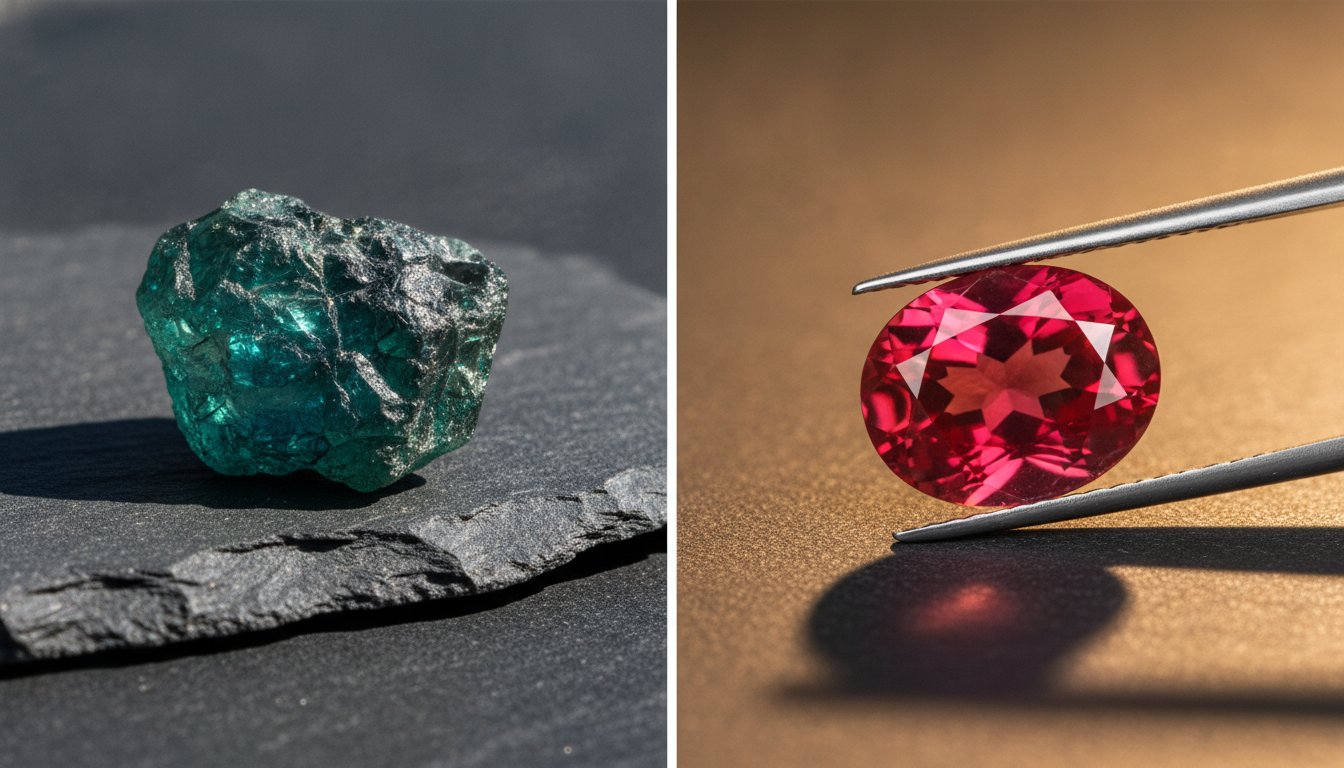
What if the most elusive treasure in your collection wasn't a diamond, but a "chameleon" that transforms with every change in light? Collectors often find themselves at a crossroads when faced with the steep entry point and extreme scarcity of this miraculous chrysoberyl variety. The natural vs lab created alexandrite debate is more than just a matter of price; it's a choice between owning a geologic miracle and a technical masterpiece. You deserve to understand exactly what you're acquiring when a single stone can represent a significant financial and emotional investment.
We recognize the frustration of navigating confusing terminology like "synthetic" and "simulated" while fearing you might overpay for a stone with a weak color shift. This guide will demystify the complexities of value, rarity, and visual performance so you can make a confident decision. We'll provide a clear analysis of the price-to-rarity ratio, teach you how to identify a superior color change, and help you determine which option best fits your lifestyle, whether you're seeking a legacy investment or a durable piece for daily wear.
Key Takeaways
- Understand the unique chemical composition of chrysoberyl that enables the dramatic "Alexandrite Effect" under varying light sources.
- Learn how specific mining locations in Brazil and East Africa influence the base hue and the intensity of the gem's color shift.
- Evaluate the natural vs lab created alexandrite trade-off by comparing the flawless saturation of lab-grown gems with the unique "jardin" of earth-mined stones.
- Master the terminology of the trade to ensure you don't mistake a low-value "simulated" stone for a high-quality synthetic alexandrite.
- Determine if your collection requires the historical rarity of a natural specimen or the attainable luxury of a lab-grown stone for a [gemstone pendant](https://www.africagems.com/gemstone-pendants.html).
The Phenomenon of Alexandrite: Understanding the Color-Change Marvel
Alexandrite isn't just a gemstone; it's a profound optical event that challenges our perception of color. This rare variety of the chrysoberyl mineral family stands as a testament to nature's unpredictability and refined beauty. Discovered in Russia's Ural Mountains in 1834, the gem was named for Tsar Alexander II, as its red and green flashes mirrored the military colors of Imperial Russia. While many collectors focus on traditional precious stones, seasoned connoisseurs recognize alexandrite as a member of the "Big Three" of rarity, often sharing the spotlight with Paraiba tourmaline and Padparadscha sapphire. Understanding the nuances of natural vs lab created alexandrite begins with appreciating why this stone exists at all.
What Causes the 'Emerald by Day, Ruby by Night' Effect?
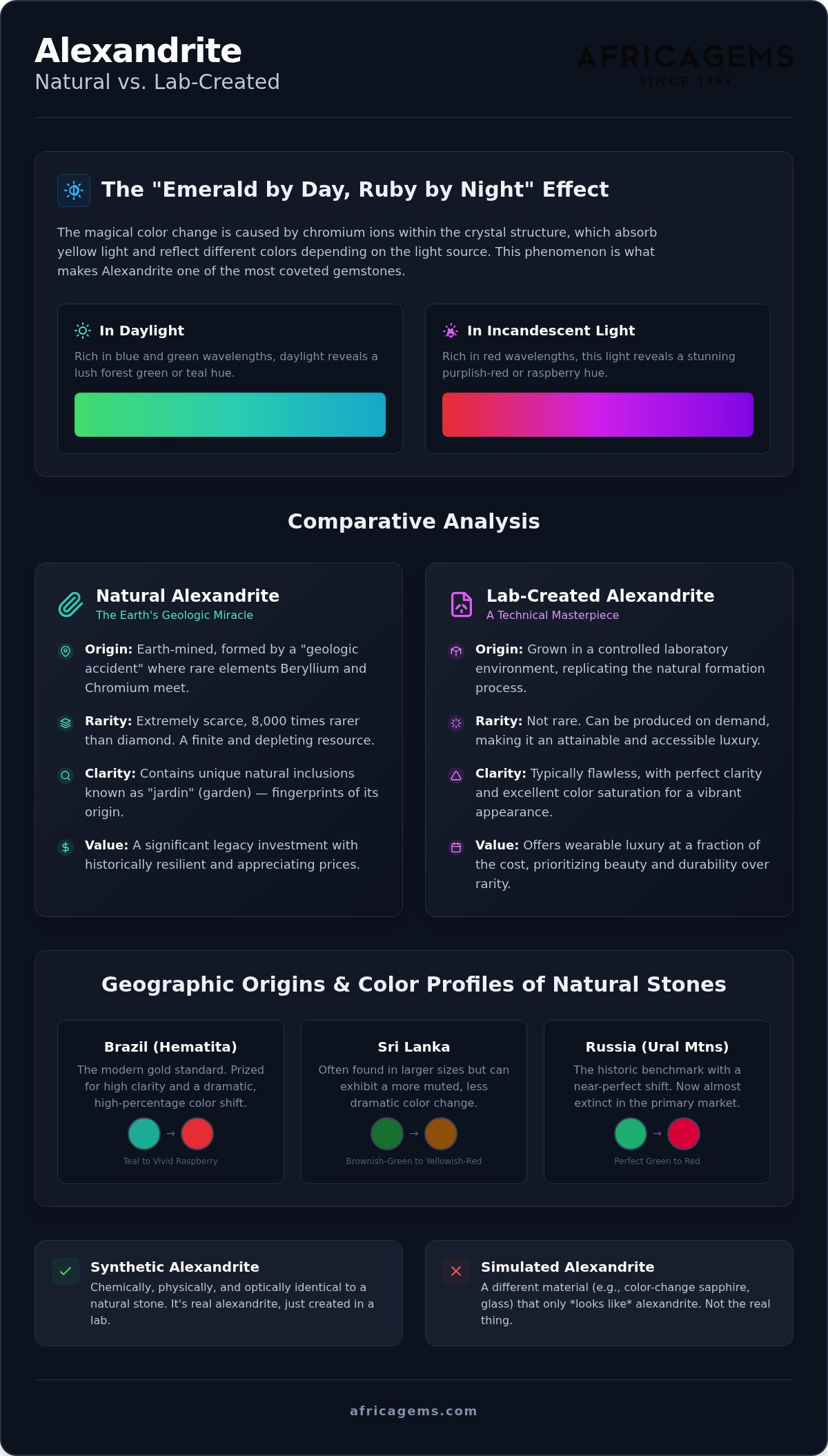
The secret lies in a specific light absorption phenomenon caused by chromium ions within the crystal structure. These ions create narrow absorption bands in the yellow region of the visible spectrum, leaving the blue, green, and red regions available for reflection. In natural daylight, which is rich in blue and green wavelengths, the stone reflects a lush forest green or teal. Switch to incandescent light, and the shift toward the long-wave red end of the spectrum transforms the gem into a purplish-red or raspberry hue. Pleochroism is the gemological term for a crystal's ability to show different colors from different angles. This complex interaction with light defines the visual drama of every specimen.
The Rarity Scale: Why Is Alexandrite So Hard to Find?
The formation of this gem is a geologic miracle that almost never happens in nature. Beryllium, an extremely rare element, must meet chromium, which is typically found in entirely different rock types like chromite. They rarely coexist in the same environment. This "geologic accident" means that finding high-quality loose alexandrite gemstones is significantly more difficult than sourcing traditional diamonds. Because the conditions required for its birth are so precise, the global supply remains perpetually constrained and unpredictable. Most mined deposits are exhausted within years of discovery, leaving a market that relies on small-scale artisanal mining in remote locations. This extreme scarcity is the primary driver for collectors weighing the merits of natural vs lab created alexandrite, as the earth-mined variety represents a finite resource of immense historical and financial significance.
Natural Alexandrite: The Earth’s Rarest Geologic Miracle
While we've established the chemical miracle of the "alexandrite effect," the physical reality of an earth-mined stone is a story of extreme scarcity. Natural alexandrite is a geologic rarity that occurs approximately 8,000 times less frequently than diamonds, making it a pinnacle of any serious collection. Unlike the flawless consistency often seen in the natural vs lab created alexandrite comparison, natural specimens carry unique inclusions known as "jardin." These microscopic "fingerprints" of nature confirm the stone's organic origin. For a collector, these internal features aren't flaws; they're the silent witnesses to a journey that began millions of years ago in the earth's mantle. The Gemological Institute of America notes that these characteristics help gemologists verify authenticity and determine geographic origin.
Geographic Origins and Their Color Profiles
Location dictates the personality of a natural stone. Brazilian alexandrite, particularly from the Hematita mine, is the modern gold standard. It's prized for its high clarity and dramatic, high-percentage color shifts from teal to a vivid raspberry red. However, yields from Hematita have drastically decreased recently, driving up the value of existing stock. Sri Lankan stones offer a different appeal. They're often found in larger sizes but frequently exhibit a more muted, brownish-green to yellowish-red shift. Then there's Russia. The original Ural Mountain deposits produced the historic benchmark stones with a near-perfect green-to-red transition, but these are now almost extinct in the primary market. Most "Russian" stones found today are heirlooms or come from secondary auctions.
The Investment Value of Natural Alexandrite
Price trends for natural alexandrite have shown remarkable resilience and growth. High-quality one-carat stones have appreciated by over $6,000 in the four years leading up to early 2026. This appreciation makes rare gemstones like these a true form of portable wealth. When considering natural vs lab created alexandrite, remember that natural stones command an exponential price premium as size increases. A fine-quality one-carat natural stone can cost between $10,000 and $50,000, while stones over five carats are virtually non-existent. Additionally, a natural stone with a 100% color change can cost 60% more than a stone with a 70% shift in the 2026 market.
Integrity is the bedrock of this investment. You shouldn't acquire a natural stone without a reputable report from the GIA or AGTA. These documents provide the security you need when navigating such high-value transactions. If you're ready to explore these geologic wonders, viewing our curated selection of natural alexandrite gemstones is the first step toward ownership.
Lab-Created Alexandrite: Technical Innovation Meets Timeless Beauty
The conversation around natural vs lab created alexandrite often suffers from a fundamental misunderstanding of terminology. While "natural" refers to stones forged in the earth over millennia, "lab-created" (or synthetic) stones are grown in controlled environments that replicate those exact geologic conditions. It's a common misconception that these are "fakes." In reality, as defined by the Gemological Institute of America (GIA), synthetic alexandrite possesses the same chemical, physical, and optical properties as its earth-mined counterpart. This is distinct from "simulated" stones, such as color-change synthetic sapphire or glass, which merely mimic the appearance without sharing the mineral's identity.
Choosing a synthetic stone isn't a compromise on beauty; it's an investment in technical precision. These stones offer the same "emerald by day, ruby by night" phenomenon because they contain the same chromium-rich chrysoberyl structure found in nature. For many, the choice of a lab-grown specimen allows for a level of saturation and clarity that would be financially out of reach in a natural stone of similar size.
The Science of Growth: Czochralski vs. Flux Methods
The method used to grow a crystal significantly impacts its final quality and price. The Czochralski method, also known as "pulled" growth, involves melting raw materials in a iridium crucible and slowly withdrawing a rotating seed crystal. This process produces exceptionally clear crystals often used in laser technology and high-end jewelry. Flux growth is a slower, more expensive alternative where elements dissolve in a molten solvent, allowing crystals to form over several months. While flux-grown stones sometimes exhibit inclusions that mimic the "jardin" of natural gems, the Czochralski method remains the gold standard for those prioritizing flawless visual performance and dramatic color shifts.
The Chatham Difference: Why Brand Reputation Matters
In the world of synthetic gems, brand heritage is the ultimate proxy for quality. Chatham lab created gemstones represent the pinnacle of this industry, carrying a legacy that dates back to the mid-20th century. Chatham doesn't just "mass-produce" crystals; they employ a proprietary growth process that prioritizes the "ideal" color change. This means you get a stone with a 100% shift from a lush forest green to a deep raspberry red, a feat rarely achieved by generic lab-grown alternatives. Their strict grading standards ensure that every stone meets a level of brilliance and color saturation that rivals the finest museum-quality natural specimens, providing a reliable alternative for those who demand perfection without the five-figure-per-carat price tag.
Natural vs. Lab-Created Alexandrite: A Comparative Analysis
When we place these two side-by-side, the natural vs lab created alexandrite debate moves from the abstract to the visual. Lab-grown specimens often present the "platonic ideal" of the gem, featuring a crisp, 100% color shift from teal-green to raspberry-red. Natural stones, while possessing an undeniable "soul," frequently exhibit more muted or "muddy" secondary hues, such as brownish-greens or yellowish-reds, unless you're investing in a museum-grade specimen. In the 2026 market, a natural stone with a 100% shift can cost 60% more than a stone with a 70% shift, which highlights how difficult it is to find that perfect transition in nature.
The price delta remains the most significant factor for many collectors. A high-quality natural stone can be 20 to 50 times more expensive than a lab-grown alternative of the same size. Despite this massive value gap, both options share the same physical resilience. Ranking 8.5 on the Mohs scale, both natural and synthetic varieties are durable enough for daily wear in gemstone rings, resisting the scratches and abrasions that often plague softer stones.
Visual Integrity: Color Saturation and Clarity
Under a jeweler's loupe, the differences become scientifically clear. Natural alexandrite almost always contains "jardin," a collection of needles, crystals, or liquid-filled cavities that act as a geologic ID card. Conversely, synthetic stones are often eye-clean. When examining a stone for its origin, gemologists look for curved striae, which are growth lines found in some lab processes, versus the angular, straight growth patterns seen in natural crystals. While the "crispness" of a lab stone is undeniably beautiful, many connoisseurs prefer the unique character of natural inclusions, viewing them as a testament to the stone's organic birth.
Ethics and Sustainability in the Modern Market
Modern luxury is increasingly defined by radical transparency and ethical integrity. Laboratory production offers a smaller environmental footprint and a shorter supply chain, which appeals to the sustainability-minded buyer. However, natural stones continue to hold a unique appeal for those who value the story of the earth. At AfricaGems, we maintain a strict commitment to ethically sourced natural stones, ensuring that every earth-mined treasure we offer supports responsible mining practices. Whether you prioritize the technical perfection of a lab-grown marvel or the historical rarity of a mined gem, your choice should reflect your personal values and lifestyle. If you're ready to make your selection, you can explore our full collection of precious gemstones to find the perfect match for your collection.
Choosing Your Alexandrite: Investment Rarity or Wearable Luxury?
Deciding on your path requires a clear understanding of your long-term intentions. If you view gemstones as a store of value or a legacy asset, the natural route is your only destination. You're buying a geologic miracle that's increasingly difficult to source in high-carat weights. Conversely, if your priority is a visually stunning, high-impact piece for a gemstone pendant or an engagement ring, lab-grown stones offer a level of perfection that nature rarely provides. It's essential to remember that both options are "real" alexandrite; they share the same chrysoberyl mineralogy and the same physical properties. The difference isn't in the material, but in the story and the scarcity.
Navigating the natural vs lab created alexandrite market requires a mentor's eye. We encourage you to consult with experts like Marc Sarosi, whose decades of experience can help you find a stone that matches your specific criteria. This personal consultation transforms a simple transaction into a legacy-oriented experience. Whether you're a seasoned collector or a first-time buyer, having an insider's perspective ensures you don't overpay for stones that lack a strong color change.
The Importance of Certification and Expert Sourcing
Integrity is non-negotiable when dealing with the chameleon gem. You should never acquire a natural stone without a comprehensive report from a major laboratory like GIA or AGTA. These documents verify the stone's origin and confirm that no undisclosed treatments have been applied. Be wary of online listings where the word "synthetic" is buried in the fine print; radical transparency is the hallmark of a reputable dealer. AfricaGems has built a 40-year legacy as a trusted resource for those who want to buy gemstones online with absolute confidence and security.
Custom Design: Bringing Your Alexandrite to Life
Once you've selected your stone, the setting becomes the stage for its performance. Platinum or white gold is often the preferred choice to enhance the cool teal-green of the gem's daylight persona. For those who want to emphasize the warm raspberry-red shift, yellow gold provides a stunning, high-contrast backdrop. Our custom jewelry design services allow you to create a one-of-a-kind setting that maximizes the stone's unique optical properties. Whether you choose the rarity of the earth or the innovation of the lab, your stone deserves a mount that reflects its brilliance. We invite you to view our current selection of loose alexandrite gemstones to begin your journey.
Secure Your Legacy with the Chameleon Gem
Choosing between natural vs lab created alexandrite is a decision that balances geologic rarity with technical perfection. You now understand that natural stones represent a finite, appreciating asset, while lab-grown gems like Chatham offer an ideal color change for sophisticated daily wear. Both varieties share the same durable chrysoberyl mineralogy, ensuring your investment remains as resilient as it is beautiful. Whether you seek a piece of history or a modern masterpiece, the integrity of your source is the most critical factor in your journey.
With over 40 years of gemstone industry leadership, AfricaGems provides the radical transparency you deserve. Our GIA Graduate Gemologist expertise ensures full disclosure of all treatments, giving you the security of an informed insider. It's our mission to guide you toward a purchase you'll cherish for a lifetime. We invite you to Explore Our Curated Collection of Natural and Chatham Alexandrite to find the stone that speaks to your personal story. Trust your instincts and let the magic of the chameleon gem transform your collection today.
Frequently Asked Questions
Is lab-created alexandrite a 'real' alexandrite?
Lab-created alexandrite is a "real" gemstone in every mineralogical sense. It possesses the exact same chemical, physical, and optical properties as the earth-mined variety. While it's grown in a controlled laboratory environment rather than the earth's crust, it's still chrysoberyl. It's vital to distinguish these from simulants like color-change glass, which don't share the same atomic structure. This distinction is a core part of the natural vs lab created alexandrite discussion for modern buyers.
Why is natural alexandrite so much more expensive than other gems?
Natural alexandrite's price reflects its status as a geologic miracle. The specific conditions required for its formation require beryllium and chromium to meet, which rarely happens in the same rock strata. As historic deposits in Russia and Brazil face depletion, the diminishing supply coupled with rising global demand for rare, untreated specimens keeps prices at a significant premium compared to more common precious stones like sapphire or emerald.
Can a jeweler tell the difference between natural and lab-grown alexandrite?
A trained gemologist or experienced jeweler can typically distinguish between the two using high-magnification tools. Natural stones carry internal "fingerprints" called inclusions, such as needles or liquid-filled cavities, which are unique to their organic growth. Lab-grown stones often appear remarkably clean or exhibit curved striae from the pulling process. For high-value transactions, we always recommend a report from the GIA to provide an objective, scientific confirmation of the stone's origin.
Does lab-created alexandrite change color as well as natural?
Lab-created alexandrite often exhibits a more dramatic and consistent color change than many natural specimens. Because these stones are engineered for optical perfection, they typically show a 100% shift from a crisp teal-green to a vivid raspberry-red. Natural stones frequently show a partial shift or contain secondary "muddy" hues like brown or yellow. While a museum-grade natural stone can match this performance, such specimens are exceptionally rare and carry a significantly higher price tag.
What is the best light to see the color change in alexandrite?
To appreciate the full "Alexandrite Effect," you must observe the stone under two distinct light sources. Natural sunlight or standard fluorescent lighting reveals the gem's cool green or blue-green side. Switching to incandescent light, such as a traditional light bulb or candlelight, triggers the shift to its warm red or purplish-red hue. Comparing the stone in these contrasting environments is the only way to accurately judge the intensity and quality of the color transition.
Is alexandrite durable enough for an engagement ring?
Alexandrite is exceptionally durable and perfectly suited for an engagement ring. It ranks 8.5 on the Mohs scale of mineral hardness, placing it just below diamonds, rubies, and sapphires. This high ranking means it resists the daily abrasions and scratches that can dull softer gemstones over time. Whether you're comparing natural vs lab created alexandrite, both varieties offer the structural integrity required for a piece of jewelry intended to be worn for a lifetime.
What should I look for on an alexandrite grading report?
When reviewing a grading report, prioritize the percentage and quality of the color change. Look for a clear description of the "daylight" and "incandescent" colors. For natural stones, the report should also specify the geographic origin and confirm that no enhancements or treatments were used. Always ensure the report comes from a reputable institution like the GIA or AGTA. This documentation is your primary security against misrepresentation in the high-stakes gemstone market.
Does lab-grown alexandrite hold any resale value?
Lab-grown alexandrite generally possesses very little resale value. These stones are purchased for their visual beauty, durability, and attainable luxury rather than their potential for financial appreciation. In contrast, high-quality natural alexandrite has historically served as a form of "portable wealth" that appreciates over time due to its extreme scarcity. If you're buying with an eye toward future investment, the natural variety is the only choice that fits a collector's long-term financial portfolio.

Article by
Marc Sarosi
Professional gemstone dealer for more than 40 years. Started off mining Aquamarine in Zambia, Africa and travelled throughout the continent in search of fine gems. Trusted authority on fine gemstones and have donated a fine collection of more than 27 extraordinary gemstones to the Smithsonian Institute Gem Hall for generations to see.