
Mozambique Ruby vs. Burmese Ruby Quality: The Connoisseur’s Comparison
Apr 21st 2026
The legendary prestige of a Burmese ruby might actually be obscuring a superior investment opportunity waiting in the mines of Montepuez. For decades, the Mogok Valley held an uncontested crown, yet the most discerning collectors today are questioning if the "Burma" label is worth its astronomical premium. You likely feel the weight of this decision, knowing that the nuances of mozambique ruby vs burmese ruby quality dictate both the soul and the price tag of your gem. It's natural to worry about overpaying for a name when a breathtaking, loupe-clean alternative is within reach.
This guide provides the technical clarity you need to invest with absolute confidence. You'll discover how the 2009 discovery in Mozambique shifted the market and why technical factors like iron content and pleochroism matter more than a laboratory report's header. We'll break down the "Pigeon Blood" standard across both origins and examine the ethical integrity of your purchase. By the end, you'll have the insider knowledge to select an exquisite, unheated stone that balances historical allure with the AfricaGems Difference.
Key Takeaways
- Understand how the chemical interplay of chromium and iron dictates the iconic "glow" of Mogok stones versus the rich saturation of Montepuez gems.
- Gain a deep understanding of mozambique ruby vs burmese ruby quality by analyzing how trace elements impact light extinction and fluorescence.
- Navigate the complex ethical landscape of 2026 with insights into trade sanctions and the AfricaGems commitment to sourcing integrity.
- Learn to evaluate the "Burma Premium" and identify which origin offers the most strategic value for your specific investment goals.
- Utilize our expert decision framework to determine whether your profile aligns with the heritage of a traditional Mogok treasure or the modern brilliance of a Mozambique find.
Understanding Ruby Origins: Mogok vs. Montepuez
For serious collectors, the debate over mozambique ruby vs burmese ruby quality isn't just about aesthetics; it's about geological pedigree and market trajectory. By 2026, the origin of a stone has become a primary driver of its valuation, often carrying more weight than the clarity grade itself. Understanding Ruby gemstone origins allows you to look past the surface and appreciate the internal physics that create that signature red glow. While both locations produce stones that reach the coveted 'Pigeon Blood' standard, the path they took through the Earth's crust creates distinct visual signatures.
To better understand how these two titans of the gem world compare, watch this expert breakdown:
The Legend of Burma: Why Mogok Matters
The Mogok Stone Tract in Myanmar has defined the pinnacle of luxury for over 800 years. These gems formed within marble-hosted deposits, a geological quirk that results in exceptionally low iron content. This absence of iron allows Burmese rubies to fluoresce under UV light, creating a "glowing coal" effect that seems to radiate from within the stone. Because of their storied history and dwindling supply from these ancient mines, a fine Mogok ruby remains the ultimate blue-chip asset for any gemstone portfolio in 2026.
The Rise of Mozambique: A New Standard
The 2009 discovery of massive deposits in Montepuez, Mozambique, fundamentally shifted the global gemstone trade. Unlike their Burmese counterparts, these stones are found in amphibolite-hosted environments. This geology typically introduces higher iron levels, which provides a deeper, more consistent crimson but reduces the intense fluorescence found in marble-hosted stones. Mozambique's emergence has successfully stabilized the market for high-carat, unheated rubies, offering collectors a level of transparency and availability that was previously impossible to find in the mozambique ruby vs burmese ruby quality comparison.
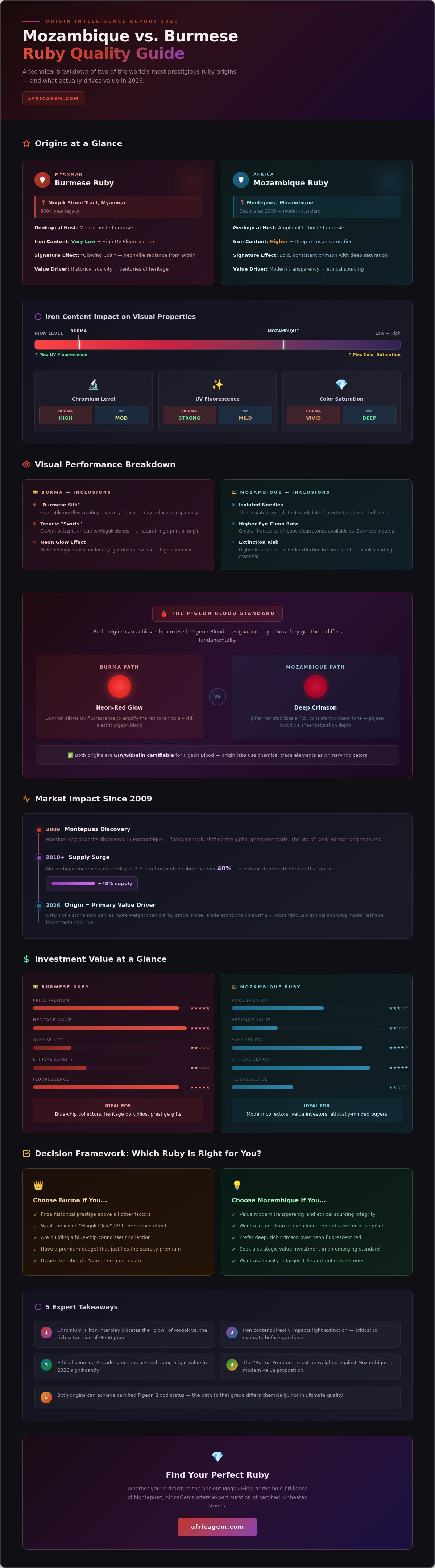
- Geological Host: Burma uses marble-hosted deposits; Mozambique uses amphibolite-hosted deposits.
- Iron Content: Low iron in Burma leads to high fluorescence; higher iron in Mozambique leads to rich, deep saturation.
- Market Impact: Mozambique has increased the availability of 3-carat to 5-carat unheated stones by over 40% since 2010.
- Value Driver: Burma relies on historical scarcity, while Mozambique relies on modern transparency and ethical sourcing.
At AfricaGems, we believe that choosing between these origins is a matter of personal philosophy. You're either investing in the centuries-old "Mogok Glow" or the bold, modern brilliance of the Montepuez mines. Both represent the absolute peak of the corundum family, but they speak to different aspects of a connoisseur's soul.
Visual Performance: Color, Clarity, and Fluorescence
The chemical soul of a ruby dictates its visual performance. Chromium is the primary element responsible for that iconic red, but iron acts as the silent moderator. In Burmese stones, high chromium levels paired with negligible iron create a vibrant, neon-like appearance. Conversely, Mozambique rubies, primarily from the Montepuez mines discovered in 2009, possess higher iron concentrations. This iron stabilizes the red but can cause extinction, where the stone fails to return light and looks black in certain facets. Understanding these trace elements is essential for any connoisseur evaluating mozambique ruby vs burmese ruby quality. These chemical signatures are so distinct that gemological laboratories use them as primary indicators for origin determination.
Visual characteristics are often defined by the following inclusion patterns:
- Burmese Silk: Fine rutile needles that create a velvety sheen but can decrease overall transparency.
- Mozambique Needles: Isolated, thin crystals that rarely interfere with the stone's brilliance.
- Burmese "Swirls": Growth patterns often described as treacle, which are common in Mogok stones.
- Mozambique Clarity: A higher frequency of eye-clean stones even in sizes exceeding 5 carats.
Fluorescence and the Chromium Factor
Burmese rubies possess a legendary glow because chromium fluoresces under ultraviolet light. Sunlight makes the stone emit its own red light, creating a soft, velvety texture that seems to hover above the facets. Mozambique stones contain iron that acts as a quenching agent. This prevents the glow but results in a crisper, more consistent visual. The color remains deep even in low-light settings where Burmese stones might appear pinker or lose their saturation.
Clarity Standards: The Loupe-Clean Benchmark
Geological history dictates the internal landscape of these gems. Burmese rubies are famous for rutile silk, which softens light but impacts transparency. Finding a Burmese ruby over 3 carats without visible inclusions is statistically rare. Mozambique rubies are generally much cleaner, exhibiting glass-like transparency. When assessing mozambique ruby vs burmese ruby quality, the internal landscape tells the story. At AfricaGems, loupe-clean means no inclusions under 10x magnification for Mozambique material. For Burmese stones, we accept minimal, well-placed silk that doesn't hinder brilliance, as a totally clean Mogok stone is a once-in-a-decade find.
Choosing between these origins depends on your preference for glow versus brilliance. A Burmese stone offers an ethereal, lit-from-within quality that feels historic. A Mozambique stone offers a modern, high-definition clarity that stands up to the most scrutinizing gaze. We prioritize stones that exhibit open color, meaning the red doesn't turn black in the corners of the gem. If you're ready to see these differences in person, browse our collection of ethically sourced rubies to find a gem that matches your personal standard of excellence.
The Ethical Landscape and Sourcing Integrity
For the modern collector, the debate regarding mozambique ruby vs burmese ruby quality extends far beyond the crystal lattice. It reaches deep into the earth where the stone was birthed. At AfricaGems, we define this as the AfricaGems Difference. It's a commitment to radical transparency and full disclosure that ensures every gemstone carries a clean, documented history. Ethical provenance has evolved into a non-negotiable quality factor. A stone's beauty is diminished if its journey to your hand involved exploitation or opaque trade practices.
The history of Burmese gems is inextricably linked to political volatility. The 2008 JADE Act and subsequent executive orders established a precedent for trade sanctions that continue to shape the market. As we move through 2026, the status of Burmese rubies remains complex. Most primary mining sites in Mogok are under the influence of the military junta, making conflict-free certification for new production nearly impossible. This "closed" system contrasts sharply with the "monitored" environment found in East Africa.
The Montepuez supply chain in Mozambique, largely overseen by entities like Gemfields, provides a level of traceability previously unseen in the ruby world. These operations utilize structured auction platforms and contribute to local infrastructure. This structured approach allows us to vet every stone for conflict-free status before it enters our inventory. When you evaluate mozambique ruby vs burmese ruby quality, you're also assessing the integrity of the supply chain that brought that gem to light.
Transparency in the 2026 Market
The disparity between Myanmar and Mozambique is stark. Myanmar's mining remains shrouded in secrecy, while Mozambique's major deposits are subject to international oversight and environmental standards. AfricaGems maintains rigorous vetting protocols to ensure no stone funds regional instability. We believe that a GIA or GRS origin report is essential for ethical validation in today's market. These documents provide the objective proof required to confirm a stone's geographic birthright and its ethical standing.
Unheated vs. Treated: The Integrity of the Stone
Unheated stones represent the gold standard for both origins. They're the purest expression of nature's artistry. However, the market is flooded with lower-quality Mozambique material that has been "improved" through lead-glass filling. This treatment is unstable and drastically reduces the stone's value. We warn collectors to be vigilant against these enhancements. AfricaGems remains steadfast in our commitment to selling only natural, ethically sourced gems. We prioritize the inherent integrity of the stone over artificial perfection, ensuring your investment retains its value for generations.
Investment Value and Price Per Carat in 2026
The 2026 gemstone market displays a clear divergence between historical prestige and modern performance. While both origins produce world-class gems, the price-per-carat framework remains heavily influenced by the "Burma Premium." At the 1ct mark, the price gap is noticeable but accessible. As you move to 3ct and 5ct stones, the scarcity of Mogok material causes Burmese prices to scale exponentially. A 5ct unheated Burmese ruby often commands five times the price of a Mozambique stone with identical color saturation, highlighting the dramatic impact of mozambique ruby vs burmese ruby quality on final valuation.
- 1 Carat: Mozambique offers high transparency at a baseline, while Burmese stones carry a 50% to 80% premium.
- 3 Carats: The "Burma Premium" accelerates, often reaching 3x the cost of African counterparts.
- 5 Carats+: Burmese stones enter the realm of museum-grade rarities, while Mozambique rubies remain the primary source for clean, large-scale investment gems.
The Burma Premium: Is it Worth It?
Collectors pay a massive multiplier for the "Burma" name because it represents a finite geological history. This premium isn't shrinking in 2026; it's intensifying for top-tier specimens. The sweet spot for savvy investors is the 2ct unheated Burmese ruby. These stones offer the perfect balance of rarity and liquidity without the astronomical jump seen at the 3ct threshold. If you're seeking a stone with a storied pedigree, you should consult our Loose Burma Rubies: The Connoisseur’s Guide to understand the nuances of this rare market.
Mozambique as a Growth Asset
Mozambique rubies have achieved full status in the secondary auction market. Since the first major Montepuez auctions in 2014, Sotheby’s and Christie’s have consistently realized record prices for African material. High-clarity Mozambique stones are currently appreciating faster than included Burmese stones. Investors often find they get "more stone" for their money by choosing Mozambique. You can secure a loupe-clean, 5ct vivid red African ruby for the price of a 2ct Burmese stone that may have visible silk or inclusions. For those who prioritize visual fire and sheer size over a historical birth certificate, Mozambique is the superior growth asset.
Choosing between these origins requires a balance of emotional connection to history and a cold analysis of gemological perfection. Whether you value the fluorescent glow of Mogok or the crystalline clarity of Montepuez, the 2026 market rewards those who prioritize unheated, ethically sourced specimens. It's about finding the right stone that matches your portfolio goals and aesthetic desires.
Choosing Your Ruby: The AfricaGems Decision Framework
Selecting the perfect gemstone requires a balance of historical prestige and visual performance. When you analyze mozambique ruby vs burmese ruby quality, your final decision usually reflects your personal philosophy as a collector. These two origins offer distinct personalities that cater to different aesthetic and investment goals. It isn't just about the red; it's about the story the stone tells on your hand.
The traditionalist and heritage collector will always find the Burmese ruby irresistible. These stones carry a legacy of royal patronage stretching back centuries. Their unique fluorescence, caused by high chromium and low iron levels, creates a "glowing coal" effect that is nearly impossible to replicate. If you value historical provenance and that classic Mogok "pigeon's blood" glow, a Burma stone is your pinnacle choice. It represents a finite piece of geological history that has set the global standard for centuries.
The modern investor and jewelry enthusiast often find better value and visual impact in Mozambique. Since the 2009 discovery of the Montepuez deposits, these gems have redefined the high-end market. They typically offer superior clarity and larger sizes compared to Burmese rubies of the same price point. For those who prioritize a deep, saturated red and a stone that remains eye-clean under close inspection, Mozambique provides a sophisticated, modern alternative. To maximize these traits, I recommend a precision European cut for Mozambique rubies to highlight their natural brilliance. Conversely, a traditional native cut often suits Burma stones, as it preserves the rare carat weight of the rough material.
Matching the Stone to the Setting
The secondary hues of a ruby dictate which metal will best enhance its beauty. Mozambique rubies often exhibit a "cool" red with subtle blue undertones. This profile excels in 18k white gold or platinum settings, which emphasize the stone's crispness and depth. The "warm" glow of Burma rubies pairs perfectly with high-karat yellow gold. The yellow metal complements the orange or pink secondary flashes often found in Mogok stones, amplifying their natural fire. If you have a specific vision, our custom jewelry design services can transform your loose stone into a bespoke masterpiece tailored to these specific optical traits.
Final Checklist for the Smart Buyer
Before finalizing your acquisition, ensure the stone meets the rigorous standards required for a high-value gemstone. I always advise my clients to follow this essential protocol:
- Verify the Lab Report: Only trust reputable, independent labs like GIA, GRS, or SSEF to confirm origin and treatment status.
- Clarity Standards: Determine if you require "loupe-clean" perfection or if an "eye-clean" stone meets your needs. Mozambique stones often reach higher clarity grades more consistently than Burmese ones.
- The AfricaGems Difference: Every purchase is backed by our 40-year reputation for radical transparency and our comprehensive gemstone guarantee.
I invite you to a personal consultation with me, Marc Sarosi, for a bespoke selection process that ensures your ruby meets the highest standards of the trade. You can Browse our curated collection of Loose Mozambique Rubies today to find a stone that speaks to your unique style and investment goals.
Securing Your Legacy in Red
Choosing between these two legendary origins is a strategic decision for your private collection. When evaluating mozambique ruby vs burmese ruby quality, remember that Mogok stones provide the historical benchmark for fluorescence. Conversely, Montepuez gems often offer superior transparency and larger loupe-clean crystals. Both origins represent the pinnacle of the corundum family for collectors looking toward 2026. For over 40 years, founder Marc Sarosi has curated stones that meet the rigorous standards of the AfricaGems Difference. Every investment-grade ruby we offer includes a GIA or GRS certified origin report to ensure absolute technical validation. Our comprehensive ethical sourcing policy guarantees that your gemstone's journey from the mine is as transparent as its clarity. Whether you're drawn to the historic prestige of Myanmar or the modern brilliance of Africa, the right choice is the one that aligns with your long-term goals. You're now equipped to select a masterpiece that'll endure for generations. Explore our investment-grade Loose Mozambique Rubies and find the perfect centerpiece for your next heirloom.
Frequently Asked Questions
Which ruby is more expensive, Mozambique or Burmese?
Burmese rubies command a higher price per carat than Mozambique rubies because of their historical scarcity and the prestigious Mogok provenance. According to the 2023 GemGuide pricing index, top-quality unheated Burmese rubies often carry a 50% to 100% premium over Mozambique stones of comparable saturation. While Mozambique provides exceptional value, the legendary status of Myanmar's mines keeps Burmese prices at the peak of the global market.
Can a Mozambique ruby be 'Pigeon Blood' red?
Mozambique rubies can certainly earn the 'Pigeon Blood' red designation from major gemological laboratories. Since 2012, labs like GRS and SSEF have regularly granted this prestigious trade color grade to high-chromium, low-iron stones from the Montepuez mines. These gems exhibit the intense, vivid red saturation once thought unique to Burma. It's a testament to the mozambique ruby vs burmese ruby quality debate that both origins now compete for this elite status.
Is a Burmese ruby a better investment than a Mozambique ruby?
Burmese rubies currently hold a more established track record for long-term value retention in the auction market. Data from the Knight Frank 2023 Luxury Investment Index shows that rare colored gemstones have seen a 97% price increase over the last decade, with Burmese Mogok stones leading the surge. Mozambique rubies offer high growth potential because they're currently undervalued relative to their high crystalline transparency and comparable color.
What are the most common inclusions in Mozambique rubies?
Mozambique rubies are frequently characterized by amphibole crystals and fine needles of rutile. You'll often see small, dark mineral clusters or silk that's less dense than what's found in Burmese material. These inclusions act as a geologic fingerprint for the Montepuez region. Expert gemologists look for these specific internal features under 10x magnification to distinguish them from the swirly treacle-like inclusions typical of Myanmar's marble-hosted deposits.
Why is fluorescence so important in Burmese rubies?
Fluorescence is vital because it creates the glowing coal effect that makes Burmese rubies appear to radiate from within. Because stones from the Mogok region contain very low iron levels, often below 0.1% by weight, the red fluorescence isn't suppressed by the presence of iron. This reaction to ultraviolet light intensifies the red hue in natural sunlight. It's a key factor in the mozambique ruby vs burmese ruby quality comparison for many collectors.
Are Mozambique rubies more ethical than Burmese rubies?
Mozambique rubies are generally considered a more ethical choice due to the transparent supply chains established by major mining operations like Gemfields. In contrast, the Burmese gemstone trade has faced numerous international sanctions, including the 2021 US Treasury Department restrictions on state-owned enterprises. Buying Mozambique stones allows for better traceability from the mine to the market. This transparency ensures your purchase supports legitimate labor practices and local community development.
How can I tell the difference between the two without a lab report?
Identifying the origin without a lab report is nearly impossible for anyone except an experienced gemologist using a 10x loupe or spectroscope. You might notice that Mozambique rubies often have a slightly darker, cooler undertone due to higher iron content. Burmese stones usually show more silk and a warmer, more fluorescent glow under sunlight. Because nature produces overlaps in appearance, you should always rely on a GIA or GRS certificate for definitive origin.
Do Mozambique rubies require different care than Burmese rubies?
Mozambique rubies require the same care as Burmese rubies because they both share a hardness of 9 on the Mohs scale. You should clean your ruby jewelry using warm, soapy water and a soft brush to remove oils and debris. Avoid harsh chemicals or steam cleaners if a lab report identifies surface-reaching fractures. Both varieties are exceptionally durable, making them perfect for daily wear in engagement rings or heirloom pieces.