
Loose Zircon Gemstones: The Connoisseur’s Guide to Natural Fire and Brilliance
Sep 23rd 2026
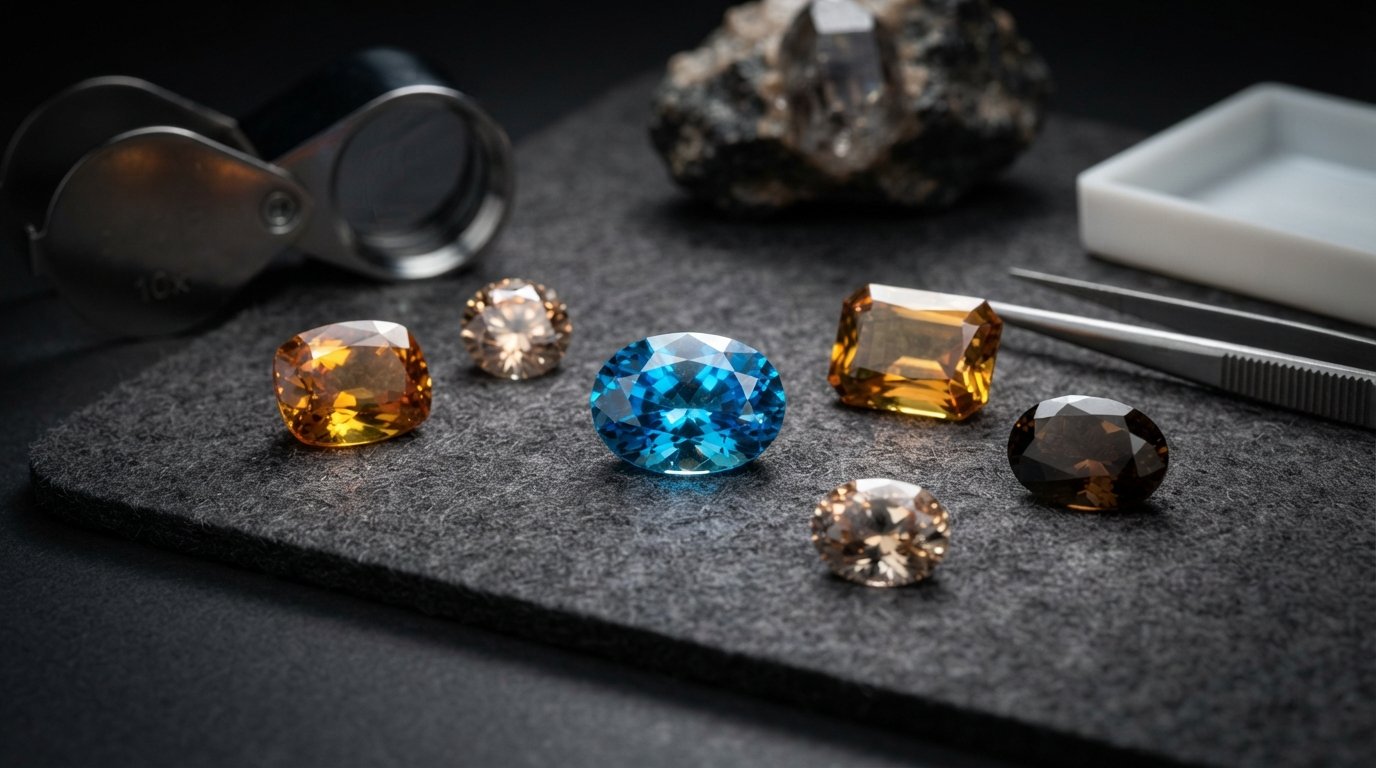
Natural zircon is not a cheap synthetic imitation; it is an ancient geological marvel boasting an optical fire that rivals fine diamond. Yet, because its name sounds deceptively close to cubic zirconia, many collectors overlook loose zircon gemstones, wondering whether this vibrant crystal is genuinely earth-mined or durable enough for a bespoke ring. You aren't alone if you've hesitated to buy, caught between the desire for an electric blue centerpiece and the frustration of retail misinformation.
In this guide, you'll master the art of selecting loose zircon gemstones by demystifying their remarkable optical properties, rich geological history, and professional grading standards. We examine the exact physical distinctions that separate genuine zircon from lab simulants, explain how strong double refraction creates its signature fiery sparkle, and provide the insider knowledge you need to evaluate color saturation, cut precision, and ethical origin with absolute confidence.
Key Takeaways
- Clarify the vital distinction between ancient, earth-mined zirconium silicate and lab-created cubic zirconia to ensure you invest in genuine natural material.
- Discover how extreme double refraction fuels zircon's diamond-like fire, and learn how precise facet alignment prevents optical haziness.
- Explore the market's shifting color palette, balancing classic electric blues with increasingly coveted unheated champagne, honey, and autumnal earth tones.
- Evaluate hardness ratings alongside refractive index data to choose protective jewelry settings that preserve your stone for daily wear.
- Learn how to read independent laboratory certificates and verify thermal treatment disclosures when acquiring natural loose zircon gemstones online.
What are Loose Zircon Gemstones? Understanding the Oldest Mineral on Earth
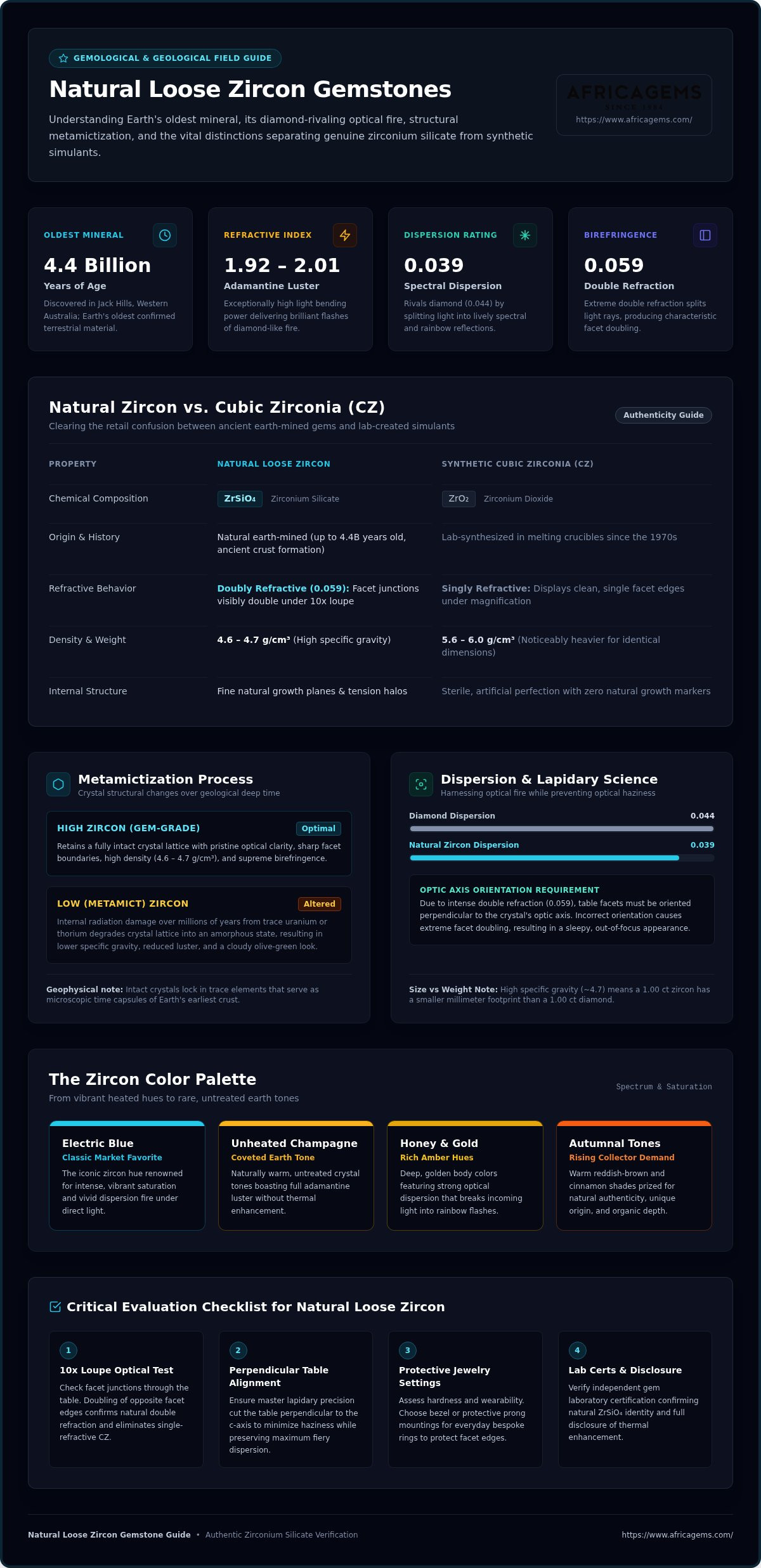
To truly appreciate this gem, one must first ask: What are Loose Zircon Gemstones? At its core, zircon is a natural zirconium silicate mineral (ZrSiO4) celebrated by gemologists for an adamantine luster and extraordinary optical properties. Unlike most colored stones, natural zircon possesses an exceptionally high refractive index ranging from 1.92 to 2.01, allowing cut gems to disperse light into flashes of rainbow fire. Whether acquiring stones for custom jewelry or adding to an investment portfolio, collectors explore high-grade inventory within precious gemstones and specialized suites to find specimens featuring this elite, diamond-like brilliance.
To see this remarkable optical depth and electric coloration in motion, watch this brief showcase of an exceptional cut stone:
The Geological Marvel of Natural Zircon
Discovered in Western Australia's Jack Hills, the oldest confirmed fragments of zircon date back an astounding 4.4 billion years, making them the most ancient terrestrial materials ever identified. Zircon resists severe chemical weathering and intense crustal pressures, effectively locking in trace elements that serve as microscopic time capsules for geophysicists studying Earth's earliest crust formation.
This deep time also creates a critical gemological distinction between "high" and "low" zircon through a process called metamictization:
- High Zircon: Retains a fully intact crystal lattice with pristine optical clarity, sharp facet boundaries, high density (4.6 to 4.7 g/cm³), and supreme birefringence.
- Low (Metamict) Zircon: Suffers internal radiation damage over millions of years from trace uranium or thorium, degrading the crystal structure into an amorphous state with lower specific gravity, reduced luster, and a cloudy, olive-green appearance.
Zircon vs. Cubic Zirconia: Clearing the Confusion
Natural zircon frequently suffers from unfair association with cubic zirconia (CZ), an artificial simulant synthesized in laboratories since the 1970s. Zircon is an authentic zirconium silicate, whereas cubic zirconia is zirconium dioxide (ZrO2) mass-produced in melting crucibles. You can spot the physical differences immediately through focused examination:
- Double Refraction: Natural zircon displays strong birefringence (0.059), causing facet junctions viewed through the table to appear doubled under a standard 10x loupe. Cubic zirconia is singly refractive and displays single facet edges.
- Weight and Density: Cubic zirconia is significantly denser (around 5.6 to 6.0 g/cm³) than high zircon, feeling noticeably heavier in the hand for identical dimensions.
- Natural Inclusions: Authentic loose zircon gemstones frequently exhibit fine growth planes or tension halos, contrasting sharply with the sterile perfection of synthetic stones.
Evaluating Quality: The Four Cs of Loose Zircon
Applying the classic Four Cs to loose zircon gemstones requires a specialized eye. Unlike diamonds, colored gems prioritize hue saturation, yet zircon demands equal rigor in cut precision and optical clarity. Density is another critical factor to remember when judging size. Because zircon possesses a high specific gravity near 4.7, a one-carat zircon has a noticeably smaller millimeter footprint than a one-carat diamond. To master evaluating zircon quality, one must understand how light physics, crystal structure, and lapidary craftsmanship interact.
Dispersion and the Secret of Zircon’s Fire
Zircon boasts an exceptional dispersion rating of 0.039, trailing diamond's 0.044 by only a slim margin. This optical power breaks white light into lively spectral flashes. Yet zircon's pronounced birefringence presents a delicate hurdle for the lapidary. When light splits into two polarized rays, facet doubling occurs. If a cutter doesn't orient the table facet perpendicular to the crystal's optic axis, this doubling can make the gem look sleepy or out-of-focus. A master cutter aligns the rough precisely, harnessing double refraction to magnify fiery brilliance rather than compromising crispness.
Clarity and Inclusion Standards for Collectors
Collector-grade loose zircon gemstones should be eye-clean, especially vibrant blue and pure white varieties where internal flaws immediately break up the path of light. Untreated or earth-toned crystals might show slight planar growth lines or microscopic mineral inclusions, but heavy clouds destroy the stone's lively scintillation. Because zircon is slightly brittle along sharp edges, you must also watch for "paper wear," which refers to micro-chipping along facet junctions caused by stones rubbing together in transit.
When evaluating loose stones online, always examine high-resolution, unedited 360-degree videos to assess windowing and facet junction integrity. If you're seeking exceptional brilliance verified by seasoned gemologists, browse the hand-selected inventory across AfricaGems loose stones to locate specimens cut for maximum optical performance.
The Spectrum of Color: From Electric Blue to Rare Earth Tones
Color defines the soul of loose zircon gemstones. While the mineral's crystalline lattice forms primarily with trace impurities like iron, uranium, and thorium, these atomic substitutions create an expansive chromatic range that few other species match. According to GIA's guide to zircon, blue represents at least 80% of all zircon sold in today's trade. Yet, discerning collectors increasingly seek unheated earth tones, prizing the organic warmth of golden honey, burnt cognac, and autumnal oranges.
The Allure of Heated Blue Zircons
Nature rarely produces intense blue zircon straight from the ground. Instead, brownish rough, primarily sourced from the Ratanakiri province of Cambodia, undergoes controlled thermal treatment at approximately 900°C to 1000°C in a reducing environment. This heat alters the valency state of trace color centers, converting dull brown into breathtaking Caribbean blue, vivid teal, or icy sky tones. When performed properly, this enhancement is permanent and stable under standard wear conditions, offering vivid saturation that commands premium attention among bespoke jewelry connoisseurs.
Starlight and Hyacinth: Exploring Rare Varieties
Beyond modern blues lies an ancient world of distinct varietal names that shaped early gem trading:
- Starlight (Colorless): Heat-treated to eliminate all brownish tint, pure white zircon served as the premiere natural diamond substitute throughout the Victorian and Edwardian eras.
- Hyacinth (Jacinth): Historic terminology describing yellow, vibrant orange, red-orange, and rich red stones. High-clarity red zircon remains exceptionally rare and prized by mineral collectors.
- Unheated Earth Tones: Champagne, cinnamon, and golden-brown stones that retain their raw crystalline state, celebrated today for their authentic, untreated origin.
- Metamict Green: Low zircon stones that display mossy, olive tones due to internal radiation breakdown over geological epochs, yielding a velvety, slightly muted luster.
For collectors balancing vibrant blue centerpieces against subtle organic hues, inspecting fine semi-precious gemstones reveals just how versatile natural zircon can be across diverse cuts and settings.
Zircon vs. Diamond and Sapphire: A Comparative Analysis
Side by side in a jeweler's tray, high-quality loose zircon gemstones easily hold their own against diamond and fine sapphire. Where sapphire offers velvety depth and diamond delivers cold, brilliant fire, zircon occupies a rare middle ground. Its refractive index (1.92 to 2.01) sits far closer to diamond (2.42) than sapphire (1.76 to 1.77), yielding a vibrant play of light that looks extraordinary in fine jewelry. Yet, understanding the structural differences between these classic stones is critical for any long-term collection.
The Visual Match: Why Zircon Rivals Diamond
Zircon shares an adamantine luster with diamond, meaning light reflects off its polished surface with a crisp, sub-metallic gleam. In antique Edwardian and Victorian estate pieces, white zircon frequently substituted for diamond, deceiving even seasoned appraisers under candlelit chandeliers. With a dispersion rating of 0.039 against diamond's 0.044, zircon splits incoming rays into vivid spectral flashes. When cut with strict symmetry, it produces fiery dispersion that sapphire, with its modest 0.018 dispersion, simply cannot match.
Durability Considerations for Jewelry
Hardness presents the true gemological trade-off. While diamond registers at 10 and sapphire at 9 on the Mohs scale, high zircon falls between 6.5 and 7.5. More significantly, zircon displays a distinct structural brittleness. Sharp blows can cause tiny abrasions along facet edges, meaning setting choice directly dictates a stone's longevity:
- Necklaces and Brooches: Ideal formats that protect stones completely from physical contact, allowing uninterrupted light transmission.
- Earrings: Excellent platforms for high-dispersion rounds or cushions, safe from accidental knocks.
- Rings: Perfectly wearable, provided the gemstone is housed within protective bezels, halo crowns, or heavy prongs rather than exposed high-profile tension mounts.
Caring for your stone requires gentle handling. Avoid ultrasonic machines and steam cleaners, which can induce thermal shock or cleave brittle facet lines. Clean your zircon with lukewarm water, mild dish soap, and a soft-bristled brush. If you plan to create a bespoke ring featuring this fiery gem, explore protective settings at AfricaGems jewelry mountings to secure your stone for years of safe wear.
How to Buy Loose Zircon Online: Authenticity and Ethics at AfricaGems
Purchasing loose zircon gemstones online requires verifiable provenance and unyielding commercial transparency. Founded in 1984 by Marc Sarosi, AfricaGems operates on the principle that buyers deserve complete disclosure regarding every stone's geological history and treatment status. Traceable origins matter deeply. Cambodia's Ratanakiri province remains the historic source for the finest rough destined for blue conversion, while gem gravels across Sri Lanka produce extraordinary untreated golden and pastel crystals. Ethical sourcing ensures these materials reach you with verified provenance and full accountability.
The Importance of Treatment Disclosure
Thermal treatment is standard practice to produce vibrant blue hues, but deceptive sellers sometimes fail to disclose permanent heat or disguise coated simulants as genuine crystals. When acquiring stones, always demand clear confirmation of mineral identity, exact measurements, and heating history. Independent laboratory reports from institutions like the GIA verify whether a stone is natural zirconium silicate and outline any thermal treatments. To explore deeper evaluation strategies before placing an order, consult the educational resources on the AfricaGems gemstone blog.
Designing Custom Jewelry with Your Loose Zircon
Transforming a loose stone into bespoke fine jewelry allows you to accentuate the gem's intense fire while safeguarding its facet edges. Metal choice plays a crucial role in visual harmony:
- Platinum and White Gold: Create a striking contrast that intensifies the crisp, electric dispersion of heated blue and white zircons.
- Yellow and Rose Gold: Provide a rich, warm backdrop that complements untreated cinnamon, honey, and autumnal earth tones.
Because zircon requires thoughtful mounting to protect against edge wear, working with skilled craftsmen is essential. AfricaGems offers specialized custom jewelry design services to help bring your unique setting concepts to fruition. Whether you envision a bezel-protected cocktail ring or an open-basket pendant, you can explore precision-crafted settings through AfricaGems jewelry mountings to ensure your certified loose zircon gemstones remain safely showcased for decades to come.
Elevate Your Collection with Exceptional Natural Zircon
Selecting natural zircon means welcoming an ancient optical powerhouse into your personal collection. Armed with an understanding of its deep geological heritage, exceptional dispersion, and proper mounting considerations, you can look beyond synthetic imitations with complete clarity. Whether you're drawn to the electric radiance of classic Cambodian blues or the organic warmth of untreated golden earth tones, natural zircon delivers a fiery personality found nowhere else in the mineral kingdom.
When you're ready to invest, partner with a gemologist committed to absolute transparency. Drawing on over 40 years of expertise in rare gemstones, AfricaGems founder Marc Sarosi backs every specimen with full treatment disclosure and an uncompromising personal guarantee of authenticity. Take the next step toward designing a bespoke heirloom today: browse our curated collection of natural loose zircon gemstones at AfricaGems and discover a stone worthy of your vision.
Frequently Asked Questions
Is zircon a natural gemstone or man-made?
Zircon is a 100% natural gemstone, not a lab-created mineral. It is an authentic zirconium silicate that crystallizes deep within igneous and metamorphic rocks over millions of years. In fact, zircon crystals found in Western Australia represent the oldest known terrestrial materials on Earth, dating back 4.4 billion years. Its natural origins stand completely separate from factory-synthesized materials, making it a legitimate collector's gem.
How can I tell the difference between zircon and cubic zirconia?
You can quickly separate natural zircon from synthetic cubic zirconia by looking for double refraction under a standard 10x jeweler's loupe. Zircon exhibits strong birefringence, which causes facet junctions on the opposite side of the stone to appear doubled. Cubic zirconia is singly refractive, so facet edges always appear single and sharp. Natural loose zircon gemstones also show tiny growth characteristics, whereas cubic zirconia looks unnaturally flawless and feels noticeably heavier.
Is blue zircon a real, natural color?
While natural brownish zircon rough comes directly from the earth, virtually all vivid blue zircon achieves its color through traditional thermal treatment. Heating Cambodian brownish rough to roughly 900°C to 1000°C in an oxygen-depleted environment alters trace element valencies, permanently transforming the crystal into vivid teal or sky blue. This stable enhancement is universally accepted in the gem trade, provided dealers practice full treatment disclosure before completing a sale.
How hard is a zircon gemstone on the Mohs scale?
Zircon rates between 6.5 and 7.5 on the Mohs hardness scale, placing it slightly below sapphire (9) and quartz (7). While it resists everyday airborne dust scratching reasonably well, it possesses structural brittleness along facet junctions. This means sharp impacts can cause minute edge chipping, often termed paper wear. Setting zircon in protective mountings ensures the gemstone retains its crisp facet integrity over generations of careful wear.
Can zircon be used in an engagement ring?
Zircon can serve as an engagement ring centerpiece if placed in a protective setting. Because its 6.5 to 7.5 hardness makes it vulnerable to facet edge abrasion from hard knocks, bezel mountings or halo settings work best to shield the stone's perimeter. If you wear a zircon engagement ring, remove it before heavy manual labor, gym sessions, or sports to preserve its spectacular diamond-rivaling fire for a lifetime.
Where do the best loose zircon gemstones come from?
The most celebrated loose zircon gemstones originate in the Ratanakiri province of Cambodia, which produces the premier brownish rough that transforms into iconic electric blue gems. Sri Lanka is another historic origin, famous for untreated golden-yellow, honey, and green stones recovered from alluvial gravels. Other notable deposits producing quality material include Australia, Myanmar, and Madagascar, each offering distinct color variations and geological pedigrees.
What is the most valuable color of zircon?
Vivid electric blue commands the highest demand and market value among commercial buyers, especially in stones displaying saturated Caribbean shades with zero muddy undertones. Close behind in collector circles are rare, unheated red and fiery orange-red specimens, historically called Hyacinth. Pure, untreated earth tones like champagne and rich golden honey have also surged in collector appeal, prized for their completely natural, unenhanced crystal origins.
How should I clean and care for my loose zircon?
Clean your zircon safely using warm water, mild liquid dish soap, and a soft-bristled toothbrush to gently lift oils and dust. Never use ultrasonic or steam cleaners, as rapid temperature shifts and high-frequency vibrations can fracture brittle facet edges. Store your loose stones individually in padded gem jars or soft fabric pouches so harder stones like diamonds and sapphires don't scratch their polished surfaces.

Article by
Marc Sarosi
Professional gemstone dealer for more than 40 years. Started off mining Aquamarine in Zambia, Africa and travelled throughout the continent in search of fine gems. Trusted authority on fine gemstones and have donated a fine collection of more than 27 extraordinary gemstones to the Smithsonian Institute Gem Hall for generations to see.