
Loose Tanzanite Gemstones: The Connoisseur’s Guide to Quality & Value in 2026
Aug 21st 2026
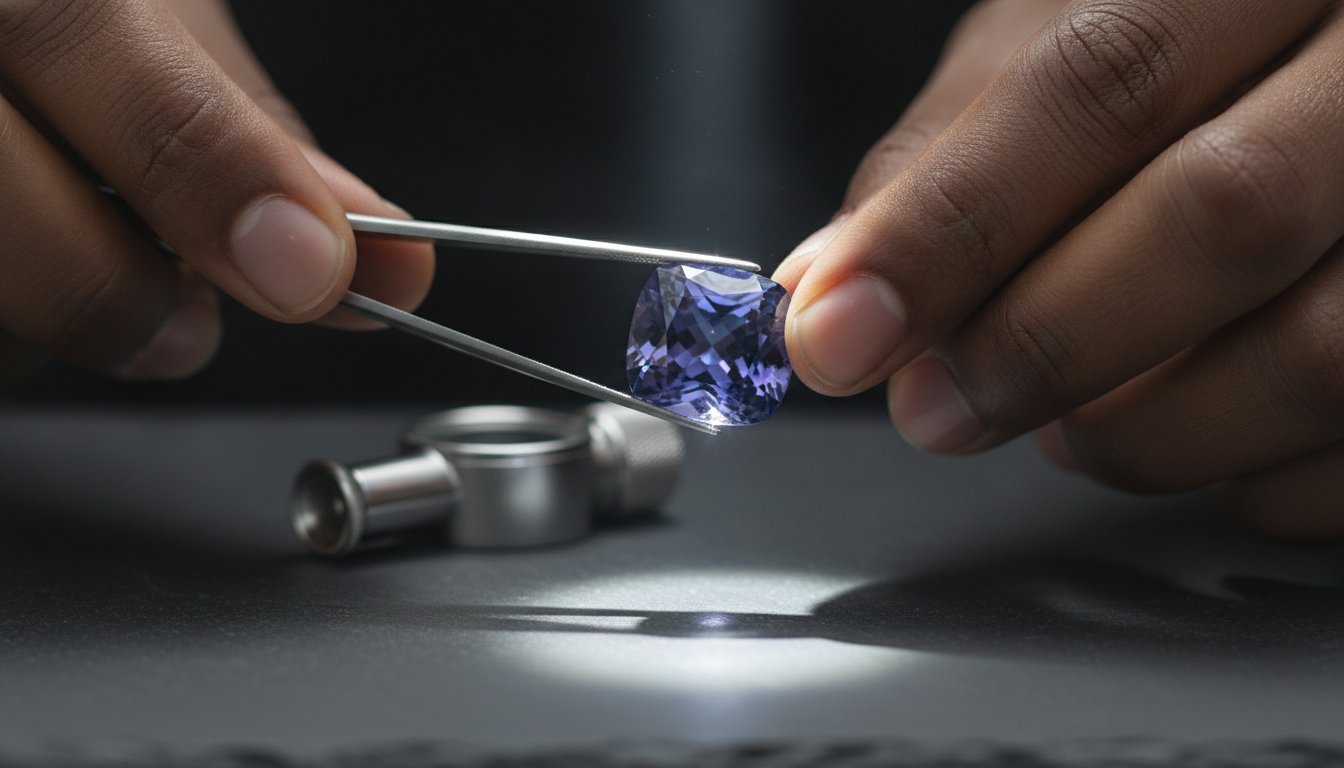
Geologists estimate that the world's only source of tanzanite will be exhausted within twenty five years, making this geological miracle 1,000 times rarer than a diamond. You likely recognize the magnetic pull of its deep blue and violet hues, but you might also feel the weight of uncertainty when looking at loose tanzanite gemstones. It's natural to worry about distinguishing a genuine heirloom from a glass imitation or wondering if a stone is durable enough for a daily ring. Pricing variations for similar looking stones can feel like a riddle without the right expert guidance.
This guide provides the clarity you need to invest with absolute confidence. I'll share the exact criteria used by premier dealers to evaluate saturation, clarity, and the precision cuts that unlock a stone's fire. We'll explore the shifting 2026 market dynamics, the "one-generation" supply factor, and how to select a stone that serves as a stunning centerpiece for custom jewelry while retaining its long term value. By the end, you'll possess the technical knowledge of an insider to secure a piece of history before the Merelani Hills fall silent. This is your path to owning a rare, ethically sourced treasure with total transparency.
Key Takeaways
- Understand why the single-source origin in the Merelani Hills makes tanzanite 1,000 times rarer than diamonds and a finite geological miracle.
- Learn to master the 4Cs specifically for loose tanzanite gemstones, focusing on how color saturation and grading nuances impact long-term value.
- Discover why purchasing loose stones allows you to detect "windowing" or hidden inclusions that standard jewelry settings often mask.
- Gain clarity on the industry standard of heat treatment and why rare, unheated specimens command a significant premium for their natural trichroism.
- Explore how ethical sourcing and a 40-year legacy of expertise provide the ultimate security when selecting stones for custom jewelry design services.
The Allure of Loose Tanzanite Gemstones: A Finite Treasure
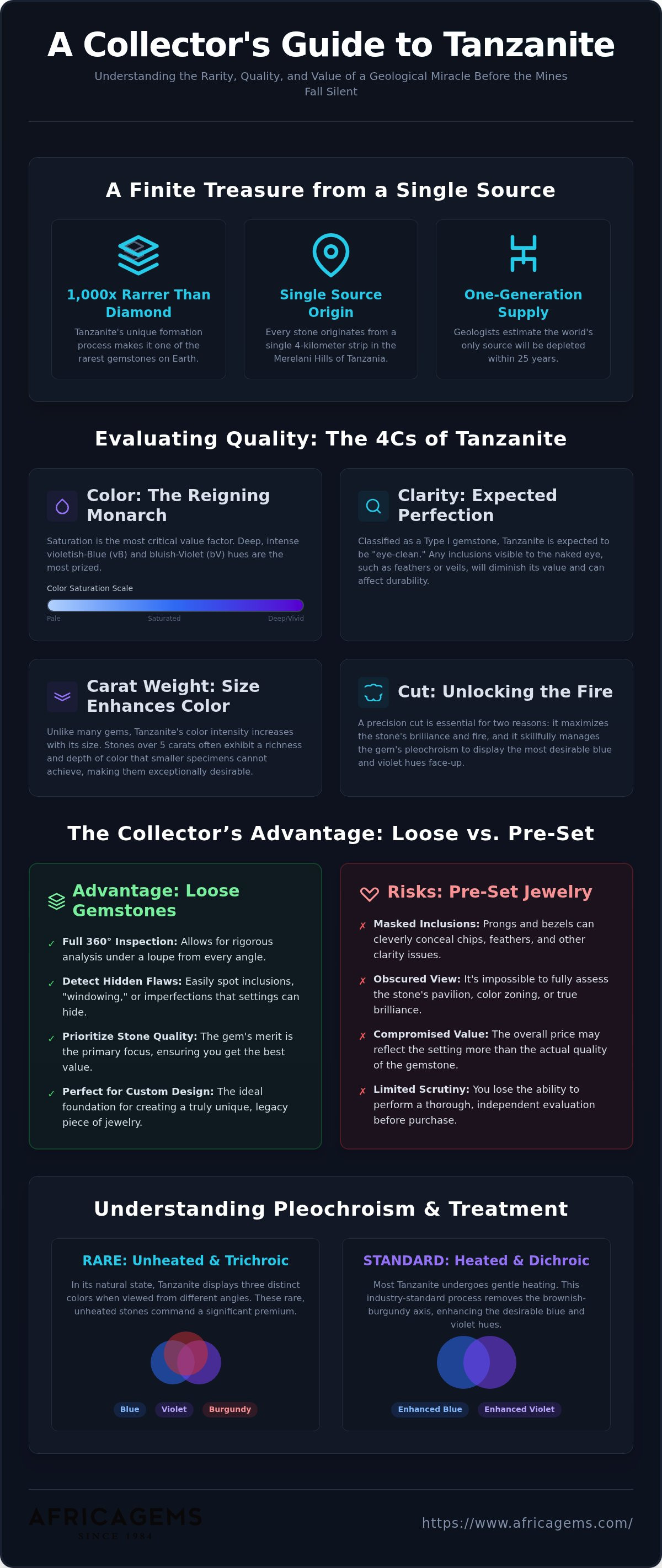
Tanzanite represents one of nature's most spectacular geological accidents. Scientifically, it's the blue-violet variety of the mineral zoisite, but its value is inextricably linked to its extreme geographical isolation. Every specimen in existence originates from a single, four-kilometer strip in the Merelani Hills of Tanzania. This "single source" status creates a ticking clock for collectors and investors alike. Geologists estimate that the world’s tanzanite supply could be exhausted within a single generation, making every loose stone a finite piece of history. When you choose loose tanzanite gemstones, you're securing a geological artifact before it transitions entirely into the secondary collector market. This approach also allows for a rigorous 360-degree quality inspection. You can view the stone under a loupe to ensure no hidden inclusions lurk near the girdle or pavilion, a level of scrutiny impossible with pre-set jewelry.
The Discovery and Geological Rarity
The gem’s journey into the global spotlight began with its 1967 discovery in the foothills of Mount Kilimanjaro. Tiffany & Co. quickly realized the stone's potential, choosing the name "tanzanite" to honor its unique heritage. Its formation required the violent tectonic energy of the Great Rift Valley, where specific heat and pressure forced vanadium into the zoisite crystal lattice. This rare alignment of events is why tanzanite is 1,000 times rarer than a diamond. For those interested in the mineral's chemical structure and famous trichroic nature, the entry for Tanzanite on Wikipedia offers a deep technical dive into its properties. It's a miracle of chemistry that shouldn't exist, yet it sits at the pinnacle of modern gem collecting.
Why Tanzanite is the Modern Collector’s Choice
In 2026, the appetite for rare, single-origin precious gemstones has reached a fever pitch. Collectors now prioritize stones that offer a unique visual narrative, and tanzanite’s pleochroism delivers exactly that. Unlike the uniform blue of a sapphire, tanzanite shifts between deep sapphire blue, royal violet, and even flashes of burgundy as it moves. This dynamic personality makes it a premier candidate for bespoke creations. Starting with loose tanzanite gemstones ensures that the stone's specific dimensions and fire are the primary focus before you move into custom jewelry design. It's the most secure way to build a legacy piece that reflects both your sophisticated taste and the stone's inherent rarity.
Evaluating Quality: The 4Cs of Loose Tanzanite Selection
Evaluation starts with the eye. Unlike diamonds where brilliance is the primary draw, color saturation is the absolute monarch when grading loose tanzanite gemstones. The industry uses a specific shorthand: "vB" for violetish Blue and "bV" for bluish Violet. While both hues are stunning, the deep, saturated blues (vB) often command the highest interest among serious connoisseurs. According to GIA's guide to tanzanite, the most valuable stones are those with intense saturation and a hue that rivals the finest sapphires. If the color looks "washed out" or pale, the value drops significantly, regardless of the stone's size.
Clarity in tanzanite is generally high. It's classified as a Type I gemstone, meaning it's expected to be eye-clean. Any visible inclusions, such as small feathers or veils, can diminish both the stone's beauty and its structural integrity. Carat weight also plays a unique role in this species. Unlike many gems where color is consistent across different sizes, tanzanite’s color intensity typically increases with volume. You'll find that stones over five carats often exhibit a richness and depth that smaller specimens simply can't achieve. This makes larger, high-quality stones exceptionally desirable for those looking to make a statement.
Pleochroism: The Secret to Tanzanite’s Color
Pleochroism is the optical phenomenon that gives tanzanite its "shifting" personality. In its natural rough state, tanzanite is trichroic. This means it displays three different colors—blue, violet, and burgundy—depending on the angle of view. Most stones undergo gentle heating to remove the brownish-burgundy axis. This process simplifies the stone's personality to dichroism, balancing deep blue and royal violet. This color shift isn't a flaw. It's the gemstone's signature, ensuring the stone's appearance evolves as you move from natural daylight to warm incandescent evening light.
The Importance of a Master Cut
A master lapidary doesn't just cut for weight; they cut for color and life. The orientation of the crystal during the cutting process determines whether the stone faces up as blue or violet. Mastering the blue-dominant orientation requires significant weight loss from the rough crystal. This sacrifice is why blue-facing stones command a premium. Popular shapes like the Cushion, Oval, and Trillion are favored because they maximize the gem's internal fire. A poor cut leads to "extinction," where large areas of the stone appear black and lifeless. If you're ready to see the difference a precision cut makes, you can explore our curated selection of loose tanzanite gemstones to find a specimen with exceptional brilliance.
Loose Stones vs. Pre-Set Jewelry: The Collector’s Advantage
Choosing loose tanzanite gemstones over pre-set jewelry is the hallmark of a disciplined collector. While a finished ring might offer immediate gratification, settings often act as a veil. Metal prongs and bezels can easily mask "windowing"—an area where light leaks through the back of the stone—or hide significant inclusions tucked away near the girdle. By purchasing a stone in its unmounted state, you gain an unobstructed view of its true character. This transparency is why loose stones are the gold standard for estate planning and high-value investments. It's also an invitation to explore all gemstones in our collection to compare how tanzanite's unique pleochroism stands against other world-class treasures.
Verifying Integrity and Proportions
A loose stone allows for a level of technical validation that pre-set jewelry simply cannot match. When the gem is unmounted, you can use a jeweler’s loupe to inspect the entire pavilion and crown for symmetry and polish. You can also place the stone on a high-precision scale to verify the exact carat count to the second decimal point. The American Gem Society on tanzanite emphasizes the importance of evaluating a stone's specific properties and durability before it's subjected to the pressure of a setting. Checking for a "flat" pavilion or an overly deep cut is far more accurate when you can view the stone from every possible angle without the interference of a metal mounting.
The Path to Bespoke Jewelry
Starting with a loose gem ensures that your final piece is a work of art built around the stone, rather than forcing a stone into a mass-produced setting. This is especially vital for gemstone rings, where the setting must be engineered to protect tanzanite's cleavage planes from daily wear. By selecting your stone first, you unlock the full potential of custom jewelry design. AfricaGems specializes in this transition, providing the expert guidance needed to move from a raw investment to a finished heirloom. We ensure that the metal choice—be it platinum or gold—and the mounting style are perfectly calibrated to enhance the specific blue or violet nuances of your chosen specimen.
Understanding Treatments and Certification for Tanzanite
Transparency is the cornerstone of trust in the high-end gemstone market. When you evaluate loose tanzanite gemstones, you must understand that over 95% of all specimens have undergone gentle heat treatment. This isn't a synthetic alteration or a reason for concern. Instead, it's a standard process that removes the muddy brown and yellow undertones common in rough zoisite crystals. AfricaGems operates on a policy of radical transparency. Every stone we offer comes with full disclosure of its history, ensuring you're never left guessing about the integrity of your investment.
While heated stones are the norm, a tiny niche of "Unheated Tanzanite" exists for the most dedicated collectors. These rare gems possess natural trichroism, showing blue, violet, and burgundy flashes without any human intervention. Because they are so difficult to source in investment-grade saturations, they command a significant premium. Whether you choose a classic heated stone or a rare unheated specimen, the key is knowing exactly what you're buying through reputable documentation.
Why Heat Treatment is Industry Standard
The heating process for tanzanite is remarkably stable. It essentially mimics the geothermal heat that would have naturally occurred in the earth over millions of years. Unlike "diffusion" treatments used in some sapphires or "fracture filling" seen in lower-quality emeralds, tanzanite heating involves no foreign chemicals or additives. The result is a permanent color change that won't fade over time and requires no special care beyond standard gemstone handling. It's a clean, widely accepted enhancement that unlocks the stone's true blue-violet potential.
The Value of a Gemological Report
For any serious acquisition, an independent lab report is your greatest security. These certificates from authorities like the GIA or AGL provide an unbiased verification of the stone’s weight, dimensions, and origin. Most importantly, they explicitly state the treatment status. AfricaGems only offers stones with reputable documentation to protect your legacy and the stone's future resale value. You can dive deeper into the technical nuances of gem grading in our connoisseur's guide to tanzanite. This level of detail ensures that your purchase is backed by scientific validation rather than just marketing claims.
If you're ready to select a stone backed by a legacy of expertise and full disclosure, I invite you to browse our current inventory of loose tanzanite gemstones to find your perfect match.
Sourcing Ethical Tanzanite: The AfricaGems Commitment
The integrity of a gemstone is as vital as its saturation or clarity. When you acquire loose tanzanite gemstones, you aren't just buying a mineral. You're participating in a global supply chain that starts in the Merelani Hills. AfricaGems maintains direct, long-standing relationships with reputable suppliers in Tanzania to ensure every stone is ethically recovered and processed. Marc Sarosi founded this business in 1984. His 40-year legacy in the gem trade provides the foundation for our strict sourcing standards. This deep industry history allows us to bypass the opaque layers of traditional gem trading. It provides you with a direct line to the source and the security of a personal guarantee from a recognized expert.
Radical Transparency in the Gem Trade
Our "No Mystery" guarantee is a commitment to radical transparency. Every stone in our inventory is exactly as described, with every treatment and characteristic documented with clinical precision. Buying from a US-based expert with a global reputation offers a layer of security that anonymous digital storefronts often lack. We don't just sell gems; we provide a personal consultation for every client who seeks it. For those who wish to deepen their knowledge, our blog serves as a resource for ongoing collector education. We cover everything from market trends to technical grading to keep you informed.
Investing in the Future of Tanzania
The tanzanite trade is a massive pillar of the Tanzanian economy. By prioritizing ethical sourcing, we ensure that the value of these stones supports the miners and their families in the Merelani region. We align our practices with the standards set by the TanzaniteOne initiative and similar regulatory bodies that focus on fair labor and community development. This commitment ensures that your investment has a positive social impact at the source. If your interest in ethical sourcing extends to other varieties, we encourage you to explore our semi-precious gemstones for a wide range of responsibly handled treasures from around the globe.
Choosing the right stone is a journey of education and appreciation. We invite you to browse our curated collection of loose tanzanite gemstones and discover a piece that meets the highest standards of quality, rarity, and integrity.
Securing Your Piece of Geological History
Acquiring tanzanite in 2026 is a race against time. With the Merelani Hills supply expected to be exhausted within a generation, these gems are transitioning from a retail staple to a rare collector's item. By choosing loose tanzanite gemstones, you've empowered yourself to inspect every facet for windowing and inclusions while ensuring a 360-degree view of the stone's saturation. You now understand that while heat treatment is a stable industry standard, the true value lies in the documentation from labs like the GIA or AGL.
At AfricaGems, we've prioritized this level of transparency and ethical sourcing since 1984. Founder Marc Sarosi personally selects each specimen to ensure it meets our uncompromising standards for fire and brilliance. Whether you're planning a unique heirloom or a strategic investment, we're here to act as your expert mentor. I invite you to Explore the AfricaGems Collection of Loose Tanzanite today. Every stone is 100% conflict-free and arrives with the security of professional GIA or AGL certification. Own a treasure that's as rare as it is beautiful.
Frequently Asked Questions
Is tanzanite a good investment in 2026?
Tanzanite remains a compelling choice for collectors in 2026 because it's a finite resource. Geologists estimate the world's only source in the Merelani Hills will be exhausted within twenty five years. This "one-generation" factor creates a natural supply ceiling. As high-quality rough material becomes harder to extract, the value of existing investment-grade stones is expected to follow a steady upward trajectory. It's a rare chance to own a diminishing geological treasure.
How can I tell if a loose tanzanite is real or synthetic?
You can identify genuine specimens by observing their strong pleochroism, which is the ability to show different colors from different angles. Real tanzanite typically shifts between deep blue and royal violet. While synthetic zoisite is quite rare, many imitations are actually glass or coated stones. The only foolproof method to verify loose tanzanite gemstones is through an independent laboratory report from a reputable authority like the GIA or AGL.
Does heat treatment affect the value of loose tanzanite?
Heat treatment is an industry-standard practice and generally doesn't decrease a stone's market value. It's a stable, permanent process that removes brown or yellow undertones to reveal the gem's signature blue-violet brilliance. However, rare unheated stones that naturally possess intense saturation are highly prized by connoisseurs. These specimens command a premium because they achieved their color through geological heat alone, making them a unique niche within the collector market.
What is the best shape for a loose tanzanite gemstone?
The best shapes for loose tanzanite gemstones are those that maximize color saturation while maintaining high brilliance. Cushion, Oval, and Trillion cuts are the most popular because they allow the lapidary to orient the crystal for the most vivid face-up color. A well-executed cut prevents "windowing," where light leaks through the center of the stone. Choosing these shapes ensures the gem retains its "fire" and displays the most intense color possible.
How should I care for my loose tanzanite before it is set?
Proper storage is critical to protecting your stone's integrity. You should store your loose gem in a dedicated gemstone jar with a foam insert or a soft, individual cloth pouch. Tanzanite has a hardness of 6.5 to 7, so it can be scratched by harder stones like sapphires or diamonds. Avoid keeping it in a container where it can knock against other materials. This prevents accidental chipping before the stone is safely mounted.
Why is tanzanite only found in one place on Earth?
Tanzanite's existence required a unique geological event that occurred roughly 585 million years ago. It needed the specific chemical environment of the Great Rift Valley, including the presence of vanadium, combined with extreme tectonic heat and pressure. These conditions only aligned in a small four-kilometer strip in Tanzania. This geographical isolation is why tanzanite is 1,000 times rarer than a diamond and cannot be found in any other mining region.
What is the current price per carat for high-quality tanzanite?
The price for high-quality specimens is dictated by the intensity of color saturation and the overall carat weight. In 2026, market values reflect the increasing scarcity of top-tier rough material as mines reach deeper, more difficult levels. Larger gems with vivid blue and violet hues command a substantial premium over commercial grades. Because the supply is finite, value is heavily influenced by current yield and global demand from serious collectors rather than fixed retail pricing.
Can I buy a loose tanzanite and have AfricaGems design a custom ring?
AfricaGems specializes in custom jewelry design services to transform your chosen stone into a finished heirloom. We recommend selecting your loose gem first so the setting can be engineered to its exact dimensions and cleavage planes. This ensures the mounting provides maximum protection for the stone while enhancing its specific color profile. Starting with a loose stone allows you to create a truly bespoke piece that reflects your personal aesthetic and the gem's rarity.

Article by
Marc Sarosi
Professional gemstone dealer for more than 40 years. Started off mining Aquamarine in Zambia, Africa and travelled throughout the continent in search of fine gems. Trusted authority on fine gemstones and have donated a fine collection of more than 27 extraordinary gemstones to the Smithsonian Institute Gem Hall for generations to see.