
Loose Star Sapphires: The Connoisseur’s Guide to Asterism and Value in 2026
Sep 22nd 2026
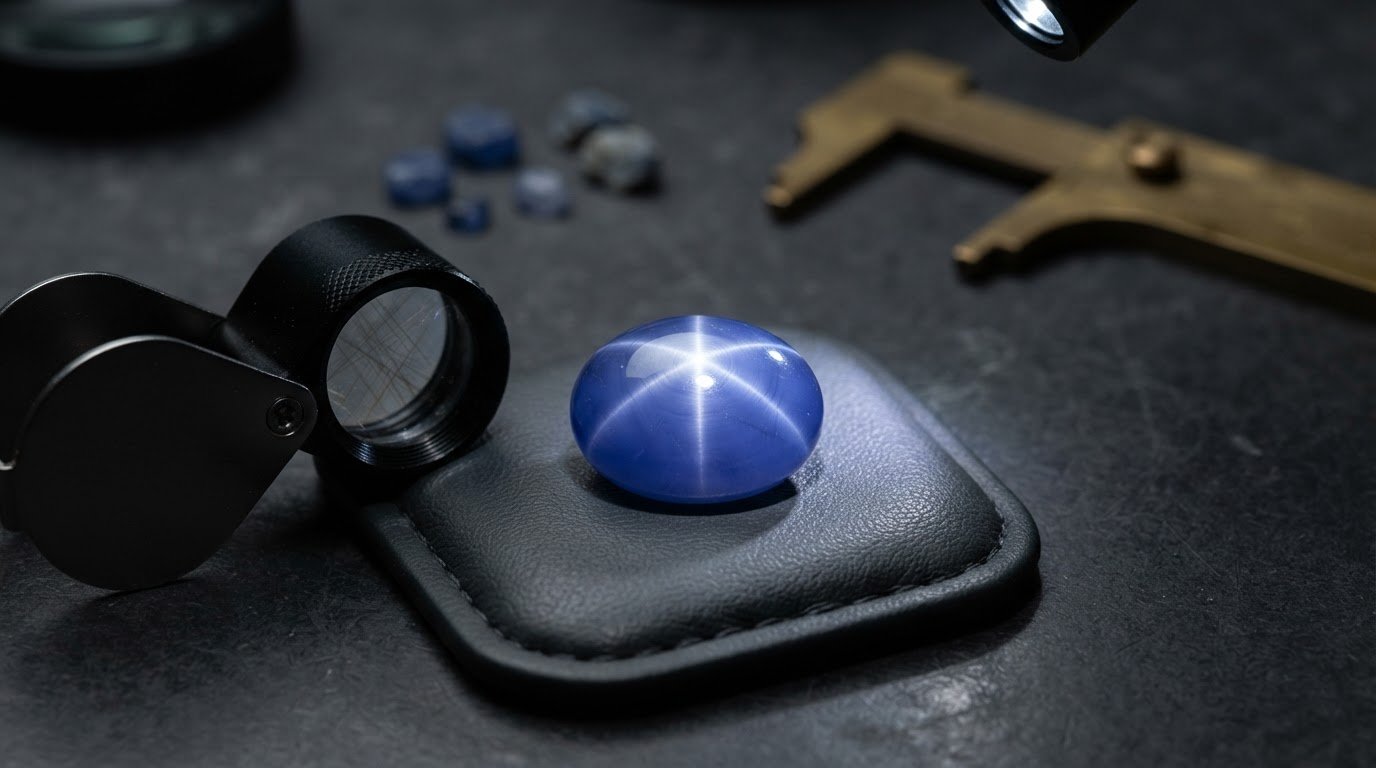
The most coveted loose star sapphires owe their celestial beauty to microscopic mineral inclusions that traditional heat treaters spend lifetimes trying to burn away. If you've ever felt hesitant trying to evaluate these rare cabochons online, you aren't alone. Between deceptive studio lighting, synthetic stones masquerading as natural treasures, and titanium diffusion treatments designed to fake a floating star on lifeless rough, judging genuine crystal quality through a screen can feel daunting.
You can master the art of evaluating these phenomenal gems with total clarity. This guide shows you how to judge a razor-sharp, perfectly centered six-ray star, unpacks why completely unheated crystalline stones command such reverence among collectors, and gives you the exact diagnostic signs to spot laboratory imitations. Here is your definitive insider's roadmap to the science of asterism, genuine mineral integrity, and selecting an exceptional loose gem with lasting confidence.
Key Takeaways
- Understand the precise optical science of asterism, including how microscopic rutile silk creates a floating star inside natural corundum.
- Master the four essential pillars of evaluation to grade the symmetry, sharpness, and motion of fine loose star sapphires like a seasoned gemologist.
- Learn the key diagnostic indicators that instantly separate genuine, unheated treasures from flame-fusion synthetics and shallow surface-diffusion treatments.
- Discover how classic origins like Sri Lanka influence crystal transparency, body tone, and long-term collector desirability.
- Explore specialized setting architecture, including protective bezels and open under-galleries, designed to safeguard your cabochon while maximizing its optical display.
The Allure and Science of Loose Star Sapphires
Few natural gemstones capture the imagination quite like phenomenal corundum. Asterism is an optical reflection phenomenon where intersecting light bands create a distinct, floating star across the curved surface of a gemstone. For serious collectors, natural loose star sapphires represent an intoxicating paradox. While high-temperature heating melts mineral inclusions to clarify transparent gems, star corundum requires those very inclusions to remain completely undisturbed to produce its celestial show.
Understanding this visual effect requires looking into the underlying mineralogy. To explore the crystallographic physics behind asterism in gemology, watch this informative visual breakdown:
From an expert perspective, finding a specimen that balances vivid color with a crisp, natural star is an exceptional event. Lapidaries must cut these treasures en cabochon rather than faceting them. Flat facets disperse reflected light into random flashes, whereas a smooth, convex dome acts as a focal lens that concentrates internal reflections into distinct, luminous bands across the stone.
Corundum and the Birth of a Star
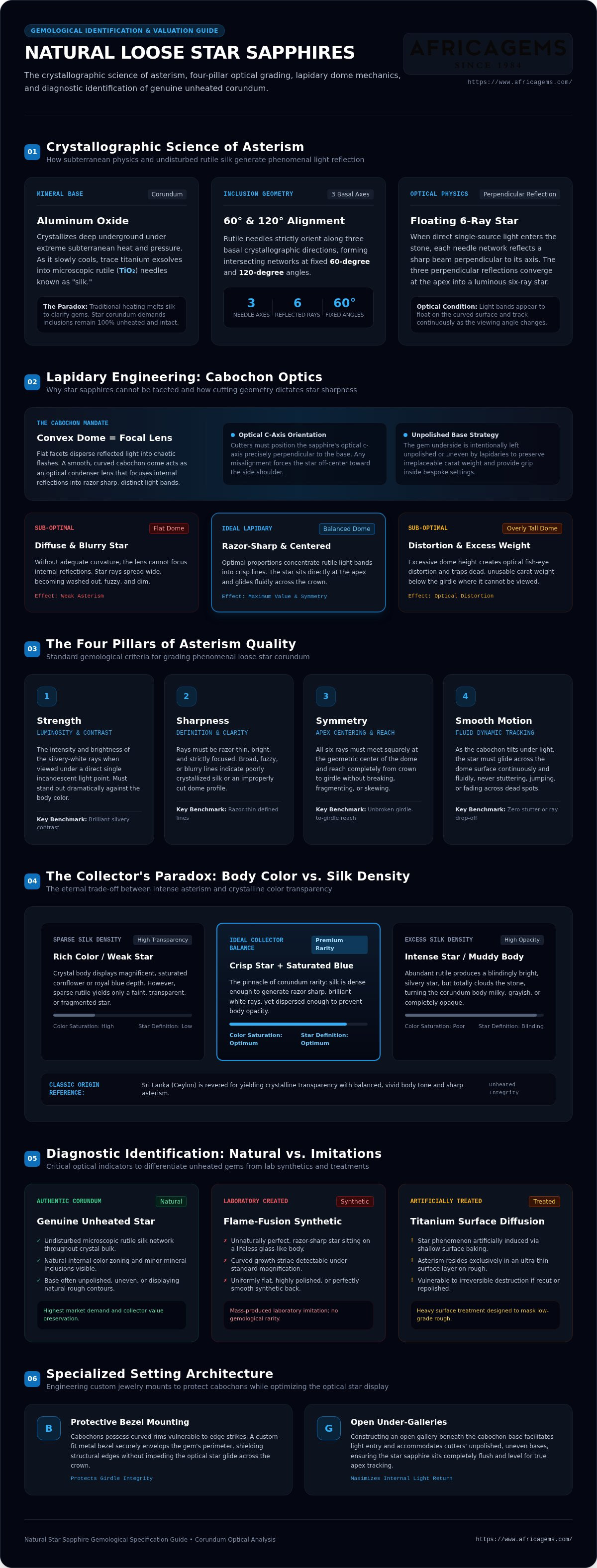
Sapphire crystallizes from aluminum oxide under immense subterranean heat and pressure. During slow cooling, trace titanium exsolves into microscopic rutile needles, commonly called silk. These needle-like inclusions align along three basal crystallographic axes, intersecting at precise 60-degree and 120-degree angles. When overhead light strikes these three intersecting needle networks, it reflects perpendicular lines that meet to form a classic six-ray star. Achieving this balance in nature is exceedingly rare; the silk must be dense enough to yield a brilliant star, yet sparse enough not to turn the body color muddy or fully opaque.
Cabochon Cutting: Shaping the Phenomenon
Cutting a star cabochon demands extraordinary lapidary precision. Dome height is critical; a dome cut too flat yields a diffuse, blurry star, while an overly tall dome creates optical distortion and traps excess carat weight beneath the girdle. The base of the gem is frequently left unpolished or uneven by cutters to preserve precious weight and anchor the stone securely within custom settings. Orienting a gem means precisely aligning the sapphire's optical c-axis perpendicular to the cabochon base, ensuring the six-ray star glides cleanly across the apex rather than sitting lopsided along the shoulder.
Evaluating Quality: The Four Pillars of Asterism
Judging fine loose star sapphires requires a trained eye for how light, crystal structure, and color coexist. While traditional faceted sapphires prioritize eye-clean clarity and facet brilliance, phenomenal cabochons are evaluated through an entirely distinct gemological lens. Asterism quality rests on four foundational pillars: strength, sharpness, symmetry, and smoothness of motion. A premier specimen displays an intense, silvery star that tracks fluidly across the stone as you tilt it under single-point incandescent light, with rays that never stutter or break across the crystal dome.
Most commercial evaluations focus on color alone, yet the interplay of structural elements is what truly commands collector prestige. Authoritative standards established in GIA sapphire quality factors highlight that the sharpness and completeness of the rays dictate gemological value just as heavily as the richness of the base material.
Star Sharpness and Centering
An ideal star presents six razor-thin, brilliant white rays intersecting cleanly at the apex of the cabochon. When rutile silk is misaligned or sparse, the rays appear fuzzy, broad, or fragmented, a serious optical flaw known as a broken star. Connoisseurs insist that each of the six rays must extend unbroken from the crown all the way down to the girdle. If the lapidary cut the rough off-center, the star sits permanently skewed toward one flank, diminishing both beauty and market value.
Body Color vs. Silk Density
The greatest challenge in sourcing natural star corundum is balancing body saturation against internal silk concentration. Dense rutile produces a blindingly bright star, but excessive silk inevitably turns the sapphire milky, grayish, or opaque, washing out the coveted royal or cornflower blue. Conversely, a transparent crystal offers breathtaking depth, yet sparse rutile yields only a faint, ghostly star. The ultimate prize is the semi-transparent "jelly" star sapphire, which retains vibrant body saturation while maintaining enough pristine silk to ignite an unmistakable six-ray star. If you are comparing hues, exploring curated precious gemstones helps reveal how light behaves differently across various mineral species.
Before investing, review video footage under moving, single-source light rather than static studio diffusion. If you are seeking an extraordinary collector cabochon with verified natural provenance, explore the ethically sourced collection of unheated gems at AfricaGems to inspect individual stones from every angle.
Identifying Treatments and Synthetic Star Sapphires
The single greatest hurdle facing collectors of loose star sapphires is the fear of purchasing an imitation. Synthetic star corundum, famously pioneered under trade names like "Linde," flooded mid-century markets and continues to circulate in estate sales and online platforms. Genuine unheated gems represent the ultimate prize, but unscrupulous sellers also employ high-temperature titanium diffusion to artificially induce asterism on otherwise lifeless rough. Protecting your investment requires learning the telltale physical signatures of genuine stones versus laboratory creations, backed by independent certification from trusted laboratories like the GIA.
The Flashlight Test for Authenticity
You don't need a complete gemological laboratory to conduct an initial screening. A simple handheld penlight provides crucial diagnostics. Synthetic star sapphires produced via the flame-fusion method look unnaturally perfect. Their stars appear intensely chalky and sharp, sitting directly on the surface dome like painted decals, whereas natural stars emerge organically from deep within the crystalline body. Under 10x magnification, synthetic stones reveal microscopic gas bubbles and curved growth striae. Natural cabochons display straight, angular growth zoning, subtle color banding, and microscopic rutile needles that catch the light unevenly as the stone moves.
Flat, perfectly uniform bases are another synthetic red flag. Cutters of natural rough preserve precious weight by leaving the bottom uneven or unpolished. If you turn a cabochon over and find a glass-smooth flat plane, treat it with immediate skepticism.
Unheated vs. Diffusion Treated
Titanium surface diffusion presents a different challenge because the host stone can be natural corundum. In this process, cutters coat low-grade rough in titanium powder and bake it at temperatures near corundum's melting point. This diffuses a paper-thin layer of rutile needles onto the stone's exterior, fabricating a sharp star on an otherwise dead crystal. If you polish or chip a diffusion-treated cabochon, the star disappears completely.
Unheated, natural star sapphires command a substantial premium because their phenomenal optical patterns formed undisturbed through geological time. As explored in our educational guides on the AfricaGems blog, extreme thermal heating alters rutile inclusions, meaning natural asterism can only survive when Mother Nature is left completely unedited. Never buy high-value loose star sapphires without an independent laboratory report verifying natural origin and certifying the stone as unheated.
Collector’s Guide: Origin, Rarity, and Market Value
Geographic provenance shapes the soul, coloration, and value profile of natural phenomenal corundum. Mineral composition varies across mining deposits, giving stones distinct optical signatures. While fine faceted gems are celebrated for transparency alone, loose star sapphires are prized for how geological conditions balanced trace elements with rutile formation. Understanding these regional distinctions helps collectors pinpoint exactly what type of phenomenal display speaks to their aesthetic preferences.
Corundum colors diverge dramatically across classic mining regions. While red star rubies represent an extreme anomaly due to chromium inhibiting crystal size and clarity, star sapphires span a diverse palette of blues, violets, and bronzes:
- Sri Lanka (Ceylon): Renowned for open cornflower blues, delicate pastels, and exceptional crystal transparency that lets light penetrate the dome.
- Myanmar (Mogok): Historically celebrated for richly saturated royal blues, velvety body color, and razor-sharp ray contrast.
- Thailand and Australia: Famous for producing dense, inky midnight-blue gems as well as dramatic black star sapphires featuring golden hematite-ilmenite asterism.
- Madagascar: An essential modern source yielding translucent violet-blues with remarkably fluid, centered stars.
Global Sources of Phenomenal Corundum
Sri Lanka holds legendary status as the historic benchmark for phenomenal sapphires. Ceylon rough typically displays a luminous cornflower blue with soft translucency, allowing the silvery star to glide effortlessly across an open, bright body. Burmese gems from Mogok provide an intense contrast, where dense pigment creates a dramatic backdrop for bright white asterism. To explore geological origins across exceptional mineral families, review our collector guides on the AfricaGems blog.
The Rarity of Large Star Specimens
Carat weight exerts an exponential impact on valuation. While rough corundum over five carats is uncommon, locating an unheated crystal that retains intact asterism without major structural fractures past ten carats enters true museum territory. Legendary specimens like the 733-carat Black Star of Queensland illustrate how monumental rough captivates collectors across generations. In top translucent qualities, large stones are extraordinary geologic anomalies. Read our comprehensive rare gemstones guide to understand how scarcity governs premier natural treasures.
When you are ready to acquire a certified, unheated cabochon sourced with complete transparency, view available loose star sapphires curated personally by Marc Sarosi at AfricaGems.
Custom Settings for Star Sapphires at AfricaGems
Transforming an exceptional cabochon into a wearable heirloom requires specialized jewelry architecture. While sapphire boasts an impressive Mohs hardness of 9, the curved geometry of phenomenal stones demands careful engineering. Protective bezel settings are particularly popular for loose star sapphires. A tailored precious metal bezel encloses the stone's perimeter, shielding the vulnerable girdle against direct impacts while creating a sleek, elegant frame that highlights the star's central glide. Through AfricaGems' custom jewelry design services, every mount is calibrated to the stone's exact proportions, with founder Marc Sarosi personally inspecting each finished piece to ensure the gem sits level so the star tracks true across the dome.
Selecting the right setting involves balancing physical security with light performance:
- Bezel Mounts: Provide smooth, snag-free protection ideal for daily wear in men's signet rings or modern low-profile rings.
- Heavy Prongs: Allow maximum ambient light to strike the gem's shoulders while lifting the cabochon for visual prominence.
- Open Under-Galleries: Ensure illumination penetrates from multiple angles, keeping the floating star active and vibrant.
Designing for the Phenomenon
Precious metal selection directly influences how a star presents to the eye. Platinum and white gold mirror the icy, silvery-white hue of intersecting rutile needles, creating a crisp, contemporary contrast against vivid blue corundum. In contrast, rich yellow gold brings warm vintage elegance, pairing gorgeously with deep midnight or bronze-toned specimens. Framing a central cabochon with brilliant accent diamonds enhances the celestial aesthetic, juxtaposing sharp diamond scintillation with the smooth, fluid motion of asterism. Discover curated setting styles and shop mountings engineered specifically to showcase phenomenal gems.
The AfricaGems Commitment
Acquiring fine phenomenal gemstones shouldn't feel like a leap into the unknown. Since 1984, AfricaGems has operated on foundational principles of direct ethical sourcing, strict standards of curation, and radical transparency with complete treatment disclosure. Every specimen is backed by Marc Sarosi's personal guarantee and verified by premier independent gemological laboratories, giving you total peace of mind.
Whether you're crafting a bespoke talisman or seeking an investment-grade cabochon to pass down through generations, selecting the right stone is the essential first step. Explore our hand-curated inventory of unheated Loose Star Sapphires, or contact Marc Sarosi for a personal consultation to bring your custom jewelry vision to life.
Selecting an Exceptional Star Sapphire with Confidence
Evaluating fine loose star sapphires is an exercise in discerning natural balance. It unites the crisp symmetry of an unbroken six-ray star with the rich depth of unheated corundum body color. By recognizing how microscopic rutile silk behaves, verifying diagnostic indicators to steer clear of synthetic imitations, and insisting on independent laboratory certification, you now have the tools to choose a phenomenal treasure with absolute assurance.
Every stone tells a story of geological wonder, and true connoisseurship begins with complete transparency. Ethically sourced since 1984, each cabochon at AfricaGems reflects decades of dedicated curation under the personal standards of founder Marc Sarosi. Backed by full treatment disclosure and premier independent grading, our unheated gems represent the purest expression of natural asterism. Whether you're envisioning a bespoke talisman ring or acquiring a rare mineral display, explore our ethically sourced Loose Star Sapphires at AfricaGems and claim a remarkable piece of the earth's legacy.
Frequently Asked Questions
What causes the star effect in a sapphire?
Asterism occurs when light reflects off microscopic rutile needle inclusions aligned along the sapphire crystal lattice. As corundum cools, titanium separates into titanium dioxide silk crystals that orient at 60-degree and 120-degree angles across three basal directions. When shaped into a curved cabochon, directional light striking these needle planes produces three perpendicular reflection bands. These intersecting bands form the floating six-ray star across the gem's surface.
How can I tell if a star sapphire is natural or synthetic?
Natural star sapphires exhibit subtle internal growth bands, natural inclusions, and a star that glides organically across the cabochon. Flame-fusion synthetics typically show an unnaturally sharp, chalky star that stays static on the surface dome, often paired with curved striae under magnification. High-quality loose star sapphires will have an independent lab certificate from institutions like the GIA confirming natural origin and unheated status, while fakes often feature unnaturally flat, stamped bases.
Are star sapphires more valuable than faceted sapphires?
Value depends on individual quality, but top-tier unheated star sapphires can rival or surpass faceted gems due to their extreme scarcity. Faceted sapphires represent the vast majority of mined rough, while specimens possessing both rich color and sharp asterism are rare geological anomalies. Commercial opaque stars often trade below fine faceted stones, but semi-transparent, vivid blue cabochons with razor-sharp rays command historic premiums among seasoned collectors and gem connoisseurs worldwide.
What is the best lighting to view a star sapphire's rays?
A single, direct, concentrated light source is essential to view a star sapphire at its best. Direct sunlight, a focused incandescent desk lamp, or a single-beam LED penlight will concentrate the reflection across the rutile silk, making the rays crisp and distinct. Diffused fluorescent room lighting or cloudy outdoor light scatters illumination across the dome, which softens or entirely masks the floating star effect.
Do star sapphires require special care or cleaning?
Natural star sapphires are exceptionally durable with a Mohs hardness of 9, requiring only straightforward, gentle cleaning. Clean your cabochon using warm water, mild dish soap, and a soft-bristled toothbrush to clear away skin oils and dust. While untreated corundum is tough, avoid harsh ultrasonic cleaners if the stone features significant surface-reaching fissures. Always store phenomenal gems separately in padded compartments so harder stones like diamonds don't abrade their polished domes.
Why are some star sapphires unpolished on the bottom?
Cutters leave the base of a star sapphire rough or unpolished to preserve carat weight and anchor the cabochon firmly in jewelry mountings. Polishing the flat underside grinds away valuable material without improving the face-up appearance or optical performance of the star. An unpolished, slightly textured base also gives jewelers better mechanical traction when setting the cabochon into custom bezels, ensuring the stone remains secure and level over a lifetime of wear.
Can a star sapphire be heat treated without losing the star?
Traditional high-temperature heating will permanently dissolve the rutile silk, destroying the star effect completely. Heat treaters routinely apply thermal temperatures above 1,600 degrees Celsius to faceted stones specifically to melt silk and improve clarity. While gentle, low-temperature thermal experiments exist in specialized laboratories, genuine loose star sapphires are prized almost exclusively in their completely unheated, natural state, where internal crystal structures remain untouched by human intervention.
What is the most desirable color for a star sapphire?
Saturated cornflower and vivid royal blue remain the most commercially coveted body colors for star sapphires. Collectors prioritize stones where rich, vibrant blue pigmentation coexists with exceptional transparency. While classic Ceylon blues lead global demand, fancy pastel shades like lavender, pink, and violet corundum have earned strong dedicated followings. The key is ensuring the body color remains rich and saturated rather than grayed out by overly dense rutile silk.

Article by
Marc Sarosi
Professional gemstone dealer for more than 40 years. Started off mining Aquamarine in Zambia, Africa and travelled throughout the continent in search of fine gems. Trusted authority on fine gemstones and have donated a fine collection of more than 27 extraordinary gemstones to the Smithsonian Institute Gem Hall for generations to see.