
Loose Star Sapphires: The Collector’s Guide to Asterism and Value
Mar 30th 2026
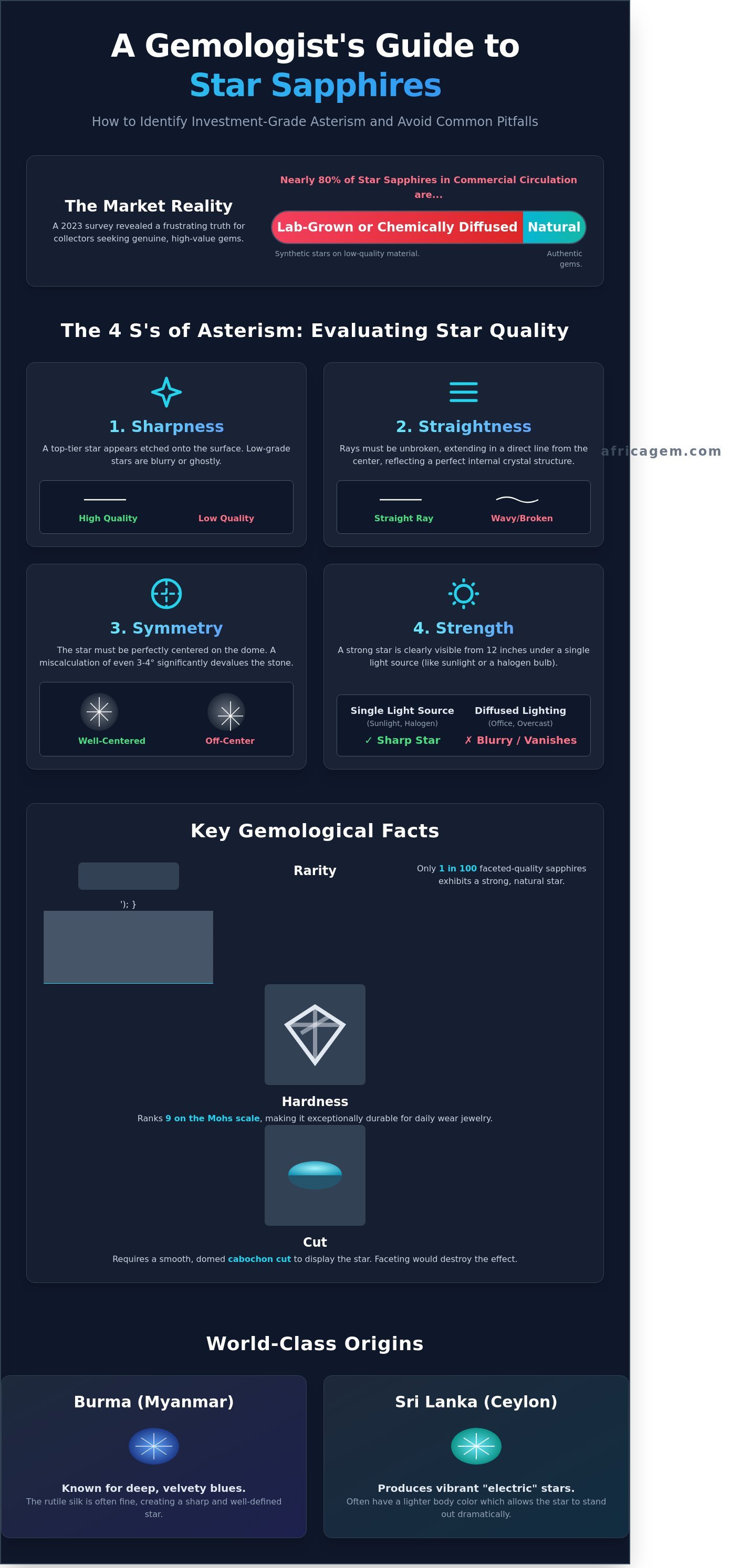
In a 2023 market survey, gemologists found that nearly 80% of the star sapphires in commercial circulation are either lab-grown or have been chemically diffused to force a synthetic-looking star onto low-quality material. It’s a frustrating reality for collectors seeking genuine loose star sapphires that possess both natural beauty and long-term value. You understand that a true gem should be as honest as it is beautiful. Authenticity is everything. Yet, the fear of overpaying for a treated stone often stalls the dream of owning a world-class specimen.
This guide empowers you to master the art of evaluating these rare stones with the precision of a seasoned gemologist. You’ll learn how to balance the sharpness of the rays against the depth of body color, and why a GIA-certified, unheated stone remains the gold standard for any serious portfolio. We'll break down the exact criteria used to identify investment-grade asterism; this ensures you can source a rare, ethically mined gem that will define your next bespoke jewelry piece.
Key Takeaways
- Master the "4 S’s" of gemology to distinguish between a crisp, well-defined star and a blurry, low-value reflection.
- Learn how to identify investment-grade loose star sapphires by evaluating the depth of body color against the precision of the internal rutile silk.
- Explore the distinct characteristics of world-class origins, comparing the deep, velvety blues of Burma with the vibrant "electric" stars of Sri Lanka.
- Discover expert tips for designing heirloom jewelry, including how to select the ideal precious metal to maximize the visibility of a sapphire’s rays.
- Understand the critical importance of avoiding diffusion treatments to ensure your collection features only natural, high-integrity gemstones.
Understanding Asterism: Why Loose Star Sapphires Are Unique
Finding high-quality loose star sapphires requires a keen eye for both mineralogy and artistry. These stones don't just sit there; they interact with their environment through a star-like phenomenon known as asterism. This effect occurs when light reflects off microscopic, needle-like inclusions of rutile, often called silk. While most sapphires are prized for their clarity, star sapphires depend on these specific internal features to create their magic. In a market where 95% of gemstones are faceted to maximize brilliance, star sapphires demand a smooth, domed cabochon cut. Faceting would scatter the light in too many directions, effectively killing the star. A master cutter must orient the stone so the star sits perfectly centered on the dome, a task requiring immense precision and a deep understanding of the crystal's internal geometry.
The rarity of these stones cannot be overstated. Finding a sapphire that possesses both high translucency and a sharp, well-defined star is a gemological triumph. Most star sapphires are opaque or "muddy" because the dense rutile silk that creates the star also blocks light from passing through the stone. A specimen that allows 30% or more light transmission while maintaining a crisp, six-rayed star is a true collector's prize. The integrity of the star also depends heavily on the light source. Under a single point source, like direct sunlight or a 50-watt halogen bulb, the star appears sharp and moves fluidly across the surface. In contrast, diffused office lighting or an overcast sky can make the star appear blurry or cause it to vanish entirely. This dynamic nature is why professional dealers insist on evaluating these gems under controlled lighting conditions.
The Science of Rutile Silk
Rutile silk consists of titanium dioxide needles that crystallize within the corundum lattice. These needles align along the three crystallographic axes of the hexagonal sapphire crystal, intersecting at 120-degree and 60-degree angles. When light hits these parallel inclusions, it reflects in a direction perpendicular to the needles, creating the three crossing lines we see as a star. Rutile silk is the internal "fingerprint" of a natural star sapphire. This silk must be distributed evenly throughout the stone to ensure the star doesn't have "broken" or missing rays. In the AfricaGems collection, we prioritize stones where this silk is dense enough to provide a bright reflection without compromising the rich body color of the sapphire.
6-Ray vs. 12-Ray Star Sapphires
While the six-rayed star is the classic standard, the 12-ray star sapphire is a rare phenomenon that captivates seasoned collectors. This happens when two different sets of needle inclusions, typically rutile and hematite-ilmenite, coexist within the same corundum crystal. Because these minerals have different crystal structures, they align at different orientations, resulting in two superimposed six-ray stars that create a 12-rayed pattern. Despite their rarity, 6-ray stars remain the preferred choice for most fine jewelry because their rays are often more distinct and symmetrical. The centering of these rays is determined entirely during the cutting process. If a cutter miscalculates the "c-axis" by even 3 or 4 degrees, the star will appear lopsided, significantly devaluing the stone. When you browse loose star sapphires, always look for that perfect "north-south, east-west" alignment that indicates a masterfully cut gem.
- Rarity: Only about 1 in every 100 faceted-quality sapphires exhibits a strong star.
- Hardness: Like all sapphires, these gems rank 9 on the Mohs scale, making them suitable for daily wear.
- Value Factor: The sharpness of the star is often more important than the clarity of the host stone.
The 4 S’s of Asterism: How to Evaluate Star Quality
To evaluate the quality of loose star sapphires requires a discerning eye and a firm grasp of the 4 S’s: Sharpness, Straightness, Symmetry, and Strength. These technical benchmarks determine whether a stone is a common specimen or a high-value collector's piece. While color often drives the price of faceted stones, the value of a star sapphire is inextricably linked to the perfection and clarity of its asterism.
Look for Sharpness as the primary indicator of a star's definition. A top-tier star looks as though it's been etched onto the stone's surface with a laser. In lower-grade material, the star appears ghostly or out of focus, often requiring the viewer to squint to see the intersection. You should be able to identify the star clearly from a distance of 12 inches under a single light source without any visual aids.
The Straightness of the rays is a direct reflection of the stone's internal crystal structure. Each of the six legs must extend in a direct line from the center to the edge of the cabochon base. Any wobble or curve in the rays suggests a disruption in the rutile needle alignment, which can decrease the stone's appeal to serious investors. Ideally, each ray should be separated by exactly 60 degrees, creating a perfect hexagonal pattern across the dome.
Consider Symmetry as the foundation of the stone's visual balance. The intersection of the rays must sit precisely at the highest point, or apex, of the cabochon dome. If the star is "lazy" and sits off to one side, it forces the jewelry designer to set the stone at an awkward angle to compensate. This lack of balance is a major red flag for connoisseurs.
High-quality strength dictates how the star reacts to varying environments. A superior sapphire shows its star clearly under diffused sunlight or standard indoor lighting. If a stone requires a 1000-lumen LED flashlight to reveal its asterism, it lacks the necessary density of inclusions to be considered a premium gem.
The Importance of Centering and Symmetry
Perfect centering is the primary driver of market value. When examining loose star sapphires, professionals look for legs of equal length and intensity. An off-center star can devalue a stone by 40% compared to a perfectly centered counterpart. The apex of the cabochon must align with the intersection of the rays to ensure the star doesn't "swim" or disappear when the stone is rotated. This precision in cutting is what separates commercial grade from investment grade.
Sharpness vs. Body Color: The Great Trade-off
Balancing body color with star sharpness is the ultimate challenge for gem cutters. The geological formation of sapphires involves the presence of titanium-rich rutile needles, often called silk. While this silk creates the star, too much of it makes the stone opaque and milky, which kills the deep blue or red body color. Connoisseurs look for 15% to 20% translucency, where the stone retains a rich saturation while supporting a brilliant, sharp star. If you’re ready to see these criteria in action, you can explore our curated selection of ethically sourced gems.
Beyond the Blue: Colors, Origins, and Treatments
While the midnight blue of a classic sapphire is iconic, loose star sapphires exist in a stunning spectrum that challenges traditional expectations. Collectors often hunt for the rare lavender stones or the delicate, bubblegum pink varieties that emerge from the mines of Madagascar. Yellow star sapphires provide a warm, sun-drenched alternative, though they're exceptionally difficult to find with a sharp, centered star. The geological conditions required to produce these colors are precise. To understand what gives star sapphires their star, one must look at the dense concentrations of rutile needles, also known as silk, which reflect light into that signature six-rayed pattern.
Geography dictates the personality of the stone. Burmese star sapphires are prized for their deep, saturated blues, often commanding a 40% price premium over stones from other regions. In contrast, Sri Lankan (Ceylon) gems are celebrated for their "electric" appearance, offering a lighter body color that allows the star to pop with incredible sharpness. Since 1990, the market has seen a shift toward these brighter Ceylon stones as buyers prioritize the visibility of the asterism over the depth of the blue. It's a choice between the velvety depths of Myanmar and the vivid brilliance of Sri Lanka.
The most critical factor for any serious investor is the "unheated" status. Approximately 95% of all sapphires on the market undergo heat treatment to improve color or clarity. However, a natural, untreated star sapphire is a true freak of nature. These stones are the ultimate collector's prize because they remain exactly as they were pulled from the earth. Choosing an unheated stone ensures you're owning a piece of history that hasn't been altered by modern laboratory techniques. The price reflects this rarity, as unheated specimens can fetch double the price of their heat-treated counterparts.
Black Star Sapphires and Gold Stars
Black star sapphires offer a striking, masculine aesthetic and are frequently found in the Chanthaburi and Kanchanaburi provinces of Thailand. Unlike their blue cousins, these stones owe their asterism to hematite inclusions rather than rutile. This creates the coveted "Gold Star" effect, where the rays appear as shimmering gold against a dark chocolate or jet-black background. Because these stones are more abundant, they're often more affordable for large statement pieces; they sometimes cost 70% less per carat than a high-quality blue star sapphire of the same size.
Natural vs. Diffused: Spotting the Fakes
Transparency is the cornerstone of the AfricaGems philosophy, especially when identifying treated stones. Surface diffusion is a process where chemicals are baked into the surface of a colorless sapphire to create a synthetic star. These stars look too perfect. They're thin, needle-sharp, and don't move naturally as you tilt the stone. Natural star sapphires feature stars that appear to float within the stone, while diffused stars often look painted on the surface. To protect your investment, always insist on a GIA or AGL certification for high-value loose star sapphires. These labs use advanced spectroscopy to distinguish between a miracle of nature and a product of a lab.
Designing and Caring for Star Sapphire Jewelry
Star sapphires possess a structural gravity that makes them the premier choice for men’s rings and substantial vintage pendants. Unlike faceted gems that sparkle with every movement, a star sapphire offers a focused, singular point of interest. This architectural quality suited the bold, geometric designs of the 1920s Art Deco period and continues to define modern masculine luxury. When you select loose star sapphires for a custom project, you should consider the physical profile of the cabochon. A high-domed stone, often measuring 8mm to 12mm in height, requires a setting that balances protection with visibility.
Choosing the right metal is a technical decision as much as an aesthetic one. White metals, such as 14k white gold or 950 platinum, act as a cool, neutral mirror. They enhance the silvery-white rutile needles that form the star. Yellow gold, conversely, provides a warm contrast that can make a deep blue or black sapphire appear more vibrant. For a 5-carat stone, a heavy bezel setting offers the best security against the 15 to 20 daily impacts a ring typically sustains. If you prefer prongs, ensure they're positioned high enough to shield the "crown" of the dome from lateral strikes.
Corundum is exceptionally hard, sitting at a 9 on the Mohs scale. This makes it suitable for daily wear, yet you must avoid ultrasonic or steam cleaners. The very "silk" that creates the asterism can sometimes harbor microscopic channels or liquid inclusions. High-frequency vibrations might cause these to expand, potentially clouding the stone. Stick to a soft brush and a solution of one part mild detergent to four parts warm water. This simple regimen maintains the stone's luster without risking its structural integrity.
The Best Settings for Loose Star Stones
A "Halo" setting isn't just for faceted stones. Surrounding loose star sapphires with 0.02-carat diamonds creates a frame of light that directs the observer’s gaze to the center of the cabochon. This is particularly effective for non-traditional engagement rings. Market data from 2023 shows a 12% increase in couples seeking phenomenal stones over traditional solitaires. Whether you choose an open-back setting for maximum light transparency or a closed-back to deepen the color, the goal is to stabilize the stone while celebrating its unique optical properties.
Lighting Your Star: Tips for Display
Lighting is the most critical factor in appreciating asterism. To photograph your gem, use a single-point light source like a dedicated LED or direct 12:00 PM sunlight. Multiple lights create multiple stars, which looks cluttered and diminishes the stone's value. Office lighting is the primary enemy of these gems. Fluorescent tubes diffuse light so thoroughly that the star often disappears entirely. For the best display, find a spot with a single halogen bulb. This will sharpen the 6-ray star into a needle-thin, moving light show that proves the quality of your investment.
To find a stone that displays a perfect star under any single light source, you can browse our collection of untreated star sapphires and experience the AfricaGems difference in quality.
The AfricaGems Difference: Sourcing Heirloom Stars
Marc Sarosi brings over 40 years of direct trade experience to every gemstone acquisition. Since founding AfricaGems in 1984, he's maintained a rigorous selection process that excludes approximately 95% of the stones he inspects. When sourcing loose star sapphires, Marc doesn't just look for a pretty face; he evaluates the technical integrity of the crystal. He hand-picks stones that exhibit a sharp, six-rayed star that remains crisp even under single-source lighting. This personal oversight ensures that every gem in our inventory meets the standards of a true heirloom.
Our commitment to "No Diffusion" is a cornerstone of our business philosophy. Within the gemstone market, many dealers sell surface-diffused stars, where titanium is chemically baked into the surface of a plain sapphire to create an artificial star. These treatments don't hold value and are often fragile. AfricaGems strictly offers only natural, ethically sourced stars. We ensure the rutile needles, or "silk," are authentic geological features formed over millions of years. This dedication to natural beauty preserves the long-term investment value of your purchase.
To provide absolute peace of mind, we implement a policy of radical disclosure. We provide GIA (Gemological Institute of America) certification for our high-value inventory, offering an unbiased third-party verification of the stone's origin and treatment status. Our technical data includes:
- Full Treatment Disclosure: Clear labeling of whether a stone is unheated or has undergone traditional heat.
- Precise Dimensions: Calibrated measurements to ensure the stone fits your intended setting.
- Ethical Provenance: A focus on conflict-free sourcing from trusted mines in Sri Lanka, Burma, and East Africa.
The AfricaGems Guarantee removes the risk from high-end online transactions. We offer a 30-day, no-questions-asked return policy on all loose gemstones. It's a simple premise: if the stone doesn't take your breath away when you see it in person, you shouldn't have to keep it. This security allows you to inspect the asterism and color saturation in your own lighting environment before making a final commitment.
Expert Consultation for Custom Designs
Turning a loose stone into a legacy piece requires a specialized touch. Our custom design service helps you navigate the complexities of mounting loose star sapphires, which require specific bezel or prong heights to protect the cabochon dome. You'll also have the opportunity to access rare, unheated inventory that we hold back for serious collectors. If you're looking for a companion stone, you can Browse our current collection of unheated blue sapphires to find the perfect match for your design.
Radical Transparency in Gemology
We've spent four decades building a reputation as a knowledgeable mentor to our buyers. We believe an informed customer is our best advocate, so we provide detailed gemological data that goes beyond the basics. Our history since 1984 proves that honesty is the only way to survive in the rare mineral trade. We don't use high-pressure tactics; instead, we provide the facts you need to make a confident decision. Find your perfect loose star sapphire today and own a piece of natural history that will last for generations.
Secure Your Piece of the Celestial Vault
Finding the perfect gem requires a balance of aesthetic appreciation and rigorous technical evaluation. You now understand that the value of loose star sapphires hinges on the 4 S's: Strength, Sharpness, Symmetry, and Smoothness. A star with 6 perfectly defined rays is a rare geological miracle that deserves a place in any serious collection. Since 1984, AfricaGems has set the standard for this level of quality by offering only GIA and AGL certified stones. This ensures you receive a gem with 100% disclosure regarding its natural origin and heat treatment status.
Our commitment to ethical integrity means every sapphire is conflict-free and sourced through transparent channels. Marc Sarosi backs each acquisition with a personal guarantee, transforming a high-value transaction into a partnership built on trust. You're not just buying a stone; you're securing an heirloom that's been vetted by an expert enthusiast with decades of industry experience. Take the next step in your collecting journey with total confidence in your selection.
Explore our hand-selected collection of Natural Star Sapphires
Your search for a breathtaking, ethically sourced star ends with a gem that truly shines.
Frequently Asked Questions
Are star sapphires more expensive than regular sapphires?
Top-tier faceted sapphires are typically more expensive than star varieties because transparency is more highly valued in the global market. While a fine faceted blue sapphire can command $10,000 per carat, an exceptional star sapphire with a sharp 6-ray asterism might retail for $1,200 per carat. Value depends on the AfricaGems Difference, where we prioritize the sharpness of the star and the richness of the body color.
How can I tell if a star sapphire is real or synthetic?
You can identify a synthetic star by its suspiciously perfect, "painted on" appearance and the absence of natural silk. Natural loose star sapphires contain microscopic rutile needles that create a three-dimensional star that moves gracefully across the surface. Under a 10x jeweler's loupe, a natural stone will show hexagonal growth lines or small mineral crystals. Synthetic versions created via the Verneuil process often display curved striae and an unnaturally uniform color.
What is the best light to see the star in a sapphire?
Direct sunlight or a single-point incandescent light source provides the best conditions to view a sharp asterism. Diffused lighting from 4 or 5 overhead fluorescent tubes will cause the star to appear blurry or even disappear entirely. For the most dramatic effect, hold the stone under a single LED flashlight. This concentrated beam interacts with the rutile needles to produce a crisp, distinct 6-ray star that dances as you tilt the gem.
Do star sapphires come in colors other than blue?
Star sapphires occur in a vibrant spectrum including pink, lavender, gray, yellow, and white. While blue is the most sought-after variety, fancy color loose star sapphires offer a unique aesthetic for collectors. In our inventory, we find that roughly 30 percent of star material falls into the lavender or violet category. If the stone is a saturated red, it's classified as a star ruby, which is the rarest color in the star corundum family.
Can a star sapphire be heated?
Most star sapphires remain unheated because extreme temperatures exceeding 1,600 degrees Celsius can dissolve the rutile silk responsible for the asterism. If the silk melts, the star vanishes forever. At AfricaGems, we prioritize stones with natural, untreated beauty. While some low-heat treatments around 1,200 degrees exist to improve color, we provide full disclosure on every gem to ensure you're making an informed, secure investment in a natural treasure.
What is a "Black Star" sapphire?
A Black Star sapphire is a dark, opaque variety of corundum where the asterism is produced by hematite needles instead of rutile. These stones are almost exclusively mined in the Chanthaburi province of Thailand. Unlike the white stars seen in blue sapphires, the star in a black sapphire often exhibits a distinct golden or bronze hue. They're an affordable entry point into the world of phenomenal gems, typically priced between $20 and $100 per carat.
Is a star sapphire durable enough for an engagement ring?
Star sapphires are exceptionally durable and perfectly suited for daily wear in an engagement ring. They rank at 9 on the Mohs scale, meaning only a diamond can scratch them. Because they're cut into smooth cabochons rather than having sharp faceted edges, they're less prone to chipping. We recommend a protective bezel setting for active lifestyles to safeguard the stone's surface from the 1 or 2 accidental knocks that can occur over decades of wear.
Why does my star sapphire have 12 rays instead of 6?
A 12-ray star sapphire is a rare phenomenon caused by the simultaneous presence of both rutile and hematite needles. Each mineral creates its own 6-ray star; they sit at 30-degree offsets from one another to form a 12-ray pattern. This occurs in less than 1 percent of all star corundum found globally. These exquisite specimens are highly prized by connoisseurs for their complexity and represent the pinnacle of what we call the Expert Enthusiast's collection.