
Loose Spinel Gemstones: The Connoisseur’s Guide to Buying & Collecting
Mar 30th 2026
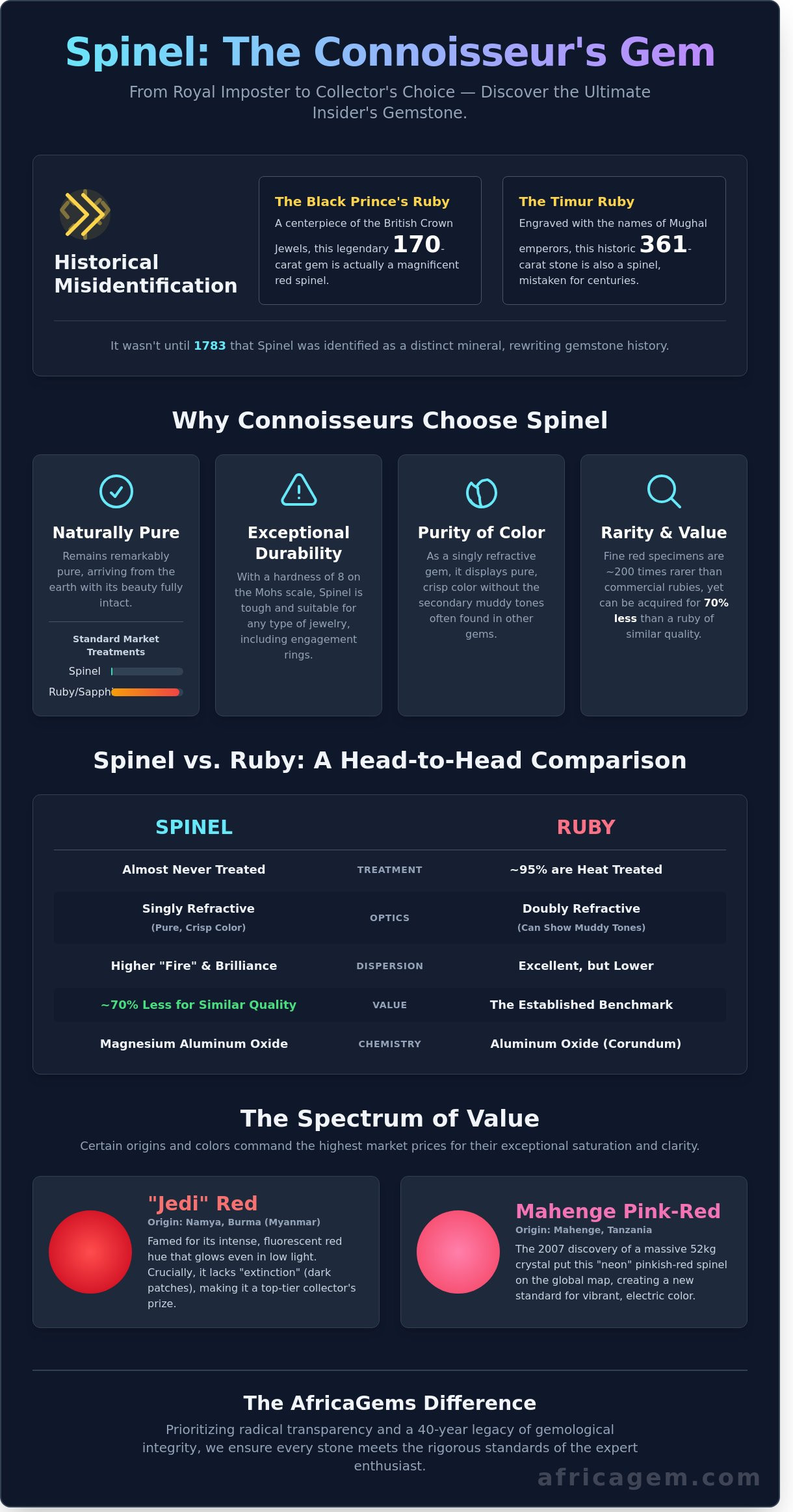
For centuries, the most iconic rubies in history, such as the 170-carat Black Prince’s Ruby in the British Crown Jewels, were actually misidentified spinels. This historical irony highlights why loose spinel gemstones are the ultimate insider’s choice for collectors who demand natural beauty without the interference of heat or chemicals. You likely recognize that the most valuable treasures are those that require zero laboratory enhancements to showcase their brilliance. It's a standard of purity that few other minerals can match, making spinel a cornerstone of any sophisticated portfolio.
I understand the frustration of encountering muddy, grayish stones when you're searching for the vibrant saturation of a Mahenge pink or a vivid Burmese red. This guide promises to transform you into a confident connoisseur by teaching you how to identify investment-grade colors and avoid the pitfalls of synthetic lookalikes. We will detail exactly what makes a specimen loupe-clean and how specific origins impact market price; ensuring your next acquisition is both breathtaking and financially sound. By the end, you'll possess the technical vocabulary and visual benchmarks necessary to navigate this market with radical transparency.
Key Takeaways
- Discover why these former "royal imposters" have evolved into the connoisseur's favorite for their natural, untreated brilliance and exceptional durability.
- Master the nuances of the color spectrum to identify high-investment loose spinel gemstones, from the legendary "Jedi" reds to electric Mahenge pinks.
- Learn to evaluate quality like a professional by assessing color saturation and clarity to ensure your stone is free from distracting brown tints.
- Gain the confidence to buy online by understanding the AfricaGems Difference, prioritizing radical transparency and a 40-year legacy of gemological integrity.
The Evolution of Loose Spinel Gemstones: From Royal Imposter to Collector Favorite
For centuries, the world's most famous "rubies" weren't rubies at all. The 170-carat Black Prince’s Ruby, which sits prominently in the British Imperial State Crown, is actually a magnificent red spinel. The 361-carat Timur Ruby shares a similar history of mistaken identity. These stones traveled through royal treasuries for over 600 years before Jean-Baptiste Louis de Romé de l'Isle identified spinel as a distinct mineral species in 1783. Because they were often found in the same gravel pits as corundum, they were grouped together by color rather than chemical composition.
Spinel spent most of the 19th and 20th centuries as an undervalued alternative to the Big Three. It lived in the shadow of ruby and sapphire, often relegated to the status of a "synthetic" because of its common use in class rings. This perception shifted dramatically in August 2007. Miners in the Mahenge region of Tanzania discovered a massive 52-kilogram spinel crystal of extraordinary "neon" pinkish-red hue. This single find alerted the global market to the potential of loose spinel gemstones as a primary luxury asset. Shortly after, the "Jedi" reds from the Namya mines in Burma gained fame for their lack of "extinction," or dark patches, within the stone. These discoveries pushed spinel from a secondary choice to a top-tier collector favorite.
Modern collectors gravitate toward spinel because of its "natural-only" reputation. In an era where 95% of sapphires and rubies undergo heat treatment to improve color, spinel remains remarkably pure. It's one of the few gems that arrives from the earth with its beauty fully intact, requiring nothing more than expert cutting to reveal its brilliance.
Spinel vs. Ruby: A Tale of Two Gems
While they look similar to the naked eye, their chemistry is distinct. Ruby is aluminum oxide, but the Spinel mineral properties consist of magnesium aluminum oxide. Spinel often displays better "fire" than ruby because it has a high level of dispersion. This means it breaks light into spectral colors more effectively. For the savvy investor, the price-to-quality ratio is compelling. You can often acquire a 3-carat, loupe-clean red spinel for 70% less than a ruby of similar saturation, allowing for a much larger stone without compromising on visual impact.
The "Insider Gem" Reputation
Gemologists frequently choose spinel for their personal collections because it's an honest stone. It's significantly rarer than sapphire, with fine red specimens being roughly 200 times harder to find in nature than commercial-grade rubies. This scarcity, combined with its incredible durability, makes it a staple for those who understand gemology. Spinel is a singly-refractive gem that offers pure color without pleochroism. This means you see the same beautiful hue regardless of the angle from which you view the stone. It doesn't have the secondary "muddy" tones often found in doubly-refractive gems, ensuring the color remains vibrant in all lighting conditions.
Choosing loose spinel gemstones is a mark of a connoisseur. It reflects an appreciation for natural beauty that hasn't been altered in a laboratory. At AfricaGems, we prioritize this transparency, ensuring every stone in our collection meets the rigorous standards of the "Expert Enthusiast."
Why Connoisseurs Choose Spinel: Durability, Brilliance, and the "No Treatment" Standard
For decades, spinel lived in the shadow of more famous corundum cousins. Today, seasoned collectors seek out loose spinel gemstones because they offer a level of purity that's vanishingly rare in the modern market. While approximately 95% of all sapphires and rubies undergo high-temperature heat treatment to enhance their appearance, spinel is almost never subjected to such processes. This "no treatment" standard isn't just a marketing claim; it's a fundamental characteristic of the mineral's chemistry. Spinel is naturally beautiful right out of the earth, requiring only expert cutting to reveal its inner fire.
The visual appeal of spinel stems from its unique physics. It's one of the few gemstones that is singly refractive, a trait it shares with diamonds and garnets. Light enters the stone and remains a single beam, resulting in colors that appear more "pure" and "crisp" to the human eye. This differs from the "doubly refractive" look found in most other gems, where light splits into two rays and can create a slightly blurred or "fuzzy" visual effect. With a high refractive index of 1.718, spinel displays a vitreous, glass-like luster that can rival a diamond's fire when cut with precision. For a deeper dive into these technical specifications, the GIA on Spinel quality guide provides exhaustive data on how these optical properties influence market value.
The Integrity of Untreated Stones
The unheated status of spinel provides significant long-term resale value. In a market where synthetic and heavily treated stones are common, a natural, untreated gem is a finite asset. AfricaGems maintains a strict commitment to natural stone integrity, ensuring every gem is exactly what we claim it to be. When you review a GIA or AGL report for our loose spinel gemstones, you'll typically find the treatment section marked as "None" or "No indications of heating." This lack of interference means the color you see is the exact shade forged by nature millions of years ago. Understanding these reports is vital; they act as the stone's birth certificate and guarantee its status as a non-enhanced specimen.
Durability for Engagement Rings
Spinel ranks 8 on the Mohs scale of mineral hardness. While it's below diamond (10) and sapphire (9), it's significantly more durable than tanzanite (6.5) or emerald (7.5). This makes it an excellent candidate for daily-wear jewelry like engagement rings. You don't have to worry about the surface dulling or scratching from minor contact with everyday objects. To ensure the stone remains secure for a lifetime, we suggest utilizing our custom jewelry design services to create a setting that protects the crown and girdle. A well-set spinel is a heritage piece that survives generations, resisting the chipping that often plagues softer stones.
Navigating the Spinel Color Spectrum: From "Jedi" Reds to Cobalt Blues
Spinel's palette is a masterclass in trace element chemistry. The most coveted red variety, the "Jedi" spinel, was first identified in 2002 at the Man Sin mine in Burma by gemologist Vincent Pardieu. These gems are defined by a total absence of iron, allowing a high level of chromium induced fluorescence to create a neon red glow. Unlike rubies, which often require heat to reach this level of vibrancy, these spinels are typically unheated and loupe-clean. The "Stoplight Red" variety is equally prized, offering a pure, vivid red that mimics the legendary pigeon's blood ruby without the heavy price tag associated with Corundum.
The 2007 discovery in the Mahenge region of Tanzania introduced the world to "Flame" spinels, which possess a secondary orange hue that creates a vivid, sunset-like saturation. These stones are famous for their electric pink tones. A massive 52-kilogram crystal found during that initial 2007 excavation redefined our understanding of pink saturation in the gemstone world. When you evaluate high-quality loose spinel gemstones, the intensity of the color often dictates the investment potential more than the carat weight alone.
Blue varieties are categorized by their specific coloring agents. Most blue spinels exhibit a "steely" or "denim" tone due to iron impurities, resulting in a muted, sophisticated appearance. Cobalt spinel is the true prize for blue gemstone collectors. These stones are colored by cobalt rather than iron, creating a vivid blue that rivals the finest Kashmir sapphires. Because the Spinel geological formation process rarely isolates cobalt without the presence of iron, these stones are exceptionally rare. A top-tier Cobalt spinel from Luc Yen, Vietnam, can command prices exceeding $25,000 per carat for specimens over 2 carats.
Investment-Grade Colors
What makes a "Jedi" red so valuable? The secret lies in the lack of iron "masking," which permits the stone to fluoresce under any light source. This neon effect is a rare optical phenomenon that collectors prioritize. Cobalt spinel remains the most expensive blue variety because of its extreme scarcity; less than 1% of blue spinels qualify as true cobalt-colored. Saturation remains the primary price driver in loose spinel gemstones, meaning a smaller, more vivid stone often outvalues a larger, duller one.
The Rise of the "Gray" Spinel
Modern tastes have shifted toward the "Stormy" and "Lavender" spectrum over the last five years. Between 2018 and 2023, demand for metallic and silver spinels rose by 45% among Gen Z and Millennial buyers seeking alternative engagement rings. These "Metalic" stones offer a unique luster that traditional gems lack. You must evaluate the undertones carefully to avoid "muddy" or "dark" stones that look like common graphite. Look for a crisp, silver secondary hue that reflects light across the facets. Pairing loose gray spinels with 18k rose gold provides a warm contrast that makes the metallic, cool undertones of the stone pop with modern elegance.
Evaluating Quality: A 5-Step Guide to Buying Loose Spinel Online
Selecting loose spinel gemstones demands a disciplined approach to gemological detail. Spinel's high refractive index of 1.718 makes it naturally brilliant, but poor sourcing or cutting can dim its inherent fire. You aren't just buying a rock; you're investing in a rare mineral that has survived millions of years of geological pressure. Follow these five steps to ensure your acquisition meets the standards of a true investment piece.
- Step 1: Assess Color Saturation. Seek vibrant, "popping" hues. The most valuable spinels avoid the brown or gray secondary masks that plague lower-quality material. A pure "flame" orange or "neon" pink should remain bright even in low-light environments. If the color looks "muddy" or "inky," the stone's value drops by as much as 60%.
- Step 2: Check Clarity. Spinel is classified as a Type II gemstone. While some microscopic inclusions are expected, you should prioritize "eye-clean" or "loupe-clean" specimens. Avoid stones with internal fractures that reach the surface, as these compromise the gem's 8.0 Mohs scale hardness and long-term durability.
- Step 3: Analyze the Cut. A superior cut provides a "lively" return of light across the entire face of the gem. If the center looks transparent like a pane of glass, it has a "window." This indicates the cutter prioritized weight over beauty, which is a compromise we don't accept at AfricaGems.
- Step 4: Verify Origin. Location drives value and personality. The 2007 discovery of vibrant pinks in Mahenge, Tanzania, shifted the market forever, yet Burma (Myanmar) remains the gold standard for deep, pigeon-blood reds.
- Step 5: Demand Certification. Never finalize a high-value purchase without a report from a top-tier lab like GIA or AGL. This confirms the stone is natural and, crucially, unheated.
Cut and Brilliance
The Origin Factor
You deserve a gemstone that combines technical perfection with an ethical soul. Explore our curated selection of certified loose spinel gemstones to find a specimen that meets the highest standards of the AfricaGems Difference.
The AfricaGems Difference: Sourcing Exceptional Loose Spinel
For four decades, AfricaGems has operated with a singular focus on gemological integrity. Since our founding in 1984, we've prioritized radical transparency over quick sales. Choosing a gemstone is an act of trust. We honor that trust by providing a comprehensive history for every stone in our vault. Our 40-year legacy isn't just a number; it's a record of thousands of successful transactions where the buyer felt like an empowered insider. You aren't just buying a mineral; you're participating in a tradition of excellence.
Our selection process is notoriously rigorous. We reject 90% of the stones presented to us by suppliers. A spinel might have a beautiful hue, but if the cut shows a "window" or the clarity doesn't meet our standards, it won't enter our inventory. We look for stones that are loupe-clean and possess exceptional pleochroism. This curation ensures that when you browse our loose spinel gemstones, you're only seeing the elite 10% of the market. We do the difficult work of filtering so you don't have to.
The AfricaGems Guarantee is our promise of 100% treatment disclosure. While most spinels are naturally unheated, we verify every claim with rigorous testing. You'll never find a hidden treatment here. We provide the technical data you need to make an informed decision, from refractive index to specific gravity. If you want to move beyond the loose stone, our custom design capabilities allow you to transform your selection into a bespoke masterpiece. We bridge the gap between a rare mineral and a finished heirloom through expert craftsmanship.
Why Buy Loose Stones?
Purchasing loose spinel gemstones offers a level of control that pre-set jewelry cannot match. You can inspect the stone from every angle, ensuring there are no hidden inclusions tucked under a prong. It provides the ultimate creative freedom to design a setting that reflects your personal style. For collectors, loose stones offer superior investment flexibility. It's much easier to store, trade, or appraise a stone when it isn't obscured by a metal mounting.
Start Your Spinel Journey Today
We've designed our digital storefront to be as intuitive as a personal consultation. You can use our advanced filters to sort by carat weight, color saturation, or origin to find a stone that fits your specific criteria. If you need a more tailored experience, you can contact Marc Sarosi directly. He provides the expert guidance you'd expect from a family-run business with global reach. Whether you're a first-time buyer or a seasoned connoisseur, we're here to help you find a stone that resonates with your vision.
Secure Your Place in the Spinel Renaissance
Spinel has finally shed its historical shadow as a mere ruby substitute. It now stands as a premier choice for those who value natural, untreated beauty. When you select loose spinel gemstones, you're investing in a mineral that offers exceptional 8 on the Mohs scale durability and high refractive indices. These stones don't require heat or glass filling to shine. They arrive from the earth with inherent fire and a vibrant color spectrum ranging from "Jedi" reds to rare cobalt blues.
Since 1984, AfricaGems has served as a bridge between the mines and the most discerning collectors. We bring 40 years of gemological authority to every transaction, backed by the personal accountability of Marc Sarosi. For qualifying investment-grade stones, we provide complimentary GIA or AGL certification to ensure your peace of mind. Every purchase is protected by a 100% money-back guarantee and our signature full treatment disclosure. It's the level of radical transparency you deserve when acquiring world-class rarities.
Explore Our Hand-Selected Loose Spinel Collection
Your journey into the world of rare minerals is just beginning, and we're here to guide every step of the way.
Frequently Asked Questions
Is spinel a natural gemstone or is it lab-created?
Spinel is a 100% natural gemstone formed deep within the Earth's crust, though synthetic versions created via the flame-fusion process have existed since 1908. At AfricaGems, we specialize exclusively in natural, untreated specimens that possess a single refractive index of 1.718 and a cubic crystal structure. Unlike the lab-grown alternatives found in inexpensive jewelry, our natural gems offer unique inclusions that prove their organic origin and geological history.
How much does a high-quality loose spinel cost per carat?
High-quality loose spinel gemstones typically cost between $2,000 and $5,000 per carat for stones weighing over 2 carats. Exceptional vibrant red or "Jedi" pink specimens often exceed $10,000 per carat at international auctions. Prices for these rare minerals have increased by approximately 20% annually since 2018 as collectors recognize their scarcity. Factors like internal clarity and the precision of the cut significantly influence the final market value of these exquisite gems.
Does spinel change color like alexandrite?
Rare color-change spinels do exist, typically shifting from a cool grayish-blue in 6500K daylight to a warm violet or purple under 2700K incandescent light. While they don't usually show the dramatic green-to-red shift of a fine Russian Alexandrite, the phenomenon is distinct and highly sought after by connoisseurs. These stones are exceptionally rare, representing less than 1% of the total global spinel production found in deposits like those in Sri Lanka.
Is spinel harder than sapphire?
Spinel is not harder than sapphire; it ranks at an 8 on the Mohs scale of mineral hardness while sapphire sits at a 9. This means sapphire is approximately four times harder than spinel in terms of absolute scratch resistance. However, spinel remains an incredibly durable choice for daily jewelry. Its lack of cleavage planes means it's less likely to chip or fracture when struck compared to many other high-end gemstones like emerald or tanzanite.
What is a "Jedi" spinel and why is it so expensive?
"Jedi" spinel is a trade name coined by gemologist Vincent Pardieu in 2002 to describe neon, highly fluorescent pinkish-red stones from Man Sin, Myanmar. These gems are expensive because they lack the "dark side," meaning they show zero extinction or black patches within the stone. A 1-carat Jedi spinel can command prices 300% higher than a standard red spinel of the same size due to its intense, glowing saturation and legendary rarity.
Can I use a loose spinel for an engagement ring?
You can absolutely use a loose spinel for an engagement ring because its 8 Mohs hardness provides the durability required for a lifetime of daily wear. These stones offer a breathtaking brilliance that often rivals diamonds due to their high refractive index. Because they're typically untreated, you're getting a stone with 100% natural color integrity. This transparency is a hallmark of the AfricaGems Difference, ensuring your symbol of commitment is both ethically sourced and physically resilient.
Which origin produces the best red spinels?
The Mogok Valley in Myanmar historically produces the world's finest "pigeon blood" red spinels, prized for their intense saturation and minimal secondary hues. Tanzania's Mahenge region also gained international fame following a massive 2007 discovery of vibrant, neon pink-red crystals. While Vietnam produces exquisite electric pinks, the Burmese stones remain the gold standard for serious collectors. Prices for Mogok-sourced reds often carry a 50% premium over stones from other global localities.
What is the difference between blue spinel and cobalt spinel?
Cobalt spinel is a specific variety colored by the element cobalt, resulting in a vivid, "electric" blue that mimics the finest sapphires. Standard blue spinels are colored by iron, which typically produces a more muted, denim-like, or grayish-blue tone. Genuine cobalt spinels are incredibly rare and can cost ten times more than iron-dominant blue stones. Laboratory spectroscope testing is the only definitive way to confirm the presence of cobalt in these high-value, loupe-clean gems.