
Loose Spessartite Garnets: The Connoisseur’s Guide to the Mandarin Gem in 2026
Aug 31st 2026
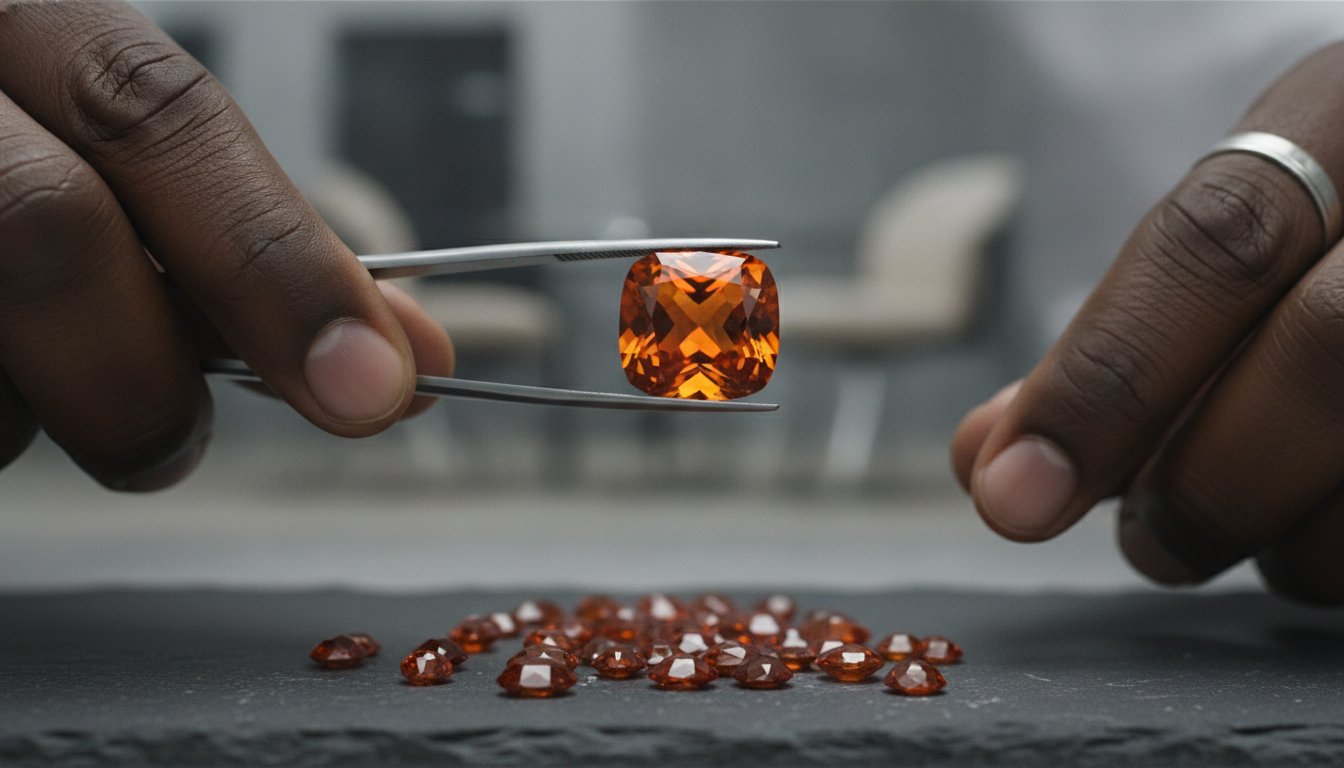
Most collectors spend years chasing the fire of a sapphire, only to realize that the most vibrant, untreated glow in the gemstone world actually belongs to a rare orange garnet. While diamonds often dominate the conversation, the demand for high-quality loose spessartite garnets is growing even faster in 2026. You've likely felt the frustration of trying to distinguish a generic orange stone from a true, vivid "Mandarin" specimen. It's a market where "sugar" inclusions and murky origins can make even a seasoned buyer hesitate about their investment.
I understand that search for perfection. This guide will empower you to master the art of selecting high-investment stones by decoding the Mandarin color standard and the rare geological signatures of Namibia versus Nigeria. We'll explore how to identify eye-clean brilliance and navigate a market where prices for premium stones can double once they cross the three-carat mark. You'll gain the insider knowledge required to evaluate these idiochromatic marvels with confidence. By the end, you'll have the technical validation and visual appreciation needed to choose a centerpiece that offers both a lifetime guarantee and unparalleled natural beauty.
Key Takeaways
- Discover why the "Mandarin" color standard represents the pinnacle of hue and saturation when evaluating high-quality loose spessartite garnets for your collection.
- Learn how the high refractive index and single-refractive nature of these gems produce a fire that rivals the brilliance of the finest colored stones.
- Master the critical distinctions between rare Namibian origins and larger Nigerian production to make informed valuation decisions in the 2026 market.
- Identify the specific clarity markers and cut standards required to secure a vibrant, eye-clean stone that holds its value as a custom jewelry centerpiece.
- Understand why the naturally untreated status of these garnets, combined with expert selection, provides the security essential for high-value gemstone investments.
The Allure of Loose Spessartite Garnets: Nature’s Purest Orange
Spessartite represents a rare intersection of chemistry and aesthetic perfection. Unlike many gems that owe their hue to trace impurities, this species is idiochromatic. This means the vivid orange comes from its own essential chemical composition. Specifically, it is a Spessartine manganese aluminium garnet. While an orange sapphire relies on iron and chromium to achieve its look, spessartite's color is structural. This distinction matters to the connoisseur. It ensures a depth of color that remains consistent throughout the crystal, providing a glow that feels internal rather than superficial.
When sourcing loose spessartite garnets, you'll notice they possess a brilliance that citrine simply cannot replicate. Garnets have a high refractive index, meaning they bend light more aggressively than quartz-based gems. This results in a "fire" or scintillation that holds its own even in dim evening light. Because these stones are almost never treated, the vibrancy you see is exactly what the earth produced millions of years ago. Collectors prize this honesty in a market often dominated by heat-treated alternatives.
The 'Mandarin' Standard: What Defines the Best Color?
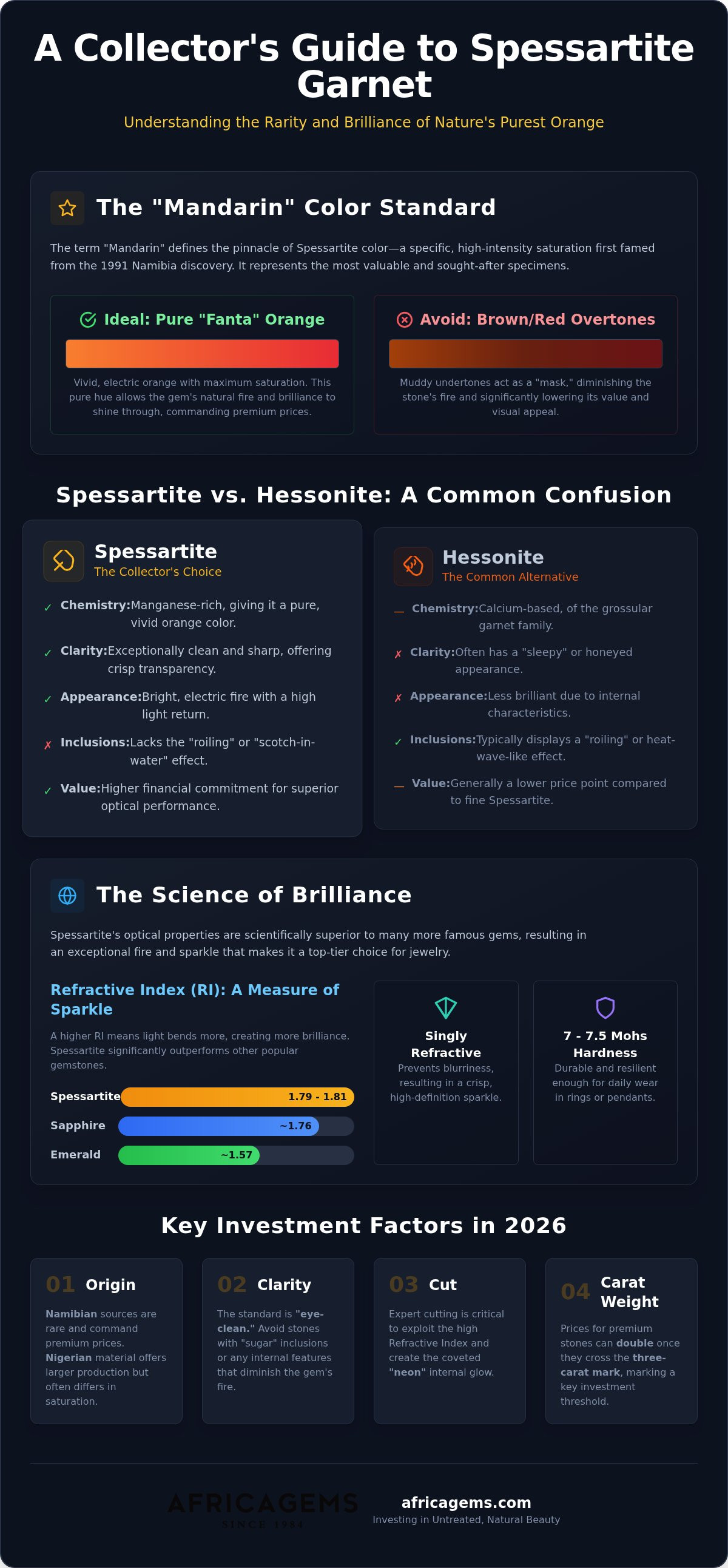
The term "Mandarin" isn't just a marketing buzzword. It describes a specific, high-intensity saturation that first gained fame after the 1991 Namibia discovery. The ideal stone features a pure "Fanta" orange hue. It shouldn't have secondary brown or red overtones. These muddy undertones act as a "mask" that lowers the stone's value and diminishes its fire. True Mandarin specimens are rare. They command premium prices because they sit at the top of the vivid orange category. Collectors prioritize this saturation because it defines the gem's identity. If the orange isn't electric, it isn't truly Mandarin.
Spessartite vs. Hessonite: Avoiding Common Confusion
Novice buyers often confuse spessartite with hessonite, another orange garnet variety. However, they're fundamentally different species. Spessartite is manganese-rich. Hessonite belongs to the grossular family and is calcium-based. You can spot the difference through visual texture. Hessonite typically displays a "roiling" or "scotch-in-water" effect. These are internal heat-wave-like inclusions that give the stone a sleepy, honeyed appearance. Spessartite is much cleaner and sharper. It lacks that roiling effect, offering a crisp transparency that showcases its high refractive index. Choosing the rarer spessartite species usually involves a higher financial commitment, but the reward is a stone with superior clarity and a more aggressive light return.
The Science of Brilliance: Understanding Spessartite’s Optical Properties
Spessartite isn't just bright; it's optically superior to many more famous gems. Its refractive index (RI) sits between 1.79 and 1.81. This is significantly higher than sapphire, which usually rests around 1.76. This high RI means light is trapped and reflected more efficiently. Refractive index is the measure of how light bends and sparkles within the stone. Because garnets are singly refractive, light enters and exits in a single beam. This prevents the blurriness or "doubling" seen in stones like zircon, resulting in a crisp, high-definition sparkle that defines the best loose spessartite garnets.
The presence of manganese is what dictates this unique spectral signature. It absorbs specific wavelengths of light to produce that signature neon orange. This chemical makeup is often a result of the geological formation of spessartine in manganese-rich environments like pegmatites. Beyond beauty, these stones are durable. With a hardness of 7 to 7.5 on the Mohs scale, they're resilient enough for daily wear in rings or pendants. They don't require the delicate handling of softer gems like opal or tanzanite.
Refractive Index and Light Return
While emeralds (RI ~1.57) can look "sleepy" or dark in certain environments, spessartite seems to generate its own illumination. Expert lapidaries use specific facet angles to exploit this high RI, creating the "neon" effect collectors crave. This internal fire is why spessartite remains vibrant even in low-light settings. It's a quality that makes them excellent candidates for bespoke jewelry designs where the stone must perform under various lighting conditions. The single-refractive nature simplifies the light return, ensuring that every beam of light that enters the stone is returned to the eye with maximum intensity.
Clarity and Inclusions: The 'Sugar' Effect
Spessartite is classified as a Type II gemstone. This means it's expected to have some minor inclusions as part of its natural character. You'll often see "sugar" inclusions; these are tiny, dust-like crystals that can give a stone a slightly hazy look if they're too dense. However, in moderation, these shreds and crystals are markers of authenticity. Consider these points when evaluating clarity:
- Eye-Clean Standard: The gold standard where no inclusions are visible to the naked eye at a distance of six inches.
- Untreated Proof: Tiny crystals often prove the stone is natural, as heat treatments would destroy these delicate features.
- Internal Character: Minor "shreds" can sometimes confirm the stone's origin, adding to its story.
While some collectors fear any inclusion, a few microscopic markers can be a sign of security. They guarantee you're holding a natural, earth-mined treasure that hasn't been subjected to artificial enhancements.
Origin and Rarity: From the Kunene River to Your Collection
The history of loose spessartite garnets changed forever in 1991. Before the discovery along the Kunene River in Namibia, spessartite was largely a collector's oddity, rarely seen in vibrant, pure orange. This find birthed the "Mandarin" market, setting a standard for intensity that remains the benchmark today. While production from this original site has slowed to a trickle, its legacy continues to define the value of every stone on the market. In 2026, the rarity of these original Namibian specimens has only increased their allure among serious collectors.
The Namibian Legend: The Purest Mandarins
The unique geology of the Kunene River deposits produced crystals with a saturation that felt almost radioactive. These stones were usually small, rarely exceeding five carats, but their impact was massive. Today, Namibian material is increasingly rare. Connoisseurs hunt for these stones because they represent the historical peak of the species. Understanding this scarcity is vital when exploring rare gemstones, as origin often dictates the price ceiling for investment-grade material. These gems possess a "neon" quality that later discoveries struggle to match.
Nigerian and Madagascan Varieties
As Namibian production waned, Nigeria emerged as a significant player. Nigerian spessartite often comes in larger carat weights, frequently exceeding ten carats. While some of this material can be darker or "rustier" in tone, the best Nigerian stones offer exceptional clarity and a deep, sophisticated orange. Madagascar has also entered the conversation with its "sunset" hues. These stones often lean toward a reddish-orange that captures the glow of a late afternoon sky. They provide a different, warmer emotional resonance compared to the electric Namibian stones.
Nigeria and Madagascar provide excellent value for those seeking impressive centerpieces for custom jewelry. You can often find an eye-clean, seven-carat Nigerian stone for a far more accessible price than a similar Namibian specimen. Tanzania has recently introduced a rare variant: bright, almost canary-yellow spessartites. These stones lack the manganese-rich orange of the Mandarins but offer a unique, sunny alternative for the adventurous collector. They represent the expanding diversity of the spessartite family.
Origin documentation is a pillar of long-term value. In 2026, the provenance of a gem is as important as its color. With production from major sources in Nigeria and Tanzania decreasing, verified origin papers help protect your investment against future market shifts. A certified Namibian origin can add a significant premium to a stone's resale value. It transforms a beautiful object into a piece of geological history. When you secure a stone with verified origin papers, you aren't just buying a gem; you're securing a legacy.
Selecting Your Stone: The 4Cs of Spessartite Garnet
Evaluating loose spessartite garnets requires a different mindset than purchasing a diamond. While the 4Cs provide the framework, their application is nuanced for this vibrant species. Color is the absolute priority. For a true connoisseur, a vivid, two-carat stone with "Fanta" orange saturation is far more valuable than a dark, brownish-orange specimen of triple the size. You should look for even color distribution and avoid "extinction," which are those dark, dead spots where light doesn't reflect. While clarity is important, these are Type II gemstones. An eye-clean appearance is the goal, but don't be afraid of microscopic inclusions that act as a natural fingerprint of an untreated stone.
The Critical Role of Cut in Orange Gems
The cut of a spessartite dictates its "life" and internal fire. Because of the gem's high refractive index, a shallow cut will almost always result in a "window." This is an optical flaw where the center of the stone appears transparent or empty, allowing light to leak through the back rather than reflecting it to your eye. To prevent this, master lapidaries often use deep pavilions. These deeper bottoms are necessary to trap light and maximize the manganese-driven glow. Precision faceting is what separates a commercial stone from a collector's piece. Cushion and oval shapes are the most popular choices because they best preserve the rough crystal's weight while providing the depth needed to avoid windowing.
Evaluating Carat and Value
Size rarity in spessartite is significant. You'll encounter major price-per-carat "cliffs" at the 3, 5, and 10-carat marks. Finding a clean stone over 5 carats is an achievement. Finding one over 10 carats that maintains top-tier Mandarin saturation is a true rarity. In 2026, investment-grade stones over 5 carats command a massive premium because the supply of large, clean rough material has significantly tightened. These oversized gems aren't just jewelry components; they're liquid assets in the world of semi-precious gemstones that tend to appreciate as mines reach exhaustion.
The right stone should balance these four factors to create a visual impact that stops you in your tracks. If you're looking for a centerpiece that combines rarity with electric color, we invite you to view our hand-selected inventory of loose spessartite garnets to find a gem that meets these uncompromising standards.
Investing in Excellence: Why Sourcing Matters at AfricaGems
Acquiring high-quality loose spessartite garnets requires more than just a keen eye; it demands a partnership with a dealer who prioritizes radical transparency. At AfricaGems, our selection process is guided by Marc Sarosi’s 40 years of expertise in the rare gemstone market. Founded in 1984, the business operates on a principle of uncompromising quality. Marc personally evaluates every stone, ensuring that only the top 1% of available material earns a place in our inventory. This methodical approach filters out stones with murky saturation or excessive "sugar" inclusions, leaving you with a gem that truly performs.
One of the most compelling aspects of spessartite is its purity. Unlike sapphires or rubies, which are frequently heat-treated to enhance their appearance, spessartite is typically 100% untreated. When you purchase from us, you receive a full disclosure guarantee. We believe that the natural, earth-mined beauty of these stones is their greatest asset. Our commitment to ethical sourcing ensures that every gem’s journey from the mine to your collection respects both the environment and the communities involved in their discovery.
Designing with Spessartite: Metals and Settings
The electric orange of a Mandarin gem presents a unique opportunity for custom jewelry design. For those seeking to maximize the stone's warmth, 18k yellow gold is the premier choice. The rich yellow metal acts as a natural extension of the manganese-driven glow, creating a seamless visual flow. If you prefer a more modern, high-contrast look, setting spessartite in platinum or white gold alongside colorless diamonds provides a striking "fire and ice" effect. These stones are particularly effective as centerpieces in gemstone rings, where their 7.5 Mohs hardness ensures durability for daily wear. For a truly sophisticated palette, consider pairing the orange hue with deep blue sapphires to create a complementary color scheme that feels both timeless and bold.
The AfricaGems Advantage
Choosing a gemstone is a significant decision that benefits from deep information density. We provide comprehensive educational resources through the AfricaGems blog, helping you understand the technical nuances of refractive indices and origin impacts. As a US-based expert with a global reach, we offer the security of a personal consultation combined with the inventory of a premier international dealer. You aren't just browsing a digital storefront; you're accessing Marc Sarosi’s decades of industry relationships and his personal guarantee of authenticity. This legacy-oriented approach transforms a high-value transaction into a secure investment in natural beauty.
Securing Your Legacy with Nature's Purest Orange
Selecting a centerpiece from the rare world of loose spessartite garnets is a journey into geological perfection. You now understand that the electric "Mandarin" glow isn't just a color; it's a structural marvel of manganese that demands expert faceting to avoid optical windowing. Whether you prioritize the historical rarity of Namibian deposits or the impressive scale of Nigerian finds, your selection represents a commitment to a gem that remains naturally untreated and increasingly scarce in the 2026 market.
At AfricaGems, we've spent over 40 years refining the standard for transparency and connoisseurship. Every stone in our vault has been expertly curated by Marc Sarosi since 1984, ensuring that only the most vibrant, ethically sourced specimens reach your collection. We provide full disclosure on every natural treasure and offer free shipping on all US orders to ensure your acquisition is as seamless as it is secure. Shop our hand-selected collection of Loose Spessartite Garnets today and find the fire that defines your personal legacy.
Frequently Asked Questions
Are loose spessartite garnets treated or enhanced?
No, loose spessartite garnets are one of the few gemstones that are almost never treated or enhanced. Their vibrant orange hue is entirely natural, resulting from their manganese chemistry. AfricaGems has maintained a policy of full disclosure since 1984, ensuring every stone is sold with its natural integrity intact. This lack of treatment makes them a favorite for collectors who value pure, earth-mined gems over heat-treated alternatives.
What is the difference between Mandarin garnet and spessartite?
Spessartite is the mineralogical name for the manganese-rich species of the garnet group. "Mandarin" is a trade name specifically reserved for stones with a vivid, high-saturation orange hue. Not all spessartite qualifies as Mandarin. While a stone might be chemically a spessartite, it only earns the Mandarin label if it meets the intense color standards first established by the 1991 Namibia discovery.
How durable is spessartite garnet for an engagement ring?
With a hardness of 7 to 7.5 on the Mohs scale, spessartite is suitable for daily wear but requires a thoughtful setting. It's more resilient than opal or tanzanite, yet it doesn't match the extreme hardness of sapphire or diamond. We often recommend using our custom jewelry design services to create a protective bezel or six-prong setting. This ensures the stone's edges are shielded from accidental impacts during everyday activities.
Why is spessartite more expensive than other garnets?
Rarity and high demand drive the premium pricing for these stones. Unlike common almandine or pyrope garnets, high-quality loose spessartite garnets are difficult to find in sizes exceeding three carats. The limited production from legendary sites like the Kunene River, combined with their exceptional refractive index, places them in a higher value bracket. In 2026, the market continues to see price increases as high-intensity orange gems outpace traditional diamonds in collector interest.
What is the most valuable color for a spessartite garnet?
The most prized color is a pure, vivid orange, often compared to the shade of a ripe tangerine or "Fanta" soda. Value decreases significantly if the stone displays secondary brown, red, or yellow overtones. These muddier shades act as a mask, dulling the gem's natural fire. Connoisseurs look for high saturation combined with exceptional clarity, as the brightest "neon" stones command the highest investment prices in the current market.
Does spessartite garnet come from Africa?
Yes, the most significant and legendary deposits are located in Africa. Namibia is famous for the original Mandarin discovery, while Nigeria and Madagascar produce larger, high-clarity specimens. AfricaGems specializes in these ethically sourced African origins, leveraging Marc Sarosi’s 40 years of industry relationships. These regions remain the primary source for the world's finest orange garnets, providing the variety and quality required for serious investment-grade collections.
How can I tell if a spessartite is real or synthetic?
Genuine spessartite has a distinctively high refractive index and specific internal inclusions that are difficult to replicate. Synthetic alternatives often lack the "sugar" inclusions or the characteristic manganese spectral signature found in natural stones. AfricaGems provides the security of a personal guarantee from Marc Sarosi, who has been hand-selecting natural gems since 1984. For high-value transactions, we always recommend a professional lab report to verify the stone's natural origin.
What is the 'sugar' inclusion in spessartite?
"Sugar" inclusions are tiny, dust-like crystals or shreds found internally that can give a stone a slightly granular appearance. While large amounts of "sugar" can make a gem look hazy, a light sprinkling often serves as a hallmark of an untreated, natural stone. These inclusions are typical for the species. Finding an eye-clean stone that maintains its "Mandarin" intensity without excessive sugar is what defines the top 1% of the market.

Article by
Marc Sarosi
Professional gemstone dealer for more than 40 years. Started off mining Aquamarine in Zambia, Africa and travelled throughout the continent in search of fine gems. Trusted authority on fine gemstones and have donated a fine collection of more than 27 extraordinary gemstones to the Smithsonian Institute Gem Hall for generations to see.