
Loose Paraiba Tourmaline for Sale: The Connoisseur’s Guide to Neon Gems
May 22nd 2026
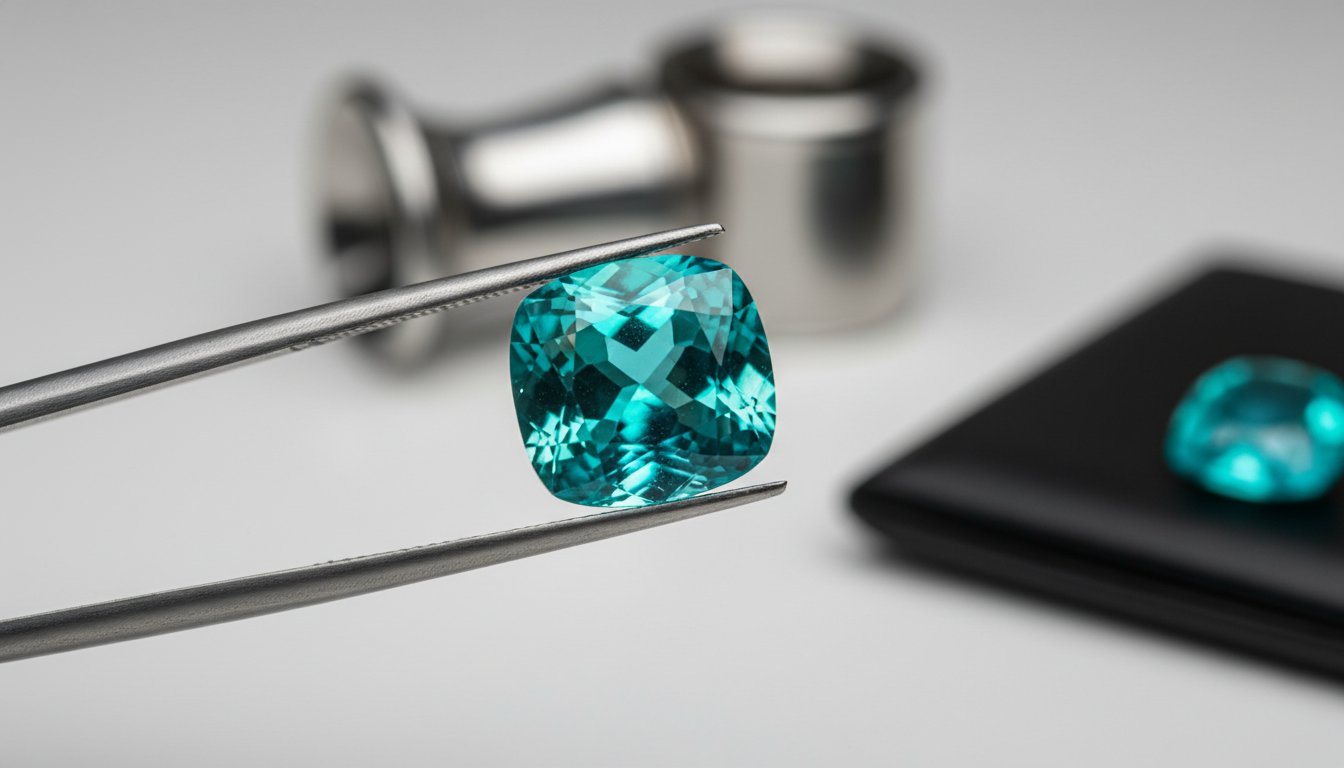
Only one Paraiba tourmaline is unearthed for every 10,000 diamonds discovered. This staggering scarcity explains why these electric gems have become the ultimate prize for serious collectors. You likely recognize that unmistakable neon glow, a vibrant turquoise that seems to pulse with its own internal light. Finding authentic loose paraiba tourmaline for sale has become increasingly difficult as the primary mines in Brazil and Nigeria reached exhaustion by 2025; leaving the market to rely almost entirely on cherished old-stock inventories.
It's natural to feel overwhelmed by the price disparities between Brazilian and African origins or the technical nuances of copper-bearing chemistry. This guide provides the clarity you need to make a confident acquisition. You'll discover the science behind the "neon" phenomenon and the specific criteria used to identify investment-grade stones. We'll examine the critical role of GIA certification, the impact of provenance on value, and how to ensure your selection meets the highest standards of ethical sourcing and transparency.
Key Takeaways
- Understand the precise chemical interaction between copper and manganese that produces the unique "electric" luminescence found only in Paraiba tourmaline.
- Master the professional buyer’s framework by prioritizing high color saturation over minor internal inclusions to ensure your gem possesses the characteristic neon glow.
- Navigate the complexities of the 2026 market to find authentic loose paraiba tourmaline for sale despite the near-total depletion of classic Brazilian and African mines.
- Evaluate the historical price trajectory and investment potential of copper-bearing tourmalines, which continue to outperform many traditional luxury assets.
- Discover the AfricaGems commitment to radical transparency, ensuring every stone is backed by expert verification of origin, ethical sourcing, and full disclosure of treatments.
What Makes Paraiba Tourmaline the World’s Most Coveted Neon Gemstone?
Paraiba tourmaline isn't merely a gemstone; it's a geological anomaly. Defined as a copper-bearing elbaite, it represents the pinnacle of the tourmaline species. While standard tourmalines are found across the globe, the specific conditions required to infuse copper into the crystal structure occur only in a handful of locations. This unique chemistry creates a vivid saturation that was entirely unknown to the gemological world until 1989. In that year, after years of dedicated searching, Heitor Dimas Barbosa unearthed the first specimens from the Batalha mine in the state of Paraíba, Brazil. These initial stones were so vibrant they defied existing color charts, instantly commanding the attention of the world's elite dealers.
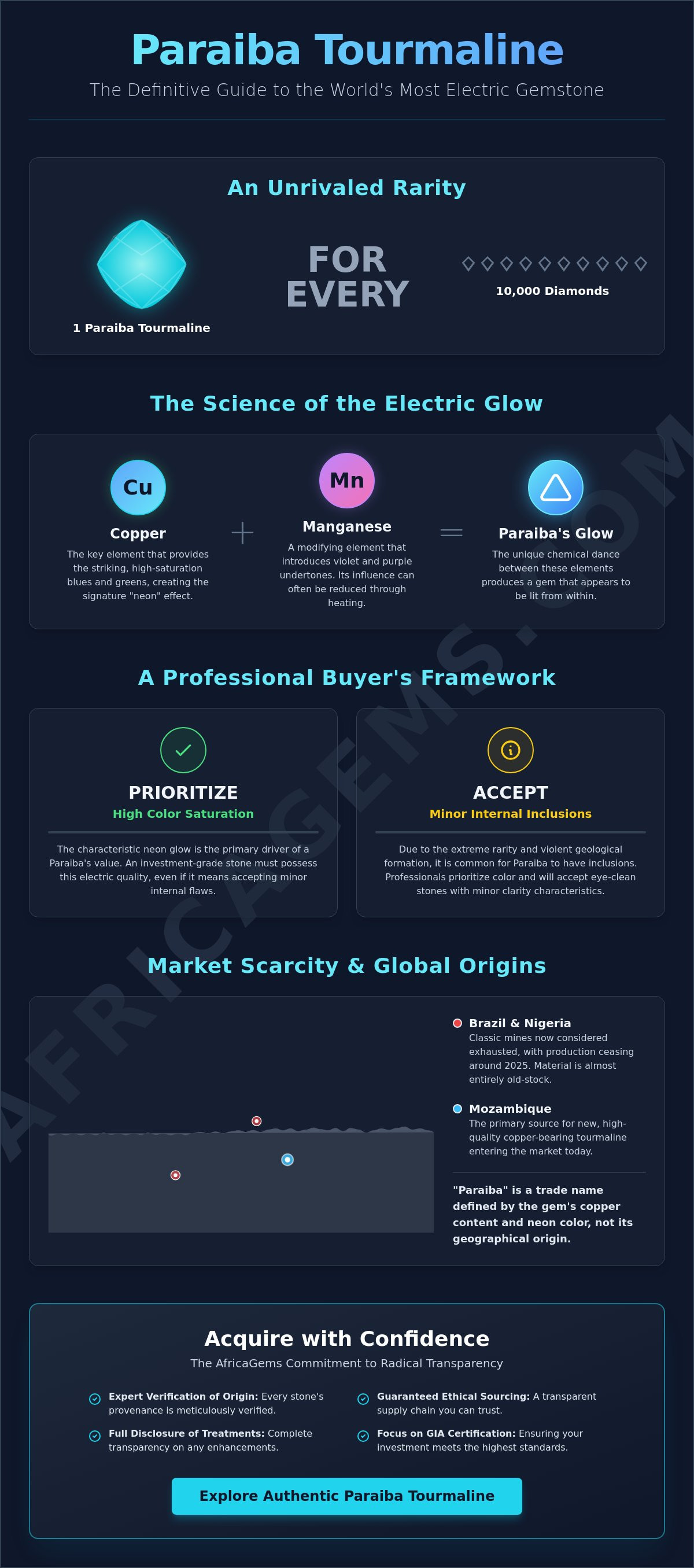
The rarity of these stones cannot be overstated. Statistical data suggests that for every 10,000 diamonds mined, only one Paraiba tourmaline of any quality is recovered. This extreme scarcity, combined with an unparalleled visual profile, is why collectors prioritize finding investment-grade loose paraiba tourmaline for sale over almost any other colored stone. The most defining characteristic is the gem's "neon" or "electric" glow. Unlike other stones that require a direct light source to sparkle, a high-quality Paraiba appears to be lit from within, maintaining its vibrant personality even in the shadows of a dim room.
To better understand this concept, watch this helpful video:
The "Electric" Difference: Neon Blue vs. Standard Blue
What truly separates this gem from its cousins, like the iron-rich Indicolite, is its interaction with light. Traditional blue tourmalines often appear dark or "inky" because they absorb a significant amount of light. In contrast, Paraiba gems seem to emit light. This "neon" or "electric" glow is the result of copper ions within the crystal lattice. These ions produce the iconic "Windex blue" and electric turquoise hues that remain strikingly bright even in dim environments.
A Legacy of Rarity: From Brazil to the World
Today, the term "Paraiba" is recognized by major labs as a trade name. It refers to any copper-bearing tourmaline that exhibits these specific, high-saturation neon colors, regardless of whether it was mined in South America or Africa. This evolution ensures that while the original Brazilian material is nearly impossible to find, connoisseurs can still secure exceptional loose paraiba tourmaline for sale from secondary deposits that share the same spectacular chemical fingerprint and electric visual appeal.
The Science of the Glow: Copper, Manganese, and the Great Origin Debate
The secret to Paraiba's impossible color lies in a delicate chemical dance between copper and manganese. While most tourmalines get their color from iron or chrome, Paraiba is a cuprian elbaite. Copper provides the striking blues and greens, while manganese acts as a modifier, often introducing violet or purple undertones. When the ratio favors copper, you get that coveted "electric" blue. If manganese dominates, the stone leans toward violet, though professional heating can often remove the manganese-induced purple to reveal the hidden copper blue. This chemical signature is why searching for loose paraiba tourmaline for sale is so different from shopping for any other gem; you're literally buying a concentration of rare elements.
The Market Scarcity and Investment Value of these stones is fundamentally tied to this chemistry. Whether the stone comes from a hill in Brazil or a plain in Mozambique, the presence of copper is what defines its soul. However, the market still debates if origin influences the intensity of the glow. While the chemistry might be identical, the concentrations vary, leading to a persistent premium for specific locales.
Brazilian Paraiba: The Gold Standard
Stones from the original Batalha mine or the subsequent Rio Grande do Norte finds remain the most prized. Brazilian material typically exhibits a higher concentration of copper, leading to a saturation that feels almost dense. Because of their historical status and the fact that these mines are effectively exhausted as of 2025, Brazilian stones often command a 30% to 50% price premium over African counterparts. Connoisseurs accept that Brazilian stones are rarely eye-clean and almost never exceed one carat. Finding a two-carat Brazilian Paraiba is a once-in-a-career event for most dealers.
African Cuprian Tourmaline: Mozambique and Nigeria
The discovery of copper-bearing tourmaline in Nigeria in 2001 and later Mozambique in 2005 changed the landscape. These African deposits often produce much larger, cleaner crystals than the Brazilian mines. It's common to find Mozambique stones in the three to five-carat range with exceptional clarity. While some purists argue the color is slightly less "electric," top-tier African stones are visually indistinguishable from Brazilian ones to the naked eye. GIA reports now provide origin determination to help collectors navigate these differences. If you're looking for significant size and brilliance, exploring the current collection of loose Paraiba tourmalines can provide access to these impressive African specimens.
How to Evaluate Loose Paraiba Tourmaline for Sale: A Buyer’s Framework
Evaluating loose paraiba tourmaline for sale requires a fundamental shift in how you perceive gemstone quality. Unlike the rigid standards applied to diamonds or even blue sapphires, Paraiba value is driven almost exclusively by its optical performance. You must prioritize color over clarity. While minor internal inclusions are common in this species, they're acceptable as long as they don't impede the stone's ability to transmit light. Collectors typically aim for "eye-clean" specimens; stones that appear perfect to the naked eye; because "loupe-clean" Paraibas are nearly non-existent in sizes over one carat.
The definitive metric for quality is the "glow test." A premier specimen should exhibit its signature neon saturation even in low-light conditions. If a stone requires direct, high-intensity spotlighting to show its color, it likely lacks the necessary copper concentration. You're looking for a balance between vivid saturation and a medium tone. Stones that are too dark lose their "neon" quality, while those that are too light can appear washed out. This balance is what creates the "electric" effect that defines the species.
Understanding the 4 Cs of Paraiba
Color: This is the most critical factor. The market recognizes a hierarchy led by "Electric Neon Blue," followed by "Turquoise" and "Mint Green." The presence of secondary green hues is common and often preferred by those seeking a tropical aesthetic.
Cut: Precision faceting is essential to manage the stone's light return. A master cutter will align the facets to maximize internal reflection, ensuring the copper-induced glow is visible from every angle without "extinction" or dark spots.
Carat: Due to the geological rarity mentioned earlier, prices don't rise linearly. You'll see significant, exponential price jumps at the 1.00, 2.00, and 5.00-carat thresholds, as stones of this size are increasingly difficult to source.
Clarity: While inclusions are tolerated, the ultimate goal is "swimming pool" clarity. This refers to a stone so transparent and vibrantly blue that it mimics the look of sunlit tropical water, free from distracting veils.
Navigating Certification: GIA, GRS, and AGL
A GIA report is a non-negotiable requirement for any high-value acquisition. These reports provide more than just a grade; they offer chemical validation. When reviewing a lab report for loose paraiba tourmaline for sale, confirm the presence of "copper-bearing" in the comments and ensure the origin is clearly stated. This documentation protects your investment by verifying the stone's identity and treatment history. Professional lab verification remains the only definitive method to distinguish a genuine copper-bearing Paraiba from a standard heated Indicolite tourmaline.
Market Scarcity and Investment Value: Paraiba Tourmaline in 2026
The investment landscape for Paraiba tourmaline has reached a critical juncture in 2026. With the definitive exhaustion of the Batalha mines in Brazil and the Oyo deposits in Nigeria as of 2025, the market now operates almost exclusively on "old stock" inventories. This supply-side collapse has triggered an exponential surge in value. Throughout 2025 alone, average prices for these electric gems climbed by over 45%. For the serious collector, acquiring loose paraiba tourmaline for sale represents more than a luxury purchase; it's a strategic move into one of the world's most rapidly appreciating alternative assets.
Choosing loose stones over pre-set jewelry offers the connoisseur unparalleled flexibility. A loose gem allows for a 360-degree inspection of its "neon" saturation and clarity, ensuring no hidden inclusions are masked by a setting. It also provides the freedom to commission a custom masterpiece or hold the stone as a liquid investment that can be easily transported and appraised. While diamonds are relatively common in the earth's crust, Paraiba tourmaline is a true geological fluke that occurs only where copper and manganese intersect under precise, rare conditions.
Price Drivers in the Current Market
In 2026, color saturation remains the primary driver of value. For investment-grade stones certified by major labs, we're seeing statistical floor price targets that reflect this extreme scarcity. Brazilian specimens between 0.50 and 0.99 carats now command between $45,000 and $75,000 per carat. Top-tier African "Vivid Neon" stones in the 2.00 to 2.99-carat range have reached levels between $85,000 and $145,000 per carat. While most stones undergo gentle heating to resolve manganese-induced purple tones, unheated specimens with natural neon blue hues are virtually non-existent and command massive premiums. Global demand, particularly from the US and Asian markets, continues to outpace the dwindling supply.
Paraiba vs. Other Rare Gems
When diversifying a portfolio, it's helpful to compare Paraiba to other high-performance assets. Unlike tanzanite, which faces its own supply-side pressures as Tanzanian mines deepen, Paraiba's primary sources are already factually depleted. It occupies a unique space alongside other rare gemstones like Alexandrite, where scarcity is absolute rather than relative. The 2025 record auction price of over $311,000 per carat for a Brazilian specimen underscores this elite status. To explore current market opportunities, you can view our authenticated inventory of loose Paraiba tourmalines to find a stone that meets these rigorous investment criteria.
Why AfricaGems is the Premier Destination for Ethically Sourced Paraiba
Marc Sarosi’s 40 year legacy in the gemstone industry isn't just a point of pride; it's your gateway to stones that rarely reach the open market. In an era where primary mines are factually exhausted and supply is dwindling, having an expert with deep, historical roots in both Brazil and Africa is indispensable. AfricaGems operates on a foundation of radical transparency, ensuring that every loose paraiba tourmaline for sale is accompanied by a full disclosure of origin and any heat treatments. You aren't just buying a gem; you're gaining a mentor who prioritizes the integrity of the industry and your security as a collector.
Our curated inventory exclusively features stones with top-tier certification from GIA or GRS. We understand that for a high-value investment, a simple receipt isn't enough to provide peace of mind. You need technical validation of copper content and origin determination to secure your legacy. Each stone is presented with high-definition video to mimic a personal consultation, allowing you to witness the neon glow from every angle before making a final decision. This methodical approach builds buyer confidence through information density rather than high-pressure sales tactics.
Ethical Sourcing and Full Disclosure
We believe that the beauty of a neon gem shouldn't be tarnished by its history. AfricaGems maintains a strict commitment to conflict-free and ethically mined gemstones, working only with suppliers who share our values of social responsibility. This ethical pillar ensures that your investment supports local mining communities while maintaining a transparent supply chain. The "Insider" experience we offer includes direct access to our expertise, transforming a digital storefront into a personal consultation. We provide the technical specifications you need, grounded in a narrative of the stone’s unique journey from the earth to our collection.
Designing with Paraiba
Once you've selected your perfect gem, our custom jewelry design services can transform that loose stone into a bespoke masterpiece. We typically recommend platinum or 18k white gold for these electric stones. The cool, bright tones of these metals perfectly amplify the neon blue saturation without competing for attention. Our master jewelers understand the specific structural sensitivities of cuprian tourmaline, ensuring your investment is handled with the reverence it deserves during the setting process. Every custom piece is a collaboration, designed to protect the stone while showcasing its impossible, internal light.
View our current collection of Loose Paraiba Tourmaline for Sale and find the electric centerpiece for your next investment or heirloom design.
Securing Your Legacy in Neon
Acquiring a copper-bearing tourmaline is more than a purchase; it's a commitment to preserving one of nature's rarest chemical anomalies. You now understand that the electric glow isn't just a visual trait but a result of precise copper concentrations that are increasingly difficult to find. With the depletion of primary mines in Brazil and Nigeria, the window to own an investment-grade specimen is narrowing as the market shifts toward a finite supply of old-stock gems.
When you explore the finest loose paraiba tourmaline for sale, prioritize stones with GIA or GRS certification to ensure your investment is technically sound and ethically sourced. AfricaGems has been dedicated to radical transparency and ethical sourcing since 1984, offering a curated inventory that meets the rigorous standards of the world's most discerning collectors. Every acquisition is backed by our 30-Day Money Back Guarantee, providing the security you need for such a high-value transaction. Take the next step in your collecting journey by discovering a gem that truly pulses with its own internal light.
Browse Our Certified Loose Paraiba Tourmaline Collection
Frequently Asked Questions
Is Paraiba tourmaline more expensive than a diamond?
High-quality Paraiba tourmalines are frequently more expensive than colorless diamonds of comparable size. While a one-carat diamond is relatively accessible, a one-carat neon-blue Paraiba is a geological rarity. In the current market, top-tier Brazilian specimens command prices per carat that far outstrip standard luxury diamonds. This makes them a premier choice for collectors seeking rarity that exceeds traditional bridal gems.
Can you tell the difference between Brazilian and Mozambique Paraiba by eye?
Distinguishing between Brazilian and Mozambique origins by the naked eye is notoriously difficult even for experienced gemologists. Brazilian stones typically exhibit a denser, more saturated electric glow but are often smaller and more included. Mozambique specimens frequently offer superior clarity and larger carat weights. Because visual profiles overlap so significantly, professional lab certification is the only definitive way to confirm geographic origin.
Is Paraiba tourmaline always heated?
Most Paraiba tourmalines are gently heated to resolve the natural purple or violet undertones caused by manganese. This stable process reveals the hidden neon blue or turquoise created by the stone's copper content. While unheated specimens with natural neon saturation do exist, they're exceptionally rare. We provide full disclosure on all treatments to ensure you make an informed decision when viewing loose paraiba tourmaline for sale.
What is the best color for Paraiba tourmaline?
The most coveted color is a vivid, high-saturation Neon Blue or Electric Turquoise. This specific hue, often compared to the glow of a swimming pool, represents the pinnacle of the species. While mint greens and violet-blues are also beautiful, the neon factor is what drives the highest market value. Connoisseurs seek a balance where the stone maintains its vibrant personality even in low-light environments.
How should I care for my loose Paraiba tourmaline?
Paraiba tourmaline requires careful handling to preserve its brilliance. With a hardness of 7 to 7.5 on the Mohs scale, it's durable for jewelry but sensitive to extreme heat and pressure. You should avoid ultrasonic cleaners and steam cleaning, which can damage the stone's internal structure. Instead, use lukewarm water, mild soap, and a soft brush to maintain its signature electric glow safely.
What does "cuprian" mean on a gemstone report?
The term cuprian indicates that a gemstone contains copper, which is the essential element responsible for the Paraiba's unique luminescence. On a GIA or GRS report, this designation confirms the stone belongs to the elite group of copper-bearing tourmalines. This chemical signature is what separates a true Paraiba from standard blue tourmalines, acting as a primary validator for the stone's rarity and market value.
Why are there so few Paraiba tourmalines for sale over 5 carats?
Finding a Paraiba tourmaline over five carats is a significant event because the natural crystals are typically small and heavily included. The geological conditions required to form large, clean, copper-bearing crystals are incredibly rare. When searching for loose paraiba tourmaline for sale, you'll find that most investment-grade stones are under two carats. Anything exceeding the five-carat mark is considered a world-class museum piece.
Are lab-created Paraiba tourmalines worth anything?
Lab-created Paraiba tourmalines do not hold the same investment value or historical rarity as natural, earth-mined stones. While they can mimic the color of natural gems, they lack the geological story and absolute scarcity that drive the high prices of genuine elbaite. For collectors and investors, the value lies in the geological fluke of natural copper infusion, which cannot be replicated in a laboratory setting.