
Loose Opal Gemstones: The Connoisseur’s Guide to Evaluating Play-of-Color and Value
Apr 11th 2026
The most vibrant flash of red in an opal is worthless if the stone’s internal structure is a ticking time bomb of micro-fissures. While many collectors are mesmerized by the kaleidoscopic dance of light, seasoned connoisseurs know that the true value of loose opal gemstones lies in the intersection of stable geology and rare optical phenomena. You likely recognize that a stone's beauty is subjective, but the fear of "crazing" or the confusion over why two seemingly identical gems have a 400 percent price discrepancy is a challenge every serious buyer faces. This is where the AfricaGems Difference begins, prioritizing radical transparency and technical mastery over high-pressure sales tactics.
I'll help you master the professional grading standards established by the Gemological Institute of America, ensuring you can confidently evaluate body tone, pattern density, and play-of-color. You'll learn to identify the subtle layers that distinguish a solid opal from a doublet or triplet, protecting your investment from common market pitfalls. This guide provides a methodical framework for selecting a stone with a secure future. We'll move from the technical validation of ethical origins to the final visual appreciation of a truly breathtaking gem that suits your unique jewelry vision.
Key Takeaways
- Master the N1 to N9 body tone scale to understand how base colors serve as a sophisticated canvas for a stone’s exquisite play-of-color.
- Discover how distinct geological origins—from Australian sedimentary deposits to Ethiopian volcanic fields—dictate the stability and long-term behavior of your gem.
- Learn professional gemological techniques for inspecting loose opal gemstones to confidently identify doublets and ensure the integrity of your investment.
- Identify critical indicators of quality using a loupe to detect subtle signs of crazing or surface-reaching cracks before making a high-value purchase.
- Gain expert insights on selecting protective settings that safeguard your opal’s natural beauty while balancing refined elegance with structural durability.
The Science of Play-of-Color in Loose Opal Gemstones
Opal defies the standard definition of a mineral. It is technically a mineraloid, specifically a hydrated amorphous form of silica. Unlike the rigid crystalline structures found in diamonds or sapphires, loose opal gemstones consist of billions of sub-microscopic spheres of silica. When these spheres align in a perfect, three-dimensional grid, they diffract light into the spectral colors we call play-of-color. According to the detailed Opal on Wikipedia entry, the size of these spheres determines the specific hues produced; smaller spheres create blues and violets, while larger spheres, which are significantly rarer, produce the coveted reds and oranges.
The AfricaGems Difference centers on radical transparency and professional authority. We recognize that purchasing high-value gems online requires absolute trust, which is why we provide full disclosure regarding stability and treatments. Assessing loose opal gemstones provides a distinct advantage over buying pre-set jewelry. It allows you to inspect the "back" and the "potch" to confirm the stone is a solid natural opal rather than a doublet or triplet. This level of scrutiny is essential for any serious connoisseur looking to verify authenticity and value before the stone is obscured by a metal setting.
Precious vs. Common Opal
The distinction between precious and common opal lies in the internal arrangement of silica. Common opal, often called "potch," lacks play-of-color because its spheres are disorganized or vary too much in size to diffract light. However, potch is vital; it provides the structural backdrop and body tone for black and boulder varieties. Precious opal is defined as silica spheres arranged in a regular, repeating grid. This precise geometry is what transforms a simple mineraloid into an exquisite display of moving fire that collectors prize.
The Role of Water Content and Stability
Stability is the hallmark of a high-quality opal. These gems contain between 3% and 21% water by weight, which significantly influences their long-term durability. If a stone loses moisture too rapidly, it can develop "crazing," which is a network of fine internal cracks that ruins the gem’s integrity. At AfricaGems, our stones are seasoned for at least 12 months to ensure they've reached equilibrium before they ever reach our inventory. We also help collectors differentiate between hydrophane opals, which are water-absorbing and can change transparency, and non-hydrophane types like Australian black opals. This technical knowledge ensures your investment remains as breathtaking as the day it was mined.
The Collector's Framework: Grading Body Tone and Brightness
The background color of an opal, known as its body tone, serves as the essential canvas for its spectral display. Professionals utilize the N1 to N9 scale to categorize this base shade. An N1 rating represents a jet-black body tone, providing the maximum contrast for vibrant flashes of red, green, or blue. As you move toward N9, the stone transitions into a milky white or light base. Darker stones typically command higher prices because the deep background allows the play-of-color to appear more saturated and dramatic. Choosing high-quality loose opal gemstones requires a disciplined eye for this contrast; a stone with a dark N1 or N2 base will almost always outshine a lighter N7 stone even if they possess similar color intensity.
Brightness is arguably the most critical factor in determining market value. The industry standard B1 to B5 scale ranks stones from "Vivid" to "Subdued." A B1 stone possesses a brilliance that is visible even in low-light conditions, appearing to glow from within. According to GIA's Opal Quality Factors, the intensity and clarity of color are primary drivers of desirability. Collectors should also look for "full-faced" stones. These gems show color from every viewing angle, avoiding the "dead spots" found in directional stones that only flash when tilted at a specific degree. A stone that loses its color when rotated 45 degrees is considered directional and is valued lower than a gem with a consistent, 360-degree flash.
Decoding the Pattern Rarity
Rare patterns transform loose opal gemstones from mere curiosities into museum-grade specimens. The Harlequin pattern, featuring distinct, non-overlapping geometric units like a checkerboard, remains the rarest. Less than 1 percent of mined opals exhibit a true Harlequin display, making it the "holy grail" for serious investors. Pinfire patterns offer tiny, shimmering dots of light, while Broadflash provides large, sweeping ribbons of color that move across the surface. High pattern density, where the play-of-color covers the entire face without gaps, significantly increases the price per carat. You can explore our curated selection of ethically sourced opals to see these distinct patterns in high-resolution detail.
Transparency and Diaphaneity
Diaphaneity describes how light travels through the gem, ranging from opaque to transparent. Crystal opals are highly prized for their transparency, allowing light to penetrate the stone and reflect back with exceptional clarity. Contraluz opals provide a unique spectacle where the play-of-color is only visible when light passes through the back of the stone, a phenomenon often found in Ethiopian specimens. For delicate jewelry designs, Jelly and Water opals offer a subtle, translucent glow. These stones lack the dark backing of black opals but provide a sophisticated, ethereal aesthetic that appeals to those seeking refined elegance over bold contrast.
Comparing Global Origins: Australia, Ethiopia, and Beyond
The geological birthplace of an opal determines its stability, durability, and visual character. Sedimentary opals, primarily from the Australian outback, formed over 100 million years as silica-rich water filled crevices in sandstone. Volcanic opals from Ethiopia and Mexico crystallized within gas bubbles in cooling lava. This distinction is central to GIA's guide to opal quality factors, as it explains why Australian stones are often more resilient while volcanic varieties offer unmatched transparency. For the serious collector, origin documentation is a pillar of the AfricaGems Difference. It ensures that your investment in rare gemstones is backed by radical transparency and gemological integrity.
The Australian Titans: Lightning Ridge and Coober Pedy
Lightning Ridge remains the world's premier source for Black Opal. These stones feature a dark body tone that makes their play-of-color appear exceptionally vivid. In Queensland, Boulder Opals remain attached to their ironstone matrix, creating a natural frame for the precious silica. Coober Pedy provides the market with elegant White and Crystal opals. These are often more accessible for those starting their collection of loose opal gemstones. By 2026, experts anticipate a 12 percent decrease in high-grade Australian yields, making these legacy stones even more desirable for preservation-minded investors.
The Ethiopian Revolution: Wollo Province Hydrophane
Since the 2008 discovery in the Welo province, Ethiopian opals have redefined value. These stones are often hydrophane, which means they can absorb water. Owners must avoid liquid exposure to prevent temporary loss of color. Despite this sensitivity, Welo opals offer neon palettes and three-dimensional patterns that often rival stones ten times their price. When evaluating loose opal gemstones from this region, look for high transparency and "honeycomb" patterns. The Ethiopian market offers a high-reward entry point for connoisseurs who prioritize visual impact over traditional sedimentary stability.
Mexican Fire Opals and Rare Finds
The sun-drenched reds and oranges of Querétaro’s volcanic fire opals provide a stark contrast to traditional play-of-color. These stones are prized for their body color alone, though the rarest specimens also exhibit flashes of green or violet. Collectors are also turning toward emerging deposits in Peru and Brazil for their unique pastel hues. If your portfolio focuses on color-shift phenomena, you'll find that loose alexandrite gemstones act as a perfect complementary investment. As we move toward 2026, the scarcity of top-tier material from all these regions continues to drive the market toward a quality-over-quantity mindset.
How to Inspect Loose Opals for Integrity and Authenticity
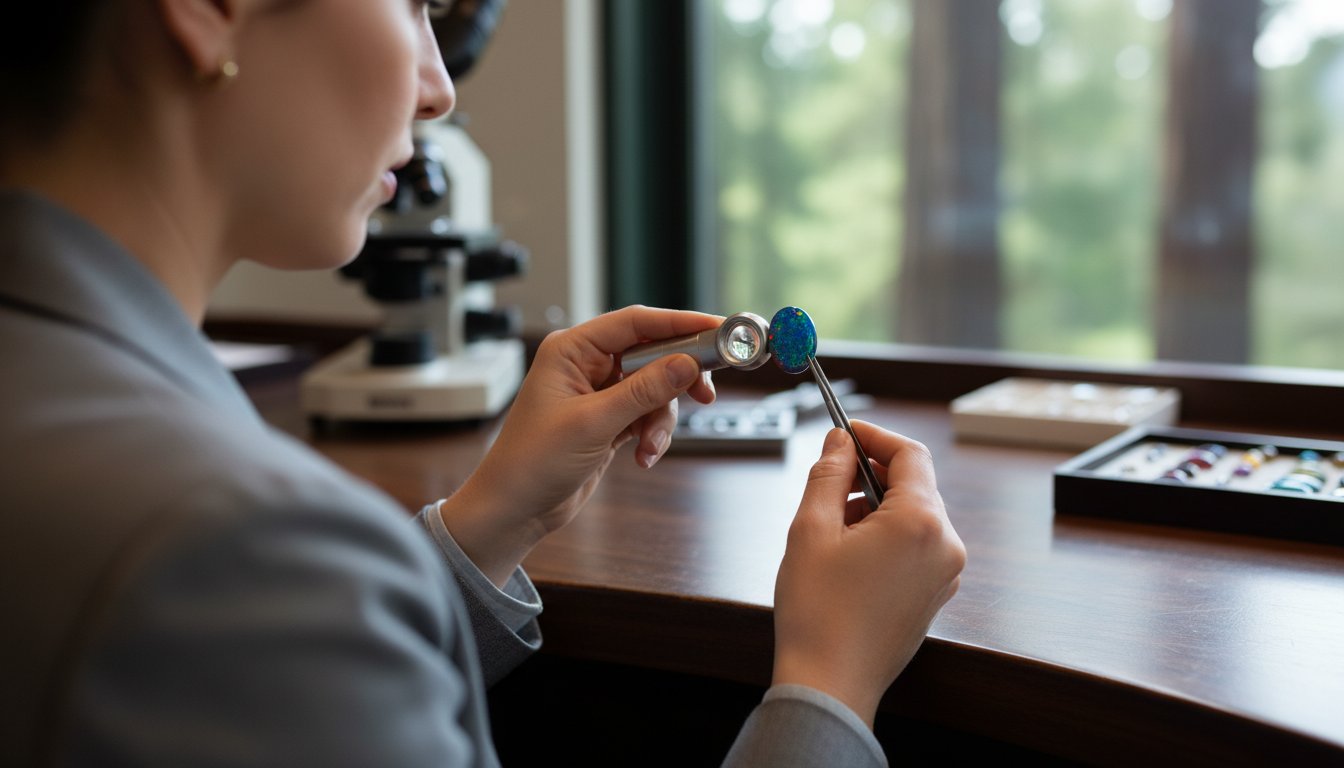
Inspecting loose opal gemstones requires a disciplined four-step protocol to ensure you aren't paying natural prices for assembled or treated material. First, perform the Side Profile Test. Rotate the stone and examine it laterally. If you see a straight, distinct line separating a thin slice of opal from a dark backing, you've found a doublet. True natural opals show a continuous, often irregular transition if matrix is present. Second, use a 10x triplet loupe to check for crazing. These are internal, spider-web cracks caused by moisture loss. Since opals contain 3% to 21% water, stability is paramount. A stone with even microscopic surface-reaching cracks is a liability for any long-term collector.
Next, conduct the Light Source Test. Rotate the gem under a single, strong light source to check for dead spots where the play-of-color disappears entirely. Finally, verify the 'Natural' status. Since the 2008 surge in Ethiopian Welo opal production, the market has seen an influx of smoke-treated stones. For any stone valued over $1,000 USD, a report from an independent laboratory like the GIA or AGL is the only way to guarantee the gem's origin and lack of synthetic intervention. This technical validation is the cornerstone of the AfricaGems Difference, ensuring every stone meets a standard of radical transparency.
Identifying Enhancements and Synthetics
Smoke treatment involves carbonizing the pores of Ethiopian hydrophane opal to mimic the body tone of rare Australian black opal. You can often spot this by looking for concentrated black spots in the surface pits or an unnaturally uniform dark body color. When evaluating potential synthetics, the Gilson synthetic, created in 1974, remains a common culprit. Under a loupe, look for the 'lizard skin' or 'chicken wire' pattern. This is a honeycomb-like structure of color patches that never appears in nature. AfricaGems strictly filters out sugar-acid treated specimens, a process where stones are soaked in warm sugar water and then boiled in sulfuric acid to darken the body color, a treatment that compromises the stone's long-term value.
Assessing the Cut and Polish
The dome height dictates how the play-of-color interacts with light. A high dome, often 60% or more of the stone's width, allows for a 180-degree display of fire. Flat cuts are sometimes necessary for thin color bars but can be harder to set in jewelry. Check for 'windowing' in transparent crystal opals. This occurs when the cut is too shallow, allowing light to pass straight through the center instead of reflecting the color play back to your eye. A superior polish should provide a mirror-like finish. If you see fine scratches or a 'pitted' texture under the light, the stone hasn't reached its full potential. Every gem in our inventory undergoes a rigorous check to ensure the polish is flawless.
Designing Custom Jewelry with Loose Opals
Acquiring loose opal gemstones is the beginning of a deeply personal creative journey. Unlike calibrated diamonds, every opal possesses a unique silhouette and color personality that dictates its final form. Choosing the right jewelry function is the first step. Pendants and earrings are ideal for more delicate specimens because they experience significantly less physical impact than rings. If you choose to set an opal in a ring, adopting a protective setting philosophy is vital for the stone's longevity.
A bezel setting is the gold standard for opal protection. By encircling the entire perimeter of the gem with a thin wall of metal, you shield the edges from chips and ensure the stone remains secure. For those who prefer a more delicate look, a halo setting provides a physical buffer. Surrounding the center stone with a ring of smaller, harder gems creates a "crumple zone" that absorbs daily wear. Integrating your opal with high-contrast accents like loose tsavorite garnets or colorless diamonds can dramatically shift the stone's visual impact. The vivid green of a tsavorite can pull out subtle emerald flashes in a dark opal that might otherwise go unnoticed.
The AfricaGems custom design service bridges the gap between a raw mineral and a finished masterpiece. We understand that loose opal gemstones aren't just commodities; they're heirlooms in waiting. Our process focuses on structural integrity without sacrificing the "Expert Enthusiast" aesthetic that collectors crave.
Metal Pairings for Maximum Color Pop
The metal you choose acts as a canvas for the opal's spectral display. Yellow gold is a classic choice for "warm" stones, such as Mexican fire opals or Australian crystals with dominant red and orange flashes. The gold's yellow hue reinforces these warm tones, making the fire appear more saturated. For opals featuring blue, violet, or cool green play-of-color, platinum and white gold are superior. These "cool" metals provide a crisp, neutral background that allows the shorter wavelengths of light to stand out. Bespoke design is about more than just aesthetics; it's about creating a narrative that highlights the stone's specific pattern, whether it's a broad flash or a delicate pinfire.
Caring for Your Opal Investment
Opals are unique in the gem world because they contain between 5% and 10% water by weight. Maintaining this internal hydration is essential. You must follow the "No Ultrasonic" rule; the high-frequency vibrations and heat of professional cleaners can cause an opal to craze or crack. Simply use warm, soapy water and a soft brush for cleaning. Storage is equally important. Avoid keeping your jewelry near heat vents or in bank vaults with dehumidifiers, as extreme dehydration can lead to permanent damage. To discuss the best way to mount or preserve your stone, contact Marc Sarosi for a personal consultation on your custom design.
Secure Your Next Rare Masterpiece
Selecting the perfect loose opal gemstones requires more than just an eye for beauty; it demands an understanding of the complex physics behind play-of-color and the rigorous grading of body tone. You now possess the framework to distinguish between the legendary deposits of Australia and the vibrant fire of Ethiopian stones. This technical knowledge ensures your next acquisition is both authentic and structurally sound, making it a worthy centerpiece for any custom jewelry design.
AfricaGems upholds the integrity of the gemstone trade through the AfricaGems Difference. Marc Sarosi provides over 40 years of professional expertise to every selection, ensuring you receive full disclosure on all gemstone treatments. We prioritize your security with a 100% money-back guarantee on every stone, reflecting a commitment to radical transparency that has defined our business for decades. You're no longer just a buyer; you're an informed connoisseur ready to choose a gem that meets the highest standards of rarity and brilliance.
Explore our Curated Collection of Ethically Sourced Loose Opals and find the perfect fire for your collection today.
Frequently Asked Questions
Are loose opal gemstones a good investment in 2026?
High-quality loose opal gemstones remain a strong asset for 2026 because of the 20% annual decrease in production from the Lightning Ridge mines. Scarcity drives value. Investors prioritize stones with a body tone of N1 to N4 on the GIA scale. These rare specimens have historically outperformed traditional commodities in the luxury sector. You should focus on stones with vibrant red flashes, as these represent the top 1% of market availability.
What is the rarest pattern to look for in a loose opal?
The Harlequin pattern is the rarest and most sought-after arrangement in the world of opals. It features a distinct, repeating geometric mosaic of color patches that resembles a checkerboard. This specific formation occurs in less than 0.1% of all gem-quality opals found in Australia. Collectors prize the Harlequin for its breathtaking symmetry and the way it maximizes light diffraction across the entire surface of the stone.
Can I wear an opal ring every day if it is set correctly?
You can wear an opal ring daily if the setting protects the stone's edges and you follow strict care protocols. Opals rank between 5.5 and 6.5 on the Mohs scale, which makes them softer than quartz. A bezel setting or a protective halo provides the necessary defense against impact. You should remove your ring before activities like gardening or gym sessions to avoid scratches from 7.0 Mohs-rated dust and debris.
How do I know if an opal is a solid stone or a doublet?
You can identify a solid opal by examining the side of the stone under 10x magnification for a visible join line. Doublets consist of a thin slice of opal glued to a dark backing, usually black industrial glass or ironstone. If you see a perfectly straight, horizontal line separating a colorful top from a dark bottom, it's a doublet. Solid loose opal gemstones show a continuous, natural transition of material from top to bottom.
Why is black opal so much more expensive than white opal?
Black opal commands a higher price because its dark N1 to N4 body tone provides a high-contrast canvas that makes colors appear 300% more vivid than on white opal. The rarity of the black potch backing found in the Wallangulla Sandstone member of New South Wales is the primary driver. While white opals are beautiful, the intense saturation of red on black is the pinnacle of gemological rarity and market demand.
Does the water content in opals really cause them to crack?
The water content in opals, which typically ranges from 3% to 10% by weight, is essential for maintaining the stone's structural integrity. If an opal loses this internal moisture due to extreme heat or low humidity, it can develop a network of fine cracks known as crazing. Industry data suggests that roughly 5% of Ethiopian opals may craze if they aren't properly cured after mining. Stable Australian opals rarely suffer this fate.
What is 'hydrophane' opal and how should I care for it?
Hydrophane opal is a porous variety, primarily from the Wollo Province of Ethiopia, that can absorb up to 15% of its weight in water. When these stones get wet, they temporarily lose their play-of-color and become transparent. You must keep these stones away from oils, soaps, and chemicals. If they absorb contaminants while in their porous state, the discoloration can become permanent. Simply let them air dry naturally if they absorb pure water.
Should I buy a certified opal, and which labs are most reputable?
You should always prioritize certified opals for high-value purchases to ensure the stone's origin and treatment status are verified. The Gemological Institute of America (GIA) and the American Gem Trade Association (AGTA) are the most reputable labs for North American buyers. These institutions provide a transparent audit of the stone's dimensions and characteristics. This documentation acts as a pillar of security for your investment and simplifies future insurance appraisals.