
Loose Blue Gemstones: The Connoisseur’s Guide to Selection and Value in 2026
Sep 24th 2026
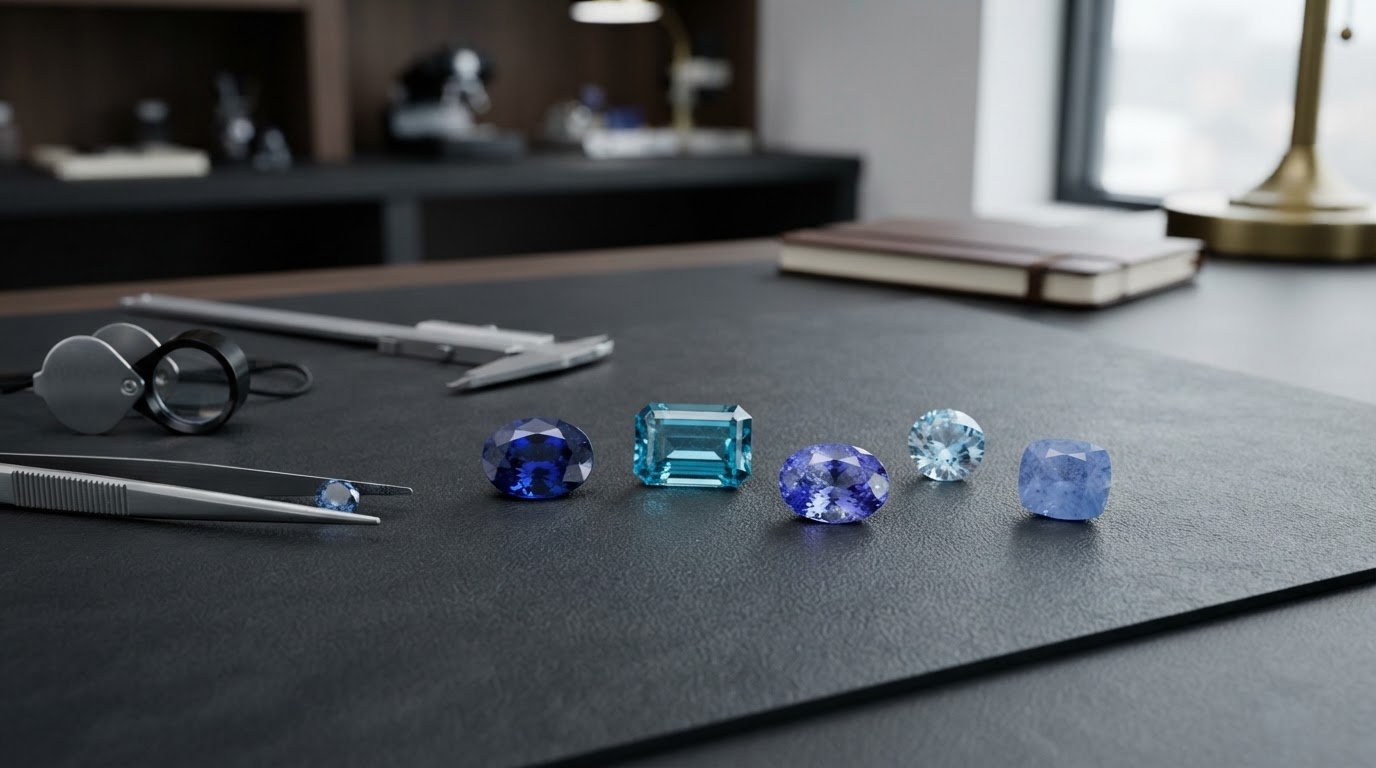
The most breathtaking color saturation in the showcase isn't always the smartest choice for an everyday ring. When you begin exploring fine loose blue gemstones, you quickly realize that nearly identical shades of cornflower, royal, or icy cerulean can belong to entirely different minerals with radically different lifespans.
It's easy to feel overwhelmed by the options. Between deceptive secondary undertones distorted by digital studio lighting, persistent worries over undisclosed heat treatments or diffusion, and the risk of softer crystals chipping under routine wear, making an investment can feel precarious. You naturally want to know which variety delivers the ultimate combination of vivid color, structural resilience, and lasting value.
You don't need a laboratory degree to collect with absolute assurance. In this guide, you'll discover how to evaluate, compare, and select fine loose blue gemstones with complete gemological confidence. We will examine the essential optical distinctions across every premier blue species, review cut and clarity standards for custom settings, and detail the independent lab documentation required to secure an authentic, conflict-free treasure.
Key Takeaways
- Explore how optical physics and crystal chemistry separate royal corundum from trichroic zoisite, glowing beryl, and high-refraction zircon.
- Master the color evaluation framework of hue, tone, and saturation to pinpoint stones that hold their brilliance without turning dark indoors.
- Evaluate Mohs hardness and internal cleavage to pair the right loose blue gemstones with appropriate custom ring or pendant settings.
- Differentiate standard thermal treatments from invasive chemical lattice diffusion to safeguard your long-term acquisition value.
- Apply a professional verification process to inspect laboratory documentation, ethical provenance, and precise lighting disclosures prior to purchase.
The Spectrum of Loose Blue Gemstones: Species and Optical Characteristics
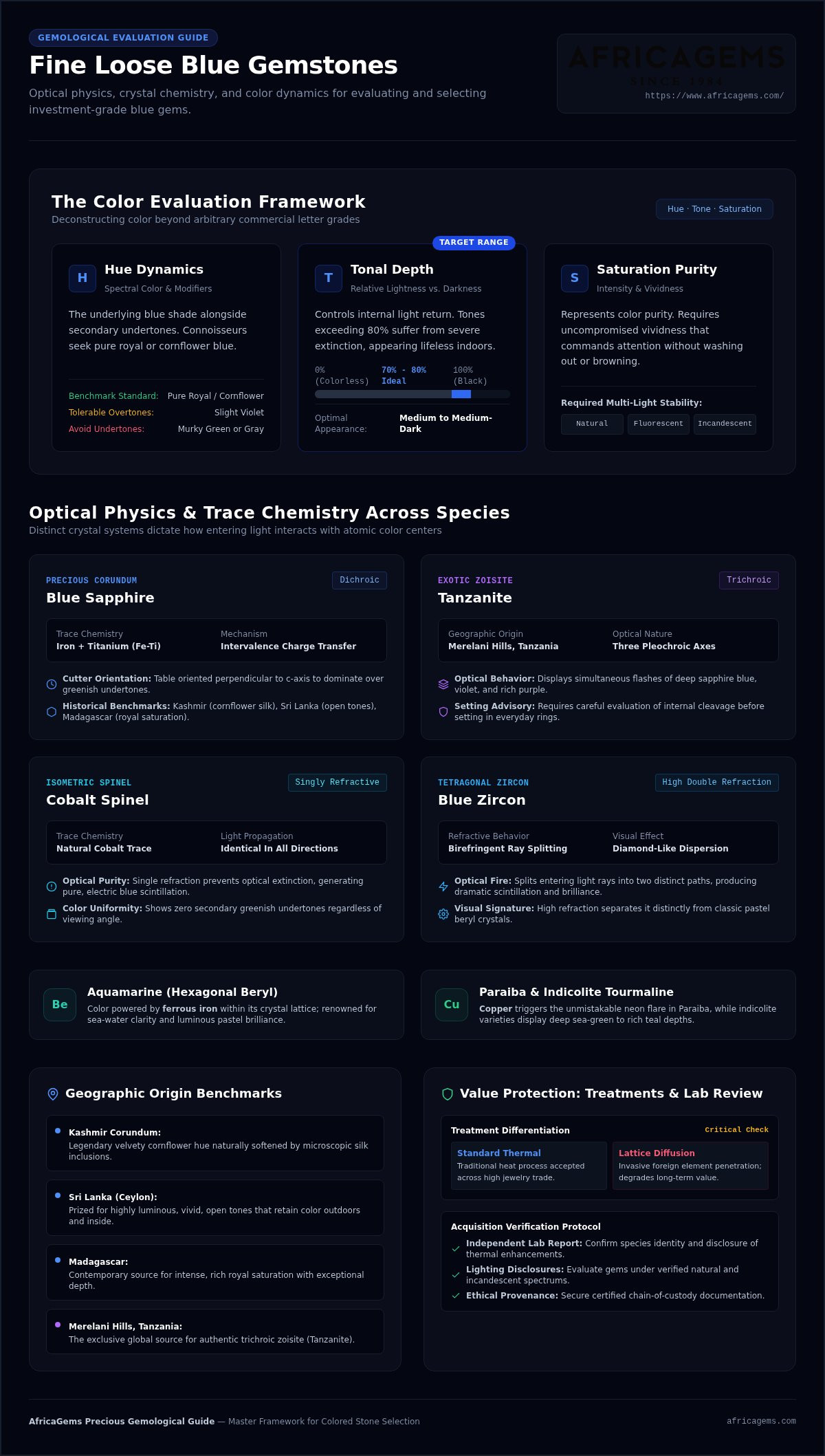
Nature produces blue in mineral crystals through subtle interactions of light and trace chemistry. While many buyers assume every rich blue specimen is a sapphire, the world of loose blue gemstones spans distinct crystal systems and optical behaviors. Understanding foundational gemstone species and characteristics reveals how specific elements dictate color. Iron and titanium charge transfer generates the deep blue of corundum; cobalt yields the electric glow in rare spinels; and copper triggers the neon flare of Paraiba tourmaline.
Many of these crystals also exhibit pleochroism, displaying different shades when viewed from different crystal axes. In our collection of fine precious gemstones, proper facet orientation determines whether a cut crystal displays pure blue or an unwanted secondary tone.
To see how these distinct crystal varieties compare in movement and light, watch this helpful overview:
Precious Blue Corundum: Classic Blue Sapphires
Sapphire represents the historical benchmark of blue corundum. Legendary deposits in Kashmir produced a velvety cornflower hue softened by microscopic silk inclusions. Modern connoisseurs seek Sri Lankan stones for their vivid, open tones and Madagascar gems for intense royal saturation. Because corundum is dichroic, cutters orient the crystal table perpendicular to the c-axis, ensuring rich blue dominates over greenish secondary undertones.
Exotic Blue Treasures: Tanzanite, Spinel, and Tourmaline
Exotic species offer optical properties that corundum can't replicate. Tanzanite, sourced exclusively from Tanzania's Merelani Hills, displays trichroism that blends sapphire blue, violet, and purple flashes. Natural cobalt spinels feature single refraction, which means light travels identically in all directions to produce a pure, electric blue without extinction. Meanwhile, copper-bearing Paraiba and rich indicolite tourmalines provide vivid sea-green to teal depths.
Luminous Pastel Varieties: Aquamarine and Blue Zircon
For lighter palettes, aquamarine delivers sea-water clarity powered by ferrous iron within its hexagonal beryl structure. Its watery brilliance contrasts with blue zircon, a crystal with dramatic double refraction and diamond-like dispersion. Zircon splits entering light rays into two paths, producing exceptional fire and sparkle. You'll find these bright, expressive options across our catalog of fine semi-precious gemstones.
Evaluating Quality: Color Grading, Clarity Standards, and Precision Cutting
Grading colored stones requires a different discipline than assessing diamonds. Commercial jewelers often rely on arbitrary letter designations like "AAA," which tell you little about actual optical physics. True connoisseurship isolates the fundamental components of color, benchmarks clarity against the host species, and evaluates how a lapidary's angles manipulate light.
Deconstructing Color: Hue, Tone, and Saturation Dynamics
Evaluating fine loose blue gemstones requires dissecting how hue, tone, and saturation interact. Hue refers to the underlying blue shade alongside any secondary modifiers. Connoisseurs seek a pure royal or cornflower blue, tolerating slight violet overtones while avoiding murky green or gray tints.
Tone dictates lightness and darkness. Target stones with a medium to medium-dark tonal depth between 70% and 80%. Anything darker results in extinction, leaving the gem looking flat and lifeless indoors. Saturation represents color purity; the benchmark standard requires vivid, uncompromised intensity that commands attention under incandescent, fluorescent, and natural light.
Clarity and Crystal Transparency Across Species
Gemologists classify colored stones into three distinct clarity categories rather than applying rigid diamond scales:
- Type I: Virtually inclusion-free crystals like aquamarine, where collectors should insist on eye-clean transparency.
- Type II: Naturally included species like corundum and spinel, where minor internal features are standard.
- Type III: Heavily included varieties where visible characteristics are an intrinsic part of crystal formation.
In fine corundum, fine rutile needles can soften light evenly across facets. As outlined in standard gemological research on gemstone treatments and disclosures, these natural growth markers also confirm whether a crystal has avoided high-heat alterations.
Lapidary Cut Proportions and Optical Performance
Many native cutters intentionally cut stones with heavy bellies to preserve raw carat weight. This practice often creates an empty "window" in the center where light drains out the bottom like clear glass. Master lapidary cutting sacrifices raw yield to align facet angles precisely, generating complete internal reflection and vibrant scintillation. When exploring your options across our curated vault of fine gemstones, examine movement videos to verify the pavilion reflects radiant color evenly from edge to edge.
Durability and Wearability: Matching Hardness to Jewelry Settings
A gem's survival on your hand depends on three distinct factors: scratch hardness, structural toughness, and environmental stability. Many buyers fall in love with loose blue gemstones based on color alone, only to discover their chosen crystal cannot handle the mechanical stress of a high-profile ring mount. Matching your stone's physical profile to the right jewelry architecture prevents heartbreak years down the road.
The Mohs Scale vs. Real-World Toughness
The Mohs scale measures scratch resistance, not shatter resistance. Sapphires rank at 9 on the scale, making corundum the premier choice for daily wear. With no cleavage planes and exceptional crystal toughness, a sapphire shrugs off abrasive household dust and accidental impacts.
Aquamarine ranks at a respectable 7.5 to 8, providing dependable durability for rings when worn with mindful care. In contrast, tanzanite rates at 6.5 Mohs and possesses distinct directional cleavage. A direct strike along that plane can split the crystal, meaning zoisite requires far more protective consideration than harder corundum.
Designing Protective Mountings for Softer Blue Gems
You don't need to avoid softer blue varieties for rings; you simply need to engineer their settings intelligently. Exposed prongs leave fragile crystal girdles vulnerable to side impacts against hard surfaces. For gems under 8 on the Mohs scale, consider protective design adaptations:
- Bezel and Semi-Bezel Settings: Encasing the perimeter in precious metal buffers the stone against daily knocks.
- Protective Halos: Surrounding a center gem with smaller, hard diamonds absorbs impact forces before they reach the main stone.
- Recessed Low-Profile Mounts: Keeping the table facet closer to the finger reduces snagging hazards.
Browse our collection to shop mountings engineered specifically to safeguard rare and sensitive collector gems.
Long-Term Care and Cleaning Protocols
Improper maintenance ruins fine gems faster than normal wear. Never subject tanzanite, blue zircon, or delicate tourmalines to commercial ultrasonic cleaners or high-pressure steam jets; vibrations and thermal shocks can widen microscopic internal fissures instantly. Keep thermal-sensitive stones away from sudden temperature swings, boiling water, and harsh household chemicals. The safest protocol is the simplest: soak the piece in warm water mixed with mild dishwashing soap, then buff gently with an ultra-soft cosmetic brush.
Gemstone Treatments and Origin: Navigating Disclosures and Certification
A crystal's market integrity rests on what happened to it between the mine and the cutting wheel. While natural color represents the ultimate prize for collectors, various enhancements have entered the commercial supply chain over decades. Understanding which processes add legitimate stability and which ones destroy intrinsic value allows you to acquire loose blue gemstones with complete peace of mind.
Common Enhancements: Traditional Heat vs. Modern Treatments
Traditional thermal enhancement mimics the earth's natural heat and pressure. It is a permanent, stable process applied to an estimated 90% to 95% of market sapphires to dissolve internal silk and maximize blue brilliance. Similarly, roughly 95% of blue zoisite undergoes gentle heating to convert muddy brown trichroic axes into pure blue-violet tones. These accepted enhancements differ sharply from invasive methods:
- Lattice Diffusion: High-heat cooking with chemicals like beryllium or titanium to artificially force a shallow skin of blue into colorless corundum. If recut or chipped, the original pale core reveals itself.
- Lead-Glass Filling: Injecting high-refractive glass into heavily fractured rough to mimic clarity, producing an unstable stone vulnerable even to household lemon juice.
- Surface Coating and Dyes: Thin artificial films painted on pavilion facets to falsify saturation, both of which scratch off over time.
The Unheated Premium and Historical Provenance
Completely untreated corundum displaying top-tier natural color is extraordinarily scarce. A certified unheated sapphire commands a massive price multiple over an otherwise identical heat-treated counterpart because it represents an unaltered geological marvel. Beyond heating status, documented origin matters deeply. Classic Ceylon deposits produce luminous, open blues; fine Madagascar crystals display velvety royal depths; and Montana's Yogo and Rock Creek mines yield distinctive metallic cornflower tones. Learn how to review provenance records across our educational guide on buying gemstones online safely.
Independent Laboratory Certification Standards
Never rely on verbal assurances or generic house certificates issued by the seller. Independent gemological laboratories like the Gemological Institute of America (GIA), the American Gem Society (AGS), or the International Gemological Institute (IGI) utilize advanced spectroscopy to verify both treatment status and country-of-origin indications. A reputable dealer always discloses every gemstone enhancement upfront, in writing, on both the product listing and final receipt. Explore our fully disclosed, certified inventory of natural precious gemstones to secure verified authenticity for your personal collection.
How to Source Certified Loose Blue Gemstones for Custom Jewelry
Acquiring fine loose blue gemstones online should be an exciting, secure experience rather than a game of chance. By shifting from automated retail configurators to a methodical sourcing strategy, you ensure the centerpiece of your custom jewelry combines genuine rarity with lasting structural integrity.
Step 1 & 2: Define Purpose and Select Optimal Gemstone Variety
Begin by defining how the piece will live in your collection. An engagement ring exposed to daily friction demands a resilient mineral like sapphire or spinel. Alternatively, occasional-wear cocktail rings, earrings, or brooches allow you to embrace softer, trichroic treasures like tanzanite or vibrant blue zircon.
Once you determine the wear profile, match your aesthetic goals to your crystal choice. Decide whether you prefer the watery ice-blue clarity of aquamarine, the electric violet flashes of unheated tanzanite, or the deep velvety depth of classic Ceylon corundum. You can explore distinct varietal profiles across our educational gemstone insights and guides.
Step 3 & 4: Verify Independent Grading and Dealer Reputation
Digital studio lighting can easily mask undertones or exaggerate saturation. Always evaluate high-definition 360-degree videos alongside direct daylight-calibrated images to see how light moves through the pavilion facets.
Next, confirm the stone's pedigree with recognized documentation:
- Independent Laboratory Reports: Insist on verification from premier institutions like GIA to confirm identity, natural origin, and enhancement status.
- Direct Sourcing Lineage: Seek established dealers who cultivate relationships at the mine level and guarantee conflict-free, ethical provenance.
- Dealer Accountability: Partner with specialists who offer transparent return privileges and visible leadership backing every specimen.
Step 5: Commission Bespoke Custom Mounting and Setting
A precision-cut colored gemstone rarely fits standard, mass-produced commercial mountings. Because master lapidaries cut for beauty rather than calibrated factory dimensions, custom fabrication protects your stone's unique geometry. Work directly with experienced artisans through our custom jewelry design services to build an heirloom setting around your chosen crystal.
Consider how metal choices interact with blue shades. Platinum and 18k white gold enhance cool, crisp cerulean tones, while rich yellow gold produces a warm, regal contrast that accentuates royal blue. Explore our bespoke gemstone rings to see how thoughtful bench craftsmanship preserves rare crystals for generations.
Curating Your Blue Gemstone Legacy with Complete Confidence
Selecting the perfect specimen comes down to harmonizing optical beauty with gemological integrity. When evaluating loose blue gemstones, balancing vivid saturation against indoor tonal extinction, respecting mineral hardness, and insisting on independent laboratory verification eliminates guesswork. You don't have to compromise between striking beauty and structural longevity.
Whether you are drawn to the velvety depth of an unheated Ceylon sapphire or the sea-spray clarity of fine aquamarine, authentic value begins with transparent provenance. Since 1984, AfricaGems has cultivated direct sourcing relationships across premier mining regions, offering collector-grade crystals backed by an uncompromising policy of 100% full treatment disclosure.
Your journey toward a bespoke heirloom starts with an exceptional natural crystal. Explore curated loose blue gemstones at AfricaGems to find certified, ethically sourced treasures ready for custom mounting.
Frequently Asked Questions
Which loose blue gemstone is best suited for an everyday engagement ring?
Natural blue sapphire is unquestionably the premier choice among loose blue gemstones for daily wear in an engagement ring. Ranking at 9 on the Mohs hardness scale with exceptional crystal toughness, sapphire resists scratches from airborne quartz dust and withstands accidental bumps far better than softer alternatives. Spinel also performs admirably at an 8 rating. Softer crystals like tanzanite require specialized protective bezels if selected for daily rings.
What is the main visual difference between a blue sapphire and blue tanzanite?
The primary difference lies in their optical behavior and secondary color flashes. Sapphires display a consistent blue tone ranging from cornflower to velvety royal blue with subtle dichroism. Tanzanite exhibits strong trichroism, flashing dynamic shifts of velvety blue, violet, and deep purple as the stone moves under shifting light angles. While sapphire offers deep monochromatic richness, tanzanite presents an enchanting, multi-colored optical dance.
Are all loose blue gemstones subjected to heat treatment before sale?
No, not all loose blue gemstones undergo heat treatment, though traditional thermal enhancement is standard practice for several species. While roughly 90% to 95% of sapphires and tanzanites are heated to optimize color and dissolve inclusions, completely unheated natural crystals do exist. Varieties like cobalt spinel and fine aquamarine frequently display exceptional natural color without any thermal intervention. Reputable dealers always disclose treatment status explicitly on every stone.
How does geographic origin influence the market value of loose blue gemstones?
Geographic origin acts as a major pricing catalyst for collector-grade gems due to historical lore and distinct geological traits. In blue corundum, verified provenance from storied deposits like Kashmir, Ceylon (Sri Lanka), or Burma commands substantial collector premiums over newer mining locations. Country-of-origin documentation doesn't replace visual beauty, but it validates historical rarity and adds significant tangible appreciation potential for serious connoisseurs.
Can I buy a loose blue gemstone and have it set into jewelry later?
Yes, purchasing an unmounted stone gives you maximum control over gemological quality and creative design. When you evaluate an unset crystal, you can thoroughly inspect its cut geometry, pavilion depth, and pavilion windowing without metal hiding flaws. You can preserve the loose stone securely in a collection box until you are ready to commission a custom ring, pendant, or bespoke heirloom tailored to its exact dimensions.
What should I look for on an independent laboratory certificate for blue gems?
Look for clear statements regarding natural species identification, precise carat weight, and enhancement disclosures from respected labs like GIA. The report should explicitly declare whether the stone shows evidence of heat enhancement, unheated status, or chemical diffusion treatments like beryllium. For high-value sapphires, also verify whether the lab provides an authoritative opinion on geographic origin, which is crucial for authenticating long-term collector value.
Why do some blue gemstones look vibrant in photos but dark in real life?
Many digital photos use intensely backlit studio lighting that penetrates stones with excessive tonal depth, making overly dark gems appear luminous. In standard indoor lighting, stones with a tonal depth above 80% suffer from extinction, causing the facets to look black or inky. Connoisseurs examine stones in neutral, indirect daylight videos to confirm that vivid blue saturation persists outside of artificial photography environments.

Article by
Marc Sarosi
Professional gemstone dealer for more than 40 years. Started off mining Aquamarine in Zambia, Africa and travelled throughout the continent in search of fine gems. Trusted authority on fine gemstones and have donated a fine collection of more than 27 extraordinary gemstones to the Smithsonian Institute Gem Hall for generations to see.