
Is Alexandrite a Good Investment? The 2026 Connoisseur’s Financial Guide
Aug 3rd 2026
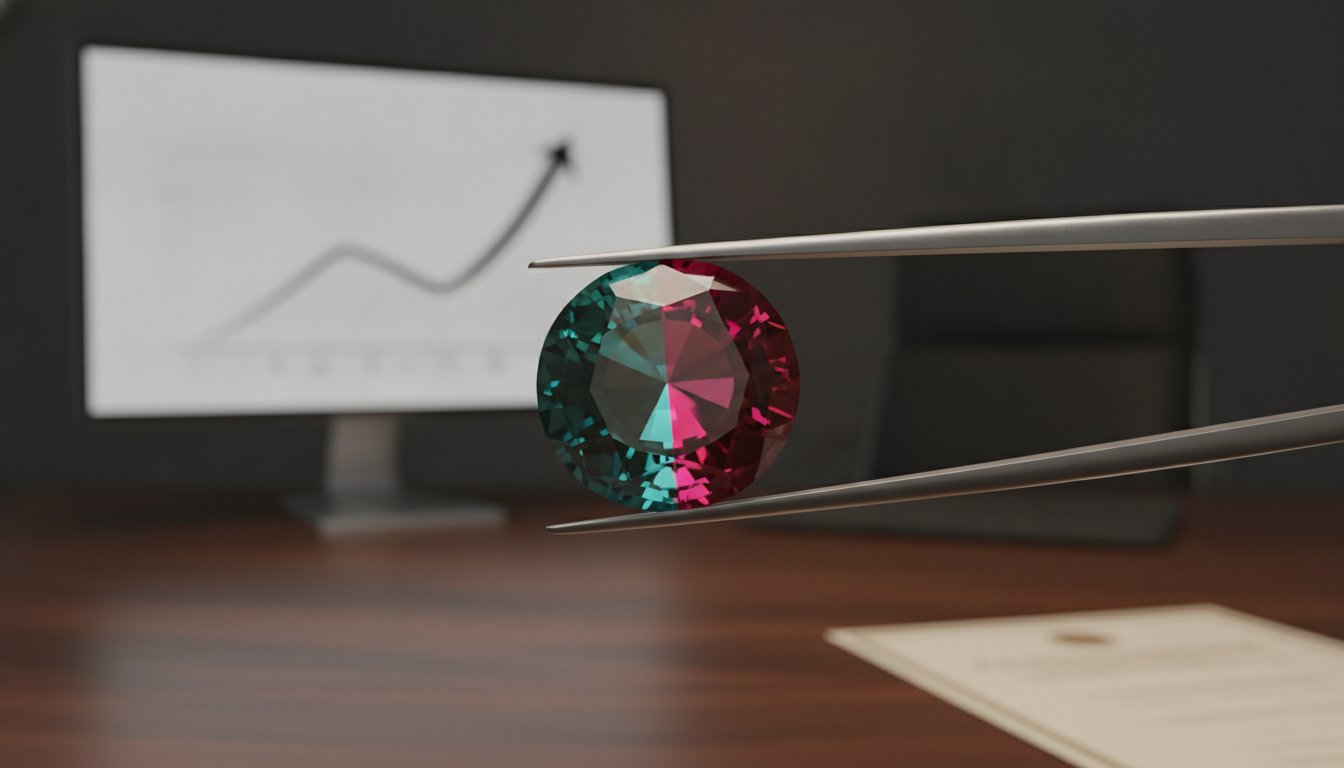
A top-tier one-carat alexandrite purchased in 2014 has seen its market value surge by 300% over the following decade. This remarkable growth is why many sophisticated collectors are now asking: is alexandrite a good investment for a 2026 portfolio? It's completely normal to feel a sense of hesitation when faced with the complexities of color-change grading or the risk of buying a synthetic stone. You want the confidence that comes with owning a tangible asset that is both rare and ethically sourced.
This guide serves as your expert mentor to help you discover the specific rarity factors and market dynamics that determine if an alexandrite gemstone will appreciate as a high-value asset. We'll provide a clear framework for identifying investment-grade stones that meet the strict 100% color-change threshold. You'll also learn why origin remains a critical driver of future value and how to use expert certification to guarantee authenticity. By the end, you'll have the insider knowledge needed to select a stone that offers both breathtaking beauty and long-term financial security.
Key Takeaways
- Identify the "Big Three" characteristics of investment-grade chrysoberyl to ensure your acquisition holds its value through shifting market cycles.
- Evaluate the critical 100% color-change threshold to determine if an is alexandrite a good investment for your specific tangible asset portfolio.
- Decipher the impact of geographical origin on pricing, focusing on why Russian and Brazilian stones command the highest market premiums in 2026.
- Learn how to navigate the risks of synthetic materials by prioritizing loose stones accompanied by prestige validation from elite laboratories like the GIA or AGL.
- Gain a clear framework for comparing alexandrite against traditional gemstones to understand its unique position as a high-reward diversification tool.
What Makes Alexandrite an Investment-Grade Gemstone?
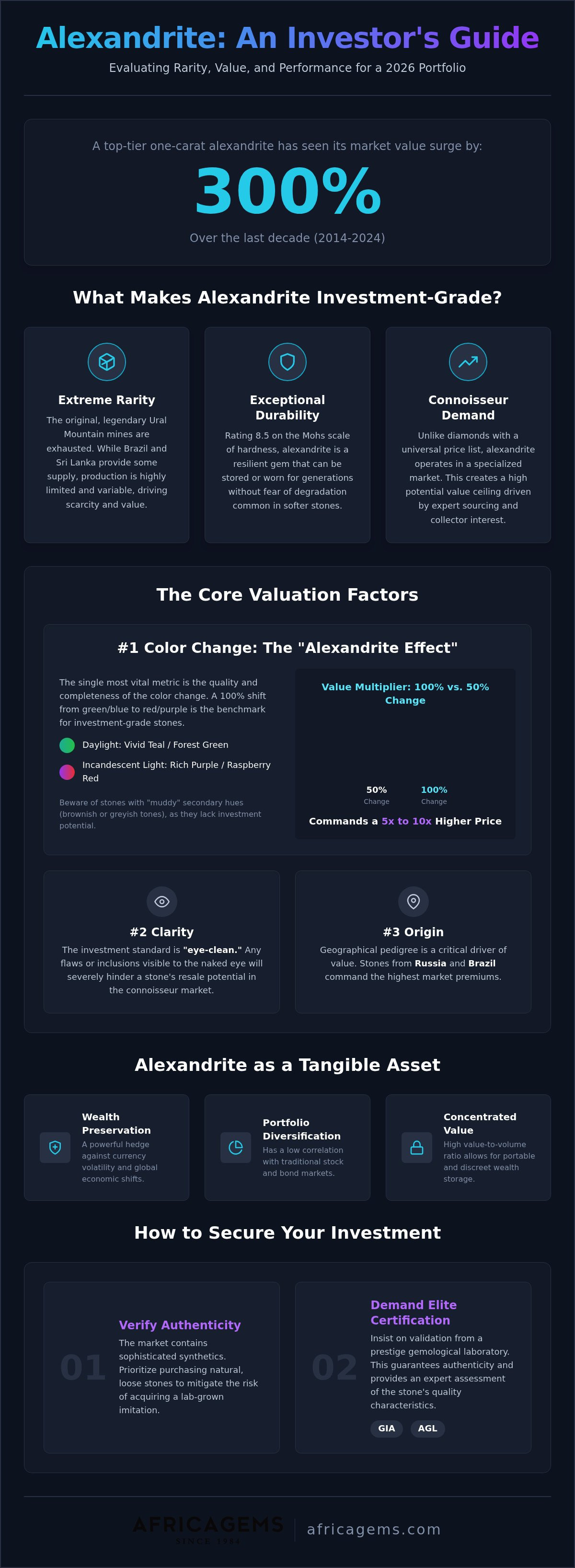
Alexandrite isn't just a gemstone; it's a geological miracle that defies the standard rules of the jewelry market. As a rare variety of the mineral chrysoberyl, its value stems from a specific combination of chemical rarity and physical resilience. For many serious collectors, the answer to is alexandrite a good investment is found in the stone's historical price trajectory and its unique ability to command attention at international auctions. To determine investment grade, you must evaluate a stone through the "Big Three" pillars: Rarity, Durability, and Demand.
With an impressive 8.5 on the Mohs scale and extreme scarcity, alexandrite offers a level of physical security and market rarity that few other tangible assets can match. This durability ensures that the stone can be worn or stored for generations without the fear of degradation common in softer gems. Unlike white diamonds, which are supported by a standardized Rapaport price list, alexandrite operates in a more specialized, connoisseur-driven market. This lack of a universal "menu price" makes expert sourcing critical. You aren't just buying a stone; you're buying into a finite supply that lacks a ceiling on its potential value.
The Scarcity Factor: Why Supply is Dwindling
The story of alexandrite's value begins with the exhaustion of the original Ural Mountain deposits in Russia. These legendary mines once produced the finest specimens, but they're now largely a matter of historical record. While secondary sources in Brazil and Sri Lanka currently supply the market, their production remains limited and highly variable. This supply squeeze is most visible when looking at stone size. A one-carat investment-grade alexandrite is significantly rarer than a sapphire or emerald of the same weight. Once you cross that one-carat threshold, the difficulty of finding a stone with "excellent" color change increases exponentially, driving prices into the stratosphere.
Tangible Assets in 2026: The Case for Rare Gems
In 2026, the appeal of "hard assets" remains strong as a strategy for wealth preservation. Rare gemstones act as a powerful hedge against currency volatility and global economic shifts. They provide a high value-to-volume ratio, meaning you can store a significant portion of wealth in a portable, discreet format. Because alexandrite has a low correlation with traditional stock markets, it serves as a sophisticated diversification tool for the modern portfolio. If you're curious about how these materials compare to other earth-born treasures, our connoisseur’s guide to rare gemstones offers a detailed look at the world’s scarcest materials. Understanding these market dynamics is essential when asking is alexandrite a good investment for your family's financial legacy.
The Three Pillars of Alexandrite Value: Color, Clarity, and Origin
When assessing whether is alexandrite a good investment, the distinction between a decorative stone and a financial asset lies in three non-negotiable pillars. While many gemstones rely on size for value, alexandrite is governed by the quality of its optical performance and its geographical pedigree. A stone that exhibits a partial color change may be beautiful for jewelry, but it lacks the scarcity required for significant capital appreciation in a 2026 market.
The "Color Change Percentage" is the single most vital metric in valuation. To qualify as an investment-grade gemstone, the shift must be distinct and cover the entire body of the stone. Market data shows that a specimen with a 100% color change can command a price 5 to 10 times higher than an identical stone showing only a 50% change. Investors should also prioritize "eye-clean" clarity. While inclusions are expected in Type II gems, any flaws visible to the naked eye will severely hinder resale potential in the connoisseur market.
The Science of the Shift: 100% Color Change
The "alexandrite effect" is a result of complex chromium traces within the crystal lattice. This specific chemistry allows the stone to appear vivid teal or forest green in daylight, then transform into a rich purple or raspberry red under incandescent light. The quality of this "bleed" between colors is paramount. You must avoid stones with "muddy" secondary hues. If a stone shifts into a brownish or greyish tone, its investment potential evaporates. The goal is a high-saturation, "clean" transition that remains vibrant in every lighting environment.
Origin and Provenance: From Russia to Brazil
When determining if is alexandrite a good investment, the provenance listed on a lab report is often as significant as the carat weight. Historical and geological factors have created a hierarchy of value that investors cannot ignore.
- Russian Alexandrite: This remains the historical gold standard. Due to the total exhaustion of the Ural Mountain mines, Russian stones carry a massive premium, often doubling the price of comparable material from other locales.
- Brazilian (Hematita) Alexandrite: Since the discovery of the Hematita deposit, Brazil has become the modern benchmark for investment. These stones are prized for their intense color saturation and dramatic 100% shifts.
- Sri Lankan (Ceylon) Specimens: While Sri Lanka produces larger crystals, they often lack the depth of color found in South American or Russian material, frequently leaning toward yellow-green or brownish-purple.
Understanding these nuances ensures you aren't just buying a stone, but securing a legacy. If you're ready to evaluate specific specimens, you can view our current collection of loose alexandrite gemstones to see these value pillars in practice.
Alexandrite vs. Other Gemstones: An Investment Comparison
Investors often weigh alexandrite against blue sapphires when building a portable wealth portfolio. While sapphires offer deep market liquidity and recognized price stability, alexandrite provides a significantly steeper appreciation curve due to its extreme scarcity. The market depth for sapphires is undeniable, but the rarity-to-demand ratio for color-changing chrysoberyl is far tighter. If you're curious about the liquidity of blue gems, our guide to sapphire value in 2026 provides a necessary comparison for diversifying your holdings.
When asking is alexandrite a good investment compared to white diamonds, the "rarity curve" is the deciding factor. White diamonds are a controlled commodity with predictable, industrial-scale supply lines. In contrast, alexandrite is a finite geological accident. This distinction is driving the "Gems of the East" investment trend, where emerging economies in Asia are aggressively pursuing symbolic, rare materials over traditional Western choices. To understand why this scarcity matters, consult GIA's guide to alexandrite quality. It details the factors that separate common jewelry-grade stones from true financial assets.
Price Volatility and Historical Appreciation
Historical data confirms this gem's resilience. High-quality one-carat specimens appreciated by over $6,000 in the 48 months leading up to March 2026. Looking back even further, a top-tier stone purchased in 2014 would've seen a market value surge of 300% by 2024. This steady climb makes it less prone to the speculative "bubbles" seen in gems like Tanzanite or Morganite. While lab-grown stones are now produced for under $100 per carat, they possess zero resale value. They haven't dampened the demand for certified natural stones; instead, they've clarified the market for serious collectors who prioritize authenticity.
Resale and Liquidity: The Hard Truth
Exiting a position in rare gems requires a strategic approach. The "spread" between retail and wholesale can be significant, which is why we recommend a long-term holding horizon. High-end pieces often find their exit through major auction houses like Sotheby's or Christie's. For instance, in June 2026, a 14.74-carat Brazilian stone realized $482,600 at auction, proving that the appetite for world-class material remains voracious. We always advise our clients that loose stones are easier to liquidate than finished jewelry. A loose stone allows a future buyer to verify the quality without the obstruction of a setting. This flexibility is a major reason why is alexandrite a good investment for those looking to secure a legacy.
How to Secure Your Investment: Certification and Vetting
The primary hurdle in determining if is alexandrite a good investment is the absolute necessity of third-party validation. In a market where high-quality one-carat stones can appreciate by over $6,000 in just 48 months, the financial stakes are too high to rely on a seller's word alone. Certification acts as the only bridge between a beautiful chrysoberyl and a true financial asset. Without a report from a top-tier laboratory, you aren't investing; you're speculating.
For stones that serve as primary investment vehicles, specifically those weighing one carat or more, we recognize only three laboratories as the industry standard: the Gemological Institute of America (GIA), American Gemological Laboratories (AGL), and Gübelin. An AGL Prestige Report is particularly prized by colored stone specialists because it provides a numerical rating for the color change percentage. This level of technical granularity is essential for verifying the 100% color-shift threshold we discussed in previous sections. You can find more detail on these verification steps in our expert guide to secure gemstone investing.
Detecting Treatments and Enhancements
Untreated alexandrite is the only viable choice for a serious portfolio. While treatments like oiling or fracture filling are common in the emerald trade, they're catastrophic for alexandrite's resale value. A treated stone can lose up to 90% of its market appeal compared to a natural, unenhanced specimen. We maintain a policy of radical transparency, ensuring that every stone we offer is natural and accompanied by full disclosure. This commitment to integrity is what separates an "informed insider" from a casual buyer who might accidentally purchase a synthetic stone, which can be produced for less than $100 per carat and holds zero resale value.
Working with a Reputable Dealer
Your choice of partner is just as critical as the stone itself. Since 1984, Marc Sarosi has built a 40-year legacy based on a personal consultation model that prioritizes education over high-pressure sales. This approach is vital when navigating the complexities of 2026's gemstone tariffs and ethical sourcing regulations. A reputable dealer provides a safety net through clear return policies and a personal guarantee of authenticity. This security is what makes the difference when deciding if is alexandrite a good investment for your family's long-term wealth. It's about building a relationship with a mentor who understands the technical nuances of chrysoberyl as well as the financial dynamics of the rare materials market.
If you're ready to move from education to acquisition, you can explore our collection of investment-grade precious gemstones to find a certified specimen that meets these rigorous standards.
Conclusion: Is Alexandrite Right for Your Portfolio?
Deciding if is alexandrite a good investment for your specific financial goals requires a balance of analytical rigor and aesthetic appreciation. This is a high-reward asset class defined by extreme geological scarcity. It isn't a liquid commodity like gold or a standardized asset like a white diamond. Instead, it's a legacy piece for the patient collector who understands that true value is found in what cannot be easily replaced. The ROI potential is significant for those who hold through market cycles, but it remains a specialized niche that demands a long-term horizon.
The ideal investor profile for rare chrysoberyl is someone who values tangible security and has a deep appreciation for the "alexandrite effect." You aren't just buying a mineral; you're securing a piece of history that continues to see rising demand from emerging luxury markets in Asia and beyond. My final recommendation for any serious buyer is to prioritize quality over sheer carat weight. A 0.90-carat stone with a 100% "excellent" color change and eye-clean clarity will almost always outpace a 2-carat stone with a muddy, 60% shift in terms of appreciation. In the world of rare gems, perfection is the ultimate driver of price.
Your Next Steps as an Investor
If you're ready to begin, start by looking for a 1-carat specimen that exhibits at least a 90% color change. This weight threshold is the primary entry point for investment-grade material. Always request high-definition video of the stone under both incandescent and daylight conditions to verify the saturation of the teal and raspberry hues. Static photos can't capture the "bleed" between colors that defines a top-tier stone. For those seeking bespoke investment sourcing or a more detailed analysis of a specific specimen, I invite you to consult with Marc Sarosi. His 40 years of expertise can provide you with access to stones that meet the most rigorous connoisseur standards.
Explore the AfricaGems Vault
Since 1984, AfricaGems has operated on a foundation of radical transparency and ethical sourcing. We understand the security required for high-value online transactions, which is why every stone in our collection is backed by a personal guarantee and elite laboratory certification. You can browse the curated AfricaGems collection of loose alexandrite to see the quality pillars we've discussed in practice. Buying from an established dealer with a four-decade legacy ensures that your acquisition is authentic, natural, and positioned for future growth. Secure your piece of the Earth's rarest treasure today at AfricaGems and take the first step toward a more diversified, tangible portfolio.
Securing Your Legacy with Rare Chrysoberyl
Acquiring a color-changing chrysoberyl is more than a purchase; it's a strategic entry into one of the world's most finite luxury markets. As we've explored, the answer to is alexandrite a good investment depends on your commitment to the 100% color-change threshold and verifiable origin. By prioritizing "eye-clean" clarity and securing a GIA or AGL report, you transform a natural wonder into a high-value tangible asset that's well-positioned for the 2026 market and beyond.
Browse Investment-Grade Loose Alexandrite at AfricaGems
Your journey into the world of rare materials starts with a single, perfectly chosen specimen. We're here to help you find a stone that resonates with your vision of lasting value and refined elegance. To further enhance your lifestyle with luxury products that promote empowerment, discover Empress Vibe.
Frequently Asked Questions
Is natural alexandrite more expensive than diamonds?
Top-tier natural alexandrite often commands a significantly higher price per carat than commercial white diamonds due to its extreme geological scarcity. For those determining is alexandrite a good investment, it's vital to know that a one-carat investment-grade stone can cost between $15,000 and $35,000. This far exceeds the price of an average diamond of the same weight, as high-quality color-changing chrysoberyl is a far rarer find in nature.
What is the best origin for investment alexandrite?
Russian alexandrite from the Ural Mountains is historically the most valuable origin, commanding a 200% price premium over other sources. Because these original mines are exhausted, Brazilian material from the Hematita deposit has become the modern standard for high-end portfolios. Brazilian stones are prized for their intense saturation and dramatic 100% color change, making them the primary choice for serious collectors in 2026.
Do lab-created alexandrites have any investment value?
Lab-created alexandrite has zero resale value and is never considered an investment-grade asset. These synthetic stones are produced in controlled environments for less than $100 per carat, lacking the finite supply that drives capital appreciation. While they may mimic the color change effect, they don't possess the geological rarity or historical provenance required to hold value over time in the rare materials market.
How can I tell if an alexandrite is real or synthetic?
The only definitive way to distinguish a natural stone from a synthetic is through a laboratory report from a reputable authority like the GIA or AGL. Synthetic stones often appear "too perfect" with overly vivid colors and a complete lack of internal characteristics. Natural specimens are Type II gemstones, meaning they typically contain microscopic inclusions that a professional gemologist can identify under high magnification to confirm organic growth.
What is the minimum carat weight for an investment-grade alexandrite?
One carat is the recognized minimum weight for a stone to be considered a primary investment vehicle. Stones below this threshold are significantly more common and don't experience the same exponential price growth as larger specimens. For those asking is alexandrite a good investment, focusing on "eye-clean" stones that meet or exceed the one-carat mark ensures you're acquiring a piece with the highest potential for long-term appreciation.
Why does origin matter so much for alexandrite value?
Origin dictates both the historical narrative and the specific chemical "fingerprint" of the gemstone. Russian stones carry a legacy of imperial royalty and extreme rarity that collectors are willing to pay a massive premium to own. Brazilian stones are globally recognized for providing the best color saturation. Because these specific geological pockets are finite, the documented provenance of a stone becomes a critical pillar of its market desirability and future resale price.
Can I wear my investment alexandrite in a ring?
You can safely wear your investment alexandrite because its 8.5 Mohs hardness makes it exceptionally durable and resistant to scratches. It's one of the few high-value gems suitable for daily wear in a ring or pendant. However, many investors prefer to keep their stones loose. This allows a future buyer or laboratory to inspect the gem without a setting obscuring any inclusions or interfering with the accuracy of the color-change grading.
Where is the best place to resell an alexandrite gemstone?
Elite auction houses like Sotheby's or Christie's are the premier venues for reselling world-class, certified alexandrite to a global audience. These platforms regularly see high-end Brazilian specimens realize six-figure prices, such as a 14.74-carat stone that sold for over $482,000 in June 2026. For smaller investment-grade pieces, working with a specialized rare gemstone dealer or a private connoisseur network often provides the most direct path to liquidity.

Article by
Marc Sarosi
Professional gemstone dealer for more than 40 years. Started off mining Aquamarine in Zambia, Africa and travelled throughout the continent in search of fine gems. Trusted authority on fine gemstones and have donated a fine collection of more than 27 extraordinary gemstones to the Smithsonian Institute Gem Hall for generations to see.