
How to Spot Fake Alexandrite: Authenticity Guide
Jul 27th 2026
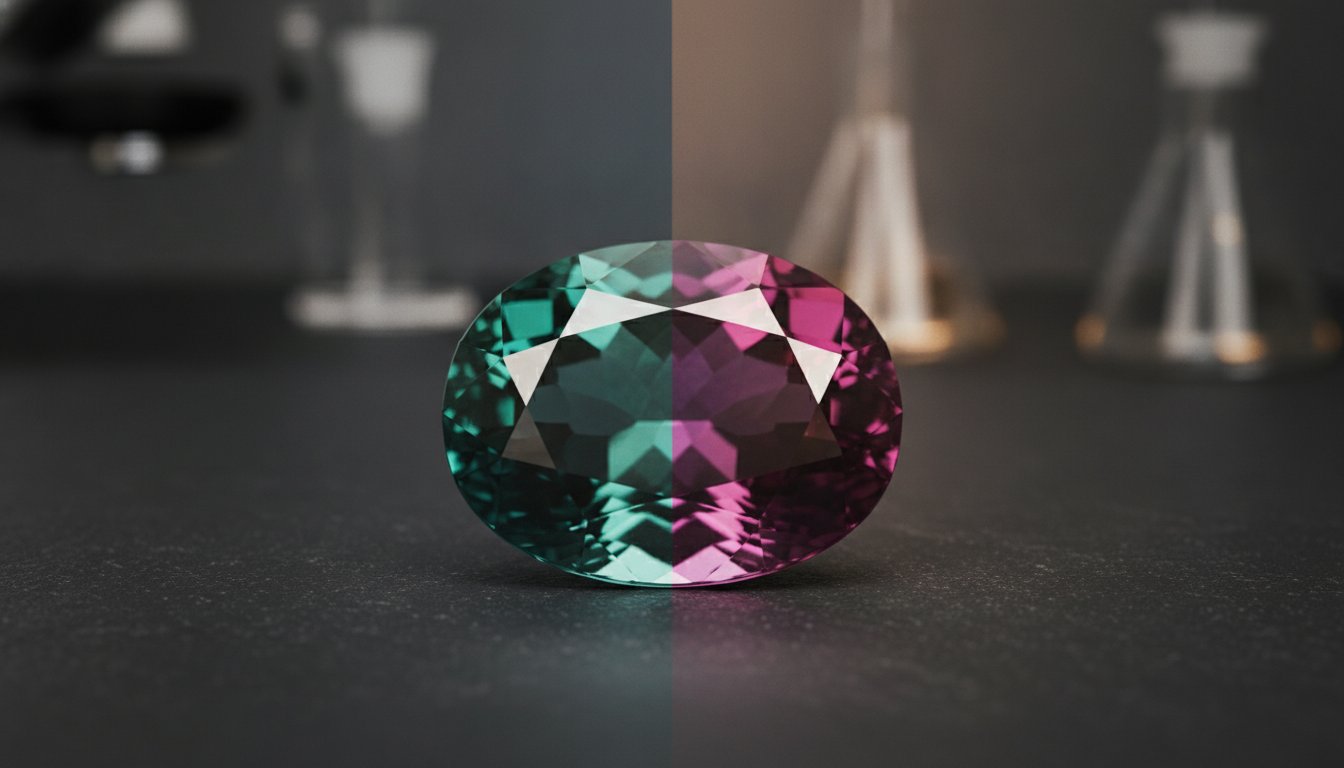
Did you know that gem-quality alexandrite is roughly 8,000 times rarer than white diamonds? When you're dealing with a gemstone this scarce, the market inevitably attracts sophisticated imitations that can deceive even the most enthusiastic collector. It's a daunting reality to face the fear of overpaying for a lab-grown stone or a glass simulant when you're searching for a natural miracle. Mastering how to spot fake alexandrite isn't just about saving money; it's about preserving the integrity of your collection and ensuring your investment is truly genuine.
We believe that every collector should feel like an informed insider, equipped with the technical data to see past the decorative surface. You'll learn the professional techniques used to distinguish natural specimens from their synthetic counterparts, giving you the security you need for high-value acquisitions. We'll walk through a preliminary home verification checklist, explore the mesmerizing physics of the "Alexandrite Effect," and explain why a professional lab report is your ultimate safeguard in a market where radical transparency is the only standard that matters.
Key Takeaways
- Discover the scientific mechanics behind the "Alexandrite Effect" and why the presence of chromium is the definitive marker of a true chrysoberyl.
- Learn how to spot fake alexandrite by identifying the distinct visual signatures of simulants like vanadium-doped sapphire compared to natural specimens.
- Identify critical red flags including unrealistic price-to-size ratios and "eye-clean" clarity that rarely occurs in nature for stones over one carat.
- Determine when a professional GIA or AGL lab report is essential to validate the refractive index and protect your high-value investment.
- Build a collection with confidence by seeking out providers who practice radical transparency regarding gemstone origins and ethical sourcing.
Understanding the Alexandrite Effect: Nature's Optical Illusion
The chrysoberyl mineral family holds many secrets, but none are as captivating as the rare variety known as alexandrite. This gemstone doesn't just display a pretty hue; it possesses a unique ability to transform its entire personality based on the light it's bathed in. Understanding this phenomenon is the first step in learning how to spot fake alexandrite, as the authenticity of a stone is written in its response to the visible spectrum. The alexandrite effect is defined as a shift from bluish-green in daylight to purplish-red in incandescent light.
This dramatic transition occurs because of trace amounts of chromium ions within the crystal lattice. These ions absorb light heavily in the yellow region of the spectrum while allowing both blue-green and red light to pass through. In an environment rich in blue and green wavelengths, the stone reflects those cool tones. When moved into light rich in red wavelengths, the stone's appearance pivots toward the warm end of the spectrum. While Synthetic alexandrite can mimic this behavior, the organic nuance found in natural precious gemstones is difficult to replicate with precision.
To better understand this concept, watch this helpful video:
It's vital to distinguish this phenomenon from pleochroism. Many collectors confuse the two, yet they're fundamentally different. Pleochroism is the ability of a gemstone to show different colors when viewed from different angles under the same light source. The alexandrite effect is a true color change that depends entirely on the light source itself, regardless of the viewing angle. If you see color shifts just by tilting the stone under a single lamp, you might be looking at a different mineral entirely.
Daylight vs. Incandescent Light: The Critical Test
Natural sunlight is rich in ultraviolet and blue-green wavelengths, which makes a genuine stone appear like a deep forest green or a vibrant teal. To perform a basic test, move the stone from a sunlit window to the glow of a candle or a traditional incandescent bulb. These yellow-red light sources reveal the hidden raspberry red or purplish-pink hues. Modern LED lighting often complicates this test. Many LEDs have a narrow spectral output that fails to provide the full range of wavelengths needed to trigger a natural transition, sometimes making a genuine stone look dull or stuck in a muddy gray phase.
The Spectrum of Color: Teal, Purple, and Brownish Hues
A common misconception is that a natural stone must show a 100% color change to be authentic. In reality, a complete shift from pure emerald green to pure ruby red is a statistical miracle. Most natural specimens exhibit secondary hues like brown, gray, or yellow. These earthy undertones are actually helpful indicators when you're determining how to spot fake alexandrite. If a stone is large, inexpensive, and shifts between an impossibly vivid neon green and a saturated grape purple, you're likely looking at a simulant. Authenticity is often found in the subtle, complex saturation of the stone rather than a cartoonish, perfect transition.
Common Types of Fake Alexandrite: Simulants vs. Synthetics
To understand how to spot fake alexandrite, you must first distinguish between a synthetic stone and a simulant. A synthetic gemstone is chemically, physically, and optically identical to its natural counterpart; it simply grew in a laboratory rather than the earth's crust. Simulants, however, are entirely different materials like glass or sapphire that merely mimic the appearance of alexandrite. While both have their place in the jewelry market, confusion arises when they're sold without full disclosure. According to GIA's guide to alexandrite, identifying these differences requires a keen eye for subtle color shifts and internal structures that only a professional can truly verify.
Marketing traps often use exotic-sounding names to mask the true nature of a stone. Terms like "Zandrite," "Alexandrium," or "Royal Alexandrite" are frequently used to sell color-change glass or inexpensive simulants. These materials often look "too perfect." They lack the organic inclusions and the complex, earthy secondary hues that characterize natural precious gemstones. If a stone appears flawlessly transparent and exhibits a neon-like color change at a fraction of the market price, it's almost certainly a simulant rather than a miracle of nature.
Synthetic Corundum: The 'Grandmother's Ring' Fake
Many vintage heirlooms from the mid-20th century are actually vanadium-doped synthetic sapphire, often referred to as synthetic corundum. These stones were incredibly popular in tourist markets and remain the most common "fakes" found in family jewelry boxes today. You can identify them by their specific color shift. While true alexandrite moves from green to red, these sapphires typically shift from a bright cornflower blue to a vivid royal purple. The colors are often too "electric" and lack the sophisticated teal and raspberry tones found in natural specimens.
Chatham Lab-Created Alexandrite: Quality with Disclosure
Not all lab-grown stones are intended to deceive. Chatham lab-created gemstones represent a pinnacle of technical achievement, using the flux-growth method to create crystals over many months. This process mirrors natural conditions, resulting in a stone that's chemically chrysoberyl. These are an ethical and affordable alternative for those who desire the alexandrite look without the significant investment required for a natural one-carat stone. The key is radical transparency. We believe that while these stones are beautiful, they must be clearly distinguished from the rare, natural treasures found in our loose gemstone collection.
The At-Home Detective: 5 Red Flags of Fake Alexandrite
While laboratory equipment provides the final word, you can often identify a questionable stone by observing its physical and economic characteristics. Understanding how to spot fake alexandrite begins with a healthy dose of skepticism regarding size and cost. Natural alexandrite typically costs thousands per carat, making $50 "deals" impossible. If you encounter a stone weighing more than one carat offered at a bargain price, the laws of gemological rarity suggest it's likely a simulant or a lab-grown variety. Remember that gem-quality alexandrite is roughly 8,000 times rarer than white diamonds; it simply won't be found in a clearance bin.
Clarity is another vital indicator. In the natural world, alexandrite is a Type II gemstone, meaning it almost always contains some internal characteristics. A perfectly "eye-clean" natural alexandrite over one carat is a statistical miracle. If the stone looks flawlessly transparent under a 10x loupe, it's likely been synthesized. Real stones often harbor a tiny, complex world within them, including mineral inclusions that tell the story of their billion-year journey from the earth's mantle.
Pay close attention to the "Traffic Light" shift. Many simulants, particularly color-change glass or synthetic corundum, exhibit an instant "flip" from one color to another. Natural stones usually have a more subtle, layered transition. You might see flashes of both colors at once, or a muddy, brownish intermediate phase as the light source changes. This complexity is exactly what we look for when sourcing precious gemstones for discerning collectors.
Using a Loupe: Searching for Nature's Fingerprints
To truly inspect a stone, you need a 10x triplet loupe. Look for "silk," which are fine rutile needles, or liquid-filled "fingerprint" inclusions that appear like delicate webs. These are nature's unique stamps of authenticity. Conversely, if you spot curved striae, you're looking at a cheap flame-fusion synthetic. These faint, curved growth lines never occur in nature. Additionally, watch for perfectly round gas bubbles. These are a dead giveaway for glass or low-quality simulants, as natural inclusions are always angular or irregular.
The Lighting Protocol for Home Testing
Testing the color change requires a specific environment to avoid false positives. First, observe the stone in indirect northern sunlight. This UV-rich environment should bring out the green or teal hues. Next, move to a dark room and use a single incandescent bulb or a candle flame. This yellow-red spectrum should reveal the purplish-red or raspberry tones. If the stone doesn't show a distinct green or teal component in daylight, it's likely a color-change sapphire or a simulant rather than a member of the loose alexandrite gemstones family.
Professional Verification: When to Seek a Lab Report
While at-home detective work provides a vital first line of defense, the high stakes of rare material acquisition demand scientific certainty. When you are investing in a stone that can command thousands of dollars per carat, subjective observation must give way to technical validation. Professional gemological laboratories like the GIA or AGL use advanced instrumentation to eliminate the guesswork involved in how to spot fake alexandrite. Their reports aren't just pieces of paper; they're the definitive proof of a stone's identity and value in a global market.
One of the primary tools used by gemologists is the Refractive Index (RI) test. Chrysoberyl has a very specific RI range, typically between 1.741 and 1.758. If a stone's RI falls outside this narrow window, it's immediately disqualified from being natural alexandrite. Labs also utilize spectroscopic analysis to look for the "smoking gun" of authenticity: the unique absorption lines of chromium. This element is responsible for the color change, and its specific signature in the light spectrum is nearly impossible for cheap simulants to replicate with precision.
Advanced testing also includes origin determination. Since a Russian alexandrite can command a significant price premium over stones from Brazil or Sri Lanka, verifying the geographic source is essential for serious collectors. Labs analyze trace elements and inclusion patterns to map the stone's geological "birthplace," ensuring that you aren't paying a premium for a stone with a less desirable pedigree.
Decoding a Gemological Report
Reading a report requires an eye for detail. You should first look for the "Variety" and "Species" designations. A genuine stone will be listed as Species: Natural Chrysoberyl and Variety: Alexandrite. Any deviation from this wording, or the presence of terms like "synthetic" or "laboratory-grown" in the comments section, indicates a non-natural origin. It's also a best practice to verify a report number online at the GIA website to ensure the document hasn't been tampered with or forged.
The Cost of Professional Appraisal vs. The Risk of Loss
Many buyers hesitate at the $100 to $200 fee required for a professional lab report. However, when you consider that a high-quality one-carat alexandrite is a major financial commitment, this cost is a negligible insurance premium against fraud. At AfricaGems, we recommend third-party certification for all significant purchases to provide our clients with absolute peace of mind. You can learn more about our precious gemstones and the rigorous standards we apply to every item in our inventory.
Browse our curated selection of loose alexandrite gemstones to find investment-grade pieces that come with the security of professional laboratory verification.
Buying Genuine Alexandrite: The AfricaGems Commitment
Buying from a reputable dealer is the final and most important step in your journey. Since 1984, AfricaGems has specialized in providing collectors with the security they need when navigating the complexities of rare materials. While learning how to spot fake alexandrite is an essential skill for any enthusiast, the ultimate safeguard is a partnership with a dealer who practices radical transparency. We believe the integrity of the gemstone industry relies on full disclosure, which is why we provide professional certification for every significant natural stone we offer.
Our commitment to excellence ensures that your investment is protected by decades of expertise. We don't just sell stones; we curate a legacy. Whether you're searching for investment-grade loose alexandrite gemstones or a unique piece for a personal collection, our process is designed to make you feel like an informed insider. We bridge the gap between technical validation and visual appreciation, ensuring that every transaction is grounded in trust.
The Marc Sarosi Standard of Quality
Every high-value gemstone that enters our inventory undergoes a rigorous personal inspection by our founder, Marc Sarosi. This level of direct accountability is rare in a global market, but it's the cornerstone of our brand. We maintain uncompromising standards for color change, clarity, and ethical sourcing. This commitment extends to our custom jewelry design services, where we prioritize the natural integrity of the stone. We ensure that every setting enhances the gem's beauty without obscuring the technical markers that prove its authenticity. Our legacy is built on the fact that every stone is exactly what we say it is.
Choosing Between Natural and Lab-Created Options
We recognize that the rarity of natural alexandrite makes it a significant investment that won't fit every budget. To serve all collectors, we offer both natural treasures and ethically disclosed Chatham lab-created varieties. Our goal is to help you decide based on your specific collection goals and financial comfort. We maintain the same level of transparency for our semi-precious categories as we do for our rarest specimens. This approach ensures that you're never confused between a synthetic and a natural stone.
Choosing between these options doesn't have to be a solitary decision. We invite you to contact us for a personal consultation to discuss your next purchase. Whether you're looking for the "Real Deal" with a GIA report or a beautiful, affordable lab-grown alternative, we're here to act as your knowledgeable mentor. Security in high-value transactions comes from information density and the steady, reassuring flow of a trusted dealer's expertise.
Secure Your Legacy with Authentic Rare Gemstones
Building a world-class collection requires more than just an appreciative eye; it demands the technical knowledge to distinguish nature's miracles from laboratory imitations. We've explored the complex physics of the chromium-driven color change and the critical role of professional spectroscopic analysis. By mastering how to spot fake alexandrite, you've transitioned from a casual observer to an informed insider. You now understand that true value lies in the subtle teal and raspberry hues that only genuine chrysoberyl can provide.
While high-end gemstones represent a significant investment, many enthusiasts also enjoy accessorizing with more accessible fashion pieces. For a curated selection of stylish and affordable jewellery, you can explore the collection at frenelle.co.nz.
Your journey toward owning one of the world's rarest materials should be defined by confidence rather than caution. At AfricaGems, we support your passion with an A+ Better Business Bureau rating and a 30-day money-back guarantee. We also offer free shipping on all gemstone orders to ensure your acquisition is as seamless as it is secure. You're now ready to make an investment that stands the test of time.
Shop our certified Loose Alexandrite Gemstones at AfricaGems and discover the magic of a natural masterpiece. The brilliance of a genuine treasure is finally within your reach.
Frequently Asked Questions
Is natural alexandrite always green and red?
No, natural specimens rarely display a pure emerald green or ruby red. Most authentic stones exhibit a range of teal, bluish-green, or forest green in daylight. Under incandescent light, the color typically shifts to a purplish-red, raspberry, or even a brownish-pink. These secondary hues are often the fingerprints of a natural origin, as perfectly "clean" colors are more common in lab-grown stones.
Can a jeweler tell if alexandrite is real just by looking at it?
Visual inspection alone is rarely sufficient for a definitive identification. While an experienced gemologist can spot obvious red flags like curved striae or gas bubbles, confirming a stone's identity requires technical validation. Tools like a refractometer are necessary to measure the specific refractive index of chrysoberyl. Without spectroscopic analysis to detect chromium, even an expert can't be 100% certain of a stone's authenticity.
Why is my alexandrite turning purple instead of red?
A shift to purple or raspberry is actually very common in natural alexandrite. The "ruby red" description is often an idealized version of the stone's color change. However, if your stone shifts from a vivid cornflower blue to a bright electric purple, it's likely a vanadium-doped synthetic sapphire. This common simulant lacks the complex teal and earthy undertones found in genuine chrysoberyl specimens.
How much does a real 1-carat alexandrite cost in 2026?
As of July 2026, an investment-grade one-carat alexandrite typically costs between $15,000 and $35,000. The price is heavily dependent on the intensity and percentage of the color change. Rare blue varieties can command up to $70,000 per carat, while stones with green primary hues range from $10,000 to $50,000. Lower-quality stones with pink or grey secondary hues generally cost between $3,000 and $20,000.
Are Chatham lab-grown alexandrites considered 'fake'?
Chatham lab-grown stones are synthetics, which means they're chemically and physically identical to natural alexandrite. They aren't "fakes" in the way glass or sapphire simulants are; they simply grew in a controlled environment. These stones are a legitimate, ethical choice for collectors who desire the beauty of chrysoberyl at a more accessible price point, provided the lab-grown origin is fully disclosed at the time of sale.
What is the most common simulant used to mimic alexandrite?
Vanadium-doped synthetic sapphire is the most prevalent simulant found in the market today. It's frequently found in vintage "grandmother's rings" from the mid-20th century. While it mimics the color-change effect, its refractive index and crystal structure are entirely different from natural alexandrite. These stones are often too large and too clean to be natural, given the extreme rarity of gem-quality chrysoberyl.
Does real alexandrite glow under UV light?
Some natural alexandrite will show a weak to moderate red fluorescence under long-wave UV light. This glow is caused by the presence of chromium, the same element responsible for the color change. However, this isn't a foolproof method for how to spot fake alexandrite. Many synthetic stones also contain chromium and will fluoresce similarly, making professional laboratory testing the only reliable way to confirm a stone's natural origin.
Should I buy an alexandrite that doesn't have a lab certificate?
Purchasing a high-value alexandrite without a certificate from a reputable lab like GIA or AGL is a significant risk. Because it's so difficult to determine how to spot fake alexandrite with the naked eye, a professional report is your only guarantee of authenticity. A report confirms the stone's species, variety, and geographic origin, ensuring you don't overpay for a synthetic stone or a clever simulant.

Article by
Marc Sarosi
Professional gemstone dealer for more than 40 years. Started off mining Aquamarine in Zambia, Africa and travelled throughout the continent in search of fine gems. Trusted authority on fine gemstones and have donated a fine collection of more than 27 extraordinary gemstones to the Smithsonian Institute Gem Hall for generations to see.