
How to Spot a Fake Ruby with a Loupe: The Connoisseur’s Guide for 2026
May 28th 2026
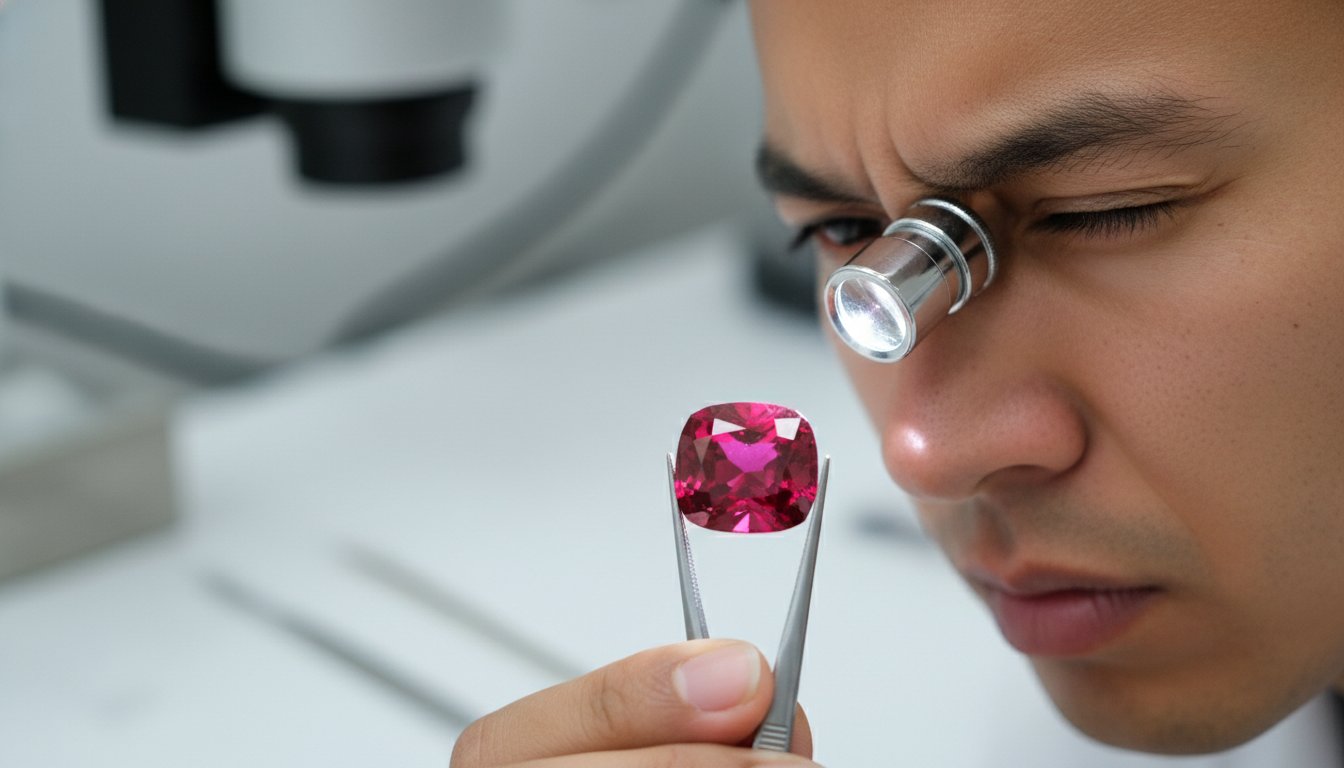
The 10x loupe is more than a tool; it's a window into the geological soul of a gemstone, revealing the microscopic "birthmarks" of time that no laboratory can perfectly replicate in three-dimensional space. Learning how to spot a fake ruby with a loupe is the defining skill that separates a casual admirer from a true connoisseur in the 2026 market. You likely understand that while a vivid red hue is captivating, the fear of overpaying for a lab-grown synthetic or a glass-filled imitation can turn a moment of beauty into one of deep anxiety.
This guide will empower you to master the art of magnification, giving you the confidence to identify the natural "silk" of a Mozambique ruby or the tell-tale bubbles of a composite stone. We'll explore the specific red flags of modern synthetics, the visual markers of unheated treasures, and the precise moment when a high-value gem demands the validation of a 2026 GIA report. By the end of this article, you'll view every inclusion not as a flaw, but as a signature of authenticity that guarantees your investment is as rare as the earth that formed it.
Key Takeaways
- Identify the industry standard 10x achromatic triplet loupe to ensure your inspections are free from the color distortion and spherical aberration common in lower-quality lenses.
- Master how to spot a fake ruby with a loupe by searching for rutile silk and delicate fingerprint inclusions, the definitive signatures of a natural, earth-mined origin.
- Detect the microscopic red flags of synthetic and treated gems, including the curved striae of flame-fusion stones and the spherical gas bubbles found in glass-filled imitations.
- Adopt the professional bracing technique to stabilize your hands, allowing for the steady, methodical observation required to differentiate between natural inclusions and lab-grown artifacts.
- Recognize the diagnostic limits of handheld magnification and determine when a high-value ruby demands the absolute security of a GIA, GRS, or AGL laboratory certification.
The Magnified Truth: Why a Loupe is a Gemologist's Best Friend
To the uninitiated, a ruby is simply a vibrant red stone. To the connoisseur, it is a complex geological record of heat, pressure, and deep-earth history. Relying on the naked eye to verify such a legacy is a gamble you shouldn't take. Modern lab-grown stones have become so sophisticated that they easily mimic the surface luster of natural treasures. Mastering how to spot a fake ruby with a loupe is your primary defense, allowing you to move past the superficial and peer into the stone's internal architecture.
The industry standard for this task is the 10x achromatic triplet loupe. This isn't a mere magnifying glass. It's a precision instrument designed to provide a color-correct, distortion-free view. While a standard lens might blur at the edges or fringe the stone with artificial rainbows, a triplet uses three distinct lenses to ensure the inclusion you're seeing is exactly as nature intended. In our pursuit of radical transparency, we believe every collector should possess the technical literacy to validate their own acquisitions.
To better understand this concept, watch this helpful video:
Anatomy of a Professional 10x Loupe
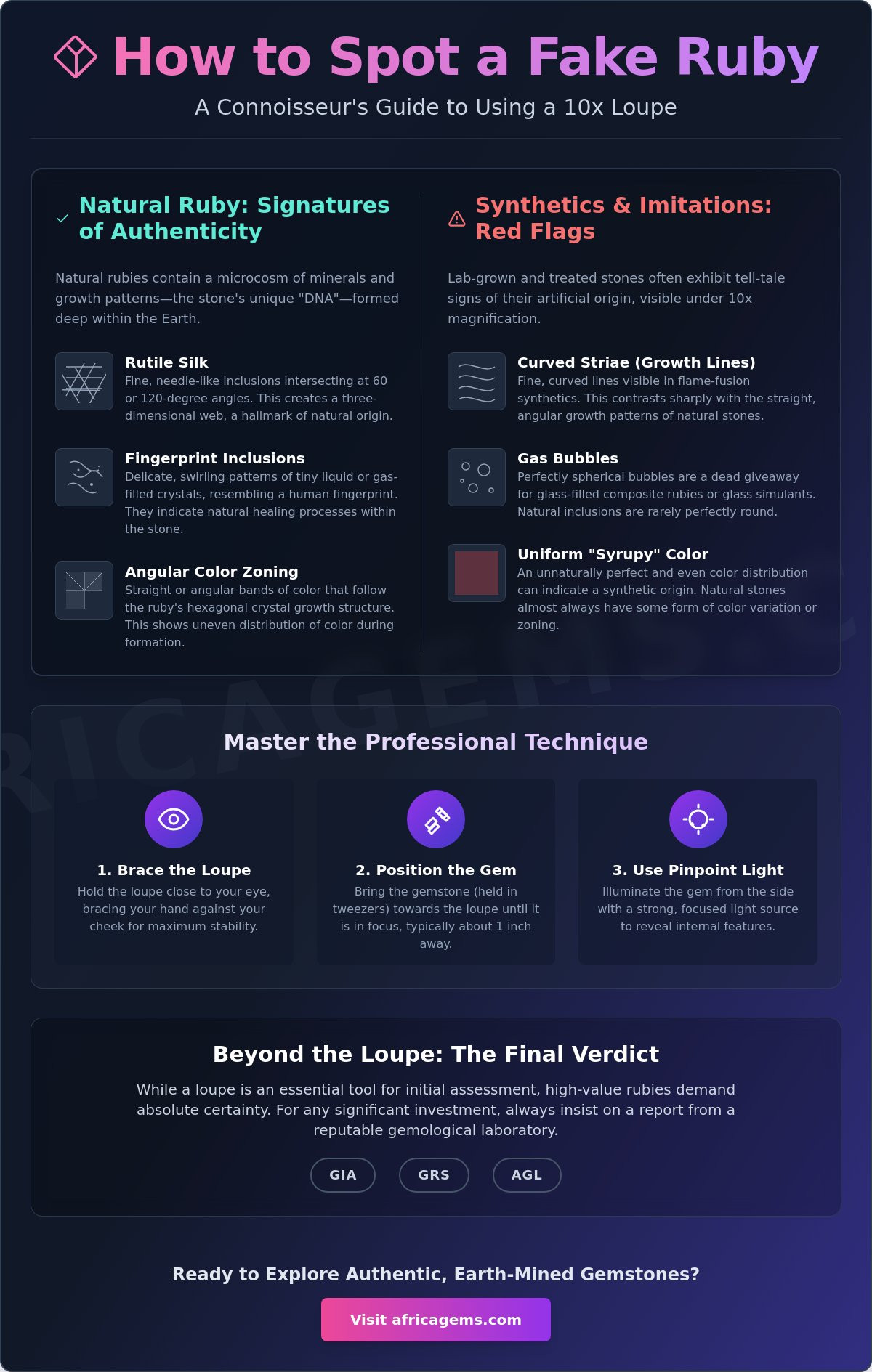
A "triplet" lens is non-negotiable because it corrects for both spherical and chromatic aberration. When you're looking for microscopic needles of rutile, you can't afford a lens that distorts the image. Success also depends on your technique. You must bring the stone to the lens, keeping the loupe braced against your cheek or glasses. This stabilizes the focal distance, which is typically about one inch. Finally, consider your light. Diffused overhead light helps you see general color, but a pinpoint light source from the side is what truly illuminates the internal "fingerprints" of a natural ruby.
The Three Categories of Non-Natural Rubies
Understanding how to spot a fake ruby with a loupe requires knowing exactly what you're looking against. First, there are simulants like red glass or garnet. These only look like rubies but have different physical properties. Next are synthetics, such as Natural vs. Synthetic Rubies. These are lab-grown corundum, like the Chatham varieties we offer for specific design needs. They share the same chemistry as natural stones but lack the messy, beautiful inclusions of the earth. Finally, composite rubies are low-grade natural stones heavily infused with lead glass. Each category requires a different visual checklist to ensure you're making an informed investment in loose rubies.
Reading the Interior: Identifying Natural Ruby Inclusions
Peering through the lens is your first step in learning how to spot a fake ruby with a loupe. While the surface might be polished to perfection, the interior tells the true story of the gem's birth. Natural rubies are rarely "clean" in the way a diamond is. Instead, they contain a microcosm of minerals and fluids trapped during their formation. These inclusions aren't just flaws; they're the DNA of the stone. A deep understanding of the Physical Properties of Ruby allows you to distinguish between these natural signatures and lab-grown imitations. You must look for the spatial depth of these inclusions. Natural markers sit at various depths, whereas "fakes" often have surface-level or flat-looking features.
Rutile silk consists of needle-like inclusions intersecting at 60 or 120-degree angles. Unlike the flat, two-dimensional appearance of some imitations, natural silk exists in a three-dimensional web within the host crystal. You should also look for color zoning. In natural stones, the chromium that provides the red hue isn't always distributed evenly. You might see straight or angular bands of color that follow the stone's hexagonal growth pattern. This is a stark contrast to the perfectly uniform, "syrupy" red often seen in flame-fusion synthetics. Look closely for crystalline inclusions like calcite or apatite. These tiny trapped crystals often have their own distinct shapes and prove the ruby grew in a natural mineral environment.
The Magic of Rutile Silk
This phenomenon is particularly vital when examining loose star rubies, where the quality of the silk directly dictates the sharpness of the star. Under a 10x loupe, these needles should look fine and delicate. If you use a darkfield light source, the silk will glow against the crimson body of the stone. Be wary of coarse, thick needles that look like they've been painted on. Natural silk is an intricate, gossamer-thin network that reflects light with a soft, silvery sheen. Once you've mastered these visual cues, you can confidently evaluate high-quality loose Mozambique rubies for your collection.
Fingerprints and Feathers
Fingerprint inclusions are perhaps the most beautiful evidence of geological time. They represent "healed fractures" where fluids were trapped as the ruby continued to grow over millennia. They look like delicate, web-like patterns or literal human fingerprints. Feathers, or internal cracks, are also common. Natural feathers have jagged, irregular edges that catch the light at different angles. This differs significantly from the smooth, curved fractures seen in glass or the rainbow "flash" effect often found in lead-glass filled stones. A natural feather is a tiny, jagged canyon within the stone, showing the stress of the earth's crust.
Red Flags Under 10x: Spotting Synthetics and Glass Fillers
Identifying a masterpiece requires an eye for the artist's signature, but in gemology, it also requires an eye for the factory's mistakes. While natural rubies carry the marks of the earth, lab-grown and heavily treated stones leave behind manufacturing artifacts. Understanding how to spot a fake ruby with a loupe involves looking for features that simply cannot exist in nature. These red flags are often microscopic, requiring a patient, methodical approach to magnification. When you encounter a stone that appears too perfect or possesses "clean" fractures, your suspicion should lead you deeper into the interior architecture of the gem.
Gas bubbles are one of the most immediate indicators of a non-natural origin. In the high-heat environments of flame-fusion or glass-filling processes, tiny pockets of air become trapped within the molten material. These bubbles are perfectly spherical, a shape that never occurs in natural ruby inclusions. If you see a round void, you aren't looking at a natural crystal; you're looking at a manufacturing byproduct. Similarly, flux-grown synthetics often contain "wispy" veils of flux residue. These look like coarse, metallic, or twisted ribbons, distinct from the delicate, organic web of a natural fingerprint inclusion.
The Telltale Curve of the Lab
The Verneuil, or flame-fusion, process is the most common method for creating affordable synthetics. Because the stone is grown in a rotating "boule," it develops curved growth lines known as striae. You won't see these by looking straight down through the table of the stone. Instead, you must rotate the ruby slowly under your loupe, looking through the side facets. These curves look like the subtle grooves on a vinyl record. They stand in sharp contrast to the straight, angular color zoning found in loose Burma rubies, which always follow the hexagonal symmetry of natural corundum crystals.
Lead-Glass Filling: The Great Deception
Composite rubies are a major concern in the modern market. These start as low-grade, opaque corundum that is "healed" with high-refractive lead glass to improve transparency. When you use your loupe to inspect these stones, look for the "flash effect." As you tilt the stone, the fractures filled with glass will often emit a distinct blue or orange flash. This unnatural play of color is a definitive sign of treatment. Surface-reaching fractures in these stones also look "oily" or unusually smooth. These composite gems lack the structural integrity and long-term value of natural Mozambique rubies, making it vital to master how to spot a fake ruby with a loupe before finalizing a high-value purchase.
The Master’s Protocol: How to Use a Loupe Like a Pro
Owning the right instrument is only half the battle. To truly understand how to spot a fake ruby with a loupe, you must master the physical ergonomics of gemological inspection. A shaky hand or improper lighting can hide the very inclusions you're trained to find. Professional gemologists don't just "look" through a lens; they employ a methodical protocol that stabilizes the image and reveals the stone's internal architecture from every possible angle. This disciplined approach ensures that no microscopic red flag goes unnoticed.
Before the lens even touches your eye, clean the stone. A simple microfiber cloth is your first line of defense. Dust, oils, and fingerprints on the surface can easily be mistaken for internal inclusions or "oily" glass-filled fractures. Once the ruby is pristine, you can begin the process of technical validation. Mastering how to spot a fake ruby with a loupe requires a steady focal plane, which is impossible to maintain if your hands are floating in mid-air. You must anchor yourself to create a consistent one-inch gap between the lens and the gem.
The 'Triple Brace' Stabilization Technique
The secret to professional magnification is the 'Triple Brace' technique. First, tuck your elbows firmly into your ribs to create a solid foundation. Second, rest your loupe-holding hand against your cheekbone or the side of your nose. Finally, connect your stone-holding hand, typically using precision tweezers like those you might find at FarmaRed24, to your loupe hand by resting your knuckles against each other. This creates a tripod of stability. It eliminates the micro-tremors that make tiny features like rutile silk or gas bubbles impossible to focus on. If the stone moves, your head and lens move with it, keeping the focus sharp.
Systematic Inspection Zones
A systematic approach prevents you from missing critical evidence. Start by inspecting the girdle for nicks or excessive wear. Since rubies are exceptionally hard, significant abrasions on facet edges often suggest a softer simulant like glass. Next, look through the table to map the heart of the stone's inclusions. Pay close attention to the facet junctions. In a natural ruby, these junctions are razor-sharp because the stone is cut and polished. In many fakes, especially molded glass, these junctions appear slightly rounded or "melted."
Transition your lighting as you scan. Start with overhead light to see the surface, then move to side-lighting. This lateral illumination is what makes internal structures like fingerprints and flux veils "pop" against the dark body of the stone. If you're ready to apply these skills to a world-class specimen, we invite you to browse our ethically sourced loose Mozambique rubies and see the difference for yourself.
Beyond the Lens: Ensuring Integrity in Your Ruby Collection
While the 10x loupe is the connoisseur's most trusted companion, you must recognize where its utility ends. Advanced treatments like beryllium diffusion or certain sophisticated flux-growth processes can be nearly invisible under handheld magnification. Understanding how to spot a fake ruby with a loupe is a vital skill for initial screening, but for high-value acquisitions, it serves as the first filter rather than the final verdict. When the stakes involve significant investments, the transition from personal observation to laboratory validation is essential for protecting your collection's long-term value. True expertise lies in knowing when your own eyes have seen enough and when the stone requires the rigorous scrutiny of advanced gemological equipment.
Building a collection based on transparency means moving beyond the pursuit of visual perfection. It requires a deep respect for the stone's journey from the earth to your hand. By mastering the master's protocol and identifying the "birthmarks" of nature, you've already distanced yourself from the average buyer. However, the final layer of security always comes from documented proof. This documentation transforms a beautiful object into a verified asset, ensuring that your knowledge of how to spot a fake ruby with a loupe is backed by the highest standards of the industry. We encourage every collector to view their loupe as a tool for appreciation and their certificates as a tool for security.
The Role of Major Gemological Labs
For stones of significant carat weight or exceptional color, a report from the GIA, GRS, or AGL is non-negotiable. These institutions use Raman spectroscopy and other advanced tech to detect treatments that a 10x lens cannot reveal. A "No Heat" designation is particularly critical; unheated rubies command a 150 percent to 300 percent price premium in the 2026 market. Furthermore, origin opinions are vital for valuation. A ruby certified as "Pigeon Blood" can be valued at 40 percent more than a standard fine red stone. These labs provide the technical validation that supports the visual appreciation you've mastered, ensuring your loose rubies are exactly what they're claimed to be.
A Legacy of Trust with AfricaGems
AfricaGems operates on a pillar of radical transparency, a commitment led by Marc Sarosi's personal guarantee of natural origin and ethical standards. We believe that an informed buyer is our best customer. This is why we provide full disclosure on every enhancement and offer both natural treasures and Chatham lab-created gemstones for various needs. Our goal is to act as a knowledgeable mentor, positioning you as an insider in the world of rare materials. We invite you to apply your new magnification skills to our curated selection of Loose Mozambique Rubies, where every inclusion tells a story of authenticity and geological wonder.
Advancing Your Legacy in Fine Gemstones
Mastering the art of magnification transforms the way you perceive the world's most coveted treasures. By identifying the delicate web of rutile silk and practicing the disciplined "Triple Brace" technique, you've moved beyond surface beauty to understand the stone's geological soul. You now possess the fundamental knowledge of how to spot a fake ruby with a loupe, allowing you to distinguish between the earth's natural signatures and the artifacts of a laboratory. This technical literacy is your greatest asset in a market where origin and treatment status define true value.
Since 1984, AfricaGems has been a pillar of integrity in the gemstone industry. Founded by Marc Sarosi, our business is built on a foundation of radical transparency and expert vetting. Whether you're seeking a rare natural specimen or a precision-grown Chatham alternative, we provide the full disclosure you deserve. We invite you to secure your investment with a certified Loose Mozambique Ruby from AfricaGems and experience the security of a personal consultation. Your journey as a connoisseur is just beginning, and we're honored to be your trusted mentor in every acquisition.
Frequently Asked Questions
Can you tell if a ruby is real just by looking at it with the naked eye?
No, a bare-eye inspection is rarely sufficient for a definitive diagnosis. While some low-quality glass imitations might look "off," modern flux-grown synthetics and high-end flame-fusion stones can easily deceive the casual observer. Professional identification requires looking past the surface color to find the internal markers that only magnification can reveal. Relying on your eyes alone leaves you vulnerable to sophisticated treatments that mimic natural luster.
What does 'silk' look like in a real ruby under a loupe?
Natural silk appears as delicate, needle-like inclusions of rutile that intersect at precise 60 or 120-degree angles. Under a 10x lens, these needles should look gossamer-thin and exist in a three-dimensional web within the host crystal. If you use a side-light source, the silk often emits a soft, silvery glow. Coarse or thick needles that appear flat are often a sign of synthetic manufacturing rather than natural growth.
Are there any bubbles in a natural ruby?
Perfectly spherical gas bubbles never occur in natural rubies. While a natural stone may contain negative crystals or jagged fluid-filled voids, these are never perfectly round. If you see tiny, circular air pockets trapped within the stone, you're likely looking at a glass-filled composite or a flame-fusion synthetic. Spotting these spherical voids is one of the fastest ways to identify a non-natural origin during your inspection.
Does a real ruby glow under a UV light?
Yes, many natural rubies exhibit a strong red fluorescence under long-wave UV light due to their chromium content. However, this isn't a definitive test for authenticity. Many lab-grown rubies also glow intensely, often even brighter than their natural counterparts. UV light is a helpful screening tool, but it cannot replace the technical validation provided by an internal inclusion analysis through a professional loupe.
What is the difference between a synthetic ruby and a fake ruby?
A synthetic ruby is lab-grown corundum that shares the same chemical and physical properties as a natural stone. A "fake" ruby, or simulant, is a different material entirely, such as red glass, garnet, or spinel. Understanding how to spot a fake ruby with a loupe allows you to distinguish between these categories by identifying the manufacturing artifacts in synthetics versus the incorrect physical signatures in common simulants.
How much magnification do I need to spot a fake ruby?
Mastering how to spot a fake ruby with a loupe requires a 10x achromatic triplet lens, which is the industry standard. While it's tempting to use 20x or 30x magnification, these lenses have a very shallow depth of field and often suffer from significant image distortion. A high-quality 10x lens provides the clarity and focus needed to map internal inclusions without losing the context of the stone's overall architecture.
Is the scratch test safe to use on a ruby I think is real?
No, the scratch test is a destructive method that should never be used on a potentially valuable gemstone. Although rubies are a 9 on the Mohs scale, they can still be chipped or fractured by the pressure of a scratch tool. Professional gemologists rely on non-destructive optical tests and inclusion analysis. Damaging a stone's surface to prove its hardness will significantly decrease its market value and aesthetic appeal.
Why do some rubies have blue flashes when I look through the loupe?
Distinct blue or orange flashes are a definitive sign of lead-glass filling, known as the "flash effect." This phenomenon occurs when light reflects off the boundary between the natural ruby and the glass used to fill its fractures. If you observe these unnatural bursts of color while tilting the stone, you're looking at a composite ruby. These stones are significantly less valuable and require special care compared to natural Mozambique rubies.

Article by
Marc Sarosi
Professional gemstone dealer for more than 40 years. Started off mining Aquamarine in Zambia, Africa and travelled throughout the continent in search of fine gems. Trusted authority on fine gemstones and have donated a fine collection of more than 27 extraordinary gemstones to the Smithsonian Institute Gem Hall for generations to see.