
How to Read a GIA Gemstone Report: A Connoisseur’s Guide (2026)
Apr 24th 2026
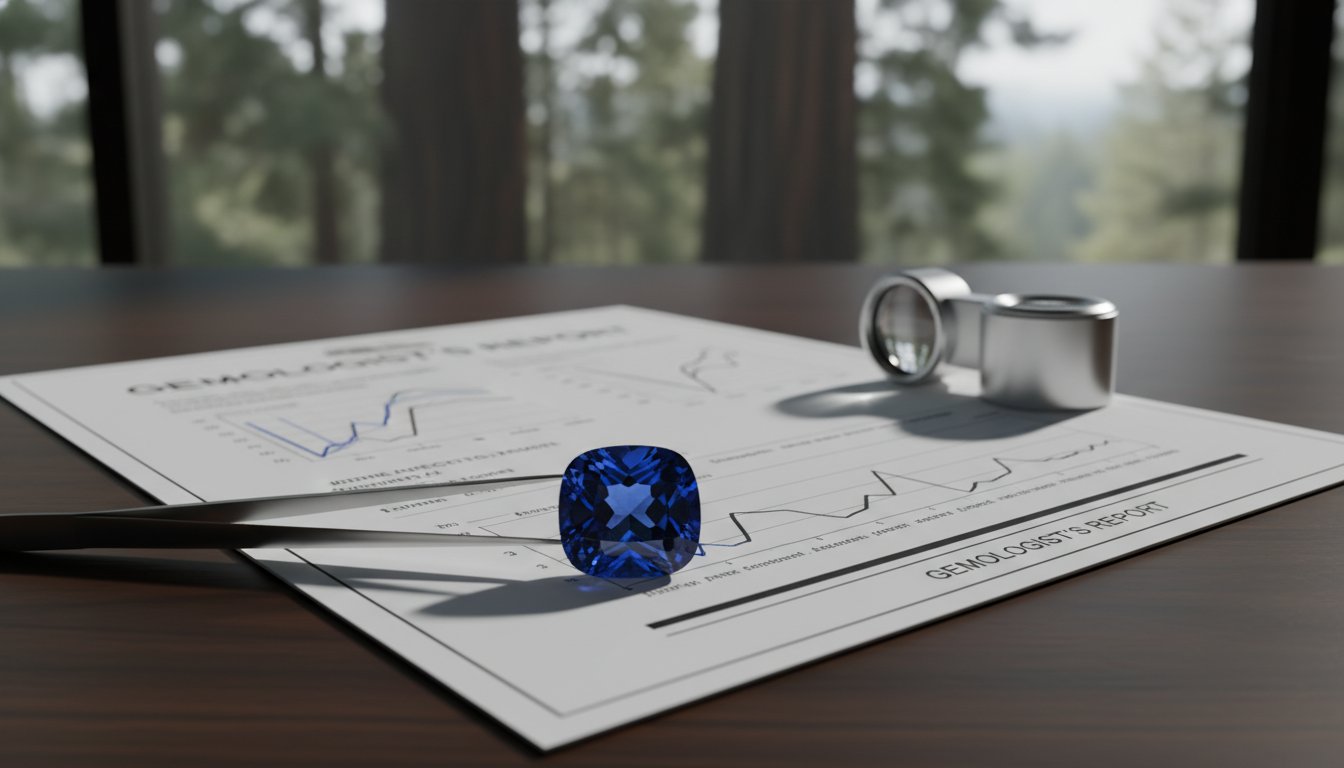
A single line of text on a GIA report often dictates whether a sapphire is a $20,000 investment or a $2,000 disappointment. While the Gemological Institute of America has provided the gold standard for transparency since 1931, the technical jargon on these documents remains a barrier for many serious collectors. You already know that a certificate is your best defense against treated stones, but the sheer density of data can feel overwhelming during a high-pressure transaction. Learning how to read a GIA gemstone report is the essential skill that separates a casual buyer from a true connoisseur who can spot world-class quality at a glance.
At AfricaGems, we believe your peace of mind is just as valuable as the pleochroism in a rare tanzanite. This guide promises to demystify every section of the 2026 report format, ensuring you can verify unheated status and origin claims with absolute certainty. We'll examine the critical distinctions between species and variety, decode the comments section for hidden treatment disclosures, and show you exactly what to look for to secure your next exquisite acquisition.
Key Takeaways
- Learn why a GIA report serves as your ultimate shield in the market, providing the definitive validation required for high-value colored stones.
- Master how to read a GIA gemstone report to interpret precise physical data and distinguish between standard cuts and investment-grade artistry.
- Discover how chemical fingerprinting identifies a gemstone's geographic origin, a critical driver in the premium valuation of rare treasures.
- Gain the confidence to verify authenticity using digital report check tools and matching physical inclusion plots to your specific stone.
- Understand the AfricaGems Difference and how rigorous technical analysis is used to hand-select only the top 1% of gemstones for your collection.
Understanding the GIA Gemstone Report: Your Shield in the Market
The GIA Gemstone Identification Report acts as the ultimate safeguard for serious collectors. It provides an objective, third-party analysis from the Gemological Institute of America (GIA), a nonprofit organization that has set the benchmark for gemological research since 1931. Unlike diamonds, which typically receive a "Grading Report" focused on the 4Cs, colored stones utilize an "Identification Report." This distinction is vital because colored gems are valued for their chemistry, origin, and treatment status rather than just a standardized cut or clarity scale. For investors seeking high-value blue sapphires, this report is the only way to ensure the stone's premium price matches its physical reality.
To better understand the layout and purpose of these documents, watch this helpful video directly from the lab:
Learning how to read a GIA gemstone report is your best defense against a market often clouded by undisclosed treatments. Whether it is beryllium diffusion or lead-glass filling, these enhancements can slash a stone's value by 90% or more. The report ensures radical transparency, moving the transaction from a leap of faith to a data-driven investment.
The Anatomy of the Report Header
The top section of the report contains the data that links the document to your specific stone. The Report Number is your unique digital fingerprint; you can instantly verify its authenticity on the GIA website. Pay close attention to the Date. Gemological science moves fast. A report from 2005 might not have been tested for treatment methods that became prevalent in 2024, such as certain low-heat techniques. To prevent forgery, every authentic report includes a hologram, a security screen, and micro-print lines that are nearly impossible to replicate accurately.
Species vs. Variety: What Are You Actually Buying?
The GIA first identifies the "Species," which is the broad mineral group based on chemical composition, such as Corundum or Beryl. They then narrow it down to the "Variety." Variety is the specific color-based name within a mineral group. For example, while the species is Corundum, the variety could be Sapphire or Ruby depending on its trace elements. Most importantly, this section confirms if the stone is natural. With lab-grown gemstone production increasing by over 15% annually in recent years, knowing your stone was formed in the earth is the primary driver of its long-term rarity and value. This technical validation is the cornerstone of how to read a GIA gemstone report with confidence.
Decoding Physical Data: Weight, Shape, and Cutting Style
The first step in learning how to read a GIA gemstone report involves scrutinizing the physical dimensions. GIA gemologists use digital calipers to measure stones to the hundredth of a millimeter. This isn't just for identification; these numbers tell you the stone's proportions. A shallow cut might lead to windowing, where light leaks through the bottom. A deep cut might hide unnecessary weight. The Shape and Cutting Style section defines the gem's silhouette and facet arrangement. You'll see terms like Oval Brilliant or Emerald Cut. Brilliant cuts maximize light return through kite shaped facets. Step cuts, like those found in fine emeralds, feature long, parallel facets that highlight the stone's internal clarity and color depth. Precision cutting dictates how light travels through the crystal lattice, turning a raw mineral into a vibrant masterpiece.Carat Weight Precision
GIA weighs every gemstone to three decimal places. However, they only report the weight to two. For a stone to be rounded up, the third decimal must be a nine. This rigor prevents weight bloating. It's vital when dealing with magic weights like 1.00, 2.00, or 5.00 carats. Hitting these marks can increase a gem's price per carat by 25% or more because they're seen as significant milestones for collectors. If you're looking for a specific investment piece, you can browse our ethically sourced gemstone collection to see how these weight classes impact rarity. Always ensure your jeweler's scale matches the report's data within a 0.01 carat margin to verify the stone's identity.Color and Transparency Descriptions
GIA provides an objective analysis of color. They don't rely on subjective eyes alone. Instead, they use master stones for comparison under controlled lighting. This process ensures that a Vivid Red ruby meets a global standard of saturation and tone. Transparency is equally critical. A Transparent stone allows light to pass through with minimal distortion. Translucent stones diffuse light, which is common in gems like jade or certain opals. You should also check the Comments section for mentions of color zoning. This occurs when color isn't distributed evenly through the crystal. High quality gems show minimal zoning, maintaining a consistent, breathtaking hue across every facet. Understanding these technicalities is a core part of how to read a GIA gemstone report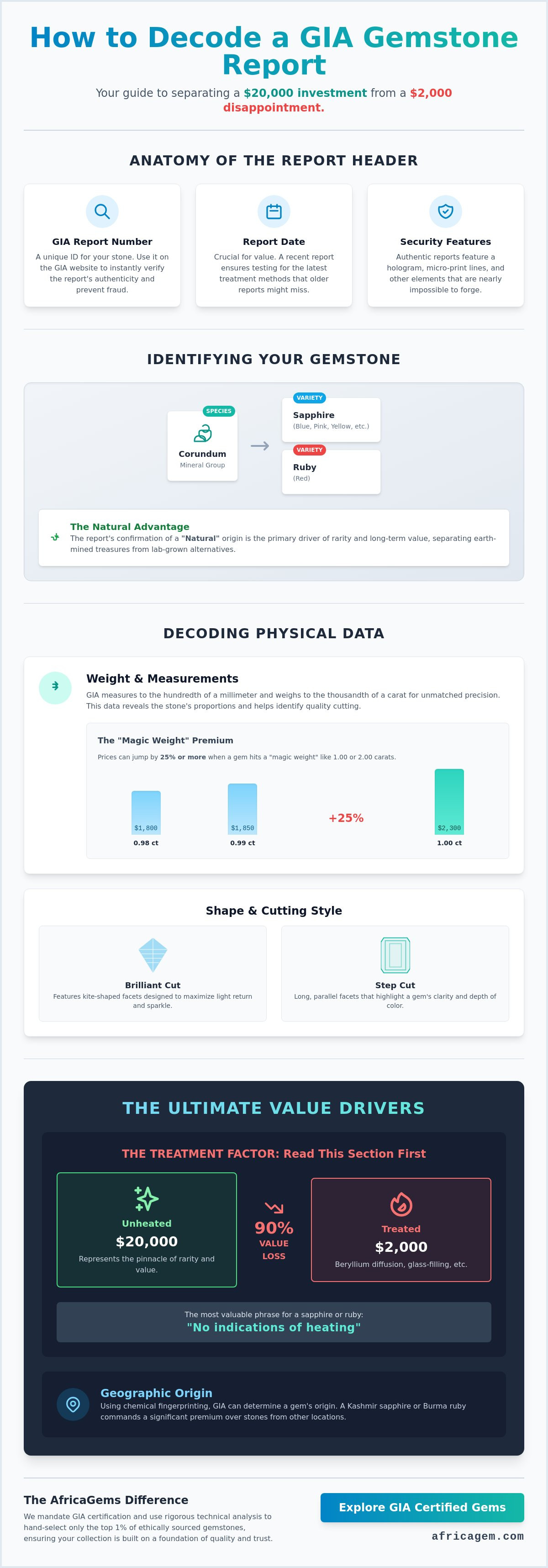
The Value Drivers: Origin and Treatment Analysis
Understanding how to read a GIA gemstone report requires a sharp eye for the "Results" and "Comments" sections. These lines determine whether a stone is a mere decorative object or a true investment-grade specimen. GIA utilizes advanced chemical fingerprinting, often employing Laser Ablation Inductively Coupled Plasma Mass Spectrometry (LA-ICP-MS), to detect trace elements unique to specific geological environments. This allows gemologists to trace a stone back to its precise birth site with remarkable accuracy.
This scientific rigor is why certain locales command astronomical premiums in the global market. For instance, loose burma rubies from the Mogok Valley often trade at prices 200% to 400% higher than comparable stones from Mozambique or Thailand. The report acts as the essential bridge between raw mineralogy and market value, providing the data necessary to justify such significant capital outlays.
Geographic Origin: Why It Matters
GIA classifies its findings as a geographic opinion based on inclusion analysis and chemical data rather than an absolute scientific fact. This distinction is vital for connoisseurs to understand. While the data is robust, the terminology reflects the inherent complexities of geological formations that cross modern borders. For stones like tanzanite, which originates solely from the Merelani Hills of Tanzania, the origin is clear. However, for emeralds, the distinction between Colombian and Zambian sources can shift values by 50% or more. A GIA report provides the security needed to navigate these price tiers with confidence.
Treatment Symbols and Comments
The "Treatment" section is the most critical area for long-term value preservation. GIA uses a standardized coding system to disclose enhancements that may not be visible to the naked eye. Deciphering these codes is a fundamental skill when learning how to read a GIA gemstone report:
- H (Heat): Indicates standard heat treatment used to improve color or clarity.
- U (Diffusion): A process that introduces color-causing elements into the stone's surface.
- O (Oil/Resin): Clarity enhancement through fillers, which is standard for emeralds but must be quantified.
The phrase "No Indications of Heating" is the most valuable string of words in gemology. It confirms the stone's color is a 100% natural gift from the earth, a rarity that represents less than 1% of all gem-quality stones. Look closely at the "Clarity Enhancement" scale. The price gap between "Minor" and "Significant" oiling can result in a value drop of 70% for the latter. AfricaGems prioritizes unheated varieties and ethically sourced stones. We ensure the AfricaGems Difference remains rooted in radical transparency, protecting your investment from the hidden pitfalls of the trade.
Verifying Authenticity: How to Spot a Valid GIA Report
A GIA report is the gold standard of gemological integrity. However, its value only holds if the document is authentic. Sophisticated forgeries exist in the secondary market, which is why knowing how to read a GIA gemstone report requires more than interpreting the data. You must also verify the document's pedigree. This process ensures the stone in your hand matches the data on the page exactly. Trust is built on verification, and for a serious collector, this step is non-negotiable.
The Digital Verification Process
The GIA Report Check tool is your first line of defense. Every report issued since January 1, 2000, is archived in GIA’s digital database to prevent fraud. Visit GIA.edu and enter the unique report number found on your document. The system will display a digital copy of the original archive. Compare the measurements, weight, and clarity characteristics of the digital version to your physical paper. If the database returns a "no record found" message, contact the GIA laboratory immediately. This discrepancy often indicates an altered number or a counterfeit document designed to deceive.
Physical Security Features
Genuine GIA reports utilize advanced security technology to prevent unauthorized duplication. Hold the document under a loupe to inspect the micro-print line. This text is too small for standard commercial printers to replicate clearly. Look for the heat-sensitive ink that changes color when touched by a warm finger. Every valid report also features a "void" pantograph. If someone attempts to photocopy the report, the word "VOID" appears across the background of the duplicate. A QR code is standard on modern reports, providing an instant link to the GIA secure server for real-time validation.
Beyond the paper, you must verify the stone itself. Compare the inclusion plot on the report to the actual gemstone under 10x magnification. Inclusions are like fingerprints; no two stones share the exact same pattern of crystals or feathers. If the report describes a "pinpoint" at the 4 o'clock position but the stone is loupe-clean, the report doesn't belong to that gem. This physical matching is a hallmark of the AfricaGems Difference, ensuring absolute transparency for every collector. We believe that full disclosure is the only way to conduct business in the high-end mineral market.
Don't settle for dealers who only provide digital scans or low-resolution copies. A reputable professional always includes the original physical report with your purchase. Forged signatures, missing holograms, or altered data fields are immediate red flags. Security is the foundation of a high-value acquisition. When you master how to read a GIA gemstone report, you protect your investment and your peace of mind.
Ready to invest in a verified masterpiece? Browse our collection of ethically sourced gemstones with original GIA reports today.
The AfricaGems Difference: Why We Mandate GIA Certification
AfricaGems stands on a foundation of radical transparency. We believe every collector deserves to know exactly what they're purchasing without any ambiguity. This is why we mandate GIA certification for our premium inventory. While learning how to read a GIA gemstone report gives you the tools to analyze a stone, our "AfricaGems Difference" ensures those tools are applied only to the finest specimens available. Marc Sarosi personally reviews every stone, using GIA data as a preliminary filter to reject 99% of the market. He only selects the top 1% of gems that display exceptional character and investment potential.
Expert Selection Beyond the Report
A technical report is a vital starting point, but it isn't the finish line. The "AfricaGems Eye" looks for "life" and "brilliance," which are subjective qualities that even the most rigorous technical reports cannot fully quantify. A GIA report might list a stone as "Eye Clean," but it won't describe how the light dances across the facets or how the color shifts in different lighting environments. We look for that specific, breathtaking fire that defines a world-class gem.
Our commitment to excellence includes providing supplemental documentation for ethically sourced gems. We've maintained these rigorous standards since 1984, ensuring our clients receive stones that are as beautiful as they are responsible. We don't just look at the numbers; we look at the soul of the stone. This dual approach of technical validation and expert aesthetic curation is what sets our collection apart from standard wholesalers.
Final Steps for the Collector
When you buy gemstones online, the GIA report acts as your primary security measure. It verifies the stone's identity, weight, and treatment status with absolute authority, removing the risks often associated with digital transactions. This document is also vital for securing accurate insurance coverage. Most high-value insurers require a third-party lab report to establish the replacement value of a piece. Without it, you might find yourself underinsured in the event of a loss.
To protect your investment for future generations, follow these practical steps:
- Secure Storage: Keep your physical GIA report in a fireproof safe, separate from the gemstone itself.
- Digital Backups: Scan your report and save a copy in a secure cloud-based folder for easy access during appraisals.
- Verification: Use the GIA Report Check service online to ensure the digital record matches your physical document.
Your journey into connoisseurship doesn't end with understanding how to read a GIA gemstone report; it begins there. By combining GIA's objective data with the AfricaGems commitment to quality, you can build a collection that holds its value and beauty for decades. If you're ready to find your next masterpiece, we invite you to view our curated selection. Explore our GIA-certified collection of rare gemstones and find a stone that speaks to your unique style.
Secure Your Legacy with Gemological Precision
A GIA report serves as more than a document; it's your definitive protection in a complex global market. By mastering how to read a GIA gemstone report, you gain the ability to distinguish between a common stone and a 100% natural, unheated treasure. You've learned to scrutinize the specific origin data and treatment analysis that dictate true market value. Since 1984, Marc Sarosi has championed this level of radical transparency through the AfricaGems Difference. We prioritize your security by providing full disclosure on every treatment and ensuring all minerals are ethically sourced and conflict-free. This commitment to integrity means you're never guessing about the quality of your acquisition. You now possess the technical knowledge to navigate the 2026 gemstone landscape with the confidence of a seasoned collector. Every exquisite stone tells a story, and you're now equipped to verify its authenticity with scientific precision. Start your search for a breathtaking, ethically sourced masterpiece today.
Browse our GIA-Certified Loose Gemstones
Frequently Asked Questions
Is a GIA report the same as an appraisal?
No, a GIA report isn't an appraisal. It's a scientific document that identifies the gemstone and describes its characteristics without assigning a monetary value. An appraisal provides a dollar estimate for insurance or retail purposes, while GIA focuses strictly on technical data like weight, dimensions, and natural origin. Most professional appraisers require a GIA report to provide an accurate valuation for high-end stones.
Does every gemstone from AfricaGems come with a GIA report?
We provide GIA reports for approximately 90% of our high-value rubies, sapphires, and emeralds to maintain the AfricaGems standard of transparency. For smaller stones or less expensive varieties, we include our own certificate of authenticity which guarantees the stone's natural origin and ethical sourcing. You can always request a GIA report for any stone in our inventory for an additional fee if one isn't already provided.
Can GIA identify if a sapphire is unheated?
Yes, GIA gemologists use advanced spectroscopy and microscopic observation to detect evidence of heat treatment. Their reports will explicitly state "No indications of heating" if the sapphire is in its natural, earth-born state. Understanding how to read a GIA gemstone report is crucial for collectors because an unheated sapphire often carries a price premium of 60% to 100% over a heated stone of the same quality.
What is the difference between GIA and other labs like AGL or SSEF?
GIA is the global authority for diamond grading and general gemology, while AGL is often preferred by American collectors for detailed treatment analysis on colored stones. SSEF, located in Switzerland, is the primary choice for the world's most expensive auction-grade rubies and sapphires. Each lab uses similar scientific equipment, but their "origin" opinions can differ based on the specific chemical reference samples in their private databases.
How much does a GIA gemstone report cost to obtain?
GIA fees for a basic colored stone identification report start at $85 for stones weighing up to 1.99 carats, according to the 2024 GIA Fee Schedule. If you require a report that includes geographic origin for a 5.00 carat ruby, the laboratory fee increases to approximately $215. These costs don't include the necessary shipping and insurance fees required to transport the gem to a GIA laboratory location.
What happens if a GIA report says the origin is "Indeterminable"?
An "Indeterminable" result means the stone's chemical "fingerprint" doesn't provide enough data to point to a single geographic location. This occurs in roughly 10% to 15% of samples where trace elements from one region, such as Madagascar, overlap with those from another, like Kashmir. It doesn't affect the stone's beauty or its status as a natural gem; it simply means the science is currently inconclusive regarding its birthplace.
Is a GIA report necessary for semi-precious stones like amethyst or citrine?
A GIA report isn't usually necessary for quartz varieties because the cost of the report often exceeds the value of the stone. Most amethyst or citrine is sold with a simple dealer guarantee of authenticity. However, for rare "semi-precious" gems like Paraiba tourmaline or fine alexandrite, a GIA report is mandatory to confirm the stone's identity and detect any sophisticated treatments that might affect its value.
How long is a GIA gemstone report valid?
A GIA report doesn't have an expiration date, but it's a permanent record of the stone's condition at the time of examination. If a stone is recut or undergoes modern treatment processes after the report is issued, the original document is no longer valid. When you learn how to read a GIA gemstone report, check the date; if it's more than 15 years old, a report update is a wise investment to account for newer laboratory testing techniques.