
How to Judge Gemstone Color Saturation: The Expert Collector's Guide
Mar 30th 2026
Why do two sapphires of the exact same carat weight and tone often differ in price by $3,000 or more? It's a frustrating reality for many collectors who find that a stone looking "vivid blue" in a studio-lit photo arrives looking like a muddy, grayish pebble. You've likely felt that hesitation when browsing online, fearing that a digital screen is hiding the brown undertones that stifle a gem's true brilliance. Learning how to judge gemstone color saturation is the essential skill that separates the amateur from the expert connoisseur.
By mastering the distinction between a stone's light-to-dark tone and its actual color intensity, you'll gain the confidence to spot "color masks" instantly. We'll show you exactly how to evaluate color purity to ensure you never overpay for a "masked" or "muddy" gemstone again. This guide reveals the AfricaGems criteria for evaluating color purity, helping you understand why a 20% increase in saturation can double a stone's value per carat. We'll provide the technical framework you need to buy loose stones online with the security of a seasoned professional.
Key Takeaways
- Understand why saturation serves as the essential "Value Multiplier" that distinguishes an exquisite, investment-grade gem from one that appears dull or muddy.
- Master the expert techniques for how to judge gemstone color saturation by decoding the GIA scale and identifying the "gray masks" that can diminish a stone's visual impact.
- Discover species-specific benchmarks to recognize what the top 1% of Sapphires, Emeralds, and Tanzanites actually look like in their most vivid, unheated state.
- Acquire the digital toolkit needed to spot edited photos, using the "Tilt Test" and white balance checks to verify a gemstone's authentic color purity before you buy.
- Gain an insider’s look at the AfricaGems Difference, where radical transparency and rigorous curation ensure your collection features only the purest, most breathtaking hues.
Understanding Gemstone Saturation: The Engine of Visual Impact
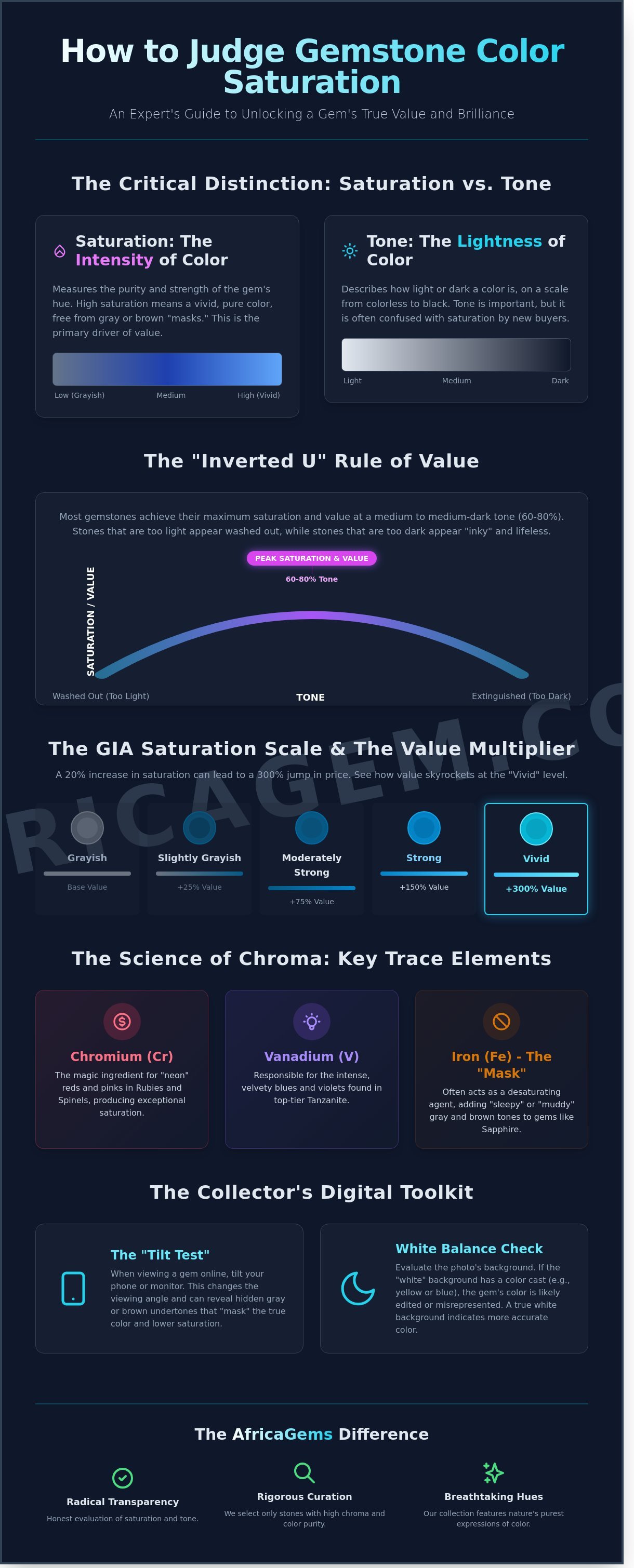
Saturation is the heartbeat of a gemstone's personality. While hue identifies the base color, saturation measures the intensity, purity, and vividness of that hue. It's the difference between a pale, watery sky and the deep, electric blue of a high-summer afternoon. In the professional trade, we often view saturation as the ultimate value multiplier. While clarity and carat weight certainly matter, a 20% increase in saturation can lead to a 300% jump in price per carat for stones like Paraiba Tourmaline or Burmese Ruby. Learning how to judge gemstone color saturation requires an eye for the subtle shift from a "vivid" color to one that's "grayish" or "brownish."
The psychological impact of saturation on a collector is profound. Highly saturated gems trigger an immediate emotional response, often described as a "glow" or "inner fire." This isn't just poetic license; it's a reaction to the way pure color interacts with human optics. When a stone reaches the "vivid" level on the GIA saturation scale, it commands attention from across a room. For many connoisseurs, this visual punch is the primary reason to collect rare minerals. It represents nature's ability to concentrate rare elements into a single, breathtaking point of light.
Saturation vs. Tone: The Critical Distinction
One of the most frequent errors new buyers make is confusing saturation with tone. Tone refers to the lightness or darkness of a gem, ranging from colorless to black. Saturation, however, is the strength of the color itself. Understanding the interplay between hue, saturation, and tone allows a collector to spot value where others see only a pretty rock. A gem can be very dark (high tone) but have very low saturation, appearing "inky" or "dead." Conversely, a light-toned stone can possess vivid saturation, resulting in a bright, neon appearance often seen in fine pink Sapphires.
To truly master how to judge gemstone color saturation, you must apply the Inverted U rule. Most gemstones reach their peak saturation at a medium-dark tone, typically between 60% and 80% on a professional scale. If the stone becomes too dark, the color is "extinguished" by blackness. In the industry, some dealers use the word "deep" to describe stones that are actually just "dark." They're trying to mask low saturation with high tone. Always look for the "flash" of color within the stone; if the gem looks black in normal lighting, the saturation isn't doing its job.
The Science of Chroma and Light Reflection
The vividness you see is a direct result of how light interacts with a gem's crystal lattice. In stones like Mahenge Spinel, the presence of trace elements such as Chromium allows the crystal to absorb specific wavelengths of light while reflecting others with incredible intensity. Iron, on the other hand, often acts as a "masking" agent, adding gray or brown tints that lower the saturation. This is why unheated stones with high saturation are so prized. They've achieved that purity without human interference.
- Chromium: Responsible for the "neon" reds and pinks in Rubies and Spinels.
- Vanadium: Provides the intense, velvety blues found in top-tier Tanzanite.
- Iron: Often reduces saturation, leading to "sleepy" or "muddy" tones in Sapphires.
Chroma is the technical gemological term for color purity and its relation to saturation. Unlike tone, which deals with light and shadow, chroma focuses entirely on how far a color sits from a neutral gray. When you evaluate a stone, you're essentially measuring its chroma. A high-chroma gem is a pure expression of its element, free from the desaturating effects of "masking" colors. At AfricaGems, we prioritize stones that maintain their saturation even in low-light environments, as this is the mark of a truly superior specimen.
The Saturation Spectrum: Decoding the GIA Scale and 'Color Masks'
The Gemological Institute of America (GIA) provides the definitive framework for professional evaluation. To understand how to judge gemstone color saturation, you must master the six levels of intensity: Grayish/Brownish, Slightly Grayish/Brownish, Moderately Strong, Strong, and Vivid. This hierarchy explains why a 2.10-carat sapphire with "Vivid" saturation often commands a 300% price premium over a stone of identical weight with a "Grayish" saturation level. Saturation represents the color's strength, purity, and brightness. When a stone lacks saturation, it appears "sleepy" or washed out, regardless of how beautiful the primary hue might be.
Professional dealers look for "masks" that diminish a stone's value. Cool-toned gems like Blue Sapphires or Green Emeralds typically exhibit a gray mask. Warm-toned gems such as Rubies, Spessartite Garnets, or Morganite usually show a brown mask. These modifiers act like a dull veil over the crystal. GIA research identifies three dimensions to color that every collector must balance: hue, tone, and saturation. High-quality gems minimize these masks to let the pure hue dominate the visual field. If a stone's cut is poor, it may also suffer from "windowing," a phenomenon where light leaks through the back of the gem. This creates a transparent hole in the center that dilutes even the most intense saturation by 50% or more.
Spotting the Modifiers: Gray and Brown
Identifying masks requires viewing the gem under indirect, natural light. A "Vivid" stone possesses high color purity with no visible gray or brown. In contrast, "Grayish" stones look muddy, as if the color is trapped behind a layer of smoke. The "vibrancy test" is a practical tool for any collector: does the color seem to "pop" and glow from within the pavilion, or does it sit flat on the surface? At AfricaGems, we focus on stones that reach the "Strong" to "Vivid" tiers, as these represent the top 3% of global mineral production. You can browse our curated gemstone inventory to see how these saturation levels compare in high-resolution video.
The Impact of Extinction on Perceived Saturation
Extinction refers to the black or dark areas in a gemstone where light fails to reflect back to the eye. This often occurs in stones with a high "tone" or deep color. It's a common trap for novice collectors to confuse high extinction with high saturation. A stone might have 85% saturation, but if 40% of the face-up area is consumed by black extinction, the true color is effectively hidden. The ideal specimen maintains high saturation with less than 15% extinction. This balance ensures the stone remains "open" and bright even in low-light environments. When you learn how to judge gemstone color saturation, you're really learning how to spot the absence of gray, brown, and black "dead spots" that steal a gem's life.
Our commitment to transparency means every stone we offer is evaluated for these specific factors. We believe a collector's confidence stems from knowing exactly where a gem sits on the saturation scale before they make a purchase. This methodical approach ensures that the "AfricaGems Difference" isn't just a slogan, but a measurable standard of quality.
Saturation by Species: Benchmarks for the 'Big Three' and Beyond
Understanding how to judge gemstone color saturation requires recognizing that every mineral species has a unique saturation ceiling. You cannot compare a sapphire to a tanzanite using a single template. A Vivid Sapphire possesses a velvety, deep-seated intensity, while a Vivid Tanzanite often displays an electric, violet-blue punch that feels more metallic. The top 1% of investment-grade stones reach a point of vividness where the color appears to pulse from within the crystal. This isn't just a matter of "darkness." It's the purity of the primary hue at its maximum possible concentration before it begins to look black or "over-inked."
The fluorescence factor plays a massive role in specific species like Rubies. Chromium traces in the crystal lattice react to UV light, causing the stone to glow red even in standard daylight. This optical phenomenon boosts perceived saturation by approximately 15% compared to non-fluorescent stones from different geographic origins. In rare gems like Paraiba Tourmaline, collectors look for "Neon" saturation. This is a visual effect where copper traces create a glow that seems to defy natural lighting conditions, maintaining its intensity even in low-light environments where other stones would appear dull.
Sapphires and Rubies: The Standard for Intensity
In the market for loose blue sapphires, collectors weigh the merits of Cornflower versus Royal Blue. Cornflower blue occupies a medium-high saturation level, prized for its soft, bright appearance. Royal Blue represents the pinnacle of intensity, characterized by a deep, regal saturation without any gray modifiers. For Rubies, the Pigeon Blood designation requires a 100% saturation of red with a complete absence of brown. At AfricaGems, we see unheated stones command a 40% to 60% price premium because they achieve these benchmarks naturally. Heat treatment is common, but unheated stones offer a level of "untouched" saturation that remains the gold standard for connoisseurs.
Emeralds and Tsavorite: The Green Spectrum
When you're judging the glow in loose Colombian emeralds, you'll notice a warm, yellowish-green saturation. This differs from the cooler, bluish-green saturation found in Zambian stones. Tsavorite Garnet frequently outshines Emerald in pure intensity. It has a high refractive index of 1.74 and lacks the "Jardin" (internal inclusions) common in emeralds. These inclusions can disrupt light return and reduce perceived saturation by 20% or more. A top-tier Tsavorite offers a crisp, vivid green that remains consistent across the entire face of the gem.
Alexandrite: Saturation in Color Change
Evaluating loose alexandrite gemstones presents a double-challenge. You must judge saturation across two different light sources. In 6500K daylight, the stone should show a saturated forest green; under 2700K incandescent light, it should shift to a saturated purplish-red. We value these gems by the strength of this color change. Low-saturation Alexandrites suffer from a "bleed" effect. This occurs when the two colors mix, resulting in a muddy brownish-gray that lacks the crisp definition of a 90% to 100% color change stone. To master how to judge gemstone color saturation in Alexandrite, you must see the stone reach its peak intensity in both lighting environments.
- Ruby: Look for the "glow" caused by UV fluorescence.
- Sapphire: Avoid "inky" stones where saturation turns to black.
- Emerald: Balance the "Jardin" against the depth of green.
- Paraiba: Prioritize the "Neon" glow over sheer darkness.
The Collector’s Toolkit: Judging Saturation via Digital Media
Digital connoisseurship requires a skeptical eye and a disciplined methodology. When you aren't holding a loupe in a laboratory, your screen becomes the primary filter for quality. Mastering how to judge gemstone color saturation from a high-resolution photograph involves more than just admiring a pretty image; it requires an analysis of light physics and digital honesty. Professional collectors rely on the 'Tilt Test' via video. A static photo can hide extinction, which is the black, lifeless area where light fails to reflect. By watching a stone move, you can see if the saturation remains vivid through the full 360-degree rotation or if it 'greys out' at specific angles.
Lighting environments dictate the story a gemstone tells. Most professional studio shots utilize 5500 Kelvin bulbs to simulate perfect noon sunlight. While this displays the stone in its best light, it doesn't reflect your daily reality. Since 2015, high-end dealers have increasingly provided 'Office Light' shots, typically around 3500 to 4000 Kelvin. This warmer, weaker light often reveals brown or gray modifiers that a bright studio flash might mask. If a sapphire maintains its velvety blue in a dim office setting, its saturation is truly superior. Always ask to see the stone under a penlight; this concentrated beam reveals the internal 'glow' or fluorescence that contributes to the overall saturation of stones like Mogok rubies.
Digital 'Master Stones' serve as a vital benchmark. Serious buyers often keep a calibrated image of a known 'Vivid' stone on their second monitor to compare against a prospective purchase. This prevents 'eye fatigue,' where looking at dozens of gems makes a mediocre stone appear more vibrant than it is. The AfricaGems Difference is rooted in this level of transparency, ensuring the digital representation aligns with the physical reality of the mineral.
The Digital Inspection Checklist
Check the background first. If the white balance is off, the gemstone's color is a lie. Look for a neutral gray or crisp white background. If the background has a blueish tint or looks unnaturally 'blown out,' the saturation has likely been digitally enhanced. Search for color zoning by pausing videos. In 75% of commercial-grade stones, saturation isn't uniform. You want to see consistent color depth across the entire table of the gem, not just in the corners or the culet.
Ask the Dealer: Questions to Verify Saturation
Don't be afraid to demand specifics. Ask the dealer if the photo was color-corrected to match the stone in person. It's a common practice to adjust images because cameras often struggle to capture the exact hue of emeralds or paraiba tourmalines. Request a 'hand shot' taken in natural, indirect daylight. This is the ultimate test. If the stone loses its punch when held between fingers away from studio lights, the saturation isn't as high as the professional listing suggests. Inquire if the stone possesses a gray or brown modifier that isn't visible in the high-contrast studio environment. Understanding how to judge gemstone color saturation requires looking past the studio flash to find the stone's true character.
The AfricaGems Difference: Curating for Color Purity
Marc Sarosi founded AfricaGems in 1984 with a vision that prioritized the "Expert Enthusiast" philosophy over mere volume. When we evaluate new inventory, we reject approximately 90% of the stones presented to us by suppliers. Most gems fail our rigorous standards because they lack the necessary color purity or exhibit "extinction" black zones that kill the stone's life. Learning how to judge gemstone color saturation involves identifying these subtle nuances, and our job is to ensure only the top 10% of the world's production reaches our vault. We look for gems that possess a vivid, primary hue without the distracting gray or brown masks that often plague lower-quality stones.
Radical transparency serves as the cornerstone of our business model. We provide full disclosure on every treatment, whether it is traditional heat or modern clarity enhancements. Many online retailers use specific lighting tricks or colored backgrounds to artificially inflate the perceived saturation of their gems. We refuse this practice. Our photography utilizes neutral 5500K daylight-balanced lighting. This ensures that your decision to buy gemstones online is backed by visual accuracy. What you see on your screen is a faithful representation of the gem's true character in hand.
For collectors seeking bespoke jewelry, saturation remains the most critical factor in the design process. A stone with high saturation maintains its "pop" even when surrounded by the fire of brilliant-cut diamonds or the warm glow of 18k yellow gold. We've helped over 10,000 clients since our inception, selecting high-saturation stones that won't "wash out" in different environments. Whether we are setting a 5-carat Tsavorite or a rare Padparadscha Sapphire, our custom design team ensures the mounting enhances the stone's natural saturation rather than competing with it.
The Integrity of the Trade
Ethical sourcing directly influences the final color quality you see in our collection. We've maintained relationships with artisanal mines in regions like the Umba Valley for over three decades. These miners treat the mineral with respect, avoiding the aggressive extraction methods that can cause internal fractures. Every significant stone at AfricaGems is hand-selected by a gemologist with decades of experience. We use full lab certification from GIA, AGL, or GRS as a baseline for color validation, ensuring that the saturation levels we claim are backed by the world's most respected authorities.
Your Path to a World-Class Collection
Building a collection is a journey that requires a clear strategy. You might begin by acquiring a 1-carat Tanzanite with "AAA" saturation or choose to invest in a "Big Three" masterpiece like an unheated Burmese Ruby. Saturation is the primary guardian of your investment. Market data from the last 20 years indicates that gems with "vivid" saturation levels appreciate at a rate 15% higher than their "light" or "fair" counterparts. High saturation is a physical manifestation of rarity. Explore our curated collection of high-saturation loose gemstones today and find the perfect centerpiece for your portfolio.
The AfricaGems Guarantee provides a 30-day no-questions-asked return policy. We offer this because we are confident in our ability to teach you how to judge gemstone color saturation through the quality of our inventory. Every purchase is a secure transaction, backed by Marc Sarosi’s personal accountability and a commitment to the integrity of the gemstone trade. We don't just sell minerals; we provide the technical validation and aesthetic excellence required for true connoisseurship.
Secure Your Next Investment with Chromatic Precision
Mastering the nuances of the GIA saturation scale helps you identify stones that truly vibrate with life. You've learned to spot the subtle gray or brown color masks that often diminish the value of rubies and sapphires. You also understand that digital media requires a disciplined eye to navigate. Refining your knowledge of how to judge gemstone color saturation is the final step in transitioning from a casual buyer to a serious connoisseur.
Since 1984, Marc Sarosi has curated a collection defined by radical transparency and ethical integrity. AfricaGems provides 100% disclosure on all gemstone treatments, ensuring you possess the technical data needed for a confident acquisition. Every piece in our inventory is guaranteed conflict-free and ethically sourced. This commitment to purity ensures your collection remains as untarnished as the gems themselves. It's time to apply your expertise to a stone that meets your exacting standards.
Discover the AfricaGems Difference: Shop High-Saturation Loose Gemstones
Your journey toward owning a world-class gemstone begins with a single, informed choice.
Frequently Asked Questions
What is the difference between gemstone hue and saturation?
Hue is the actual color you see, such as red, blue, or green, while saturation is the intensity or strength of that color. Think of hue as the stone's position on the color wheel and saturation as the distance from the center. A ruby with a pure red hue can have low saturation, appearing pinkish, or high saturation, appearing vivid red. This distinction is critical when you learn how to judge gemstone color saturation because hue identifies the stone, but saturation determines its soul.
Why do some gemstones look 'gray' even if they are a dark color?
Gemstones look gray because of a saturation modifier that reduces the purity of the primary color. In cool-toned stones like blue sapphire or amethyst, a gray mask is common; warm stones often show a brown mask. GIA grading scales define this as the saturation modifier where a level 1 saturation appears almost entirely gray or brown. Only stones reaching levels 5 or 6 on the saturation scale are considered vivid and free from these dulling modifiers.
Does gemstone saturation affect the price per carat?
Saturation is the primary driver of value, often accounting for 50% to 70% of a gemstone's total price per carat. For example, a 1-carat sapphire with light saturation might retail for $300, while the same stone with vivid saturation can command over $3,000. Collectors pay a premium for intensity because high saturation is geologically rare. The market value drops sharply once a stone becomes over-saturated or so dark that it appears black and loses its brilliance.
Can heat treatment improve a gemstone's saturation?
Heat treatment can significantly enhance saturation by dissolving trace element inclusions like rutile needles, which allows more light to interact with the crystal lattice. In Tanzanite, heating to 600 degrees Celsius consistently transforms brownish-red stones into the coveted deep violet-blue. While 95% of sapphires on the market are heat-treated to boost their color, AfricaGems prioritizes full disclosure so you understand exactly how a stone reached its current intensity.
How can I judge gemstone saturation on a computer screen?
You can judge saturation on a screen by comparing the stone against a known reference point, such as a neutral gray background or a standardized color chart. Since 100% of digital screens vary in calibration, look for videos shot in 5500K daylight-balanced lighting. This specific color temperature provides the most accurate representation of the stone's true saturation. Always check if the dealer provides a 360-degree video to see how the color behaves under movement.
What is 'vivid' saturation and why is it so rare?
Vivid saturation represents the highest point of color purity, where the hue is as intense as possible without becoming overly dark. In the GIA system, Vivid is the sixth and highest level of the saturation scale. It's incredibly rare because it requires a perfect concentration of trace elements like chromium or vanadium. Only about 2% of mined rubies reach this pigeon blood level of vividness, making them the most sought-after specimens for serious investment portfolios.
Do all gemstones have the same saturation levels?
Every gemstone species has a unique saturation ceiling based on its chemical composition and light refraction properties. While a sapphire can reach a level 6 vivid intensity, a light-toned stone like Morganite or Aquamarine rarely exceeds a level 3 or 4. Understanding these species-specific limits is vital as you master how to judge gemstone color saturation. You shouldn't compare the saturation of a Peridot to a Tsavorite garnet, as their chemical limits are fundamentally different.
How does lighting affect the way saturation appears in a gem?
Lighting changes saturation by altering the wavelengths available for the gemstone to reflect back to your eye. Incandescent bulbs, which peak in the red spectrum at 2700K, make a ruby's saturation look more intense but will dull a blue sapphire. Conversely, north-facing daylight at 6500K is the industry standard for grading because it contains a balanced spectrum. A stone's saturation can appear to shift by 20% or more depending on whether it's viewed under office fluorescents or natural sunlight.