
How to Judge Alexandrite Quality: The Connoisseur’s Guide (2026)
Apr 30th 2026
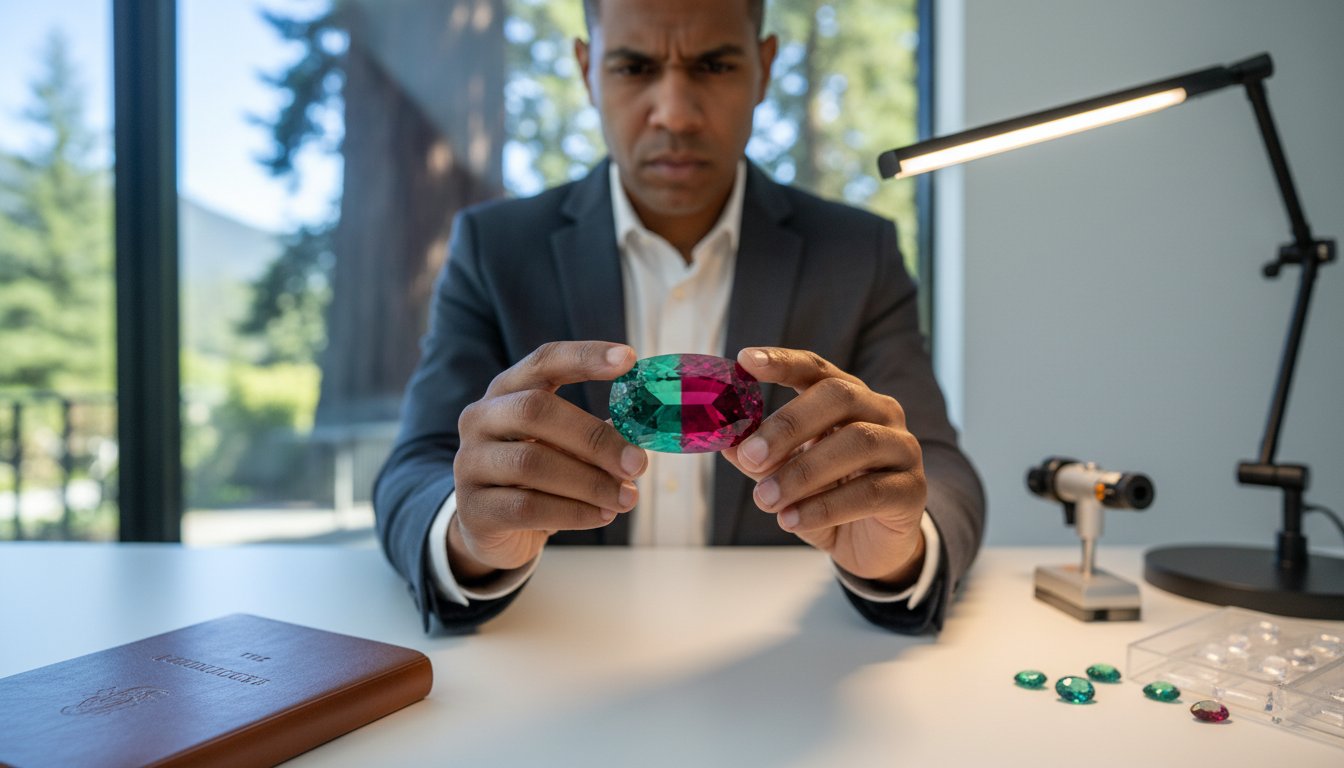
If you believe a dramatic color change is the only mark of a masterpiece, you might be surprised to learn that 90% of the stones marketed as "alexandrite" in standard retail shops are actually synthetic lab creations. It's a daunting reality for collectors who want to own a genuine piece of Earth's history without the risk of overpaying for a mediocre imitation. You've likely felt the frustration of trying to discern a true "emerald by day, ruby by night" shift through a digital screen, where lighting is often deceptive and descriptions are vague. You deserve total confidence before you invest.
Our goal at AfricaGems is to provide the radical transparency you need to evaluate these treasures with absolute security. This guide provides a definitive masterclass on how to judge alexandrite quality like a professional gemologist, focusing on the precision of the color transition and the integrity of the stone's origin. We'll explore a clear framework for scoring the percentage of color change, examine the impact of loupe-clean clarity on value, and explain why a certified stone from a 2026 perspective remains one of the most stable investments in the rare mineral world.
Key Takeaways
- Understand the science of the "Alexandrite Effect" to evaluate how chromium levels dictate the intensity of the "emerald by day, ruby by night" transformation.
- Learn how to judge alexandrite quality by mastering the specific weighting of the 4Cs, where color shift intensity dictates nearly 70% of a stone's total value.
- Compare the historical rarity of Russian Ural Mountain specimens with the exquisite modern brilliance of Brazilian sources to determine the impact of origin on market rarity.
- Distinguish between lab-created flux-grown crystals and natural stones to ensure your high-value acquisitions align with your investment and ethical standards.
- Gain the confidence of an insider by applying the AfricaGems standard of radical transparency and full disclosure to every professional gemstone evaluation.
The Soul of Alexandrite: Understanding the Color-Change Phenomenon
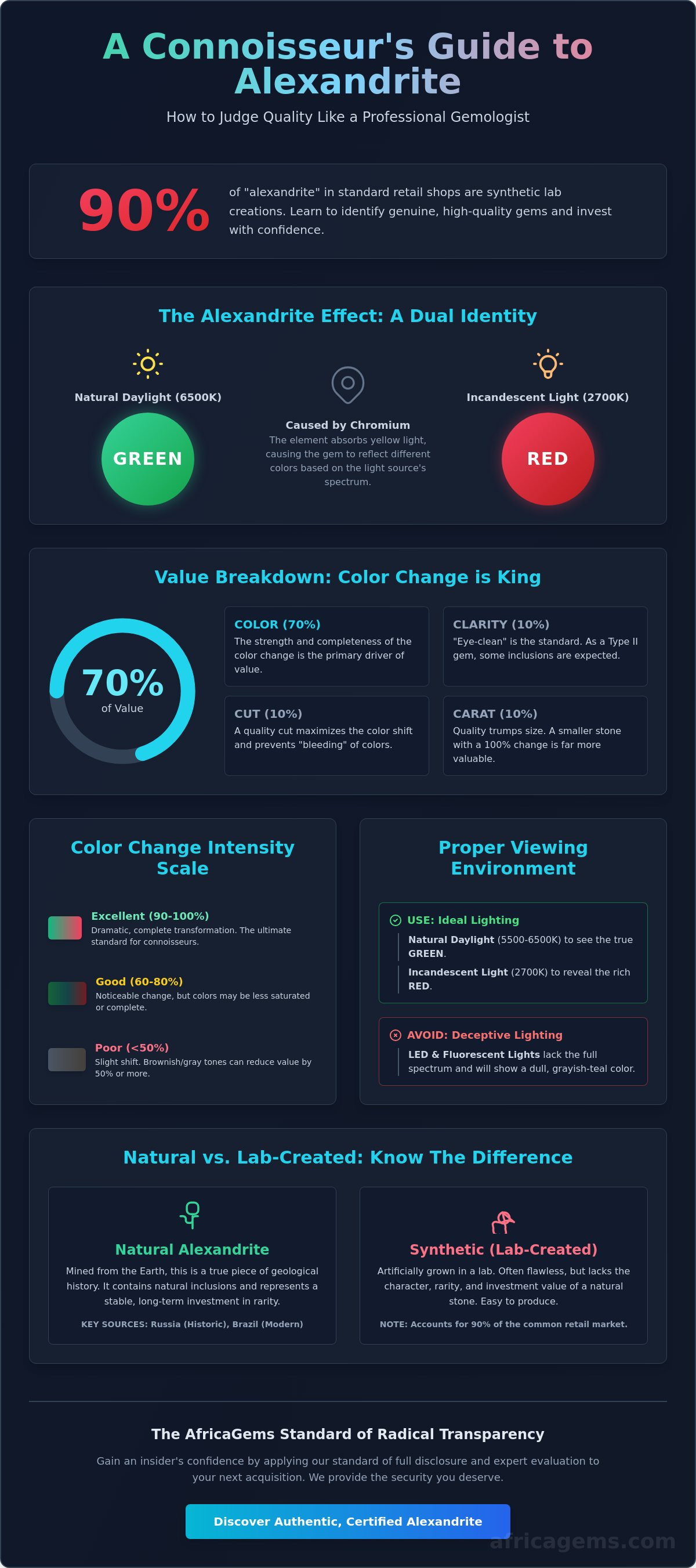
Alexandrite is a rare variety of Chrysoberyl that contains trace amounts of chromium. This specific impurity creates the famous "Alexandrite Effect," a phenomenon that has fascinated collectors since its discovery in the Ural Mountains in 1830. When you're learning how to judge alexandrite quality, you must first understand this optical trick. Chromium ions absorb light heavily in the yellow region of the visible spectrum. This allows the gemstone to reflect green light when the environment is rich in blue-green wavelengths and red light when the environment is rich in red wavelengths.
To better understand this concept, watch this helpful video:
The GIA classifies the finest specimens as those showing a 100% color change. In natural North daylight, which typically measures 6500K, the stone should appear a lush, cool forest green. Under a 2700K incandescent source, it should transform into a vivid raspberry red. Stones that exhibit a muddy or brownish hue under either light source are significantly less valuable. The "completeness" of this shift is the ultimate gold standard for any serious connoisseur.
The Color-Change Intensity Scale
Quantifying the shift is essential for valuation. A 30% change means only a slight tint shift occurs, while a 90% change represents a dramatic, near-total transformation. Connoisseurs avoid the "Bleed" factor. This happens when a stone shows green and red simultaneously, often due to poor cutting or internal zoning. It muddies the visual impact. Vivid saturation is the goal. Brownish or gray modifiers can reduce the price of a gem by 50% or more compared to a vivid, highly saturated counterpart.
Lighting Environments: How to Judge the Shift
Evaluation requires controlled environments. North daylight provides the 5500K to 6500K range needed to see the primary green accurately. For the red shift, use an incandescent bulb or candlelight at 2700K. Don't rely on modern LED or fluorescent office lights during your inspection. These sources often lack the full spectral range, causing the stone to look dull or "stuck" in an unattractive grayish-teal. Understanding these variables is the first step in mastering how to judge alexandrite quality like a professional dealer. We always recommend viewing a stone in multiple environments before making a final decision.
Beyond Color: Applying the 4Cs to Alexandrite
Understanding how to judge alexandrite quality requires a strategic shift from traditional diamond grading. While the 4Cs remain the industry standard, their weight is redistributed for this specific chrysoberyl variety. Color isn't just a factor; it's the primary driver, often accounting for 70% of the gem's total value. A serious collector knows that a 1-carat stone with a vivid, 100% color change is far more desirable than a 5-carat specimen with a dull, muddy appearance. In this market, quality doesn't just scale with size; it's defined by the intensity of the optical phenomenon.
The GIA provides a clear framework for these Alexandrite Quality Factors, emphasizing that the strength of the shift defines the stone's soul. Pleochroism also plays a critical role in the visual appeal. This optical property allows the gem to show different colors when viewed from different directions, adding a layer of visual complexity that goes beyond the basic color change. When you're learning how to judge alexandrite quality, you must look for a stone where the pleochroic colors complement the primary color change rather than making the stone look overly dark or "inky."
Clarity and the "Eye-Clean" Standard
Alexandrite is classified as a Type II gemstone. This means inclusions are expected by nature. You'll rarely find a stone that's loupe-clean. The connoisseur's goal is "eye-clean" clarity, where no internal flaws distract from the color change. Large inclusions are problematic because they scatter light and interfere with the chromium-driven color shift. However, certain features like fine "silk" or microscopic needles can be beneficial. These often act as a signature of natural, untreated origin, distinguishing them from synthetic counterparts.
The Precision Cut: Maximizing the Phenomenon
Cutting rare gemstones like alexandrite is a high-stakes balancing act. A shallow cut causes light to leak through the bottom, which kills the color intensity. Conversely, a cut that's too deep creates "extinction," resulting in unattractive black areas where the color change is invisible. The lapidary must orient the crystal with extreme precision to align the pleochroic colors with the table of the stone. We prioritize symmetry and polish to ensure every facet contributes to the gem's life. If you're looking for a stone that meets these rigorous standards, you can explore our curated collection of ethically sourced alexandrite to see these principles in practice.
Origin and Rarity: How Geography Dictates Quality
Origin isn't just a pedigree; it's a predictor of performance. When you're learning how to judge alexandrite quality, you'll find that where a stone was mined dictates its chemical composition and visual drama. The 1830 discovery in Russia’s Ural Mountains set a legendary benchmark. These stones displayed a vivid grass green that shifted to a purplish red. Today, Russian material is nearly extinct in the primary market. Most authentic Russian gems appear only at high-end auctions or through specialized estate dealers.
The 1987 discovery at the Hematita mine in Brazil changed the market forever. Brazilian alexandrite often rivals Russian stones for color change intensity, which is the most critical metric. While Russian gems lean toward grass green, Brazilian specimens showcase a sophisticated teal-blue green under daylight. This distinction is vital for collectors. Experts often reference the Alexandrite Quality Factors to explain how these geographic nuances impact the stone's ultimate grade and market value.
Sri Lankan (Ceylon) stones offer a different profile for the connoisseur. They're often larger, sometimes exceeding 50 carats, but the color change frequently includes "muddy" brownish or yellowish secondary hues. In contrast, East African deposits in Tanzania and Madagascar, which gained prominence in the late 1990s, provide unique bluish-green hues. These African stones often possess excellent clarity, making them a favorite for those who prioritize transparency alongside the color-change phenomenon.
The Russian Standard vs. Brazilian Brilliance
Russian stones command a massive premium, often exceeding 200% to 300% of the price of other origins, even when they possess lower clarity. Their historical scarcity and "grass green" daylight color drive this demand. Brazilian stones are the modern gold standard for "teal-blue green" brilliance. To verify origin claims, you must read a lab report from a reputable institution like GIA or AGL. These reports use trace element analysis to confirm the geographic "fingerprint" of the gem, ensuring your investment is secure.
Cat’s Eye Alexandrite: The Rare Phenomenon
Cat’s eye alexandrite occurs when light reflects off parallel needle-like inclusions, a phenomenon known as chatoyancy. You should judge the "eye" based on its sharpness, centration, and how it reacts to light. A top-tier specimen shows a distinct, bright line that appears to open and close as the stone rotates. This combination of color change and chatoyancy makes it a collector’s holy grail. It's a rare double-phenomenon that acts as a significant value multiplier. When you're mastering how to judge alexandrite quality, remember that a sharp "eye" in a stone with a 90% color shift is one of the rarest finds in the gemological world.
Natural vs. Lab-Created: Navigating the Quality Divide
Understanding the distinction between natural and lab-created specimens is essential when learning how to judge alexandrite quality. A common misconception persists that "synthetic" means "fake." In truth, a lab-grown alexandrite is chemically, physically, and optically identical to its mined counterpart. It's a real chrysoberyl, not a simulant like color-change sapphire or glass. Since Carroll Chatham first mastered the flux-growth process in the 1970s, connoisseurs have had access to stones that mirror the slow, crystalline growth found in nature's own pressure cooker.
From an investment perspective, natural alexandrite remains a finite, appreciating asset. While a 2-carat lab stone is easily replaced, a natural 2-carat Brazilian alexandrite with a 90% color change is a geological miracle. This rarity drives the price delta. When you buy gemstones online, transparency is your greatest protection. Ethical dealers provide full disclosure, ensuring you know exactly whether your stone was birthed in a laboratory or the earth's crust. This integrity is the pillar of the AfricaGems difference.
Spotting the Differences
A primary clue in how to judge alexandrite quality lies in clarity. Nature is rarely perfect. Natural stones typically contain "silk," small needles, or tiny crystals. If a stone appears "too perfect" or loupe-clean at a large size, it likely originated in a lab. Color behavior also provides evidence. Lab-grown stones often display a consistent, almost neon purple-to-teal shift. Natural stones exhibit more complex, moody pleochroism. Microscopic analysis remains the gold standard. Experts look for flux inclusions or curved growth lines, which are tell-tale signs of a controlled environment.
Choosing the Right Path for Your Needs
Your choice depends on your objective. Select a natural alexandrite for heirloom jewelry or a long-term collection. Its value preservation is unmatched. Conversely, Chatham lab-grown stones are ideal for high-impact daily wear. They offer breathtaking beauty and larger sizes without the five-figure price tag of rare natural specimens. At AfricaGems, full disclosure isn't just a policy; it's our philosophy. We believe every collector deserves the truth about a stone's origin. Whether you seek the raw rarity of the earth or the scientific precision of a lab, integrity is the constant.
Ready to secure a rare specimen for your collection? Learn the secrets of the trade and buy gemstones online with total confidence.
The AfricaGems Standard: Buying with Connoisseur Confidence
The AfricaGems Difference isn't just a phrase; it's a legacy built over 39 years of sourcing the world's most elusive minerals. When you master how to judge alexandrite quality, you see how often the market relies on subjective claims. We replace those claims with hard data and visual proof. Our commitment to 100% disclosure means you'll know every detail regarding a stone's origin and any treatments it has undergone. This level of radical transparency is essential for high-value transactions. We curate our collection with a focus on 80% to 100% color-change intensity, discarding stones that show only muddy or weak transitions.
Every major purchase is backed by the security of independent lab certification. We primarily utilize the Gemological Institute of America (GIA) and American Gemological Laboratories (AGL). These reports provide an objective third-party validation of the stone's authenticity and characteristics. By combining technical validation with our decades of experience, we ensure that your acquisition is both a stunning piece of nature and a sound investment.
The Marc Sarosi Guarantee
Marc Sarosi provides personal oversight on every high-value stone. He applies his "Expert Enthusiast" criteria to ensure the gem possesses the right balance of clarity and vibrant pleochroism. We recognize that alexandrite is a light-sensitive marvel. It performs differently under various spectra. Our no-questions-asked return policy allows you to conduct a home lighting evaluation. You can observe the shift from daylight to candlelight in your own environment. If the stone doesn't speak to you, the return process is seamless. For those ready to create something permanent, our custom jewelry services turn your loose alexandrite into a bespoke masterpiece designed to last generations.
Next Steps for the Serious Collector
Serious collectors know that static images rarely tell the whole story. You can request a high-definition video of any specific stone in our inventory. We'll document the transition across multiple lighting environments so you can see the exact moment the hue shifts. Consulting with our staff gemologists is another way to refine your search. We can help you find a stone that matches your specific hue preference, whether you value the "emerald by day" green or the "ruby by night" red more heavily. Understanding how to judge alexandrite quality is the first step toward a lifelong passion. We invite you to explore our curated collection of loose alexandrite gemstones and find the center-stone that defines your collection.
Secure Your Legacy with a Masterpiece Gemstone
Selecting a premier alexandrite requires more than a casual glance; it demands a disciplined eye for the dramatic shift from forest green to raspberry red. You now understand that origin and the 4Cs dictate a stone's true market value. Knowing how to judge alexandrite quality empowers you to distinguish a rare natural treasure from common synthetic imitations. Since 1984, AfricaGems has provided this level of expert guidance to sophisticated collectors. With over 40 years of gemstone expertise, we prioritize radical transparency in every transaction. Founder Marc Sarosi provides direct accountability for every stone, ensuring full disclosure on all treatments and origins. This commitment to integrity means you don't have to guess about the rarity or ethical standing of your investment. It's time to apply your connoisseur's knowledge to a physical specimen. Browse Our Exquisite Collection of Loose Alexandrite and find a stone that speaks to your unique style. Your journey into the mesmerizing world of color-change gems is just beginning.
Frequently Asked Questions
Is natural alexandrite more expensive than a diamond?
High-quality natural alexandrite often commands a higher price per carat than traditional white diamonds due to its extreme scarcity. While a standard 1-carat G-color, VS1 diamond might retail between $6,000 and $8,000, a top-tier alexandrite of the same size can exceed $15,000. This price premium reflects the rare geological conditions where chromium replaces aluminum in the chrysoberyl crystal lattice, a phenomenon far less common than diamond formation.
Can I judge alexandrite quality by looking at photos online?
You cannot fully determine how to judge alexandrite quality through static photographs alone because a single image fails to capture the stone's dynamic pleochroism. Reliable dealers provide 360-degree videos under both 5500K daylight and 2700K incandescent light sources to demonstrate the shift. The AfricaGems Difference relies on this radical transparency, ensuring you see the 100% color change that Marc Sarosi personally guarantees for our connoisseur-grade specimens.
What is the "best" color change for an alexandrite?
The gold standard for a premier alexandrite is a 100% color shift that moves from a vivid teal or forest green in daylight to a saturated raspberry red under incandescent light. GIA grading reports prioritize this "red-to-green" contrast, as stones with muddy secondary hues are less valuable. Connoisseurs seek a balance where the colors remain vibrant and don't "black out" or become overly dark in the center of the gem.
How much does a high-quality 1-carat alexandrite cost in 2026?
Investment-grade 1-carat alexandrites in 2026 typically range from $10,000 to $30,000 based on the intensity of the color change and clarity. Historical auction data from houses like Sotheby's shows that rare specimens with a 90% to 100% shift have seen an average 15% annual appreciation. Fine gems with eye-clean clarity and a documented Brazilian or Russian pedigree sit at the highest end of this pricing spectrum.
Does alexandrite need special care in jewelry?
Alexandrite is exceptionally durable for daily wear and ranks 8.5 on the Mohs scale of mineral hardness. It's tougher than emeralds or opals, which makes it a secure choice for engagement rings and heirloom pieces. You should still avoid harsh household chemicals like bleach; instead, use warm, soapy water and a soft brush to maintain the stone's breathtaking luster and transparency over the years.
What is the difference between a synthetic alexandrite and a color-change sapphire?
Synthetic alexandrite is a lab-grown chrysoberyl with the same chemical properties as the natural stone, while color-change sapphire is a different mineral species. Sapphires typically shift from blue to violet, whereas true alexandrite moves from green to red. Part of learning how to judge alexandrite quality involves checking the refractive index, which sits at 1.74 to 1.75 for alexandrite compared to sapphire's 1.76 to 1.77.
Is Brazilian alexandrite better than Russian alexandrite?
Neither origin is objectively superior, but they offer different aesthetic profiles for the sophisticated collector. Russian stones from the Ural Mountains set the historical standard for vivid greens, though they've been nearly extinct on the primary market since the late 20th century. Brazilian gems from the Hematita mine, discovered in 1987, are world-renowned for their intense purples and high clarity, often commanding equal premiums in today's market.
Why do some alexandrites look brownish or greyish?
Brownish or greyish tints occur when the gemstone contains high concentrations of iron or other trace elements that interfere with the chromium-induced color change. These "muddy" secondary hues significantly lower the value because they prevent a crisp transition between the primary colors. Connoisseurs prefer stones with high transparency and minimal inclusions to ensure the pleochroic colors remain vibrant rather than appearing dull or desaturated.