
How to Convince Your Partner on a Non-Diamond Engagement Ring: The Connoisseur’s Strategy
Jun 9th 2026
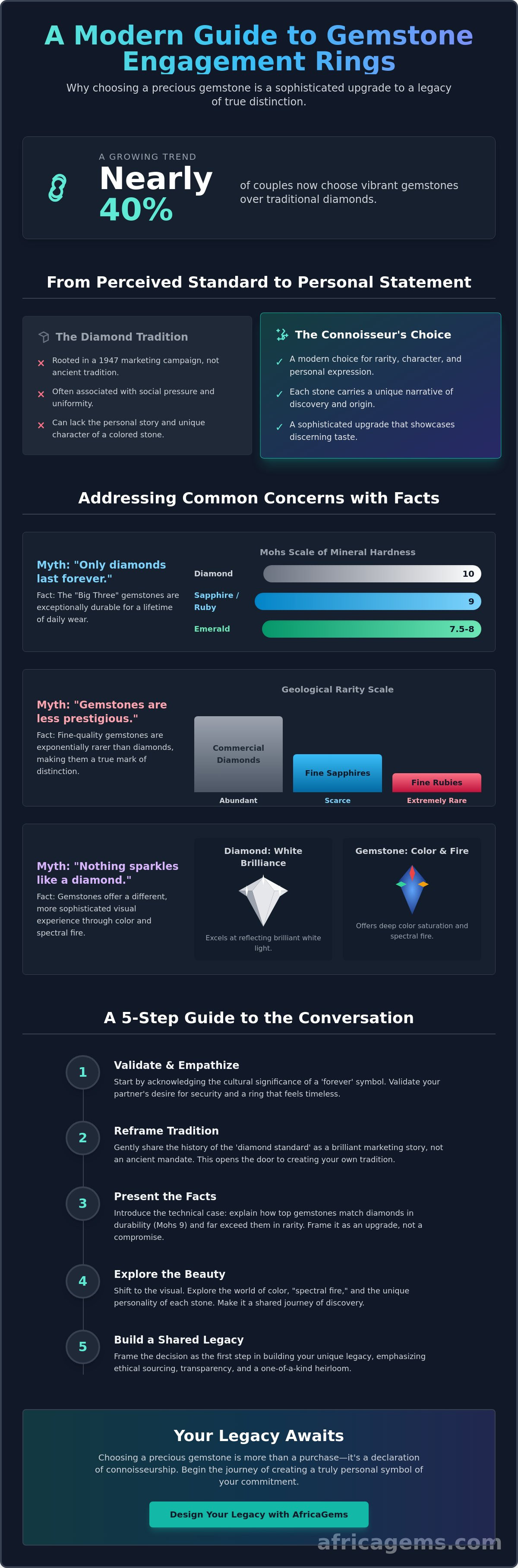
Did you know that as of early 2026, nearly 40% of engagement ring buyers are choosing vibrant gemstones over traditional diamonds? You likely feel that a ring should be as unique as your relationship, yet you might worry about how to navigate the conversation if your partner equates "non-diamond" with "compromise." Understanding how to convince my partner on a non-diamond ring isn't about cutting corners; it's about elevating the standard of rarity and personal expression. It's natural to feel the weight of social tradition and the fear that a colored stone might appear less durable or less prestigious than its colorless counterpart.
This guide will help you master both the emotional and technical aspects of this dialogue, transforming a potential hurdle into a shared journey of connoisseurship. We'll explore how to articulate the superior scarcity of stones like Mozambique rubies or Colombian emeralds while addressing practical concerns about daily wear and long-term value. By the end, you'll be equipped to show your partner that choosing a precious gemstone is a sophisticated upgrade to a legacy of true distinction.
Key Takeaways
- Reframe the diamond tradition by understanding its marketing origins, allowing you to address your partner's emotional hesitations with clarity and empathy.
- Gain confidence in gemstone durability by applying the Mohs Scale of Mineral Hardness to "The Big Three," ensuring your selection stands the test of daily wear.
- Master the nuances of how to convince my partner on a non-diamond ring by emphasizing the "Connoisseur Effect," where expert-level rarity and color saturation outweigh simple carat weight.
- Follow a five-step visual education strategy to compare the unique character of precious stones against the uniformity of standard diamonds.
- Build lasting trust through a commitment to ethical sourcing and professional transparency, turning an online transaction into a secure, legacy-oriented consultation.
Understanding the 'Diamond Standard' and Your Partner’s Hesitation
For decades, the diamond has been marketed as the singular emblem of eternal commitment. This wasn't always the case. The history of engagement rings reveals that various materials and symbols were used long before the De Beers campaign in 1947 solidified the modern standard. When you begin researching how to convince my partner on a non-diamond ring, it's vital to recognize that their hesitation often stems from eighty years of psychological conditioning rather than a lack of appreciation for beauty.
Your partner's desire for a diamond isn't necessarily about the stone itself. Often, it's about what the stone represents: security, longevity, and a public declaration of worth. By validating their need for a "forever" symbol, you can start to introduce precious gemstones as a choice of distinction. This isn't a compromise or a budget-saving tactic; it's an intentional move toward rarity and character.
To better understand this concept and how to approach the topic with sensitivity, watch this helpful video:
The Psychology of the Engagement Ring
Partners often feel a subtle pressure to "prove" their love through a high-cost, traditional purchase. This fear of social judgment from peers or family can be a significant barrier. You aren't just choosing a ring; you're choosing a piece of jewelry that will be scrutinized by others. To move past this, shift the focus from the price tag to the personal story. A rare sapphire or a vibrant emerald carries a narrative of discovery and connoisseurship that a mass-market diamond simply cannot match.
Identifying Common Misconceptions
Several myths persist that make people wary of gemstone engagement rings. One major fallacy is that only diamonds are durable enough for daily wear. While diamonds are indeed the hardest mineral, stones like sapphires and rubies are incredibly resilient. They've been passed down through generations in royal collections for centuries. Another misconception involves value. High-quality colored stones are often rarer than diamonds and hold their value remarkably well. Finally, don't confuse "sparkle" with "fire." While diamonds excel at white light reflection, gemstones offer a spectral fire and saturation of color that provides a more sophisticated visual experience. Understanding these technical truths is the first step in helping your partner see the brilliance in a different light.
The Technical Case: Durability and Rarity of Precious Gemstones
Technical resilience is the most powerful tool you have when addressing a partner's skepticism. Many people fear that a non-diamond ring lacks the longevity required for a piece intended to be worn for a lifetime. To effectively pivot the conversation, you must ground your strategy in the rigorous science of gemstone durability and rarity. While diamonds are the hardest known mineral, "The Big Three"—Sapphires, Rubies, and Emeralds—have graced the crowns of historical elites precisely because they withstand the passage of time with grace.
The "diamond standard" often relies on the idea of exclusivity, yet the geological reality is quite different. Commercial diamonds are widely available and consistently supplied to the market. In contrast, fine-quality precious gemstones are exponentially scarcer. When you explain how to convince my partner on a non-diamond ring, you aren't arguing for a lesser stone. You're advocating for a specimen that is often harder to find and more historically significant than a standard colorless diamond.
Corundum: The 'Forever' Alternative
Corundum is the mineral family that includes both rubies and loose blue sapphires. Sitting at a 9 on the Mohs Scale of Mineral Hardness, corundum is second only to diamond. Hardness measures resistance to scratching, but "toughness" measures resistance to chipping or breaking. Diamonds have perfect cleavage, meaning they can split if struck at a specific angle. Corundum is exceptionally tough and lacks this structural vulnerability. It's a structural powerhouse that handles the rigors of daily life without compromise. This technical security ensures the ring remains a pristine legacy for generations.
Rarity Beyond the 4Cs
True connoisseurs look beyond the standard grading scales to find genuine scarcity. A top-quality Paraiba Tourmaline or a natural Padparadscha Sapphire is found in far fewer locations than diamonds. These stones offer a level of "insider" value that a mass-produced diamond cannot replicate. Choosing a stone with ethical sourcing and radical transparency adds a layer of moral value to the technical rarity. Unheated, natural gemstones represent the pinnacle of rarity in 2026 because they possess perfect color and clarity exactly as they were pulled from the earth, without the common high-heat enhancements used to improve nearly 95% of the market's supply.
If you're ready to show your partner the difference that expert-grade quality makes, exploring our curated selection of precious gemstones is an excellent starting point for your shared journey.
Addressing the 'Status' Objection: Reclaiming the Luxury of Color
The objection regarding "status" often centers on the perception that a diamond is the only stone that looks impressive to peers or family. When exploring how to convince my partner on a non-diamond ring, you must redefine what luxury looks like in a modern context. For the true collector, status isn't just about the size of a stone; it's about the saturation of its hue and the rarity of its origin. While diamonds are graded on the absence of color, a vivid sapphire or ruby is celebrated for its presence, representing a higher tier of visual complexity.
This shift in perspective is known among experts as the "Connoisseur Effect." It describes why high-end dealers and gemologists often choose colored stones for their own significant life events. They appreciate the miraculous geological conditions required to produce a specific, vibrant shade. Even the British Royal Family has long preferred this approach. The most famous engagement ring in the world, the 12-carat oval blue sapphire worn by Princess Diana and now the Princess of Wales, serves as a global benchmark for prestige that transcends the diamond standard.
Furthermore, the "Ethical Advantage" provides a modern status symbol that many couples now prioritize. As of 2026, transparency in sourcing has become a default expectation. The world of precious gemstones often allows for a more direct, traceable connection to the mine than the traditional diamond industry. Choosing a stone with a documented, ethical journey reflects a level of social responsibility that carries its own form of sophisticated status.
The Investment Value of Rare Gems
Rare stones like loose alexandrite gemstones have seen remarkable value appreciation over the last few years. Because these materials are finite and often tied to specific, exhausted mines, they possess a secondary market value that standard diamonds can't always match. A high-quality, certified gemstone is a unique asset; it's much harder for a peer to "price-match" a one-of-a-kind Padparadscha sapphire than it is to look up the cost of a generic one-carat diamond. This uniqueness protects the investment and enhances the ring's exclusivity.
The Storytelling Power of Color
A colored stone stands out in a sea of identical diamond solitaires, acting as a natural conversation starter. Whether you select a birthstone or a color that mirrors a shared memory, you're creating a deeply personal narrative. According to industry reports from 2025, colored gemstones in bridal rings accounted for 15% of sales at major auction houses like Sotheby's, a clear indicator that the market is moving toward individuality. A ring that people actually ask about because of its vibrant "fire" or rare origin offers a level of engagement that a traditional stone simply cannot replicate. It isn't just jewelry; it's a legacy piece with a story to tell.
5 Steps to Navigating the 'Non-Diamond' Conversation
- Step 1: Start with the 'Why'. Focus on personal values and aesthetic. Explain that you want a symbol as unique as your relationship, rather than a mass-produced standard.
- Step 2: Use Visual Education. Show them high-resolution comparisons. Seeing the deep saturation of a fine sapphire next to a standard colorless diamond often makes the "luxury" argument for you.
- Step 3: Discuss the 'Legacy'. Frame the ring as a custom heirloom. A unique gemstone carries a story and a character that remains memorable for generations.
- Step 4: Address the Budget as a Secondary Benefit. If there's a cost advantage, position it as a way to prioritize rarity or a more intricate setting, rather than just "saving money."
- Step 5: Visit a Professional Together. Technical validation from an expert like Marc Sarosi can bridge the gap between "alternative" and "superior."
Setting the Scene for the Talk
Timing is everything. Avoid bringing this up during stressful moments or when "wedding planning fatigue" has set in. Frame the conversation as a collaborative project where you're exploring the pinnacle of natural beauty together. You can browse the AfricaGems blog together to look at the world of unheated stones. This educational pace builds buyer confidence and transforms the search into a shared journey of discovery.
The 'Custom Design' Hook
One of the most persuasive arguments involves the creative freedom a loose stone provides. Choosing a specific gem allows you to build a one-of-a-kind setting that reflects your partner's exact style. This emotional bonding experience of designing a ring from scratch is something a pre-set diamond ring can't offer. You can utilize our custom jewelry design services to visualize how a vibrant stone integrates with precious metals. This collaborative process ensures that the final piece isn't just a ring, but a bespoke masterpiece they helped bring to life.
If you're ready to begin this journey together, we invite you to explore our collection of rare, loose gemstones to find the perfect center stone for your story.
Designing Your Legacy with AfricaGems
The final step in mastering how to convince my partner on a non-diamond ring involves selecting a source that mirrors your commitment to excellence and integrity. Trust is the most valuable currency in the world of rare materials. At AfricaGems, our philosophy is rooted in radical transparency and ethical sourcing, ensuring that every stone tells a story of both geological wonder and social responsibility. When you present a gemstone backed by a 40-year legacy of expertise, you're not just offering a ring; you're offering a documented piece of history.
Marc Sarosi has spent decades positioning AfricaGems as a premier dealer for serious collectors and professionals. This legacy-oriented approach provides a level of security that big-box retailers simply cannot replicate. By choosing loose precious gemstones through a specialist, you gain access to the technical validation necessary to build absolute buyer confidence. This methodical process moves from visual appreciation to rigorous data, providing the peace of mind required for such a significant life milestone.
The AfricaGems Difference
Our commitment to full disclosure is a pillar of our brand communication. In a market where enhancements are common, we prioritize clarity regarding gemstone treatments. Understanding the distinction between "Heat Only" and "Unheated" specimens is vital for any connoisseur. An unheated stone possesses its perfect saturation exactly as it was formed in the earth, making it the pinnacle of natural rarity. Whether you are seeking a vibrant sapphire or a rare find like loose tanzanite, you will receive a comprehensive breakdown of the stone's origin and any enhancements. This level of honesty is how to convince my partner on a non-diamond ring that the value is real and the quality is uncompromising.
Starting Your Journey Today
Transitioning from a loose stone to a finished, breathtaking engagement ring is a deeply rewarding collaborative experience. Our inventory allows you to browse based on color, cut, and rarity, ensuring the center stone aligns perfectly with your partner's aesthetic. Once you've selected a specimen, our team can guide you through the process of creating a custom mounting. This bespoke approach ensures the final piece is a one-of-a-kind heirloom that standard diamond solitaires can never match. We invite you to explore our collection of rare loose gemstones to find your perfect center stone and begin the next chapter of your story with confidence.
Embarking on Your Shared Journey of Distinction
Choosing an engagement ring is one of the most significant decisions you'll make as a couple. By focusing on the technical resilience of stones like sapphire and the unmatched rarity of unheated specimens, you've already shifted the narrative from a simple purchase to a legacy of connoisseurship. Mastering how to convince my partner on a non-diamond ring isn't about debating cost. It's about revealing a world of vibrant color and ethical transparency that traditional diamonds often lack. You're now equipped to move from the shadow of 20th-century marketing into the light of true, individual luxury.
At AfricaGems, we support your vision with 40 plus years of expert gemstone sourcing and a personal guarantee from our founder, Marc Sarosi. Our commitment to radical transparency on all gemstone treatments ensures that the stone you select is as honest and enduring as your commitment to one another. When you're ready to transform these insights into a physical symbol of your love, we're here to provide the expertise you deserve.
Design Your One-of-a-Kind Engagement Ring with AfricaGems
Your search for a ring that truly represents your story ends here. We look forward to helping you find a masterpiece that'll be cherished for generations.
Frequently Asked Questions
Are non-diamond engagement rings considered 'tacky' or 'cheap'?
Non-diamond engagement rings are increasingly viewed as symbols of refined taste and individuality rather than cost-cutting measures. In the world of high-end jewelry, choosing a vibrant sapphire or ruby demonstrates a willingness to prioritize rarity and character over mass-market trends. Many of the world's most prestigious families have long favored colored stones for their unique optical properties and deep historical significance.
Which gemstone is the most durable for a daily-wear engagement ring?
Sapphires and rubies are the most resilient choices for daily wear because they possess exceptional mineral hardness and structural toughness. These stones are highly resistant to scratches and chips from everyday contact, making them ideal for a lifetime of use. While other stones like alexandrite or spinel are also durable, the corundum family provides the best security for a ring intended for constant wear.
How do I explain the value of a sapphire vs. a diamond to my partner?
Explaining how to convince my partner on a non-diamond ring often involves highlighting the extreme scarcity of fine-quality colored stones. While diamonds are readily available in almost any size and grade, a natural, unheated sapphire with perfect saturation is a geological miracle. You aren't just buying a stone; you're acquiring a finite piece of earth that is often harder to find than a standard commercial diamond.
Can I still have a traditional setting with a non-diamond stone?
You can absolutely utilize traditional settings like solitaires, three-stone designs, or halos with any precious gemstone. Many couples choose to surround a vibrant center stone with small diamond accents to maintain a classic bridal aesthetic while enjoying the personality of color. This approach bridges the gap between modern individuality and timeless tradition, ensuring the ring feels both unique and familiar to family and peers.
Do colored gemstones hold their resale value as well as diamonds?
High-quality, certified precious gemstones often hold their value remarkably well due to their inherent scarcity and the finite nature of specific mines. Unlike mass-produced diamonds, rare stones like unheated rubies or fine Colombian emeralds are finite assets that have historically seen appreciation in the secondary market. The key is to prioritize stones with radical transparency regarding treatments, as these factors drive long-term collector demand.
What are the most popular non-diamond stones for 2026?
Blue sapphires remain the definitive choice for 2026, though there's a significant rise in demand for teal and bi-color variations. Pastel tones, including morganite and the rare Padparadscha sapphire, are also trending for their romantic hues. Additionally, the color-changing properties of alexandrite continue to captivate those looking for a stone that offers different visual experiences under varying light sources, from daylight to incandescent lamps.
How do I ensure a non-diamond ring still looks like an engagement ring?
Maintaining a bridal look often comes down to the setting and the strategic use of diamond accents. Placing a colored stone in a classic platinum or yellow gold mounting with a diamond halo or pavé band immediately signals its status as an engagement piece. This combination ensures the ring stands out for its beauty while clearly communicating its symbolic meaning as a promise of eternal commitment.
Is it better to buy a loose gemstone or a pre-set ring?
Buying a loose gemstone is generally the preferred strategy for collectors because it allows for a full inspection of the stone's quality before it's mounted. This method provides the highest level of transparency regarding color and clarity while opening the door for a bespoke mounting. When you understand how to convince my partner on a non-diamond ring, presenting a loose stone highlights the intentionality and expert selection behind the gift.

Article by
Marc Sarosi
Professional gemstone dealer for more than 40 years. Started off mining Aquamarine in Zambia, Africa and travelled throughout the continent in search of fine gems. Trusted authority on fine gemstones and have donated a fine collection of more than 27 extraordinary gemstones to the Smithsonian Institute Gem Hall for generations to see.