
How to Choose a Real Oval Alexandrite: Professional Guide
Jun 18th 2026
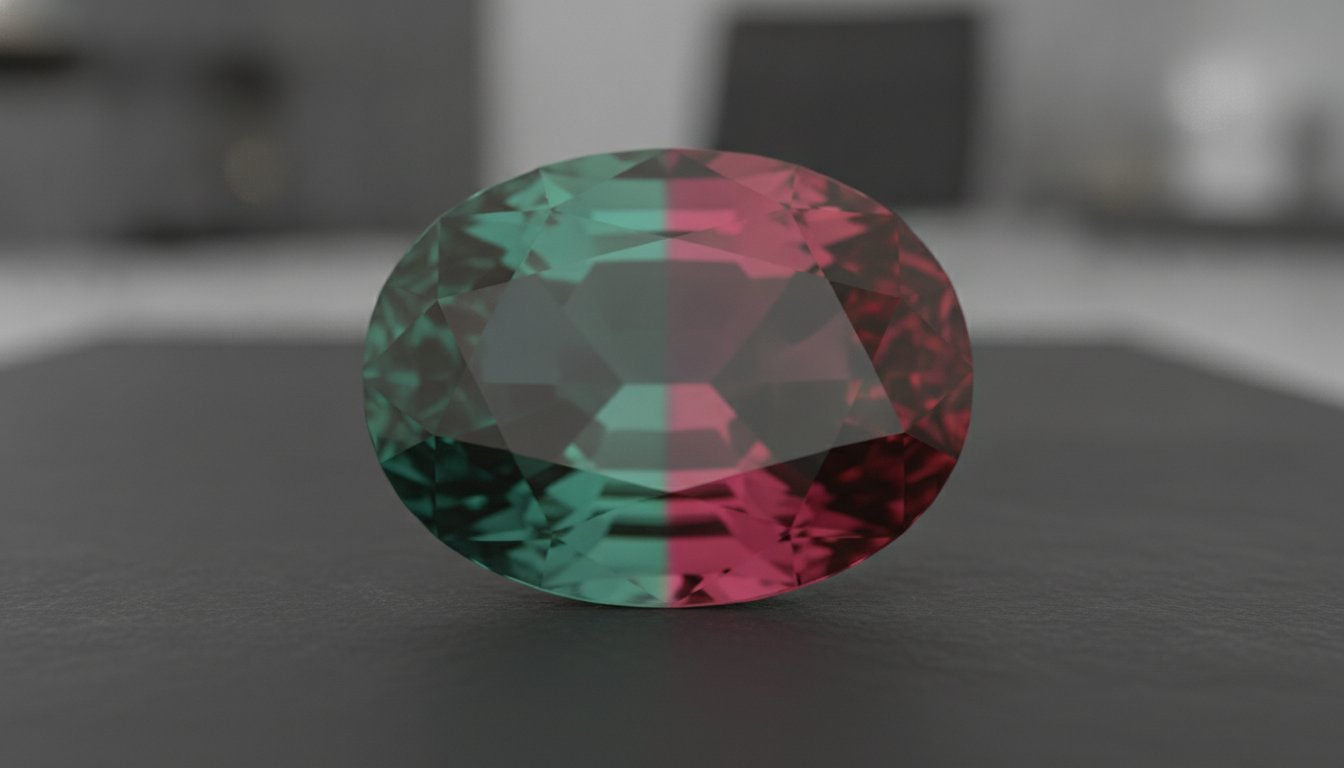
Did you know that gem-quality alexandrite is roughly 8,000 times rarer than white diamonds? This staggering scarcity explains why these "emeralds by day, rubies by night" command such a significant premium in the global luxury market. However, with synthetic alternatives often indistinguishable to the untrained eye, the stakes for serious collectors have never been higher. Learning how to choose a real oval alexandrite gemstone requires more than a casual glance at a digital photo. It demands an insider’s understanding of how light interacts with the stone's unique crystal structure, especially when faceted into an elegant oval.
It's natural to feel a sense of hesitation when you encounter two seemingly similar gems with massive price gaps. You want the security of knowing your acquisition is both authentic and investment-grade. This guide promises to help you master the art of evaluating color change and cut precision so you can acquire your stone with total confidence. We'll explore the technical secrets of the oval shape, explain why a prestigious lab certification is non-negotiable, and show you exactly how to identify a top-tier color shift to ensure your gem remains a world-class asset.
Key Takeaways
- Discover why the oval cut is the premier choice for maximizing alexandrite's natural pleochroism while honoring its unique crystal habit.
- Learn to evaluate the "emerald by day, ruby by night" effect by distinguishing between a partial shift and the coveted 100% color change.
- Identify critical technical flaws like windowing and the bow-tie effect that can diminish the brilliance and value of an otherwise beautiful stone.
- Gain the expert knowledge required for how to choose a real oval alexandrite gemstone by learning to identify natural inclusions that distinguish earth-mined gems from lab-grown counterparts.
- Understand the importance of sourcing from legacy dealers who provide radical transparency and the security of professional gemological validation.
The Oval Advantage: Why This Shape Defines Alexandrite
When you begin exploring how to choose a real oval alexandrite gemstone, you'll quickly notice that the majority of world-class specimens share this specific geometry. This isn't a coincidence or a mere fashion trend. The oval cut serves a vital purpose in preserving the soul of a rare Alexandrite gemstone. Unlike diamonds, where round brilliants dominate the market, alexandrite is almost always faceted into an oval or cushion shape to respect the original dimensions of the raw mineral.
A master cutter's primary goal is to balance visual beauty with weight retention. Because alexandrite is roughly 8,000 times rarer than white diamonds, every point of a carat is precious. The oval shape allows the cutter to follow the natural, elongated crystal habit of chrysoberyl. This ensures that the final gem looks as large and vibrant as possible without sacrificing the stone's inherent value through excessive grinding.
To better understand how these factors influence the appearance of a high-quality gem, watch this helpful video:
Maximizing the Chrysoberyl Crystal
Raw alexandrite crystals usually form in flat, tabular shapes or elongated prisms. If a cutter attempted to force a round shape onto this material, they'd end up grinding away a massive percentage of the gem's weight. For a stone that can cost upwards of $15,000 per carat, such waste is unthinkable. From an Expert Enthusiast's perspective, the oval cut is the ultimate compromise. It offers the brilliance of a round brilliant cut but utilizes the rough material far more efficiently. This efficiency means you often get a more impressive, investment-grade stone for your budget than you would with a rare, smaller round specimen.
Visual Impact and Wearability
Beyond the technicalities of the rough, ovals offer a distinct aesthetic advantage. They provide a larger "face-up" area, meaning an oval alexandrite often looks significantly bigger than a round or square stone of the same carat weight. Understanding these nuances is the first step in learning how to choose a real oval alexandrite gemstone that will hold its value for decades. This shape is also an exceptional choice for custom jewelry for several reasons:
- Finger Elongation: The vertical axis of an oval creates a slimming, elegant effect on the hand, making it a favorite for engagement rings.
- Light Performance: Modern oval brilliant cuts offer a level of fire and scintillation that rivals the best round cuts, maximizing the stone's color change.
- Scarcity and Sourcing: In the natural market, ovals are the standard for quality. In contrast, stones found at non-genuine-gems-html sources, such as lab-created varieties, are available in many calibrated shapes because the rough material isn't as scarce.
When you understand these structural benefits, you'll see why the oval is the definitive shape for this extraordinary "phenomenon" stone. It respects the earth's creation while providing the wearer with the most impactful visual experience possible.
Evaluating the "Phenomenon": The 100% Color Change Rule
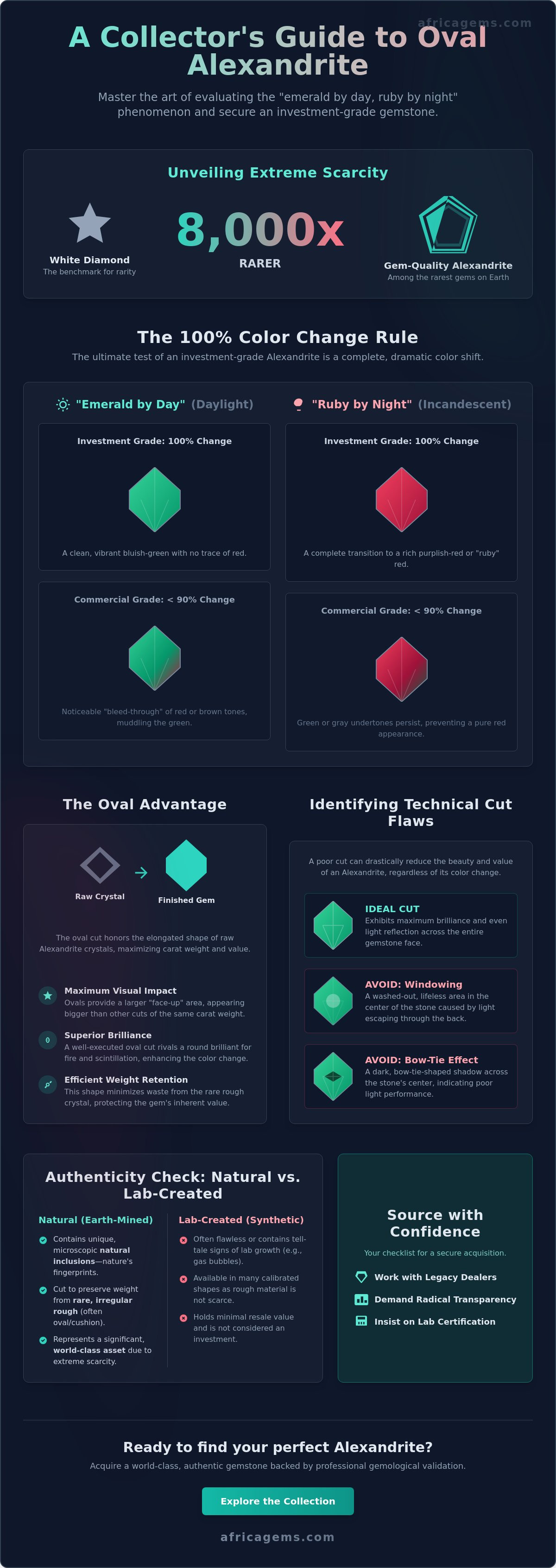
The heart of any alexandrite's value lies in its pleochroism. This optical trick, often described as "emerald by day, ruby by night," is caused by specific traces of chromium within the chrysoberyl crystal lattice. When you are learning how to choose a real oval alexandrite gemstone, you must look beyond a simple binary change. Professional collectors evaluate the percentage of the shift. A stone with a 100% color change means every facet of the gem transitions completely between lighting environments. Specimens showing only an 80% shift often retain "bleed," where you see flashes of green and red simultaneously. While some collectors find this multi-tonal effect charming, investment-grade stones require a clean, decisive transition.
According to GIA's guide to alexandrite, the quality of this change is the single most significant factor in determining market price. A one-carat gem with a 100% color shift is significantly more valuable than a three-carat stone with a weak 50% change. If you are ready to see these shifts in action, you can explore our curated selection of precious gemstones to find a specimen that meets these rigorous standards.
Testing in Daylight vs. Incandescent Light
To accurately judge a stone, you must use the correct light sources. True daylight is measured at approximately 5500K. This is where you should see the teal or bluish-green phase. Incandescent light, such as a traditional warm bulb at 2700K, reveals the purple-red or raspberry phase. Many modern LED lights can trick the eye because they lack the full spectrum of light required to trigger the chromium response. Marc Sarosi always recommends viewing the stone in natural northern light if possible. This provides the most honest representation of the gem's primary color before you introduce artificial warmth to test the shift.
Color Saturation and Tone
The specific hues you see are just as critical as the strength of the change. The most prized natural specimens transition from a vivid bluish-green to a rich raspberry or purplish-red. You should be wary of "brownish" or "grayish" modifiers. These secondary tones drastically reduce a stone's market value. In lower-quality natural specimens, the shift can appear "muddy," resulting in a dull olive green that turns into a brownish-brick red. Mastering how to choose a real oval alexandrite gemstone involves training your eye to seek out high saturation and a medium tone, ensuring the gem remains vibrant in all lighting conditions.
The Technical Evaluation of an Oval Cut Alexandrite
When you are refining your search for how to choose a real oval alexandrite gemstone, the technical precision of the cut becomes just as vital as the color change itself. A masterfully faceted stone doesn't just sit there; it dances. In the world of high-end colored gems, light return is the metric of success. If the cut is poor, even the most dramatic color shift will feel dull and lifeless. Two specific optical issues often plague the oval shape: windowing and the bow-tie effect. You must learn to identify these to ensure your investment retains its value and beauty.
Windowing occurs when the pavilion facets are cut too shallow. This creates a transparent area in the center of the gem where light passes straight through rather than reflecting back to your eye. If you can see your finger or the mounting clearly through the middle of the stone, it's a windowed gem. Conversely, the bow-tie effect is a dark, butterfly-shaped shadow across the center. While a faint bow-tie is often unavoidable in the elongated oval shape, a heavy, blacked-out shadow is a sign of poor execution. You want a stone that shows consistent brilliance across its entire face. You can see examples of well-proportioned stones in our collection of gemstones all available for serious collectors.
The Pleochroism Factor
Alexandrite is a trichroic stone, meaning it can show three different colors across three different optical axes. According to the GIA Gem Encyclopedia, this complex light interaction is what makes the cutting process so difficult. A master cutter must align the oval's table facet perfectly with these axes to showcase the most vivid green and red. A real stone should exhibit subtle shifts in hue even when the light source remains constant, simply by tilting the gem. This "internal movement" of color is a hallmark of a genuine, expertly cut specimen. Understanding these technical nuances is essential when learning how to choose a real oval alexandrite gemstone that maintains its brilliance in every environment.
Proportions and Symmetry
The silhouette of your oval should feel balanced and intentional. Professionals typically look for a length-to-width ratio between 1.33 and 1.50. If the stone is too short, it looks like a "squashed" round; if it's too long, it appears fragile. Symmetry is equally critical. The shoulders and ends of the oval must be perfectly matched without any flat spots or "bulges." Be particularly wary of a "bulgy" pavilion, where extra weight is left on the bottom of the stone to increase the carat weight. While this might look good on a lab report, it ruins the light return and makes the gem difficult to set in a standard mounting. Precision is everything when acquiring a world-class alexandrite.
Authenticity: Spotting Real Alexandrite vs. Lab-Created
Acquiring a world-class gem starts with a reality check on market value. If you encounter a 2-carat oval specimen priced at $500, it isn't natural. In the current market, a one-carat investment-grade alexandrite can command between $15,000 and $35,000. Understanding how to choose a real oval alexandrite gemstone means accepting that rarity has a high floor. Natural stones are geological miracles, while synthetic versions are mass-produced in laboratories. High-quality options like Chatham Lab Created Gemstones offer a beautiful and ethical alternative for jewelry, but they lack the scarcity and investment potential of earth-mined material.
Synthetic stones often reveal their origins under magnification. The Czochralski method, or "pulled" growth, involves drawing a crystal from a molten melt. This process frequently leaves behind curved striae or microscopic bubbles that never occur in nature. In contrast, natural alexandrite contains "fingerprints" of its journey through the earth's crust. You might see fine silk, minute needles, or tiny crystal inclusions of other minerals. These aren't flaws; they're proof of life. A "flawless" natural alexandrite is so exceptionally rare that its absence of inclusions should actually trigger suspicion rather than excitement. If you're looking for verified authenticity, browse our collection of certified precious gemstones today.
Certification Standards
For any serious acquisition, a report from the Gemological Institute of America (GIA) or American Gemological Laboratories (AGL) is non-negotiable. These independent bodies provide the radical transparency required for high-value transactions. A geographic origin report adds another layer of security and value, as stones from the Ural Mountains or specific Brazilian mines carry significant historical weight. To learn more about protecting your purchase, consult The Expert Guide to Buying Gemstones Online. These documents ensure you aren't paying natural prices for a lab-grown stone.
Microscopic Inspection
When inspecting a stone, look for the subtle presence of silk or mineral needles. Most investment-grade alexandrites are eye-clean, but they rarely pass a microscopic test without showing some natural character. This distinction is vital when learning how to choose a real oval alexandrite gemstone that is truly authentic. In the context of rare gems, "eye-clean" means no inclusions are visible to the naked eye, while "microscopically clean" refers to a stone that remains clear even under 10x magnification. A gem that appears too perfect under a loupe usually has a story that began in a lab rather than the earth.
Sourcing and Value: The AfricaGems Philosophy
Choosing a gemstone of this magnitude is as much about the source as it is about the stone itself. At AfricaGems, our approach is rooted in Marc Sarosi’s 40 plus year legacy of sourcing the world’s most exceptional materials. We believe that radical transparency is the only way to conduct high-value online transactions. This is why we provide full disclosure on every specimen, clearly distinguishing between earth-mined treasures and high-quality Chatham Lab Created Gemstones. While lab-grown stones offer a beautiful, ethical alternative for daily wear, they don't share the same investment profile as natural gems, which have seen an annual appreciation of 12% to 15% since 2015.
We understand that learning how to choose a real oval alexandrite gemstone involves significant financial and emotional investment. To provide absolute peace of mind, we offer a no-questions-asked return policy even on our most valuable alexandrite specimens. If the color change doesn't mesmerize you in person, the stone belongs back with us. Once you've secured your perfect gem, our custom jewelry design services are available to transform your loose stone into a bespoke legacy piece that will be cherished for generations.
Origin and Scarcity
The geographic origin of your alexandrite plays a massive role in its market value. Russian stones from the Ural Mountains remain the most prestigious, often commanding a 200% to 250% price premium over gems from other locations due to their historical significance and intense color shifts. However, Brazilian material currently accounts for 85% of the high-end market, offering incredible clarity and saturation that rivals the finest Russian finds. We meticulously vet every supplier to ensure that each stone in our inventory is conflict-free and ethically sourced. For those who wish to dive deeper into the world of high-end collecting, we invite you to read our Rare Gemstones: A Connoisseur’s Guide.
The Security of Your Purchase
Integrity is the pillar of our business. While alexandrite is rarely treated, we provide full disclosure on any enhancements or lack thereof for every stone. We don't use high-pressure sales tactics; instead, we provide the information density you need to make an informed decision. For major acquisitions, Marc Sarosi is available for personal consultations to help you understand the nuances of how to choose a real oval alexandrite gemstone that fits your specific portfolio or jewelry needs. When you're ready to view the pinnacle of what nature can produce, explore our curated collection of Loose Alexandrite Gemstones and find a stone that truly speaks to you.
Secure Your Legacy with a Masterpiece of Light
Acquiring a gemstone of this caliber is a journey that rewards the meticulous collector. You've seen how the oval cut honors the crystal's natural habit and why a decisive 100% color shift remains the hallmark of an investment-grade specimen. By prioritizing technical symmetry and demanding independent lab validation, you protect both the aesthetic brilliance and the future market value of your acquisition. Mastering how to choose a real oval alexandrite gemstone ensures that your collection contains only the finest examples of nature's most celebrated phenomenon.
At AfricaGems, we've spent decades refining this selection process for our clients. Founded in 1984 by Marc Sarosi, our business is built on a foundation of radical transparency and passionate connoisseurship. We provide GIA or AGL certification on all high-value gems to guarantee their natural origin and untreated status. With our 30-day money back guarantee, you can evaluate your stone's color change in the comfort of your own home with absolute security. We invite you to Browse our hand-selected Natural Oval Alexandrite collection today. It's time to begin your legacy with a gem that truly transcends the ordinary.
Frequently Asked Questions
Is natural oval alexandrite more expensive than other shapes?
Natural oval alexandrite is generally more cost effective than round cuts because the shape preserves more of the rare rough material. Round brilliants require significant grinding of the chrysoberyl crystal, leading to higher price premiums for the same weight. Since the oval is the standard for high-end specimens, it offers the best balance of value and visual impact for most collectors without the excessive waste associated with rounder geometries.
What is the best lighting to see the color change in a real alexandrite?
The most effective lighting to observe the full alexandrite phenomenon is a combination of natural northern daylight and a strong incandescent source. You need the blue-rich spectrum of the sun to see the teal-green phase and the red-rich spectrum of a warm filament bulb to reveal the purple-red shift. Mixed lighting environments often confuse the eye, so it's best to test each source individually to judge the stone's true saturation and transition.
Can I trust a "certified" alexandrite from an unknown lab?
You should only rely on reports from top-tier, internationally recognized laboratories like GIA or AGL. Unknown or "in-house" labs often lack the sophisticated equipment needed to distinguish between natural gems and advanced synthetics. For a high-value investment, an unverified certificate is essentially worthless and shouldn't influence your decision on how to choose a real oval alexandrite gemstone. Always insist on a report from a lab with a global reputation for integrity.
Does the oval cut make the alexandrite look bigger than it is?
An oval cut provides a larger "face-up" appearance compared to a round stone of the same carat weight. Because of its elongated dimensions, the oval spreads the weight across a greater surface area, creating the illusion of a more substantial gem. This makes it an excellent choice for those who want a gem with significant presence and finger coverage without the astronomical price jump that comes with moving to a higher carat weight bracket.
How do I distinguish between natural alexandrite and color-change sapphire?
Natural alexandrite is distinguished by its teal-green to raspberry-red shift, whereas color-change sapphires typically transition from blue or violet to reddish-purple. Beyond the visual cues, a professional gemologist will use a refractometer to check the refractive index. Alexandrite sits around 1.74 to 1.75, while sapphire is higher at 1.76 to 1.77. This scientific separation is definitive and ensures you aren't misidentifying a stone based on color alone.
What are the most common inclusions found in real natural alexandrite?
Common inclusions in natural specimens include fine silk, mineral needles, and liquid-filled "fingerprints." These internal markers are critical when you are learning how to choose a real oval alexandrite gemstone because they prove the stone grew in the earth. While investment-grade stones should be eye-clean, these microscopic characteristics are the signatures of authenticity that distinguish them from the sterile, inclusion-free perfection of mass-produced lab-grown alternatives.
Is a 1-carat oval alexandrite considered large for this gemstone?
A 1-carat specimen is considered exceptionally large and rare for a natural alexandrite. While diamonds of this size are common, gem-quality alexandrite rarely survives the cutting process in weights exceeding one carat. Stones of this size that also possess a 100% color change and high clarity are world-class assets. They represent the top 0.01% of global production and are highly sought after by serious collectors and legacy-oriented investors.
Why does my alexandrite look muddy or brown in some lights?
A muddy or brownish appearance is often the result of secondary iron modifiers or improper lighting conditions. If a stone is viewed in "mixed" light, where daylight and incandescent sources overlap, the competing wavelengths can cause the gem to look dull. High-quality specimens should maintain a distinct hue even during the transition, but lower-grade stones with high gray or brown saturation will always struggle to show a vivid, clean shift.