
How to Buy Gemstones Online: The Expert Guide to Secure & Ethical Investing
Apr 1st 2026
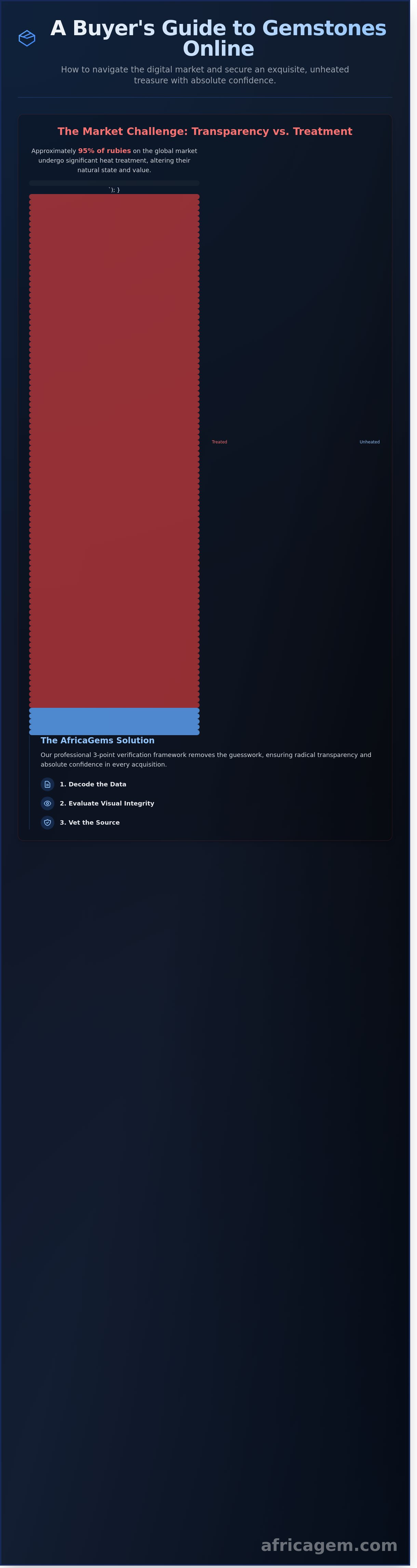
The most expensive mistake you'll make when you buy gemstones online isn't paying too much; it's paying for a synthetic lie that's been polished to look like a legacy. You're right to feel cautious when approximately 95% of rubies on the global market have undergone significant heat treatment. It's difficult to trust a digital image when you're searching for an investment grade sapphire or a loupe-clean emerald. You deserve a stone that possesses the exact pleochroism and saturation promised in the high definition video.
At AfricaGems, we believe radical transparency is the only way to do business. Marc Sarosi has spent over 38 years refining a professional 3-point verification framework that removes the guesswork from your acquisition. You'll learn how to cross-reference conflicting lab reports and verify ethical sourcing with the precision of a seasoned gemologist. This guide breaks down the technical markers of value and authenticity so you can secure an exquisite, unheated treasure with absolute confidence.
Key Takeaways
- Master the hierarchy of prestigious gemological labs like GIA and AGL to ensure every stone is backed by authoritative data rather than mere speculation.
- Learn to decode high-definition 360-degree videos to distinguish between "loupe-clean" and "eye-clean" clarity when evaluating a gemstone's visual integrity.
- Utilize our professional 3-point verification framework to safely buy gemstones online while vetting dealers for ethical sourcing and personal accountability.
- Discover why starting with a loose stone offers superior transparency for inspecting cut quality before commissioning a bespoke, wearable investment.
- Gain an insider’s edge by understanding the "Online Advantage," which provides direct access to global mines and transparent pricing once reserved for elite boutiques.
The Modern Collector's Choice: Why Buy Gemstones Online in 2026?
The jewelry market underwent a permanent transformation during the digital acceleration of the early 2020s. By 2026, serious collectors have moved away from local boutiques to the vast, transparent world of the internet. It's a shift driven by the demand for specific gemological data that local jewelers often can't provide. To appreciate the intrinsic value of a fine mineral, you first need a foundational understanding of what is a gemstone and how its crystal structure impacts its brilliance. When you buy gemstones online, you bypass the limitations of physical inventory and tap into a global supply chain that brings the mine directly to your screen.
Radical transparency is the hallmark of the current market. In 2026, over 95% of high-end digital transactions involve full disclosure of treatments and origin. The AfricaGems Difference relies on this integrity. We act as the Expert Enthusiast, bridging the gap between remote mines and your private collection. This ensures that every exquisite, unheated sapphire or loupe-clean emerald comes with a verified pedigree and a personal guarantee of quality.
Global Access vs. Local Limitations
Online platforms currently offer over 100 times the inventory of a standard brick-and-mortar store. While a local jeweler might stock two or three sapphires, a specialized digital dealer provides hundreds. Rare species like color-change Alexandrite or neon Paraiba Tourmaline are almost impossible to find in physical shops. Digital galleries allow you to compare multiple stones from different origins side-by-side. You can evaluate a Madagascar ruby against a Burmese stone instantly, ensuring the pleochroism and saturation meet your specific standards.
The Economics of Online Gemstone Retail
Buying online eliminates the massive overhead costs of high-rent retail spaces. Traditional jewelry markups often reach 300% to cover these expenses. By contrast, the direct-to-consumer model focuses on true market value. In 2026, pricing is no longer a "negotiable" mystery. It's based on real-time global demand and verified rarity. Transparency is our pillar. We disclose every treatment, ensuring you pay exactly what the stone is worth. It's a more secure way to buy gemstones online because the value is rooted in data, not sales pressure.
Step 1: Decoding the Data – Understanding Lab Reports and Certificates
A gemstone lacking a reputable lab report is merely a "pretty rock" with an unknown, speculative value. When you buy gemstones online, the certificate acts as your eyes and your primary financial protection. It transforms a subjective sales pitch into objective, scientific data. Without this document, you're essentially gambling on the seller's word rather than investing in a verified asset.
The hierarchy of gemological laboratories dictates the stone's liquidity and resale potential. For serious collectors, four names carry the necessary weight:
- GIA (Gemological Institute of America): The global gold standard for diamond grading and highly respected for colored stones.
- AGL (American Gemological Laboratories): Often preferred for colored gems due to their rigorous origin testing and detailed enhancement grading.
- GRS (GemResearch Swisslab): A premier choice for high-end rubies and sapphires, famous for their "Pigeon's Blood" and "Royal Blue" color designations.
- SSEF (Swiss Gemmological Institute): The ultimate authority for the world's most expensive estate jewelry and rare natural pearls.
The golden rule of the digital marketplace is simple: if the certificate isn't viewable on the product page before you checkout, walk away. A transparent dealer provides high-resolution scans of the report so you can verify the certificate number directly on the lab's website. If the data doesn't match the listing 100%, the transaction isn't worth the risk.
Identifying Treatments and Enhancements
The "Comments" section of a report is where the true value is hidden. A sapphire that's certified as "unheated" can command a price 2.5 times higher than a heat-treated stone of identical color and clarity. You must be vigilant for aggressive treatments like "diffusion" or "lead-glass filling." These processes use chemicals or molten glass to artificially improve appearance, rendering the stone nearly worthless for investment purposes. For emeralds, the "No Oil" designation is the pinnacle of quality. While 95% of emeralds are treated with cedar oil to fill surface-reaching fissures, a "No Oil" certificate indicates a rare, structurally superior specimen. Adhering to the American Gem Society's ethical guidelines ensures these treatments are disclosed with total honesty, protecting you from paying "natural" prices for "enhanced" stones.
Origin and Its Impact on Value
In the world of rare minerals, geography is destiny. A "Burma" (Myanmar) ruby or a "Ceylon" (Sri Lanka) sapphire often sells for double the price of stones from other regions. This isn't just snobbery; it's about the unique geological "fingerprints" and historical prestige associated with these mines. The "Muzo" label for Colombian emeralds remains the gold standard, while the "Mozambique" ruby surge that began around 2009 has created a new tier of investment-grade gems. You should always cross-reference the report's origin with the stone's visual characteristics. For instance, Burmese rubies typically show a "silk" inclusion that creates a soft, glowing internal light. Understanding these nuances is part of the AfricaGems experience, where we prioritize technical validation alongside aesthetic beauty to ensure your collection holds its value for decades.
Step 2: Evaluating Visual Integrity – Photos, Videos, and Light Performance
Static photography is no longer sufficient when you choose to buy gemstones online. By 2026, 360-degree HD video has become the mandatory baseline for professional transparency. These high-definition captures allow you to observe a stone's "face-up" appearance and its profile, revealing internal characteristics that a single, staged photo might hide. You'll often encounter the term "eye-clean," which signifies that no inclusions are visible to the naked eye at a distance of 15 centimeters. In contrast, "loupe-clean" indicates a stone is flawless even under 10x magnification. Understanding these distinctions is vital for accurate valuation. For deeper technical insights into specific species and their typical inclusion patterns, the GIA Gem Encyclopedia provides an exhaustive breakdown of how internal features affect different mineral groups.
Watch closely for pleochroism, a phenomenon where a gem displays different colors depending on the viewing angle. High-quality video captures this shifting personality, whereas a photo only shows one "frozen" hue. You should also insist on "hand-shots." Seeing a Tanzanite or Sapphire against a human skin tone provides an immediate sense of scale and true color saturation that a sterile, white background simply cannot replicate. It's the difference between seeing a specimen and seeing a future heirloom.
Digital Color Calibration and Accuracy
Screens often distort reality. An OLED display might over-saturate a Ruby, making it look "pigeon blood" when it's actually a lighter pinkish-red. Professional dealers use neutral gray backgrounds to eliminate color bleed and ensure the camera's white balance is locked. It's a smart practice to view listings on at least two different devices to check for consistency. Always verify if the stone was filmed in 5000K daylight-balanced light. For color-change gems like Alexandrite, reputable sellers must provide a side-by-side comparison showing the shift from natural daylight to incandescent light.
Judging Cut and Brilliance Online
When you buy gemstones online, you must look for "extinction" and "windows." Extinction refers to dark, dead areas where light leaks out the back of the stone. A "window" is a transparent hole in the center of the gem where you can see straight through to the tweezers. A precision-cut stone typically commands a 25% to 40% price premium over native-cut specimens because it maximizes light return. Evaluate the scintillation, the flashes of light that occur as the stone moves. If a video shows a dull, lifeless center, that's a structural cutting flaw that limits the stone's long-term investment value.
Step 3: Vetting the Source – Dealer Credibility and Ethical Sourcing
When you choose to buy gemstones online, you aren't just purchasing a mineral; you're investing in the dealer’s integrity. The "AfricaGems Difference" centers on personal accountability. Marc Sarosi has led this business since 1984, providing a level of continuity that digital-only storefronts cannot match. We maintain a physical headquarters in California and hold long-standing membership in the American Gem Trade Association (AGTA). This affiliation requires adherence to the industry's strictest ethical codes. Every stone we offer is guaranteed conflict-free and sourced through transparent supply chains that respect both the environment and the miners.
Security in high-value trades relies on the fine print. A 100% money-back guarantee isn't a luxury; it's a non-negotiable requirement for any legitimate transaction. If a dealer hides behind "final sale" policies or "store credit only" clauses, walk away. We provide a full 30-day return window because we believe the stone must earn its place in your collection once you see it in person. This timeframe allows you to inspect the pleochroism and luster under your own lighting conditions without pressure.
Transparency and Disclosure Policies
Radical transparency is the hallmark of a professional. A reputable dealer voluntarily discloses every minor treatment, such as traditional cedar oil in emeralds or heat in sapphires. You should always have the option to speak directly with the gemologist who inspected the stone. Avoid listings using stock photos or vague descriptions. If the high-resolution photos don't show the specific inclusions of the actual gem you're buying, the listing is unreliable. We ensure every exquisite detail is visible before you commit.
Securing the Transaction and Shipping
Logistics for rare minerals require specialized handling. We ship via fully insured FedEx or Brinks Global Services to ensure your acquisition arrives safely. For ultra-rare, six-figure acquisitions exceeding $100,000, we utilize third-party escrow services to protect both parties during the transfer. Once your gem arrives, we recommend taking it to an independent gemologist within the first 10 days. This verification step confirms the stone's identity and quality, providing the final layer of security for your investment.
Finalizing Your Purchase: From Loose Stone to Custom Masterpiece
Selecting a loose gemstone is the most transparent method to buy gemstones online. When a stone is already mounted, metal prongs can easily hide "feathers" or internal inclusions, and the setting often obscures the true proportions of the cut. By choosing a loose sapphire or emerald first, you obtain an unfiltered view of the stone's pavilion and girdle. This ensures the 15% premium often paid for a precision-cut gem is actually reflected in its light performance. AfricaGems simplifies this journey, guiding you from the initial acquisition of a loose stone to the creation of a bespoke engagement ring or a legacy collector's piece.
The Custom Jewelry Design Process
Modern technology removes the uncertainty from the bespoke experience. We use CAD (Computer-Aided Design) to generate 3D models, allowing you to visualize your gemstone in its finished setting with 0.01mm precision. This step is essential for rare, uniquely shaped stones that don't fit into mass-produced mountings. Selecting the right metal is equally critical. Platinum, at 95% purity, provides the density required to secure a 3-carat investment stone. 18k Gold offers the necessary durability for daily wear while enhancing the warm tones of a peach sapphire or a fine imperial topaz.
Long-term Value and Portfolio Building
A successful gemstone portfolio depends on rigorous data tracking. Professional collectors who buy gemstones online monitor "Price Per Carat" shifts through industry reports, noting that unheated blue sapphires have maintained a 10% annual growth rate in high-clarity grades since 2022. Protecting your 2026 collection involves more than just physical security. You must maintain a digital vault for your original GIA or AGL lab reports. For physical storage, a UL-rated safe with a TL-15 or TL-30 rating is the industry standard for high-value assets. Buy the best quality you can afford; the rarity will take care of the rest.
Secure Your Legacy with Rare and Ethical Natural Wonders
Investing in an exquisite unheated sapphire or a loupe clean emerald requires more than just an appreciation for color; it demands a rigorous commitment to gemological data. You now have the tools to navigate the 2026 market by prioritizing third party lab reports and demanding high definition video evidence of light performance. By vetting dealers for ethical integrity and requiring full disclosure of treatments, you transform a digital transaction into a secure investment. These steps ensure that every addition to your collection is both breathtaking and technically sound.
Since 1984, AfricaGems has championed these exact principles of radical transparency. Marc Sarosi founded this company to provide collectors with a professional consultation experience backed by global reach. We offer a 100% Money-Back Guarantee and provide full disclosure on all gemstone treatments, ensuring you're never left in the dark. When you decide to buy gemstones online, you shouldn't settle for anything less than absolute certainty. Our legacy of conflict free sourcing means your masterpiece carries a story of integrity from the mine to your hand.
Step into the world of professional connoisseurship today. Browse Our Collection of Certified Natural Gemstones and find a stone that resonates with your unique vision.
Frequently Asked Questions
Is it safe to buy high-value gemstones online?
It's entirely safe to buy gemstones online when you choose a dealer with a 100% transparency policy and a proven track record. AfricaGems has operated since 1984, providing the security of a physical business with the convenience of a digital storefront. Every transaction is backed by a full money-back guarantee; this ensures your investment is protected by 40 years of industry integrity and expert service.
How can I tell if a gemstone is real from a photo?
You can't verify a stone's authenticity through a screen alone; you must rely on high-resolution 4K video and professional lab certification. When you buy gemstones online, look for 10x magnification videos that show the stone's unique inclusions or "fingerprint." These visual tools, combined with a GIA or AGL report, provide the technical validation required for a confident and secure purchase.
Which lab certificate is the most reliable for colored gemstones?
The GIA (Gemological Institute of America) and AGL (American Gemological Laboratories) are the most trusted authorities for colored stones. For high-end rubies and sapphires, a GRS (GemResearch Swisslab) certificate is also highly respected by global collectors. These labs use advanced spectroscopy to ensure every claim about a stone's origin or treatment is 100% accurate and scientifically verified.
What is the return policy for loose gemstones at AfricaGems?
AfricaGems offers a 30-day, no-questions-asked return policy for all loose gemstones in their original condition. If you aren't completely satisfied, return the stone for a 100% refund of the purchase price. We provide this window so you can inspect the gem's pleochroism and brilliance in your own lighting environment. This ensures you're happy with the stone before making a final commitment.
How do I know if a gemstone has been heat-treated?
A professional lab report is the only definitive way to identify heat treatment in a gemstone. While 95% of sapphires and rubies undergo heating to improve color, we disclose every treatment on our product pages. Look for the "Comments" section on a GIA report; it'll specify if a stone is "H" for heated or "N" for natural, meaning no treatments were detected.
Can I have a loose gemstone I buy online set into a custom ring?
You can certainly have your loose stone set into a custom piece through our specialized design service. We work with master goldsmiths who understand how to handle rare, loupe-clean minerals without risking damage. This bespoke approach is part of the AfricaGems Difference. It allows you to transform an investment-grade stone into a wearable heirloom that fits your exact aesthetic preferences.
What does 'unheated' mean and why is it more expensive?
Unheated means the gemstone has received zero thermal enhancement after being mined from the earth. These stones are exceptionally rare, accounting for less than 1% of all gem-quality corundum found globally. Because they possess natural beauty without human intervention, they command a price premium. You'll often see unheated stones priced 50% to 100% higher than their heated counterparts due to this scarcity.
How do you ship expensive gemstones securely?
We ship all high-value orders via fully insured FedEx or UPS Priority Overnight service. Each gemstone is placed in a secure gem jar, then double-boxed to prevent tampering or damage during transit. We require an adult signature for every delivery. This ensures your package never sits unattended on a doorstep. Our 100% insurance coverage protects your investment from the moment it leaves our vault.