
How Gemstone Origin Affects Value: The Connoisseur’s Guide to Provenance and Price
Apr 18th 2026

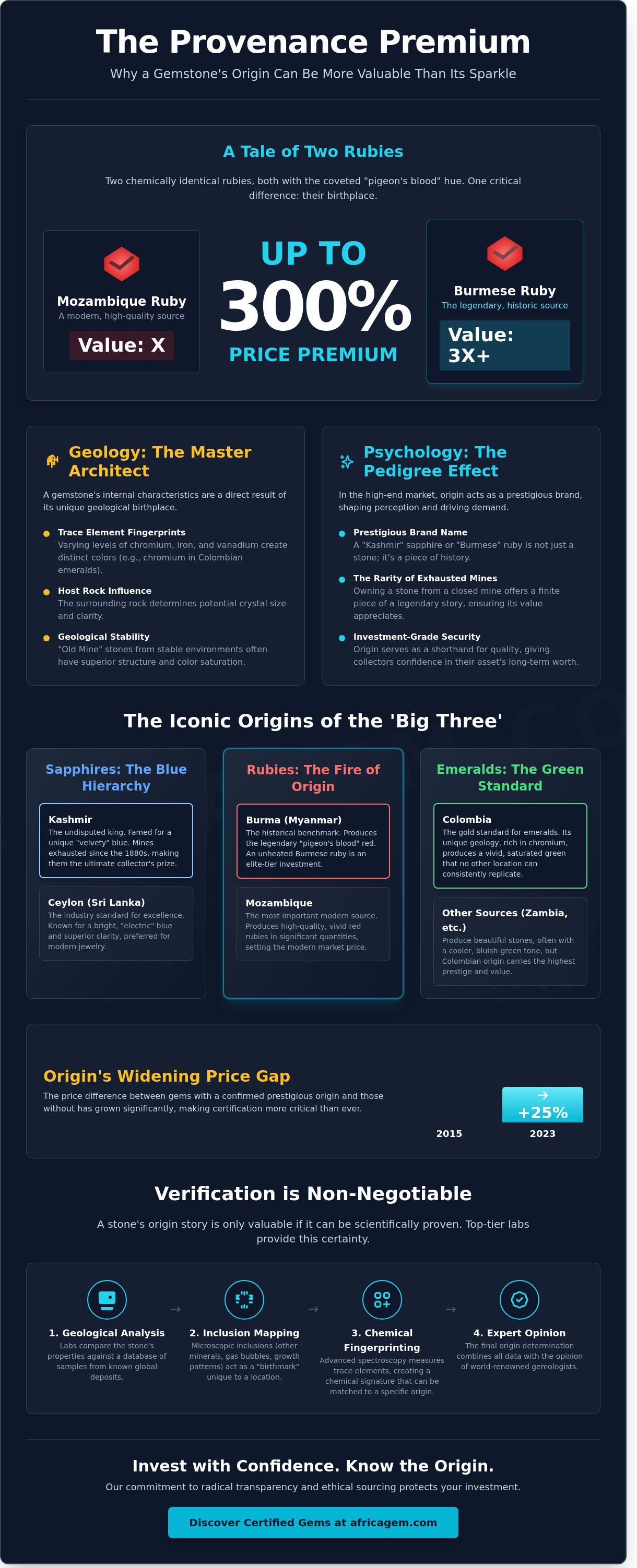
Why would two chemically identical rubies, both displaying the same vivid "pigeon's blood" hue, command price differences of over 300% at a high-end auction? This disparity isn't a fluke of the market; it's the profound reality of provenance in the world of fine gemology. You've likely felt the frustration of staring at conflicting lab reports, wondering if a specific mountain range in Myanmar really justifies a massive premium over a similar find from Mozambique. It's natural to feel a sense of distrust when a location name on a certificate seems to carry more weight than the physical beauty of the stone itself.
Understanding how gemstone origin affects value is the essential step to evolving from a casual buyer into a true connoisseur. We'll demystify the "Science of Place" to show you why certain geological conditions create incomparable internal characteristics and aesthetic prestige. You'll learn to identify which historic origins currently command the highest premiums and how to use rigorous certification from labs like the GIA to verify these claims with absolute certainty. This guide provides the technical validation and security you need to make informed, high-value investment decisions in rare minerals.
Key Takeaways
- Understand why a gemstone's geographic birthplace acts as a prestigious brand name, influencing both psychological appeal and global market demand.
- Learn exactly how gemstone origin affects value for Sapphires, Rubies, and Emeralds, and why "classic" sources command a significant price premium.
- Identify the specific scenarios where provenance outweighs the traditional 4Cs, making origin the primary driver of a stone’s total investment potential.
- Master the nuances of lab certification by distinguishing between scientific data and expert opinions to ensure your collection is backed by verifiable provenance.
- Explore the AfricaGems Difference and how our commitment to radical transparency and ethical sourcing protects your investment in rare minerals.
The Science and Psychology of Gemstone Origin
Provenance isn't just a record; it's the documented history of a stone's geographic discovery. In the elite market, origin functions as a prestigious brand name. A sapphire isn't just a sapphire when it carries the "Kashmir" label. It becomes a piece of history. This "Premium of Place" is visible in every major auction result. For example, a Burmese ruby can command prices three times higher than a similar stone from Madagascar. Understanding how gemstone origin affects value requires looking at both the dirt and the dream. A Gemstone gains its identity and its soul from the specific environment where it formed.
To better understand how geographic location influences the characteristics and desirability of rare minerals, watch this helpful video:
Geology as the Master Architect
Trace elements like iron, chromium, and vanadium vary significantly by geographic location. These microscopic inclusions act as a chemical fingerprint. In Colombian emeralds, the presence of chromium creates a vivid green that's difficult to find elsewhere. The host rocks determine the crystal size and clarity potential. High-pressure metamorphic environments often produce the "Old Mine" stones that collectors crave. These gems possess superior internal structures because they formed slowly over millions of years in stable geological pockets. This geological stability is why stones from 19th-century deposits often show better color saturation than those from newer, more volatile volcanic sites.
The 'Pedigree Effect' in Modern Collecting
Owning a stone from an exhausted mine offers immense psychological comfort. It's a finite piece of a legendary story. For many, origin serves as a shorthand for quality when they don't have a loupe handy. This has led to the rise of investment-grade stones. Between 2015 and 2023, the price gap between origin-certified gems and their counterparts widened by nearly 25%. Rarity is the primary driver here. When a mine closes, the value of its remaining stones typically climbs because no new supply can enter the market. Learning how gemstone origin affects value is essential for anyone looking to build a collection that retains its worth over decades.
This appreciation for origin and rarity is a hallmark of discerning collectors, whether they are acquiring precious gems or regional treasures. For those interested in how heritage and craftsmanship define a piece, you can discover Wildflower and their selection of artist-made sterling silver and authentic turquoise.
The Iconic Origins of the 'Big Three' Precious Stones
The global market defines the "Big Three" by geography as much as it does by chemistry. For a serious collector, understanding how gemstone origin affects value requires looking beyond the surface color to the historical prestige of the soil itself. A laboratory certificate confirming a specific locality often acts as a multiplier for price. In many cases, a stone from a prestigious "legacy" mine can command double the price of an identical gem from a newer source. This disparity reflects the rarity and the unique geological signatures that only specific regions provide.
This appreciation for regional quality and material heritage often extends from rare minerals to the stone and finishes used in fine architecture. For those who value the same level of integrity in their home's surfaces, Richmond Stone offers expert craftsmanship in custom countertops, cabinetry, and tile, drawing on over 30 years of family-owned experience.
The impact of provenance is most visible when assessing the Colored Gemstone Value Factors that professional appraisers use. Beyond color, clarity, and cut, the origin dictates the expected "look" of a stone. It also heavily influences the premium placed on unheated status. In traditional origins like Burma or Kashmir, an unheated stone is the ultimate prize, representing a pure, untouched miracle of nature that has become increasingly difficult to find in the 21st century.
Kashmir and Ceylon: The Blue Sapphire Hierarchy
Kashmir sapphires remain the world's most expensive because they possess a "velvety" blue caused by tiny, light-scattering inclusions. Since the primary deposits were largely exhausted by 1887, these stones are now mostly found in high-end auctions. In contrast, Ceylon (Sri Lanka) sapphires are the gold standard for brightness and clarity. They offer an "electric" blue that many modern collectors prefer for daily wear. While Kashmir sets the price ceiling, Sri Lankan mines provide the consistent quality that defines the high-end market. You can explore these differences in detail through our Blue Sapphires: The Ultimate Collector’s Guide to Quality, Origin, and Value in 2026.
Burma vs. Mozambique: The Ruby Value Shift
The Mogok Valley in Burma is the legendary home of "Pigeon Blood" rubies. This origin is synonymous with a high chromium content that causes the stone to fluoresce, making it glow even in low light. However, the market saw a significant shift after the 2009 discovery of major deposits in Montepuez, Mozambique. Mozambique rubies now challenge the Burma monopoly by offering exceptional transparency and size. While a Mogok stone still carries the highest historical premium, Mozambique has become the premier choice for those seeking vivid red saturation without the "Burma tax." For a deeper dive into these rarities, see our guide on Loose Burma Rubies: The Connoisseur’s Guide to the World’s Rarest Gem.
Colombian Emeralds and the 'Old Mine' Standard
Muzo and Chivor emeralds from Colombia typically command a 30% to 50% premium over Zambian stones. This is largely due to their unique "Old Mine" glow, which comes from a lack of iron in the crystal structure. This geological quirk allows for a more vibrant, pure green. Origin also dictates the "oil" factor; Colombian stones are traditionally treated with cedar oil to fill natural fissures. This is a practice the trade has accepted for centuries. Zambian stones, while often more "eye-clean," frequently have a bluish-green secondary hue that keeps their price point more accessible. Understanding these nuances is essential for any buyer, as explained in our Emerald Gemstone: The Connoisseur’s Guide to the King of Green Gems.
If you are looking to add a piece of history to your collection, you can browse our curated selection of ethically sourced precious gemstones to find the perfect match for your standards.
When Origin Outweighs the 4Cs: The Price of a Name
While the 4Cs provide a vital framework for quality, they don't always capture the full story of a stone's worth. For the serious collector, provenance acts as a massive value multiplier. This is exactly how gemstone origin affects value at the highest tiers of the market. Some stones command a staggering premium because they hail from a legendary, finite location. This "Single Source" phenomenon creates a natural supply cap that protects the long-term integrity of an investment. When a mine's output slows, the value of stones from that specific "brand name" location often rises independently of the broader market.
The geological conditions required to create these treasures are incredibly specific. The rarity of gemstones is fundamentally tied to the unique chemical environments found in only a few spots on the planet. These rare intersections of pressure, temperature, and chemistry don't repeat themselves easily. This geographic exclusivity ensures that a stone from a prestigious locale isn't just a mineral; it's a piece of a specific, non-renewable history.
The Rarity Factor: Why Tanzanite is the Ultimate Origin Gem
Tanzanite represents the pinnacle of geographic exclusivity. It's found in only one place on Earth: a tiny four-square-kilometer strip in the Merelani Hills of Tanzania. This single-source status is a primary reason why how gemstone origin affects value is so visible in this market. Because it exists in only one location, local mining regulations and political shifts in Tanzania directly dictate global availability. At AfricaGems, we emphasize that Tanzanite is a finite resource. Experts often refer to it as a "one-generation gemstone" because current geological surveys suggest the mines could be depleted within 30 years. This looming scarcity protects the investment value for those who secure high-quality stones today.
Alexandrite and Paraiba: Geographic Exclusivity
The market for Alexandrite and Paraiba tourmaline shows the most dramatic price disparities based on provenance. Russian Alexandrite from the Ural Mountains is the "Holy Grail" for connoisseurs. While Brazil and Sri Lanka produce fine specimens, the historical weight and the specific, dramatic color change of the Russian stones make them significantly more valuable. A Russian stone can easily command double or triple the price of a similar stone from another region.
Paraiba tourmaline offers a similar lesson in geography. Brazilian stones, discovered in 1989, possess a legendary "neon" glow due to high copper and manganese content. When similar copper-bearing tourmalines were found in Nigeria in 2001 and Mozambique in 2005, the trade had to distinguish them. Brazilian Paraiba often commands prices 3 to 5 times higher than African stones of similar size. This price disparity exists because the original Brazilian deposit is nearly exhausted. These stones represent the gold standard for collectors who demand the AfricaGems Difference in their portfolios. The copper content varies by continent, and for the purist, the Brazilian neon glow remains the undisputed benchmark of quality.
Navigating Lab Reports and Origin Certification
Determining a gemstone's birthplace is a forensic exercise. Gemologists use inclusion analysis to map internal fingerprints, such as the delicate silk in a Burmese ruby or the distinctive horsetail in a Russian demantoid garnet. They pair this with advanced spectroscopy, specifically Energy Dispersive X-ray Fluorescence (EDXRF) or Laser-Induced Breakdown Spectroscopy (LIBS), to detect trace elements like iron, titanium, or vanadium. These chemical ratios act as a geological signature. However, an origin report is technically an "opinion of origin" rather than an absolute scientific fact. Geology doesn't follow national borders; a stone from one side of a mountain range might share identical traits with a stone from a neighboring country. This uncertainty is how gemstone origin affects value at the highest levels. A difference in opinion between two top-tier labs can swing a final sale price by 30% or more.
The top three global authorities, GIA (Gemological Institute of America), AGL (American Gemological Laboratories), and SSEF (Swiss Gemmological Institute), occasionally provide conflicting reports. One lab might identify a sapphire as "Kashmir" while another labels it "Madagascar" based on overlapping chemical profiles. Because of these discrepancies, double certification is the standard for any stone exceeding $100,000. Having two matching reports from independent, world-class authorities provides the security required for such a significant asset. This rigorous verification ensures the provenance is backed by data, not just tradition.
Reading a GIA or AGL Origin Report
Standard identification reports only confirm the mineral species and variety. To understand provenance, you must request a Premium or Origin report. These documents include a specific "Geographic Origin" field, representing the lab's professional conclusion based on their internal database of reference stones. Authenticity is paramount. Always verify the digital record by using the lab’s online report check tool. A physical certificate can be forged, but the digital database remains the ultimate source of truth for your investment.
The Risks of Origin Speculation in Uncertified Stones
Never accept a dealer’s verbal claim that a stone is "Burmese" or "Colombian" without a reputable report. Deceptive sellers often use look-alike origins, labeling a vivid pink sapphire as Burmese simply because it possesses high saturation. This practice ignores geological reality for the sake of a higher price tag. Connoisseurs prioritize secure & ethical investing by demanding transparency and third-party validation. If a dealer resists independent testing, the origin they're selling is likely a fabrication. At AfricaGems, we believe that understanding how gemstone origin affects value requires total disclosure, ensuring you never pay a premium for a story that can't be proven.
The AfricaGems Approach: Radical Transparency and Ethical Sourcing
Since Marc Sarosi founded AfricaGems in 1984, the company has operated on a foundation of absolute integrity. Marc believes that a buyer's confidence is just as valuable as the stone itself. This is why he insists on full disclosure of every treatment and origin detail for every gem in the inventory. The AfricaGems Difference isn't just a marketing slogan; it's a rigorous vetting process that ensures every mineral is sourced from conflict-free regions. By maintaining direct relationships with mine operators in locations like the Montepuez ruby deposits in Mozambique or the traditional sapphire pits of Sri Lanka, the brand bypasses unnecessary middlemen. This direct line provides collectors with better pricing and precise provenance data, illustrating exactly how gemstone origin affects value in a competitive global market. AfricaGems acts as the vital bridge between cold, scientific lab data and the visceral passion of the high-end collector.
Beyond the Label: Why Visual Quality Still Reigns
Marc often reminds collectors that a pedigree shouldn't blind them to beauty. His philosophy is simple: a breathtaking stone from a secondary origin always outperforms a dull, lifeless stone from a primary one. While a Burmese label adds a premium, a vivid "electric" blue sapphire from Madagascar often offers superior visual performance at a fraction of the cost. Understanding these "Value Origins" allows you to maximize your investment. You can acquire a gem with world-class saturation and clarity by looking toward emerging mines that haven't yet reached the inflated price tiers of historic locations. We help you balance the how gemstone origin affects value equation by prioritizing the actual aesthetic performance of the gem over a mere name on a certificate.
Securing Your Investment: The AfricaGems Guarantee
AfricaGems provides a comprehensive money-back guarantee on every origin claim and lab report accuracy. This level of security stems from 40 years of building trust with mine owners and site holders across the globe. When you purchase a certified gem, you aren't just buying a mineral; you're acquiring a documented piece of geological history. Our commitment to radical transparency means you receive the technical data required for a sound investment alongside the aesthetic beauty you desire.
Secure Your Legacy with Provenance
Mastering the nuances of how gemstone origin affects value transforms a simple purchase into a sophisticated investment. You've seen that while the 4Cs establish a baseline, the geographic pedigree of a stone often dictates its ultimate rarity and market demand. Since Marc Sarosi founded AfricaGems in 1984, we've maintained that a gemstone's story is just as vital as its sparkle. We provide the technical validation and rigorous lab reports necessary to prove a stone's birthright, ensuring you never have to compromise on authenticity. Our approach focuses on radical transparency regarding all treatments and a steadfast commitment to sourcing from conflict-free, ethical mines.
Building a world-class collection requires a partner who values integrity as much as beauty. We don't just sell stones; we provide the professional expertise you need to become an informed insider in the high-stakes world of rare minerals. Every piece in our inventory reflects the AfricaGems difference, combining decades of industry authority with a personal guarantee of quality. You deserve a gemstone that carries both aesthetic brilliance and a clean, verifiable history.
Take the next step in your collecting journey. Browse Our Certified Collection of Rare Origin Gemstones and find a piece that truly resonates with your standards.
Frequently Asked Questions
Does gemstone origin always affect the price?
Origin significantly impacts the market value of the "Big Three" colored stones. For rubies and sapphires, a prestigious provenance can command a premium of 50% to 150% over stones with identical visual characteristics from other locations. This price disparity exists because connoisseurs view specific mines as historical benchmarks for quality. While a stone's beauty is paramount, understanding how gemstone origin affects value is essential for any serious collector or investor.
Which gemstone origin is currently the most expensive in the world?
Kashmir currently holds the title for the most expensive sapphire origin, while the Mogok Valley in Myanmar leads for rubies. Auction data from 2015 showed the Sunrise Ruby from Burma fetching over $30 million, setting a record for a non-diamond gemstone. These locations are rare because their mines are largely exhausted or difficult to access. This scarcity drives prices for top-tier specimens into the hundreds of thousands of dollars per carat.
Can a gemological lab prove a stone's origin with 100% certainty?
No gemological laboratory can guarantee origin with 100% certainty. Origin determination is a professional opinion based on microscopic inclusions and chemical fingerprints like trace elements. Top-tier labs like the GIA or SSEF use advanced spectrometers to compare a stone's data against a reference database of thousands of samples. Even with this technology, a small percentage of stones remain inconclusive because geological conditions in different countries can occasionally overlap.
Is it worth paying a premium for a Kashmir sapphire if a Ceylon sapphire looks identical?
Paying the premium for a Kashmir sapphire is a decision based on investment potential rather than just aesthetics. While a fine Ceylon sapphire offers breathtaking blue hues, the Kashmir stone carries a pedigree that historically retains value better during market fluctuations. Sotheby's sales records indicate that Kashmir sapphires have appreciated at a higher rate than Ceylon stones over the last 30 years. It's about owning a piece of gemological history.
How do I know if a gemstone's origin report is legitimate?
You can verify the legitimacy of an origin report by using the laboratory's online verification tool. Every major lab, including the GIA, AGL, and Gübelin, provides a digital portal where you enter the report number and the stone's weight. This ensures the physical document matches the lab's records. At AfricaGems, we advocate for radical transparency and only provide reports from internationally recognized institutions to ensure your peace of mind and security.
What happens to a gemstone's value if a new, larger deposit is found in a different country?
The discovery of a new deposit usually doesn't decrease the value of established, classic origins. When the Montepuez ruby deposit was discovered in Mozambique in 2009, it provided a steady supply of high-quality stones to the market. However, the price of unheated Burma rubies didn't drop. Instead, the increased market interest in rubies actually pushed the value of the rare Burma stones higher by roughly 20% over the next five years.
Why are Burma rubies more valuable than rubies from other locations?
Burma rubies are prized for their unique pigeon's blood red and a natural fluorescence that makes them glow in daylight. This specific chemical makeup, characterized by high chromium and low iron, isn't found in the same concentrations elsewhere. Historically, the Mogok Valley has been the source of the world's finest rubies for over 800 years. This long history of producing exquisite, loupe-clean specimens has cemented their status as the gold standard.
Do lab-created gemstones have an 'origin' that affects their value?
Lab-created gemstones don't have a geographic origin, and this lack of provenance is a primary reason they don't hold long-term value. While they're chemically identical to natural stones, they're mass-produced in factories rather than being rare products of the earth. Natural stones from specific mines are finite resources. Because lab-grown gems can be manufactured in unlimited quantities, they lack the scarcity that drives the AfricaGems Difference in natural, ethically sourced minerals.