
GIA Certified Sapphire for Sale: The Connoisseur’s Guide to Quality and Value
May 14th 2026
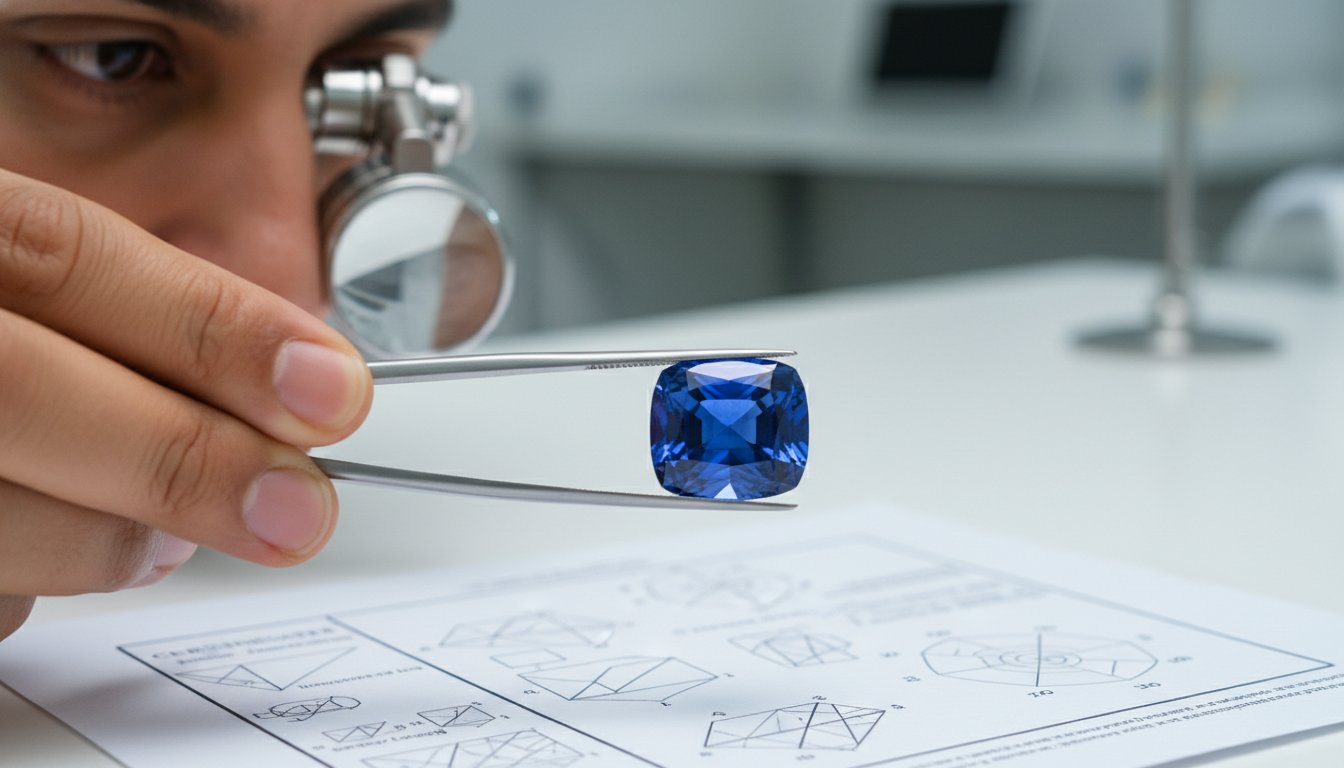
A GIA report isn't just a certificate; it's a technical blueprint that determines a sapphire's legacy and liquidity. Finding a genuine GIA certified sapphire for sale requires looking past the surface shimmer to understand the rigorous data underneath. You likely believe that a gemstone's origin and treatment status should be clear from the start, yet the market often feels clouded by vague claims and non-standardized reports. It's a valid concern, especially when over 95% of sapphires today have undergone heat treatment to enhance their appearance.
I'll show you how to evaluate and acquire investment-grade stones with the radical transparency of a master gemologist. This guide promises to demystify the complexities of the trade, helping you secure a verified, ethically sourced gemstone. We'll examine GIA's new 2026 reporting standards, the reality of origin-based pricing premiums, and the technical markers that distinguish a true collector's piece from a commercial stone.
Key Takeaways
- Learn why GIA’s rigorous analysis is the essential safeguard for verifying corundum quality and protecting against undisclosed treatment methods.
- Master the technical fields of a GIA report, from "Identification" to "Geographic Origin," to ensure a stone’s pedigree justifies its market value.
- Discover the significant value premium of unheated stones and how to find a verified GIA certified sapphire for sale that retains its natural rutile silk inclusions.
- Acquire a secure online purchasing strategy by cross-referencing report numbers with the GIA database and insisting on high-definition visual evidence.
- Understand the benefit of a professional curation process where only the top 10% of gemological specimens meet the standards for an investment-grade collection.
Why GIA Certification is Non-Negotiable for Sapphires in 2026
A GIA certified sapphire is a gemstone that has undergone rigorous technical analysis by the Gemological Institute of America, the world’s foremost non-profit gemological authority. While many buyers are familiar with diamond grading, the scrutiny required for corundum is significantly more complex. Diamonds follow a relatively linear grading scale; however, sapphires possess a chemistry that can be manipulated through high-heat kilns, beryllium diffusion, or glass filling. Without a GIA report, you're essentially taking a leap of faith on the stone's true nature.
When you look for a GIA certified sapphire for sale, you aren't just buying a blue stone; you're purchasing a verified history. GIA implemented redesigned colored stone reports and expanded origin services on January 1, 2026, to provide even greater clarity for collectors. These reports now offer a more robust framework for identifying the subtle differences between a heated stone and a rare, unheated specimen. Finding a high-quality GIA certified sapphire for sale means prioritizing technical truth over retail promises.
To better understand the nuances of sapphire quality and what to avoid, watch this helpful guide:
A GIA report functions as a safeguard for your investment liquidity. In the secondary market, a sapphire without this specific pedigree is often viewed with skepticism, leading to lower resale offers. Because GIA doesn't sell gemstones or assign monetary values, their technical data remains the only impartial standard that dealers and auction houses trust globally. This transparency ensures that the value you pay today is supported by physical evidence that will hold up for decades.
The GIA Advantage: Accuracy Over Marketing
Many regional labs are notorious for "color inflation," where they use romanticized terms far too liberally to help a dealer justify a higher price. GIA maintains a strict, conservative standard. They don't engage in marketing fluff. At AfricaGems, we see thousands of stones every year, yet we reject 90% of the GIA-graded material we encounter. We only list the finest 10% that meet our internal aesthetic criteria alongside GIA’s technical validation. This ensures your stone isn't just "certified," but truly exceptional.
Protecting Against Synthetic and Lab-Grown Confusion
Modern lab-grown sapphires have become so sophisticated that they can easily deceive local jewelers using basic handheld tools. GIA utilizes advanced spectroscopic equipment to analyze Sapphire gemstone properties and identify natural growth structures. They look for microscopic rutile silk and specific trace elements that prove a stone was forged in the earth over millions of years rather than in a laboratory. Our commitment to radical transparency means every stone we offer is natural and ethically vetted, giving you total security in your purchase.
Decoding the GIA Sapphire Report: What Every Buyer Must Check
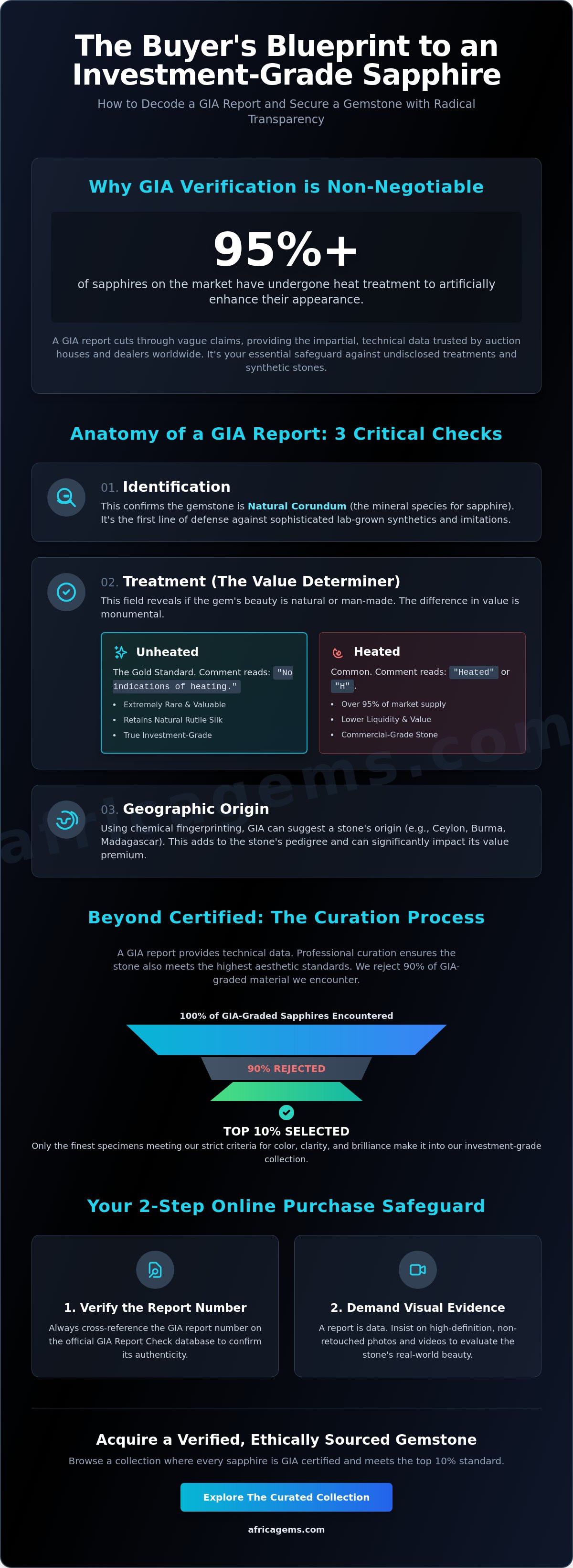
A GIA report is far more than a "pass/fail" certificate. It's a comprehensive technical document that requires careful interpretation to understand a stone's true worth. When you evaluate a GIA certified sapphire for sale, the first critical field to inspect is "Identification." This confirms the specimen is natural corundum. It distinguishes the stone from synthetic counterparts or other blue minerals that might mimic its appearance, providing the essential baseline for authenticity.
Next, look at the "Enhancement" or "Treatment" section. This is the most financially significant line on the report. It explicitly states whether the stone has been heated or subjected to more invasive treatments like lattice diffusion or lead-glass filling. A "No indications of heating" comment is the gold standard for value. It proves the sapphire's color and clarity are entirely the work of nature. This single disclosure can be the difference between a common commercial item and a museum-quality investment.
Origin Determination: Ceylon, Burma, and Beyond
GIA uses advanced chemical fingerprinting and microscopic inclusion analysis to suggest a sapphire's geographic origin. This isn't just trivia; it's a major price driver. A Kashmir or Burma origin on a GIA report can triple the price per carat compared to a stone from a newer deposit. While origin influences market value, we believe ethical sourcing is equally vital. AfricaGems goes beyond the laboratory data to ensure our rare gemstones are sourced through transparent and responsible channels.
The Color Commentary: Hue, Tone, and Saturation
GIA avoids subjective marketing terms like "Cornflower" or "Royal Blue" in their primary grading. Instead, they focus on hue, tone, and saturation. Hue refers to the basic color, while tone describes its lightness or darkness. Saturation measures the intensity. For a deeper understanding of how these factors interact, you can consult GIA's guide to sapphire quality. High-value stones typically exhibit "Vivid" or "Intense" saturation. Secondary hues like violet or green also matter; a slight violet tint can add a desirable "velvety" look, while a green secondary hue often lowers the stone's market appeal.
The GIA Report Check tool is your ultimate defense against fraud. It allows you to cross-reference the stone's weight, dimensions, and technical comments with GIA's secure database. Never finalize a high-value purchase without this digital confirmation. If you're ready to find a stone with a verifiable pedigree, you can browse our curated sapphire collection to see these technical standards in practice.
Unheated vs. Heated: How GIA Verification Impacts Value
Nature rarely produces a gemstone with perfect saturation and clarity without human intervention. This inherent scarcity is why unheated stones command a massive premium in the global market. When you search for a GIA certified sapphire for sale, the "Treatment" line on the report dictates whether you're looking at a beautiful accessory or a rare investment-grade asset. Statistics from 2026 show that roughly 95% of the world's sapphires are heat-treated to dissolve inclusions and intensify color. Consequently, a fine-quality unheated sapphire can cost two to three times more than its heated equivalent.
GIA gemologists identify these treatments by examining the stone's internal inclusions under high-power magnification. Natural, unheated sapphires often contain delicate, needle-like inclusions known as "rutile silk." When a stone is subjected to extreme temperatures in a kiln, these needles melt or become discoid. GIA's scientists use advanced spectroscopy and microscopic analysis to confirm if these structures remain intact. For a deeper dive into these technical benchmarks, refer to GIA's official guide to sapphire quality. This verification is your only objective proof that a stone’s beauty is entirely the work of nature.
While standard heat is a stable and widely accepted enhancement, more invasive methods like "Lattice Diffusion" pose a significant risk to the uninformed buyer. This process forces titanium or beryllium into the stone's surface at high temperatures to create a superficial layer of color. GIA is the industry's most reliable defense against these undisclosed treatments. They possess the sophisticated equipment required to detect trace elements that smaller, regional labs often miss. Acquiring a GIA certified sapphire for sale ensures you aren't paying a premium for a stone that has been chemically altered.
- Unheated: Entirely natural; commands the highest market premium and collector interest.
- Standard Heat: Permanent and stable; improves clarity and color saturation for fine jewelry.
- Lattice Diffusion: Invasive and artificial; color is only surface-deep and must be disclosed.
The Investment Case for Unheated Sapphires
Collectors prioritize "No Heat" stones for long-term wealth preservation. Historically, these gems have shown more resilient price performance because their supply is strictly limited by geology. We focus our selection on blue sapphires that exhibit exceptional natural color, ensuring your acquisition remains a liquid asset. A GIA report confirming "No indications of heating" is the ultimate pedigree for any serious portfolio.
Understanding 'Standard' Heat Treatment
Standard heat treatment isn't a negative factor if the price reflects it. It’s a permanent process that makes high-quality color accessible for daily wear. However, you must distinguish this from Beryllium Diffusion, which can artificially turn a dull stone into a "Padparadscha" lookalike. GIA reports will note the "Degree of Clarity Enhancement," ranging from minor to significant. This transparency allows you to decide if the stone's visual appeal matches its technical reality and your personal budget.
How to Buy a GIA Certified Sapphire Online with Confidence
The digital marketplace offers unprecedented access to rare materials, but it also demands a disciplined approach to verification. When you identify a GIA certified sapphire for sale that meets your aesthetic criteria, your first action must be technical validation. Don't rely solely on the PDF provided by the seller. Instead, take the report number and weight to the official GIA website. This step ensures the digital record matches the physical stone in every detail, from the exact millimeter dimensions to the specific treatment comments.
Visual confirmation is the next pillar of a secure purchase. Studio photography often uses controlled lighting that can mask a stone's true "extinction" or over-saturate its color. Request high-definition video captured in natural daylight. This reveals how the sapphire performs in real-world conditions. Furthermore, compare the millimeter dimensions listed on the report to a physical ruler. It's easy to misjudge scale on a screen; a stone that looks massive in a macro-photo might be more delicate in person.
Finally, a 100% money-back guarantee is non-negotiable. This window should be long enough to allow for independent re-verification if you choose. A seller's willingness to stand behind their inventory with a "no-questions-asked" return policy is the ultimate sign of confidence in their gemological standards. If you're ready to start your search, you can view our current GIA certified sapphire collection to see these transparency standards in action.
Vetting the Seller: Beyond the Certificate
A GIA report confirms what a stone is, but it doesn't tell you who you're buying from. Ethical, long-standing dealers are the backbone of a secure investment. Look for active memberships in trade organizations like the American Gem Trade Association (AGTA) or the International Colored Gemstone Association (ICA). These groups enforce strict codes of ethics and disclosure. Choosing to prioritize buying gemstones online from dedicated specialists rather than generalist marketplaces ensures you have access to expert guidance throughout the life of your jewel.
The Logistics of High-Value Gemstone Shipping
Security shouldn't end at the checkout button. Standard protocols for high-value gems include fully insured, signature-required delivery via carriers like FedEx or specialized armored services. When dealing with international customs for GIA certified stones, professional dealers handle the complex paperwork to ensure your shipment isn't delayed or improperly taxed. At AfricaGems, we provide a seamless shipping experience backed by our legacy of accountability. We offer a transparent return policy that mirrors the natural decision-making process of a serious collector, giving you total peace of mind from vault to front door.
Why AfricaGems is the Premier Source for GIA Certified Sapphires
AfricaGems isn't just a digital storefront; it's a personal consultation with a master gemologist. When you browse a GIA certified sapphire for sale on our site, you're seeing the result of a rigorous filtration process. Marc Sarosi brings over 40 years of industry expertise to every acquisition. While many dealers list any stone with a reputable lab report, we reject 90% of the GIA-certified material we evaluate. We only select the top 10% that exhibit the perfect balance of "life," color saturation, and structural integrity. This curation ensures that every stone in our vault meets the standards of a serious collector.
Our commitment to radical transparency goes beyond the lines of a standard report. We disclose every nuance of a stone's history, including minor clarity enhancements or stability factors that might not be the primary focus of laboratory grading. This level of honesty builds a bridge of trust that's essential for high-value online transactions. You aren't just buying a gemstone; you're gaining a knowledgeable mentor who prioritizes the integrity of the industry over a quick sale. Our goal is to make you an informed insider in the world of rare materials.
From Loose Stone to Bespoke Jewelry
Choosing a loose sapphire is the most strategic way to build a high-value piece. It allows you to inspect the stone's pavilion and girdle without the obstruction of metal prongs or heavy settings. Once you've selected your perfect specimen, our custom jewelry design services can transform it into a bespoke heirloom. We specialize in creating settings that highlight the specific optical properties of your GIA certified sapphire for sale, ensuring the final piece is as unique as the material itself. This collaborative process ensures your vision is executed with technical precision.
A Legacy of Ethical Sourcing
Our inventory is the product of decades-long relationships with artisanal mines in Sri Lanka and East Africa. Marc Sarosi personally vets these sources to ensure every gem is conflict-free and supports the local communities that discover them. This direct-from-the-source approach eliminates unnecessary markups and guarantees the integrity of the supply chain. Discerning collectors choose AfricaGems because they value the security of a personal guarantee backed by a lifetime of professional dedication. We remain the choice for those who demand beauty, rarity, and a clear conscience in every acquisition.
Secure Your Legacy with a Masterpiece of Nature
Acquiring a high-value gemstone requires more than just an eye for beauty; it demands the technical validation that only the world's most rigorous gemological laboratory can provide. By prioritizing the "No Heat" status and origin data found on a GIA report, you're protecting the long-term liquidity of your collection. Remember that a certificate is only as strong as the integrity of the dealer who stands behind it. Verification is the final step in transforming a digital search into a secure, physical asset.
AfricaGems has been a trusted partner for collectors since 1984. Founded by Marc Sarosi, our business is built on the pillars of radical transparency and ethical sourcing. As a proud AGTA member, we guarantee that every gemstone is obtained through responsible channels. We invite you to Browse Our Exclusive Collection of GIA Certified Sapphires and discover the difference that expert curation makes. With our 100% money-back guarantee, you can find your next GIA certified sapphire for sale with absolute confidence. Your journey toward owning a piece of geologic history starts with a single, informed decision.
Frequently Asked Questions
Is a GIA certified sapphire more expensive than an uncertified one?
A GIA certified sapphire for sale typically carries a higher market price because the report removes the risk of undisclosed treatments. While the laboratory fee itself ranges from $100 to $180 for most consumer-sized stones as of 2026, the real value lies in the price premium that a verified unheated or high-origin stone commands. Buyers are willing to pay more for the security of an independent, non-profit technical validation.
Can GIA tell if a sapphire is from Kashmir or Ceylon?
GIA uses advanced spectroscopic analysis to suggest a sapphire's geographic origin by identifying trace elements and inclusion patterns unique to specific regions. Their "Colored Stone Identification & Origin Report" can distinguish between the velvety inclusions of a Kashmir stone and the long rutile needles common in Ceylon specimens. This expert opinion is vital because origin significantly dictates the per-carat price in the global market.
What is the difference between GIA and GRS sapphire reports?
The primary difference lies in their business structure and terminology. GIA is a non-profit institution focused on strict technical data; GRS is a private laboratory famous for using marketing-friendly terms like "Pigeon’s Blood" or "Royal Blue." While both are respected, GIA’s conservative grading is often preferred by investors who want impartial analysis without the influence of commercial trends or color-naming premiums.
Does GIA grade the 'cut' of a sapphire like they do for diamonds?
GIA doesn't provide a standardized cut grade for sapphires like the "Excellent" or "Very Good" ratings seen on diamond reports. Instead, they describe the shape and cutting style, such as "Oval Brilliant" or "Cushion Step Cut." The value of a sapphire's cut is subjective and based on how well it returns color to the eye and minimizes windowing, rather than a fixed mathematical formula.
How do I verify a GIA sapphire report number online?
You can verify any report by entering the unique 10-digit number into the "Report Check" tool on GIA’s official website. This digital portal displays a copy of the original report, allowing you to cross-reference the carat weight, dimensions, and treatment status. It's a critical step to ensure the physical GIA certified sapphire for sale matches the documentation provided by the seller.
What happens if my GIA sapphire doesn't match the report?
If the stone's physical properties don't align with the report, you should immediately exercise your money-back guarantee. Minor weight variations can occur due to scale calibration, but discrepancies in dimensions or treatment status are major red flags. This is why we recommend buying from dealers who offer a "no-questions-asked" return policy, providing enough time for independent re-verification by a qualified gemologist.
Is 'Heat Only' on a GIA report a bad thing for value?
A "Heat Only" disclosure isn't a negative attribute; it simply means the stone has undergone a traditional process to improve its clarity and color. Over 95% of sapphires in the 2026 market are heated. While these stones don't command the extreme rarity premium of unheated gems, they're more affordable and perfectly suitable for high-end jewelry, provided the treatment is fully disclosed and priced correctly.
Why doesn't GIA give a sapphire a 'D' through 'Z' color grade?
GIA doesn't use the D-Z scale for sapphires because that system was designed specifically to measure the absence of color in diamonds. For colored gemstones, GIA uses a more descriptive framework that evaluates the specific hue, the darkness of the tone, and the intensity of the saturation. This allows for a nuanced appreciation of a sapphire's unique personality, which a simple letter grade couldn't capture.