
Emerald: The Connoisseur’s Guide to Nature’s Most Captivating Green Gemstone
Apr 16th 2026
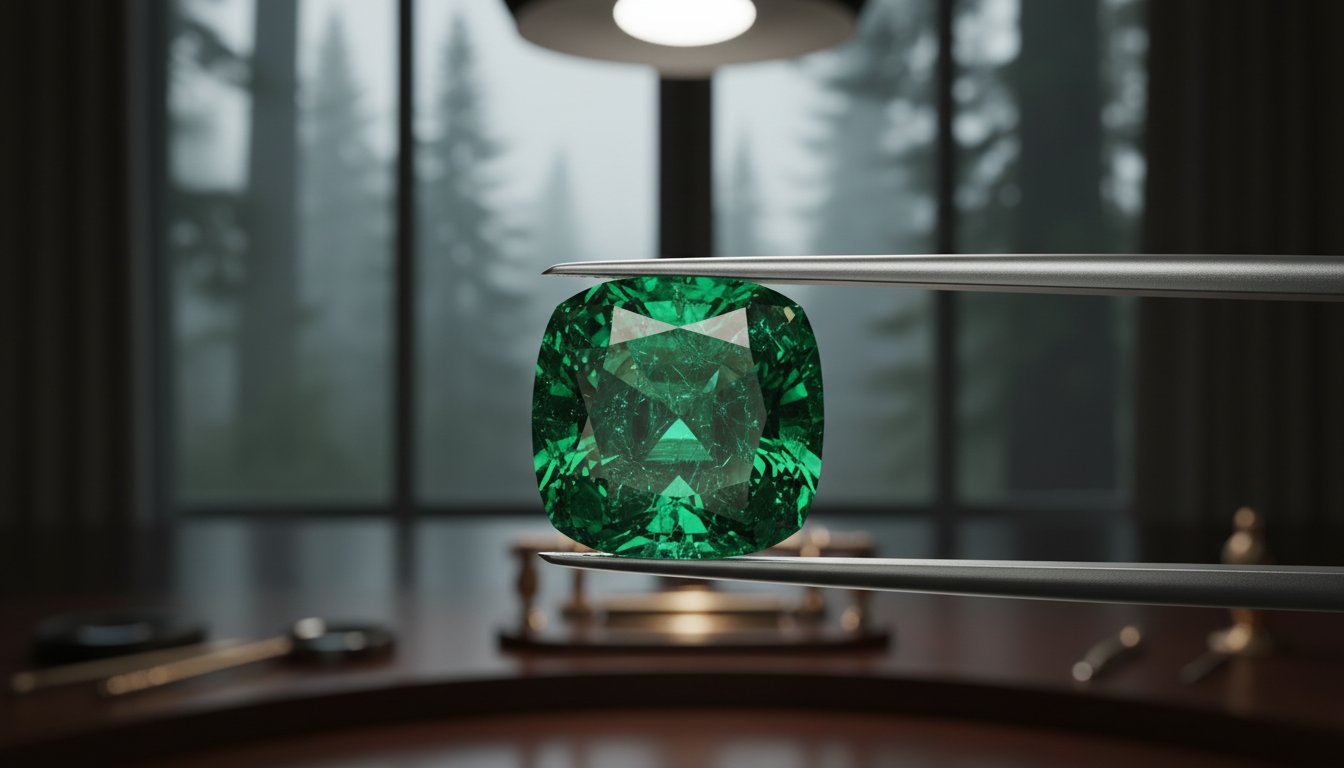
Nature never intended for the emerald to be perfect. While traditional diamond grading obsesses over microscopic clarity, the true connoisseur knows that the "Jardin," or internal garden, is the very soul of this rare beryl. You likely feel the common anxiety that these natural inclusions signal a fragile or inferior stone. It's a valid concern; industry reports indicate that over 99% of all natural specimens undergo clarity enhancement to mask these characteristic birthmarks. You deserve to know exactly what lies beneath the surface of your potential investment.
This guide empowers you to master the nuances of color saturation and the subtle chemical differences that separate a Colombian treasure from a Zambian masterpiece. We'll strip away the mystery surrounding oil treatments and synthetic imitations, replacing doubt with the rigorous gemological data used by elite collectors. From evaluating the "Old Mine" glow to implementing a professional care regimen, you're about to gain the insider knowledge required to curate a collection of breathtaking, ethically sourced green fire with the radical transparency that defines the AfricaGems Difference.
Key Takeaways
- Learn how trace elements like chromium and vanadium create the legendary "green fire" that distinguishes the most precious variety of the beryl family.
- Discover why color reigns supreme and how to adapt the traditional 4Cs to accurately evaluate the market value of a fine emerald.
- Compare the storied prestige of Colombian mines with the rising allure of Zambian origins to find the visual profile that suits your collection.
- Gain the confidence to navigate gemstone treatments by understanding the critical difference between standard industry enhancements and rare, untreated specimens.
- Explore the AfricaGems investment philosophy to see why sourcing loose stones offers a more transparent and secure path to building a high-value portfolio.
The Emerald: Beyond the Green
Collectors prioritize the emerald for its depth of color, often described as a lush, verdant garden. This stone defines the standard against which all other green gems are measured. While other stones might offer brilliance or durability, the emerald provides a unique "jardin" or internal garden of inclusions that tells the story of its formation deep within the Earth's crust.
The Science of Green: Why Emeralds Are Unique
The chemical identity of an emerald is defined by the formula Be3Al2(SiO3)6. While pure beryl is colorless, the presence of trace amounts of chromium, and sometimes vanadium, replaces aluminum in the crystal lattice to create that breathtaking green. This process requires rare geological conditions where beryllium, found in the Earth's crust, meets chromium, which is typically found in the mantle. This rarity distinguishes the emerald from other green stones like tsavorite garnet or peridot. While a tsavorite might show higher dispersion, it lacks the specific pleochroism and rich history of beryl. With a hardness of 7.5 to 8 on the Mohs scale, these stones require expert handling to preserve their integrity during the cutting process.
Emerald Symbolism and Cultural Legacy
For centuries, this stone has acted as a powerful symbol of rebirth, fertility, and foresight. In the 16th century, the Spanish conquest of South America revealed the legendary Muzo mines of Colombia, introducing the world to stones of unparalleled quality. The Muzo legend speaks of two beings, Fura and Tena, whose tears turned into green stones, cementing the gem's connection to the Colombian landscape. As the traditional birthstone for May, it represents the vibrant growth of spring. This cultural legacy, combined with our commitment to full disclosure and ethical sourcing, ensures that every stone isn't just a luxury item, but a piece of history that maintains its value across generations.
Evaluating Quality: The Connoisseur’s 4Cs for Emeralds
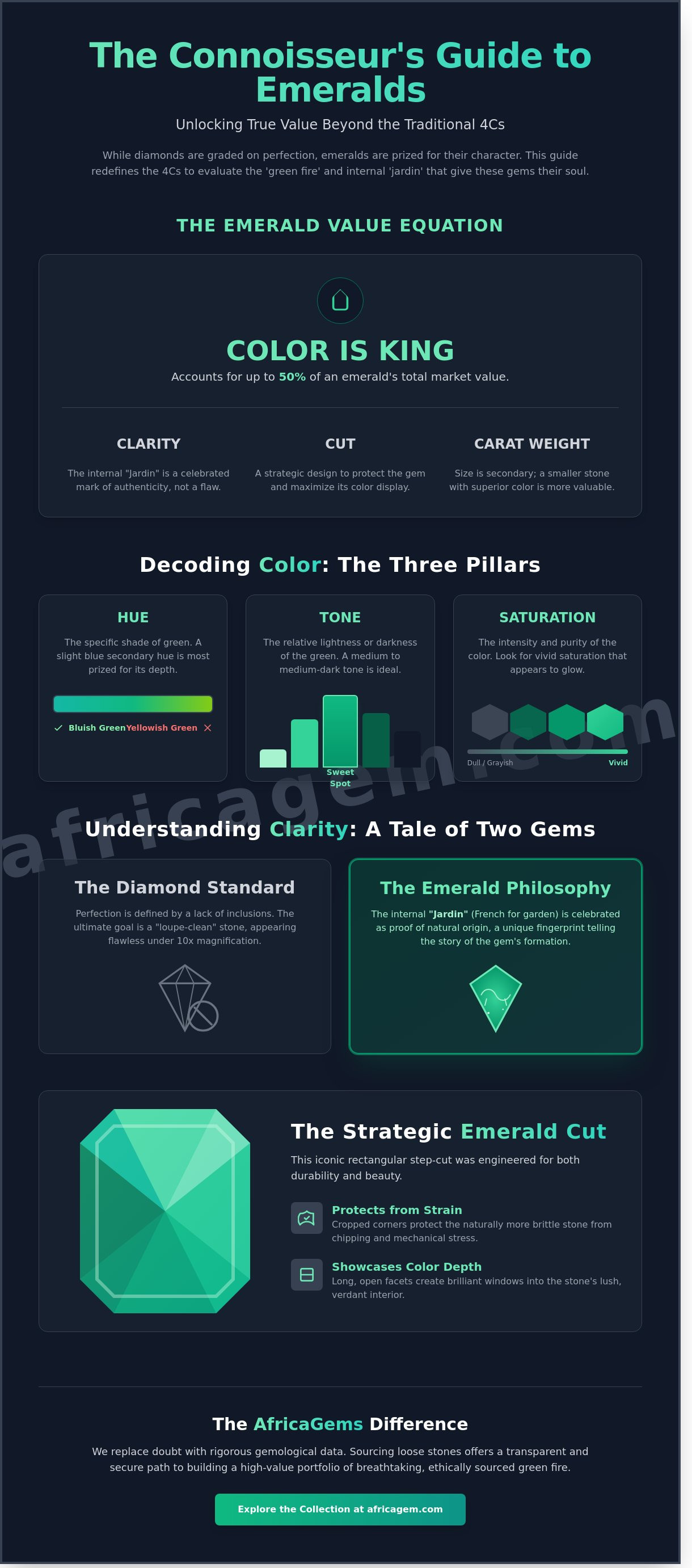
Understanding the emerald requires unlearning the rigid, clinical standards often applied to diamonds. While the 4Cs provide a familiar framework, their application changes when we evaluate colored gemstones. In the diamond world, perfection is defined by the absence of character. With emeralds, character is exactly what we seek. The hierarchy of value shifts dramatically here, placing color at the pinnacle of importance while viewing clarity through a more artistic lens.
The "Emerald Cut" itself serves as a testament to the unique physical properties of this beryl variety. Lapidaries developed this specific rectangular step-cut with cropped corners to protect the stone from mechanical strain. Because emeralds are naturally more brittle than sapphires or diamonds, these architectural facets provide necessary stability. This cut doesn't just protect the gem; it creates long, open windows that showcase the depth of color and the internal life of the stone.
Color: Hue, Tone, and Saturation
Color is the primary driver of value, accounting for up to 50% of a stone's total worth. The most coveted stones exhibit a vivid green that appears to glow from within. Secondary hues are critical; a slight blue secondary hue often adds a desirable "cool" depth, whereas a strong yellow secondary can make the gem look "leafy" or overly warm. Saturation describes the intensity of that green, determining how well the stone holds its color under the dim lights of a restaurant or the bright sun of an outdoor event. The "sweet spot" for tone generally falls between 60% and 70%, providing enough depth to look rich without becoming so dark that the stone appears black.
Clarity and the "Jardin"
In the world of fine beryl, we don't look for "loupe-clean" specimens; we look for "eye-clean" beauty. The internal world of an emerald is known as the "jardin," or garden. These inclusions are expected and often celebrated as proof of natural origin. You'll frequently encounter three-phase inclusions, which are tiny cavities containing a liquid, a gas bubble, and a solid salt crystal. Other common markers include golden pyrite crystals or fine, thread-like silk. When evaluating clarity, look for inclusions that are well-dispersed. You should avoid stones with large fissures that reach the surface or heavy inclusions near the corners, as these can threaten the structural integrity of the gem during the jewelry-setting process.
Carat Weight and Cut Precision
Large, high-quality emeralds are significantly rarer than diamonds of the same size. You'll notice substantial price-per-carat jumps at the 1.00, 3.00, and 5.00-carat marks. A master lapidary's goal is to balance weight retention with visual beauty. They must orient the rough stone to maximize the most pleasing green hue while strategically placing the jardin to minimize its visibility. A precision cut can actually improve the perceived color of a lighter stone or add brilliance to a denser one. To understand how these factors culminate in a truly world-class gem, explore our Emerald Gemstone: The Connoisseur’s Guide to the King of Green Gems.
If you're ready to find a stone that speaks to your personal style, you can browse our curated collection of ethically sourced gems today.
Origin and Rarity: Colombian vs. Zambian Emeralds
The provenance of an emerald dictates its market value and aesthetic character more than almost any other factor. While Colombia remains the traditional benchmark of luxury, the global landscape shifted significantly between 2020 and 2025. Collectors now weigh the historical prestige of South American mines against the remarkable clarity and ethical transparency of African sources. This choice isn't merely about geography; it's about the specific chemical "fingerprint" that defines the stone's personality.
Trace elements act as the primary differentiator between these regions. Colombian stones are typically low in iron, which allows the chromium and vanadium to produce a "warm," pure green that seems to glow from within. In contrast, stones from Zambia contain higher levels of iron. This element introduces a sophisticated bluish-green undertone and increases the stone's structural stability. Because iron acts as a fluorescence quencher, Zambian gems don't possess the same neon-like glow under UV light as Colombian specimens, but they offer a deep, velvety richness that many modern connoisseurs prefer.
The Colombian Standard: Muzo and Chivor
Mines like Muzo and Chivor represent the pinnacle of gemological history. These locations produce stones with a lush, grassy green color that defines the "Old Mine" aesthetic. Because these crystals grew in sedimentary shale, they often contain more inclusions, known as the "jardin." However, the rarity of a clean, high-saturation Colombian stone is so great that it commands the highest price per carat in the industry. By early 2025, top-tier Colombian specimens continued to outperform most other colored gemstones at major auction houses.
The Zambian Revolution
Zambia has transformed the market by offering stones with exceptional transparency. The Kagem mine, the world's largest emerald producer, has pioneered ethical mining standards and consistent grading. For a buyer looking at a 2-carat stone, the price-to-quality ratio is often more favorable in Zambia. You can frequently find a loupe-clean Zambian gem for approximately 40% less than a Colombian stone of similar color intensity. This accessibility has made Zambian material a favorite for high-end jewelry that requires matched sets or high clarity.
- Ethiopian Emergence: The Shakiso region in Ethiopia is gaining traction for the 2026 market, producing stones that closely mimic the low-iron "glow" of Colombian material.
- The Certification Mandate: For any stone exceeding 1.00 carat, an origin report from the GIA or GRSR is vital. These laboratories use chemical analysis to confirm origin, which directly impacts the investment value of your purchase.
At AfricaGems, we believe in radical transparency regarding these origins. Whether you're drawn to the historical allure of a Chivor stone or the crisp brilliance of a Zambian gem, the "AfricaGems Difference" ensures you have the data to make an informed decision. We provide full disclosure on all treatments and origin data, protecting your investment in these breathtaking wonders of nature.
Emerald Treatments and the Ethics of Transparency
The most frequent question we encounter from collectors is whether a stone is "real." It's a valid concern that stems from a desire for authenticity. In the professional trade, the reality is that nearly 99% of all stones undergo some form of clarity enhancement. This doesn't suggest the stone is synthetic. Instead, it reflects the natural growth process of beryl, which almost always contains internal fractures. The critical factor for any buyer isn't the presence of a treatment, but the specific type of treatment used and the honesty of the seller.
Traditionalists and connoisseurs prefer cedar oil. This organic substance has been used for centuries because its refractive index closely matches that of the host crystal. It's a stable, reversible process that respects the integrity of the mineral. Conversely, many modern labs use artificial resins or polymers. While these might offer a temporary boost in clarity, they can yellow or degrade over time, potentially trapped within the stone forever. We maintain a policy of radical transparency. Every stone in our collection comes with a full disclosure of its history, ensuring you feel like an informed insider rather than a casual observer.
Understanding Oiling: Minor, Moderate, and Significant
The GIA grading scale for clarity enhancement focuses on the volume of filler present in surface-reaching fissures. A "Minor" grade indicates that the oil barely impacts the appearance, while "Significant" suggests the filler is doing heavy lifting for the stone's beauty. A No Oil emerald is a breathtaking rarity. Because so few stones emerge from the earth without fissures, these untreated gems command a massive price premium, often valued at 200% to 300% more than treated stones of similar color and size. When you examine a lab report, verify the "Degree of Clarity Enhancement" section to ensure the value aligns with the technical data.
Natural vs. Lab-Created: The Chatham Factor
Lab-grown varieties, such as those produced by Chatham, offer an accessible entry point into high-end aesthetics. These are chemically identical to natural stones but lack the long-term value retention that makes rare minerals a true asset. You can often identify a synthetic emerald under a 10x loupe by looking for "flux-grown" markers, which appear as wispy, veil-like inclusions quite different from the "jardin" or garden-like inclusions found in nature. For those seeking a legacy piece, the natural stone remains the uncompromising choice. To understand how to navigate these technical waters safely, consult our guide on How to Buy Gemstones Online.
View our master-vetted selection and experience the security of our full disclosure policy: Browse our ethically sourced collection today.
Investing in Emeralds: The AfricaGems Difference
Choosing a loose emerald instead of a pre-set piece of jewelry is the most strategic move a collector can make. Pre-set stones often hide structural flaws or color zoning behind gold prongs. By purchasing a loose gem, you inspect every facet and inclusion under a loupe before it ever reaches a jeweler's bench. This transparency ensures that you're paying for the actual quality of the mineral, not the clever craftsmanship of a mounting designed to mask imperfections. It's about seeing the stone's true character without any distractions.
Sourcing with Integrity
The AfricaGems Difference is built on a 40-year legacy of radical transparency. Since 1984, Marc Sarosi has personally curated stones to ensure they meet rigorous standards of beauty and ethics. Being a US-based expert means you aren't dealing with an anonymous middleman across the globe; you're working with a seasoned connoisseur who stands behind every sale. We provide a 100% money-back guarantee and use fully insured, secure shipping to protect your investment from the moment it leaves our vault until it reaches your doorstep. Our commitment to fair trade and conflict-free sourcing isn't a marketing slogan. It's the foundation of our business model and our promise to you.
From Loose Stone to Bespoke Jewelry
Once you find the perfect specimen among our loose emeralds for sale, the next step is protecting that value through thoughtful design. Emeralds rank between 7.5 and 8 on the Mohs scale, which means they require protective settings to prevent chipping. We recommend using bezel settings or sturdy V-prongs to shield the vulnerable corners of an emerald cut. Our custom design services allow you to collaborate with gemologists to create a bespoke heirloom that balances aesthetic elegance with structural integrity. If you're ready to start your journey, contact us for a personal consultation to discuss your specific vision.
- Verify the origin, as 2026 market projections show a 15% increase in demand for ethically mined Zambian stones.
- Insist on a reputable lab report from GIA or GRS to confirm the exact level of clarity enhancement.
- Inspect the girdle for any inclusions that could threaten the stone's stability during the setting process.
- Confirm the seller offers a clear return policy and maintains a physical US address for accountability.
- Choose a setting that prioritizes stone protection, such as a low-profile platinum or 18k gold mounting.
Invest in Nature's Most Captivating Green Masterpiece
Owning a world-class emerald requires more than an eye for color; it demands a partnership with a dealer who prioritizes radical transparency. You've learned how the interplay of trace elements creates that legendary glow and why Colombian or Zambian origins influence market rarity. Evaluating the 4Cs through a connoisseur's lens ensures your selection holds its value for generations. At AfricaGems, we eliminate the guesswork that often clouds high-value online transactions. Founder Marc Sarosi brings 40+ years of professional gemological experience to every stone in our inventory. We provide full disclosure on all gemstone treatments and offer free GIA or AGTA certification on select stones to verify your investment's integrity. This commitment to ethics defines the AfricaGems Difference. You're not just buying a stone; you're gaining an expert mentor to guide your collection. Whether you're a seasoned collector or a first-time buyer, you deserve a gemstone that's as authentic as your passion. Trust in a legacy of excellence to find a piece that truly resonates.
Explore Our Curated Collection of Natural Loose Emeralds
Frequently Asked Questions
How much are emeralds worth per carat in 2026?
Emerald value in 2026 depends on scarcity and the 11% annual growth rate observed in high-end colored stones by recent luxury investment reports. While we don't predict exact future figures, top-tier specimens consistently outperform traditional assets in value retention. You'll find that the AfricaGems Difference ensures your investment is backed by documented provenance and ethical sourcing standards. This transparency helps maintain the stone's resale appeal in a competitive global market.
Are emeralds more expensive than diamonds?
Fine emeralds frequently cost more than colorless diamonds of the same carat weight. A top-quality Colombian stone can reach $30,000 per carat, while a high-grade diamond might average $15,000. This price gap exists because high-quality green beryl is significantly rarer in nature. Collectors value the lush, vivid saturation that only an exquisite emerald provides, making it a premier choice for rare mineral enthusiasts.
What is the best origin for a high-quality emerald?
Colombia remains the premier origin for high-quality stones, specifically the Muzo and Chivor mines. These locations produce gems with a distinct "old mine" glow due to their low iron content. Zambian mines are the second largest producers, often yielding stones with higher clarity and a slightly bluish-green hue. Selecting an emerald from these historically significant regions ensures you're acquiring a piece of geological history with proven market value.
Can I wear an emerald ring every day?
You can wear your ring every day if the setting provides adequate protection for the stone. Since these gems rank 7.5 to 8 on the Mohs scale, they're hard enough to resist scratches but remain brittle because of their internal "jardin." A bezel or halo setting guards the edges against impact. We recommend removing your jewelry during heavy activity to preserve the integrity of the crystal structure over time.
How can I tell if an emerald is natural or lab-grown?
Identifying a natural stone requires examining its internal inclusions under 10x magnification. Natural gems contain a "jardin" of liquid, gas, and mineral crystals that lab-grown alternatives can't perfectly replicate. Synthetic stones often show uniform growth patterns or "flux" inclusions that look like wispy veils. Our commitment to full disclosure means every stone undergoes rigorous testing to confirm its organic origin before it reaches your collection.
What does "minor oil" mean on an emerald certificate?
"Minor oil" indicates that a gemstone has been treated with a small amount of colorless oil to fill surface-reaching fissures. This industry-standard practice improves clarity without changing the stone's fundamental nature. Major labs like the GIA or AGL use this classification to denote the lowest level of enhancement. At AfricaGems, we prioritize stones with minimal treatments to ensure you receive a gem of breathtaking purity and lasting value.
Why do emeralds have so many inclusions?
Emeralds contain many inclusions because they form under extreme tectonic pressure where beryllium meets chromium or vanadium. This violent geological birth creates the "jardin," or garden, that gives each stone its unique fingerprint. Unlike "loupe-clean" diamonds, a natural green beryl is expected to have internal characteristics. These features prove the stone is natural and often help gemologists determine its specific country of origin.
How should I clean and care for my emerald jewelry?
Clean your jewelry using only lukewarm water, mild dish soap, and a very soft brush. You must avoid ultrasonic cleaners and steam machines because the heat and vibrations strip the essential oils from the stone's fissures. This can make the gem look dull or even cause it to crack. After cleaning, dry it gently with a lint-free cloth to maintain its exquisite, radiant luster for decades to come.