
Emerald Gemstone: The Connoisseur’s Guide to the King of Green Gems
Mar 24th 2026
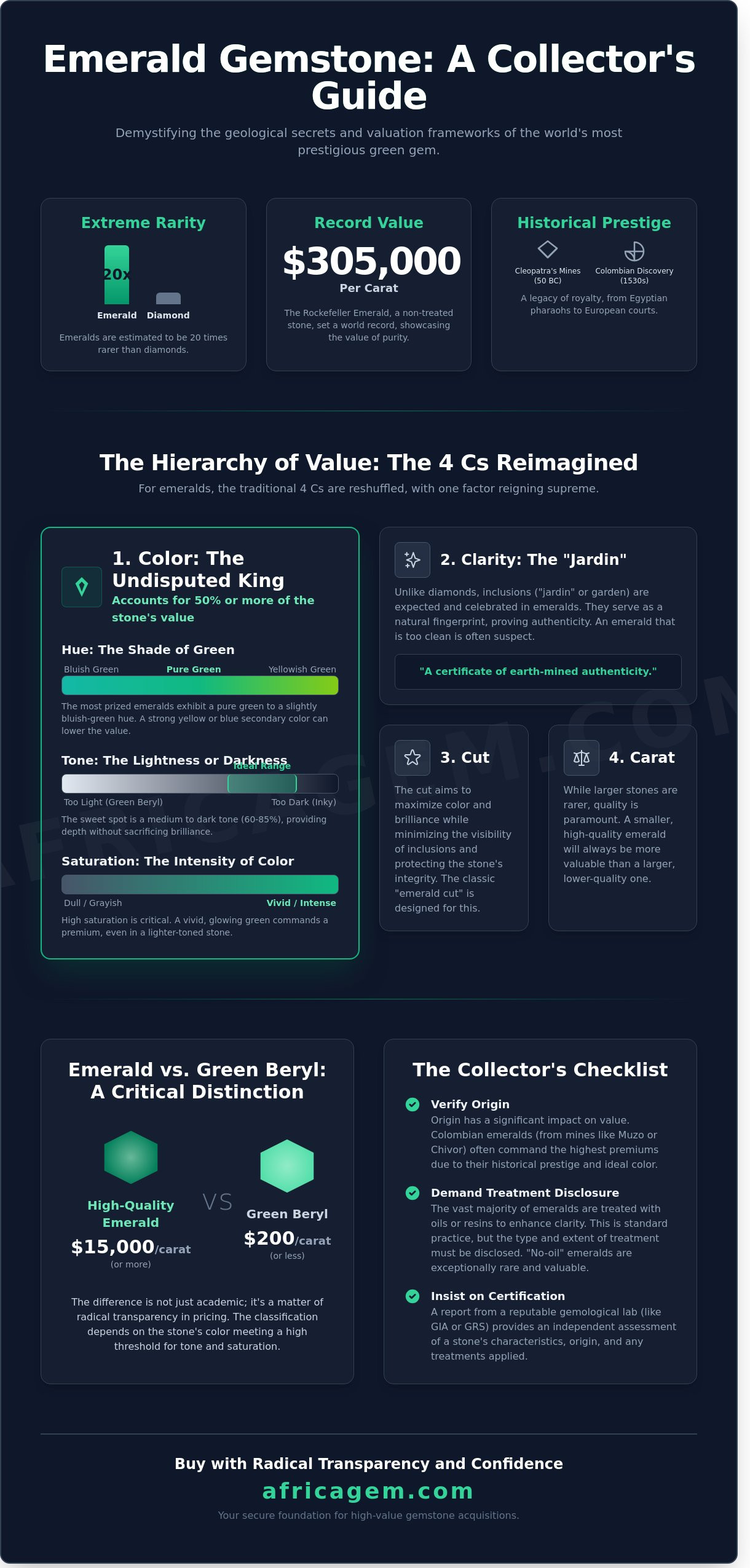
In June 2017, the Rockefeller Emerald commanded a record-breaking $5.5 million at Christie’s, a staggering $305,000 per carat price driven by its lack of clarity-enhancing treatments. You likely recognize that a high-quality emerald gemstone represents the pinnacle of luxury, yet the market often feels intentionally opaque. It's common to feel a sense of hesitation when trying to navigate the 400-year-old tradition of oil treatments or trying to distinguish a natural "Jardin" from a lab-grown imitation. You want the security of knowing that your investment is both physically authentic and ethically sourced.
This guide will transform you into an informed insider by revealing the geological secrets and valuation frameworks used by top-tier collectors. We'll demystify the impact of specific origins like Muzo or Chivor on market premiums and provide a clear methodology for identifying quality by eye. By the end of this article, you'll possess the technical vocabulary and visual confidence to secure a world-class stone with the radical transparency and integrity you deserve.
Key Takeaways
- Discover the geological origins and historical prestige of the emerald gemstone, identifying the rare chemical signatures that define its legendary "green fire."
- Learn to navigate the professional valuation framework, where specific combinations of hue, tone, and saturation dictate true market rarity.
- Gain a connoisseur’s appreciation for the "Jardin," understanding how these natural internal characteristics serve as a vital certificate of earth-mined authenticity.
- Master the collector’s checklist for origin and treatment disclosure to ensure your acquisition meets the highest standards of ethical sourcing and value.
- Understand how the AfricaGems commitment to radical transparency and personal guarantees provides a secure foundation for high-value gemstone acquisitions.
What is an Emerald? Defining the Green Fire
The emerald gemstone stands as the most prestigious member of the beryl family, celebrated for a lush color that no other mineral can replicate. Emerald is a beryllium aluminum silicate with specific trace elements that create its signature hue. While other beryls like aquamarine or morganite rely on iron or manganese for their color, the emerald owes its identity to chromium, vanadium, or a combination of both. These elements must be present in just the right proportions to achieve the intense saturation required for this designation. For those seeking a comprehensive overview of emeralds, the technical data confirms that no other stone matches its specific refractive properties and internal structure.
To understand the "Green Fire" of an emerald, one must look beyond the surface. This term describes the vibrant, almost glowing quality of the stone's color, which often seems to radiate from within. Unlike the cold, glassy green of a peridot or the darker tones of a tsavorite garnet, an emerald's green possesses a velvety depth. This visual phenomenon is frequently enhanced by the "jardin," or garden, of internal inclusions. These natural birthmarks are so common that their absence in a large stone often suggests a synthetic origin. At AfricaGems, we view these inclusions as a fingerprint of authenticity, proof that the earth labored for millions of years to create such a rare specimen.
The historical weight of this stone is staggering. Cleopatra famously laid claim to the mines of Egypt as early as 50 BC, using the gems to signify her divine status and power. Centuries later, the narrative shifted to the New World. Following the Spanish conquest of the 1530s, European royalty was introduced to the superior quality of Colombian emeralds from the Chivor and Muzo mines. These stones were larger and more vivid than anything seen in the Old World, forever changing the standards of luxury in the Spanish and Mughal courts.
The Beryl Family: Emerald vs. Green Beryl
The line between an emerald and a common green beryl is a point of intense debate in the gemological world. Gemological labs like the GIA or GRS use master stones to determine if a gem's color is sufficiently saturated and dark. If the stone's tone is too light, it's classified simply as green beryl. This distinction isn't just academic; it's a matter of radical transparency in pricing. A high-quality emerald gemstone might command $15,000 per carat, whereas a green beryl of the same weight might only fetch $200 per carat. This price gap reflects the extreme rarity of the specific chemical conditions required to produce that deep, iconic green.
A Legacy of Royalty and Mystique
Throughout history, emeralds have symbolized rebirth, fertility, and wisdom. This symbolic power has led to the preservation of legendary stones that continue to captivate collectors. The Chalk Emerald, a 37.8-carat marvel of Colombian origin, and the Hooker Emerald, weighing 75.47 carats, serve as benchmarks for the "Big Three" gemstones. Alongside rubies and sapphires, emeralds represent the pinnacle of the colored stone market. Their enduring status is fueled by their scarcity; experts estimate that emeralds are roughly 20 times rarer than diamonds. This scarcity, combined with their rich cultural heritage, ensures that the AfricaGems Difference is rooted in offering stones that aren't just beautiful, but are significant pieces of natural history.
The Gemmology of Emeralds: Understanding Value Factors
The evaluation of a high-quality emerald gemstone deviates significantly from the rigid standards applied to diamonds. While the 4Cs (color, clarity, cut, and carat weight) still provide a structural framework, their hierarchy is reshuffled to prioritize visual impact. Unlike diamonds, emerald color is 50% or more of the total value. This single factor determines whether a stone is a collector's piece or a commercial grade specimen. While a diamond's value might plummet due to a tiny internal feather, an emerald is often forgiven for its inclusions if the green is sufficiently "vivid."
Color acts as the undisputed king of emerald valuation. Experts break this down into three distinct components: hue, tone, and saturation. Hue refers to the primary green color and any secondary tints. Tone describes how light or dark the stone appears, with the most valuable stones sitting in the 60% to 85% range. Saturation is perhaps the most critical, as it measures the intensity of the green. A stone with a medium-light tone but high saturation will often command a higher price than a dark stone that looks "inky" or "muddy."
The Spectrum of Green: Hue and Saturation
Hue describes the primary green color along with any secondary tints like blue or yellow. Most connoisseurs prefer a slight bluish secondary hue, which adds a cool, lush depth to the stone. Yellowish overtones can make an emerald look "olive," which typically reduces market value. The trade benchmark is the "Muzo Green" standard. This term originated from the legendary mines in Colombia and represents a deep, slightly bluish-green that maintains high saturation without becoming overly dark.
Lighting conditions change an emerald’s appearance more than almost any other gem. A stone that glows with "green fire" under natural daylight might appear dull or overly dark under warm incandescent bulbs. Professionals often view stones against a neutral white background in northern daylight to see the true saturation. Understanding the emerald properties and treatments is essential during this phase; certain enhancements can temporarily boost saturation, so transparency about a stone's history is vital for a secure purchase.
The iconic "Emerald Cut" isn't just a stylistic choice; it's a functional necessity. This rectangular step-cut minimizes the physical pressure on the stone's corners during the setting process. This is vital because the natural inclusions found in most beryl make them more brittle than sapphires. The wide, flat table of an emerald cut also maximizes weight retention from the original rough crystal. It allows the observer to look deep into the stone, highlighting the richness of the green while minimizing the visual impact of internal "gardens" or inclusions.
Carat Weight and Rarity Curves
Size doesn't just add to the price; it multiplies it. The rarity curve for emeralds is much steeper than for almost any other precious mineral. While you can find 1-carat stones with relative ease, the scarcity of large, clean crystals is staggering. Price per carat jumps exponentially at the 2, 5, and 10-carat milestones. If you're looking for a long-term investment, you should browse our curated collection to see how these weight classes affect the overall market availability.
In a 2023 market analysis, top-tier emeralds over 5 carats saw a 25% price premium compared to their smaller counterparts. This is because large beryl crystals rarely form without significant fractures or clouding. Balancing size against quality is the ultimate challenge for a collector. You'll often find that a 2-carat stone with "vivid" saturation and "eye-clean" clarity is a better store of value than a 4-carat stone with a "pale" tone and heavy inclusions. Every millimeter counts when you're dealing with the world's most desired green fire.
Clarity and the "Jardin": Embracing Nature’s Fingerprints
In the world of fine jewelry, clarity often implies the absence of internal features. For the emerald gemstone, the rules of engagement are entirely different. Finding a natural emerald that's "eye-clean" is a statistical anomaly. In roughly 99% of cases, a perfectly clear stone is either a lab-grown synthetic or has been heavily treated with colored resins to mask significant fractures. We view these internal characteristics not as flaws, but as a map of the stone's violent birth deep within the Earth's crust.
The Jardin is the unique internal landscape of an emerald that serves as its geological DNA. This "garden" consists of a complex network of liquid-filled bubbles, tiny crystals of other minerals, and delicate fissures. These features provide a visual guarantee of a stone's natural origin. While a diamond's value plummets with the presence of inclusions, an emerald's personality is defined by them. A stone with a lush, well-distributed Jardin often displays a more velvety color than a stone that's unnaturally clear.
Serious collectors specifically hunt for three-phase inclusions. These are microscopic cavities that contain a liquid, a gas bubble, and a solid crystal, usually halite. This specific combination is the definitive proof of Colombian origin. When you see these three phases under a microscope, you're looking at a snapshot of the chemical soup that existed millions of years ago in the Muzo or Chivor regions. It's a level of provenance that lab reports alone can't replicate.
Common Emerald Inclusions and Their Meaning
When you peer into an emerald, you might notice "silk." These are fine rutile needles that scatter light, giving the gem a soft, glowing appearance. It’s vital to distinguish between "healed" fissures, which are stable veils of fluid, and structural cracks that reach the surface. Surface-reaching cracks are durability risks that can expand over time. As noted in Geoscience Australia's guide to emeralds, these minerals form under intense hydrothermal pressure. Using a 10x triplet loupe allows you to explore this internal world and ensure the inclusions don't threaten the stone's integrity.
Durability and the Mohs Scale
Emeralds possess a respectable hardness of 7.5 to 8 on the Mohs scale. Don't let that number fool you into thinking they're indestructible. They're significantly more brittle than sapphires or rubies due to their internal tension. A sharp blow against a granite countertop can easily chip a corner. This is why we advocate for protective settings. A bezel setting, which wraps the emerald gemstone in a protective rim of gold or platinum, is far superior to a four-prong setting for active wearers.
Your cleaning routine must respect the stone's chemistry. Ultrasonic cleaners are the primary enemy of the emerald. The high-frequency vibrations and heated chemical baths, often reaching 50 degrees Celsius, will vibrate the oil or resin right out of the stone's fissures. This leaves the gem looking cloudy and parched. Stick to lukewarm water, a drop of mild dish soap, and a very soft brush. This simple ritual preserves the stone’s luster and keeps the Jardin looking vibrant for generations.
Origin and Treatments: The Collector’s Checklist
Buying an emerald gemstone requires more than an eye for color; it demands a forensic approach to the stone's history. Three primary locations dominate the global market: Colombia, Zambia, and Ethiopia. Each region leaves a distinct geological fingerprint on the crystal that savvy collectors use to determine value. While color is king, the story of where a stone was birthed and how it was handled after mining determines its ultimate worth.
The Preeminence of Colombian Emeralds
Colombia's Muzo and Chivor mines represent the peak of the market. These stones possess a legendary warmth caused by low iron content and high chromium levels. This creates a pure green hue that glows even in low light. Zambian stones, by contrast, often show cool blue undertones due to higher iron levels. You can explore these differences in depth by viewing our guide on Colombian vs. Zambian Emeralds: A Comparison. Ethiopia joined the elite ranks in 2016 with discoveries in the Shakiso area, offering stones that often rival Colombian color with exceptional clarity.
Emerald Enhancements: The Truth About Oil
Natural emeralds are rarely clean. Over 99% of stones contain surface-reaching fissures. For centuries, the trade has used colorless cedar oil to fill these tiny cracks, improving clarity without altering the stone's fundamental nature. This is an accepted, stable practice. Collectors must distinguish between oil and modern artificial resins. Resins like Opticon provide a temporary fix but can discolor or dry out over five to ten years, potentially damaging the stone. We strictly advocate for traditional oiling or completely untreated specimens.
Transparency is the AfricaGems standard. The level of oiling directly dictates market value. Top-tier labs like the GIA, GRS, and AGL categorize treatments into four specific tiers: None, Minor, Moderate, and Significant. A "No Oil" emerald gemstone is a true geological miracle. Because these stones are found with zero surface-reaching inclusions, they command a price premium of 50% to 100% over stones with minor oil. For a 3-carat investment-grade stone, this can mean a price jump from $15,000 to over $30,000 instantly.
Checklist for the Informed Collector:
- Demand Certification: Insist on an independent lab report from GRS or AGL for any stone exceeding 1.00 carat.
- Verify Origin: Colombian stones typically fetch a 20% to 30% premium over Zambian counterparts of equal quality.
- Reject Heavy Fillers: Avoid stones with "Significant" treatment levels, as they lack long-term durability and resale value.
- Embrace the Jardin: These internal inclusions are the stone's DNA. They prove a stone is natural rather than synthetic.
The quest for the perfect stone is a journey of education and trust. We provide full disclosure on every enhancement level because your confidence is our greatest asset. Ready to find your investment-grade treasure? Browse our collection of certified natural emeralds and experience the AfricaGems difference.
The AfricaGems Difference: Buying Emeralds with Confidence
Marc Sarosi built AfricaGems on a foundation of radical transparency. In an industry where roughly 95% of emeralds undergo some form of clarity enhancement, full disclosure is the only ethical path. We provide a comprehensive breakdown of every treatment, from traditional cedar oil to modern resins. You'll never find hidden enhancements here. Our commitment ensures you understand exactly what you're buying, whether it's an untreated specimen or a stone with minor oil. This honesty has been our hallmark since we began serving collectors in 1984.
Buying an emerald gemstone online requires absolute trust. We eliminate the risk with a 30-day, no-questions-asked return policy. If the stone doesn't meet your expectations in person, you can send it back for a full refund. Beyond the initial purchase, we offer a 100% lifetime trade-up program. You can credit the full original purchase price toward a higher-value stone at any time. This policy provides a clear, secure path for collectors to upgrade their portfolios as their passion for fine gems grows.
Integrity extends to the mines themselves. We source our inventory from conflict-free regions, primarily working with established partners in Zambia and Colombia who adhere to strict labor and environmental standards. By supporting these communities, we help maintain a supply chain that values the human element of mining as much as the mineral itself. Your purchase supports fair wages and safe working conditions for miners in these historic regions, ensuring your heirloom carries a legacy of respect.
A loose stone is often just the beginning of a larger story. Our custom jewelry department specializes in turning rare finds into bespoke heirlooms. We work with master goldsmiths to create settings that protect the emerald's fragile structure while maximizing its light performance. Whether you desire a classic three-stone platinum ring or a modern gold pendant, we handle the transition from loose gem to finished masterpiece with surgical precision and artistic flair.
Expert Curation and Selection
Expert curation is the core of our business. We reject 99% of the stones we encounter, selecting only the top 1% for our inventory based on color saturation and crystal clarity. To bridge the gap between digital and physical, we use high-resolution 4K video and macro photography. These tools reveal the internal jardin of the stone with total clarity. Serious collectors can also request personal consultations with Marc Sarosi to discuss specific gemological nuances before committing to a purchase.
Secure Your Investment
Natural emeralds have shown consistent value appreciation, often increasing by 3% to 8% annually for top-tier specimens. Every emerald gemstone we sell includes a detailed appraisal for insurance purposes. This documentation is vital for protecting your asset against loss or theft. We recommend updated appraisals every three years to reflect current market shifts and ensure your coverage remains adequate. Protecting your investment is as important to us as the initial sale.
Begin Your Journey with the King of Green Gems
Choosing a world-class emerald gemstone is an exercise in both technical precision and artistic appreciation. You now understand how to evaluate the vivid green fire of premium beryl and why the "jardin" inclusions are celebrated as nature's unique fingerprints. Navigating the nuances of origin and treatment is essential for any serious collector who values long-term asset integrity. These factors define the difference between a simple stone and a true heirloom.
AfricaGems has served as a trusted mentor in the gemstone trade since 1984. We leverage over 40 years of gemological expertise to curate a selection that meets the most rigorous standards. Every high-value stone in our vault comes with a GIA or GRS certificate to guarantee its authenticity and quality. Because we eliminate traditional retail markups, you receive direct-to-consumer pricing on some of the world's most exquisite treasures. It's time to apply your knowledge and find a stone that resonates with your personal style.
Browse the AfricaGems Collection of Natural Loose Emeralds and discover the masterpiece your collection deserves.
Frequently Asked Questions
How can I tell if an emerald is real or lab-created?
Distinguishing between natural and lab-grown emeralds requires microscopic examination of internal inclusions. Natural stones usually contain "jardin," which are internal gardens of three-phase inclusions consisting of liquid, gas, and solid crystals. Lab-created stones, such as those made via the Chatham flux process since 1938, often show uniform nail-head inclusions or chevron growth patterns. A 10x loupe is your first tool, but a GIA certificate provides the final word on origin.
Why are emeralds so much more expensive than other green gemstones?
Emeralds command higher prices because they're significantly rarer than alternatives like tsavorite garnet or chrome tourmaline. While a high-quality 2-carat tsavorite might cost $2,000, a comparable emerald gemstone of the same size and saturation can exceed $10,000. Their formation requires specific geological conditions where beryllium meets chromium or vanadium, a rare occurrence in the Earth's crust. This scarcity, combined with 5,000 years of historical prestige, drives the market value.
What does "minor oil" mean on an emerald certificate?
Minor oil indicates that a colorless substance, typically cedarwood oil, has been used to fill surface-reaching fissures in approximately 10% to 15% of the stone's volume. This is a standard industry practice accepted by the GIA and AGTA to improve clarity. It doesn't change the stone's structure but enhances its visual transparency. At AfricaGems, we advocate for full disclosure, ensuring you understand that minor is the preferred grade over moderate or significant oiling levels.
Are Colombian emeralds really the best in the world?
Colombian emeralds are traditionally prized for their pure green hue, but gems from Zambia and Ethiopia now rival them in quality and value. Muzo and Chivor mines in Colombia have set the standard for centuries due to their low iron content. However, Zambian stones often possess superior clarity and a desirable bluish-green tint. In a 2023 market analysis, top-tier Zambian emeralds achieved auction prices within 20% of their Colombian counterparts, proving that origin is secondary to beauty.
Can I wear an emerald engagement ring every day?
You can wear an emerald daily if the setting protects the stone and you follow specific care protocols. Emeralds rank 7.5 to 8 on the Mohs scale, making them softer than diamonds or sapphires. Because 95% of emeralds contain internal inclusions, they're prone to chipping under heavy impact. We recommend a bezel or V-prong setting to shield the corners. Remove your ring before gym sessions or heavy housework to ensure the emerald gemstone remains secure and intact.
What is the most valuable color for an emerald?
The most valuable color is a vibrant, saturated bluish-green that maintains high transparency without appearing too dark. Gemologists look for a specific balance of tone and saturation, ideally around 75% tone. If the stone's too yellow or too pale, it's classified as green beryl rather than emerald. The Old Mine emeralds from Colombia, exhibiting a deep grass green with a slight blue secondary hue, represent the pinnacle of market desirability and price per carat.
How do I clean my emerald jewelry safely at home?
Clean your emeralds using only lukewarm water, a drop of mild dish soap, and a very soft microfiber cloth. Never use ultrasonic cleaners or steam machines, as the vibrations and heat can strip the oils or expand internal fissures. Statistics show that 90% of emerald damage during cleaning happens in ultrasonic tanks. Gently pat the stone dry after rinsing. This simple routine preserves the delicate surface and internal stability of your precious heirloom.
What is a "synthetic" emerald vs. a "simulated" emerald?
A synthetic emerald is chemically and physically identical to a natural stone, while a simulated emerald is merely a look-alike made of glass or plastic. Synthetic stones, often created via hydrothermal growth, possess the same 2.76 specific gravity as mined gems. Simulants, like green yag or cubic zirconia, have no chemical relation to beryl. Always check for a lab report to confirm you aren't paying a premium for a $5 piece of faceted glass masquerading as a gem.