
Colombian Emeralds Value: The 2026 Collector’s Guide to Pricing and Rarity
Jul 30th 2026
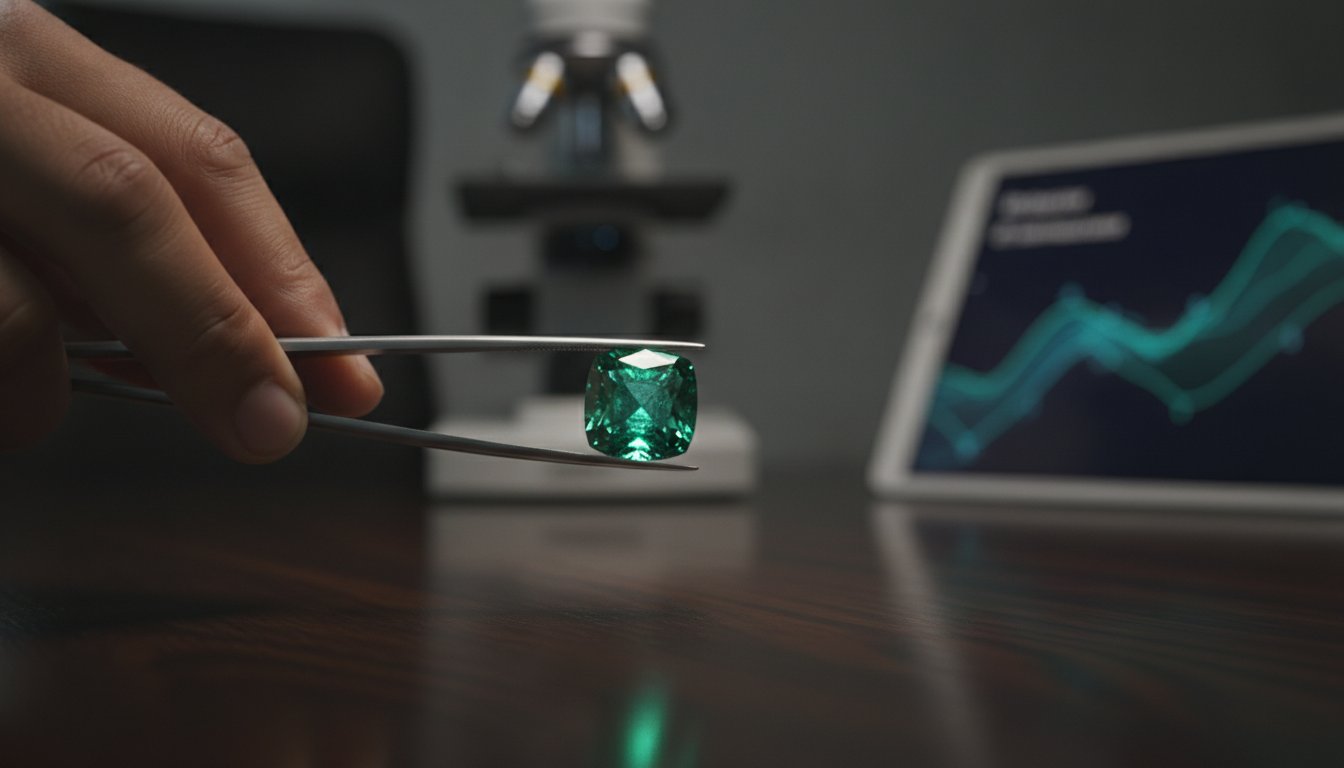
What if the true worth of a gemstone isn't found in its clarity grade, but in a chemical transparency that defies standard laboratory metrics? In early 2026, top-tier emeralds outperformed fine rubies by an average of 14% in annual value appreciation, yet calculating the colombian emeralds value remains a challenge because of the "Internal Fire" unique to these stones. You likely understand that Colombian origin commands a significant 30% to 50% premium over other sources, but the anxiety of overpaying for an over-oiled stone or misinterpreting a complex lab certificate can stall even the most seasoned collector.
I'll guide you through the intricacies of the current market, from the "Muzo Green" gold standard to the 45% premium currently commanded by unenhanced stones. We will break down the 2026 price-per-carat benchmarks and clarify the differences between legendary mine origins like Chivor and Coscuez. By the end of this guide, you'll have the technical knowledge and transparency needed to identify a legacy-quality investment stone with the confidence of a true industry insider.
Key Takeaways
- Understand why the "Colombia Premium" drives a 30% to 50% price markup and how historical prestige shapes modern market demand.
- Learn to identify the "Muzo Green" standard, the definitive benchmark for determining colombian emeralds value among serious collectors in 2026.
- Distinguish between the warm, deep greens of Muzo and the high-transparency, bluish-green profiles of Chivor to better target specific investment goals.
- Evaluate the impact of clarity enhancements by choosing traditional cedar oil over artificial resins to ensure the longevity and integrity of your stone.
- Master the 2026 price-per-carat benchmarks to confidently navigate the market and prioritize a gemstone's internal "glow" over the mere absence of inclusions.
What Defines Colombian Emeralds Value in 2026?
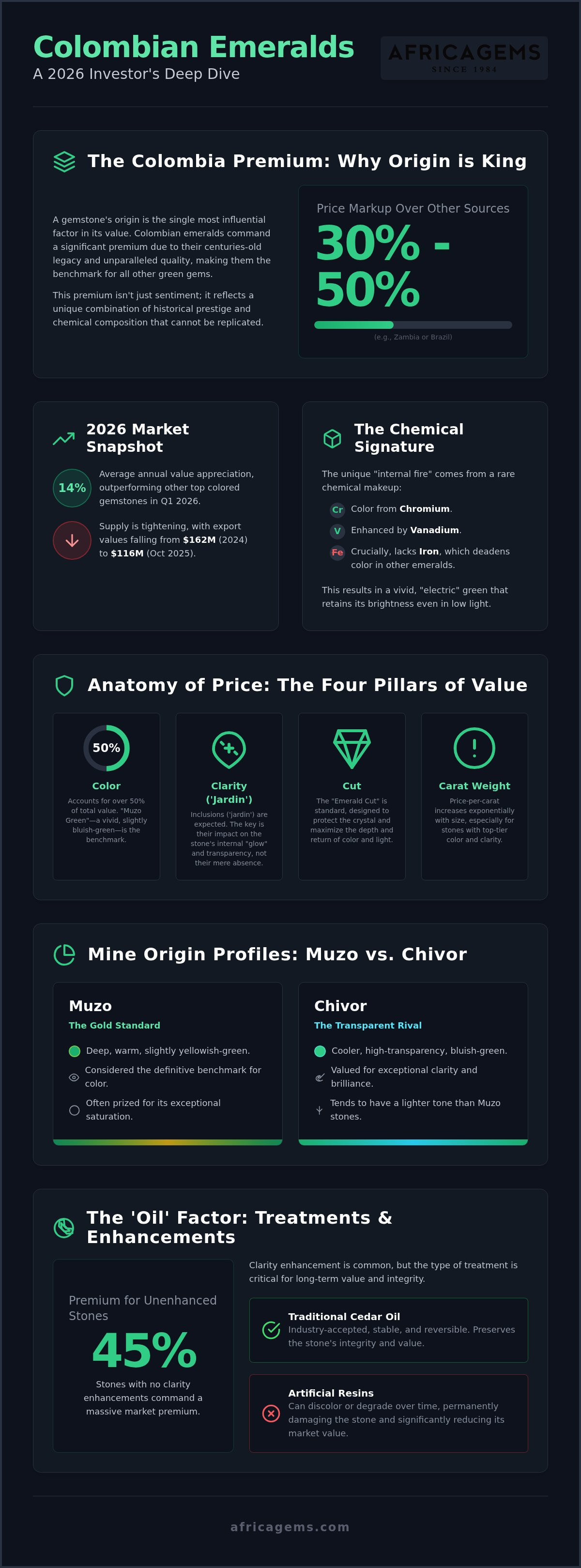
Origin is the single most influential factor in the global gemstone market. When we discuss colombian emeralds value, we are addressing a "Colombia Premium" that typically commands a 30% to 50% markup over stones from Zambia or Brazil. This isn't mere sentiment. It's a valuation rooted in a History of Colombian emeralds that stretches from the Spanish Conquest to the high-jewelry houses of the modern red carpet. For centuries, these stones have been the standard by which all other green gems are measured.
The 2026 market is currently defined by a tightening supply chain and limited production. Mine output has decreased significantly; Colombian export values fell to $116 million by October 2025, a sharp decline from the $162 million recorded in 2024. This scarcity, especially from the legendary Muzo mine, has accelerated prices for top-tier specimens. For an Expert Enthusiast like Marc Sarosi, the preference for Colombian beryl is non-negotiable. It's about the unique "inner glow" that other origins simply cannot replicate. This glow is the primary driver of value for serious collectors.
The Chemical Signature of Colombian Beryl
The secret lies in the trace elements within the crystal lattice. While most emeralds get their color from chromium, Colombian stones often contain a rare combination of chromium and vanadium. Crucially, they lack iron. Iron is a "quencher" that deadens a stone's appearance; without it, Colombian emeralds retain a vivid, "electric" green that remains bright even in low light. In this context, fluorescence refers to the stone's ability to emit visible light when stimulated by ultraviolet rays, creating a radiant effect that makes the gem appear to be lit from within.
Colombian Emeralds as a 2026 Investment
Investment patterns have shifted toward tangible assets with proven provenance. In the first quarter of 2026, top-tier emeralds outperformed other colored gemstones by an average of 14% in annual value appreciation, often exceeding the growth seen in the white diamond market. Collectors are moving toward an "Origin-First" philosophy where the pedigree of the mine is as vital as the carat weight. This shift makes high-quality precious gemstones from Colombia a cornerstone of a diversified portfolio.
As mine output faces challenges from environmental regulations and local conflicts, the colombian emeralds value for investment-grade material continues to climb. US buyers must also account for the 12.5% import tariff implemented in 2026, a factor that is currently rerouting some of the finest production toward European and Asian markets. Wise collectors are looking past the hype of auction houses and seeking transparent sources that offer direct accountability and ethical sourcing.
The Anatomy of Price: Color, Clarity, and the 'Jardin'
While origin sets the floor for pricing, the visual "anatomy" of the stone determines the ultimate ceiling for colombian emeralds value. In the world of high-end collecting, we look for the "Muzo Green" standard. This isn't just any green; it's a vivid, slightly bluish-green that maintains its saturation without turning black in low light. According to USGS Gemstone Data, the economic weight of color in the emerald market is unparalleled, often accounting for more than 50% of the total valuation.
The "Emerald Cut" is the preferred choice for these stones for reasons beyond mere aesthetics. It's a functional design intended to protect the crystal during the cutting process while maximizing the depth of color. A master cutter will align the facets to showcase the stone's "glow," ensuring that light return isn't sacrificed for carat weight. If you're ready to see these nuances firsthand, you can browse our curated selection of loose Colombian emeralds to find a stone that speaks to your personal aesthetic.
Color Grading: Beyond 'Green'
Valuation depends on three pillars: hue, tone, and saturation. Hue refers to the basic color, while tone describes how light or dark the green appears. Saturation is the most critical for investment grade stones, as it dictates the "vividness" of the gem. When a stone becomes over-saturated, the color turns overly dark or blackish, which ultimately kills the stone's brilliance and significantly reduces its market value. Collectors also look for "warmth," a subtle yellow secondary undertone found in Muzo stones, versus the cooler, blue-heavy profiles often seen in Chivor specimens.
Clarity and the 'Garden' Effect
In the world of emeralds, we don't use the term "flaw." Instead, we speak of the "Jardin," or the garden. These internal inclusions are the fingerprint of a natural stone. For Colombian gems, the "smoking gun" of authenticity is the three-phase inclusion: a microscopic cavity containing a liquid, a gas bubble, and a solid crystal of salt. You can learn more about identifying these unique markers in our Emerald Colors and Clarity: What to Look For guide. An inclusion only becomes a flaw when it threatens the structural integrity of the stone; otherwise, it's proof of a natural, untampered origin.
- Vivid Saturation: The primary driver of "Old Mine" quality.
- Three-Phase Inclusions: Essential for verifying Colombian origin.
- Transparency: Even with a heavy Jardin, the stone must remain "crystal" rather than "sleepy."
Mine Origin: Muzo, Chivor, and Coscuez Value Differences
While the "Colombia" label establishes a premium, a stone's specific mine origin serves as its genetic blueprint. For the serious collector, the distinction between a Muzo and a Chivor emerald isn't just academic; it dictates the visual character and the long-term investment trajectory. As we analyze the colombian emeralds value in 2026, we see that provenance has become the primary filter for high-value transactions. This is supported by research from the GIA on Colombian emerald value, which emphasizes how origin, verified by a reputable laboratory, cements a gem's market standing.
The 2026 market is particularly sensitive to these origins due to shifting production levels. With national exports dropping nearly 30% since 2024, the available inventory from legacy sites has become a "finite pool" for investors. Whether you are looking for the deep glow of a Muzo or the crystalline transparency of a Chivor, understanding these geological signatures is essential for building a collection of precious gemstones with lasting merit.
The Legend of the Muzo Mine
Muzo is often called the "King of Mines," and for good reason. It has become a global brand name, synonymous with a deep, warm green that possesses a "velvety" texture. This visual softness is caused by microscopic inclusions that disperse light throughout the stone without killing its transparency. In 2026, Muzo inventory is under pressure. Stricter environmental regulations and a government focus on "strategic minerals" have slowed output, making existing Muzo-certified stones even more desirable. Collectors prize these gems for their classic "Old Mine" appearance, which remains the gold standard for luxury.
Chivor and the Aesthetic of Transparency
If Muzo is about depth and warmth, Chivor is about light and brilliance. Chivor emeralds are famous for their slightly bluish-green hue and exceptional clarity. Because the geological conditions in Chivor often produce fewer internal fractures, these stones frequently appear "cleaner" to the naked eye. The "Chivor Blue" is a specific aesthetic that many modern collectors prefer for bespoke jewelry designs. We are also seeing emerging value in stones from Gachalá, which often share this high-transparency profile but currently enter the market at a slightly more accessible price point than their Chivor counterparts.
Coscuez and the Trapiche Rarity
Coscuez is the powerhouse of saturation. Stones from this mine are known for an intense, almost aggressive green that stands out in any light. It is also the primary source for the "trapiche" emerald, a rare star-patterned gem that is highly sought after by connoisseurs. However, the 2026 supply from Coscuez has been hampered by temporary mining shutdowns and local conflicts. This lack of new production means that high-quality Coscuez specimens are currently commanding a premium in the secondary market, especially those with GRS or GIA certificates confirming their origin.
Treatments and Enhancements: The 'Oil' Factor
Transparency is the bedrock of any high-value transaction, especially when discussing colombian emeralds value. In the current market, approximately 99% of all emeralds have undergone some form of clarity enhancement. Because emeralds are naturally "type III" gemstones, they almost always contain surface-reaching fissures. Filling these fissures with a colorless substance, such as traditional cedar oil, is an industry-accepted practice that improves the stone's visual clarity without altering its fundamental nature. However, the type of filler used is where the investment value is either secured or lost.
Natural cedar oil has a refractive index close to that of beryl, making it the gold standard for enhancements. Unlike artificial resins or polymers, cedar oil is stable and can be professionally cleaned or reapplied if the stone dries out over decades. At AfricaGems, Marc Sarosi maintains a policy of radical transparency. We believe you deserve to know exactly what is inside your stone. If you are seeking a gem with a verified treatment history, you can explore our collection of loose Colombian emeralds, each backed by a personal guarantee of full disclosure.
Decoding the Lab Report
Laboratories like GIA and GRS use a specific scale to quantify oiling: None, Insignificant, Minor, Moderate, and Significant. The "Price Cliff" in 2026 is most visible between "Minor" and "Moderate" enhancements. While a stone with "Minor" oiling retains its prestige, a drop to "Moderate" can result in a substantial reduction in price-per-carat. "No Oil" emeralds remain the "Unicorns" of the industry. These unenhanced gems can command a 45% premium over their treated counterparts because they represent the pinnacle of natural rarity. You should be wary of auction-grade stones that don't specify the filler type; hidden resins can mask structural issues that cedar oil would normally reveal.
The Maintenance of Value
Protecting your investment requires a different approach than caring for diamonds or sapphires. Oiled stones are sensitive to heat and pressure. You should never use ultrasonic cleaners or steam cleaners on a Colombian emerald, as these methods can strip the oil from the fissures or even shatter the stone. For detailed instructions on preserving the "glow" of your investment, visit our guide on loose stone care. Proper maintenance ensures that the oil remains stable, preventing the stone from appearing "parched" or losing its vibrant green luster over time.
- No Oil: The ultimate investment grade with the highest appreciation potential.
- Insignificant/Minor: The professional standard for high-end jewelry.
- Cedar Oil: The only acceptable traditional filler for serious collectors.
- Resins/Polymers: Often used to hide flaws; generally avoided by connoisseurs.
Buying Guide: Navigating the Colombian Emerald Market
Acquiring a high-tier gemstone requires a transition from appreciation to strategic decision-making. To secure the best colombian emeralds value, you must approach the market with a checklist that balances technical data with visual intuition. While previous sections have detailed the "Internal Fire" and mine-specific signatures, the final step is ensuring your purchase aligns with the current 2026 market realities, where supply is tightening and provenance is everything.
Follow these steps to ensure a secure and satisfying investment:
- Step 1: Define your tier. Decide if you are seeking Commercial, Fine, Premium, or Investment Grade material.
- Step 2: Prioritize "Glow" over absolute clarity. A stone with a visible Jardin that possesses a vivid, electric green will always hold more value than a cleaner stone with a "sleepy" or pale appearance.
- Step 3: Insist on a report from a top-tier laboratory. In 2026, GIA, GRS, or Gubelin certificates are the only way to verify origin and treatment levels with total certainty.
- Step 4: Evaluate the seller's transparency. A reputable dealer will provide high-resolution videos and a clear return policy.
- Step 5: Consider the setting early. Because emeralds are more delicate than sapphires, your mounting should offer protection, such as a bezel or protective prongs, to safeguard your asset.
Carat Weight Benchmarks for 2026
Pricing in the emerald world is non-linear. You'll notice exponential price jumps as you cross the 1ct, 3ct, and 5ct thresholds. For the savvy collector, a 0.95ct stone often represents a significant "value play." It offers the visual impact of a full carat but avoids the psychological price premium attached to the whole-number mark. Currently, stones with verified "Muzo" origin are commanding the highest per-carat rates in the 2026 market, largely due to the production scarcity and export challenges noted earlier in this guide.
The AfricaGems Advantage
Since 1984, AfricaGems has operated on a foundation of radical transparency and personal accountability. Marc Sarosi personally hand-selects every stone, looking for the specific "Life" and brilliance that standard lab reports cannot fully capture. We don't just sell loose stones; we provide the expert mentorship needed to turn them into legacy pieces. Once you've selected your emerald, you can explore our setting options to begin the custom design process. This ensures your investment is not only beautiful but structurally secure for generations to come.
Securing Your Legacy in Green
The landscape of 2026 has redefined what we consider a secure investment. With Colombian exports tightening and the "No Oil" premium reaching new heights, the colombian emeralds value is increasingly tied to radical transparency and verified origin. You now understand that the legendary "Muzo Green" and a stone's internal "Jardin" are not just aesthetic markers but the very fingerprints of a natural masterpiece. You're no longer just a buyer; you're an informed insider ready to distinguish between a commercial stone and a true legacy asset.
Navigating this complex market requires a partner who values integrity as much as you do. Since 1984, AfricaGems has prioritized the collector's peace of mind through a Full Disclosure Treatment Policy and a 30-Day No-Questions-Asked Return guarantee. You don't have to navigate these technical nuances alone. You have direct access to Marc Sarosi’s expertise to ensure your selection is both a visual triumph and a sound financial decision. Explore the Marc Sarosi Collection of Certified Loose Colombian Emeralds today and discover a gem that truly captures the electric spirit of the Andes. The perfect stone is waiting to become part of your story.
Frequently Asked Questions
How much is a 1-carat Colombian emerald worth in 2026?
The price of a 1-carat stone depends heavily on its quality grade. In the current 2026 market, commercial grade stones range from $100 to $1,000 per carat, while fine quality specimens fetch between $1,000 and $8,000. Premium and investment grade stones can command anywhere from $5,000 to over $20,000 per carat. These values reflect the recent 12% to 25% price increase seen across the industry since 2024.
Why are Colombian emeralds more expensive than Zambian emeralds?
Colombian stones command a 30% to 50% origin premium due to their unique chemical composition. Unlike Zambian emeralds, which often contain iron that can deaden the stone's appearance, Colombian beryl is colored by chromium and vanadium with almost no iron. This results in a superior "inner glow" and a more vivid, electric green. This geological rarity has sustained the colombian emeralds value for centuries.
What does 'Muzo Green' actually mean on a certificate?
Muzo Green is an industry trade term used by labs like GRS to describe the most desirable color profile. It refers to a vivid, highly saturated green with a slight bluish secondary hue. While it originated from the Muzo mine, it now serves as a color standard. A stone with this designation on its certificate represents the pinnacle of saturation and tone, making it highly sought after by collectors.
Is it safe to buy loose Colombian emeralds online?
Buying online is safe if you prioritize sellers who offer radical transparency and full disclosure. Look for dealers who provide high-resolution videos, third-party lab reports from GIA or GRS, and a robust return policy. At AfricaGems, we've provided personal guarantees and expert consultations since 1984. This professional accountability ensures you feel like an informed insider rather than just another transaction in an opaque market.
How can I tell if a Colombian emerald is natural or synthetic?
Natural Colombian emeralds almost always contain a "Jardin," or internal garden of inclusions. The definitive "smoking gun" is the three-phase inclusion, which consists of a microscopic cavity containing liquid, a gas bubble, and a solid salt crystal. Lab-created stones often appear "too clean" or display uniform chevron growth patterns. A professional lab certificate is the only way to verify these microscopic markers with absolute certainty.
Does the amount of oil in an emerald decrease its value over time?
The level of oiling (Minor vs. Moderate) significantly impacts the initial colombian emeralds value, but the oil itself doesn't decrease value over time if properly maintained. Value is only threatened if traditional cedar oil dries out or if unstable artificial resins were used. Periodic professional cleaning and re-oiling can restore a stone's luster. However, "No Oil" stones will always appreciate faster due to their extreme natural rarity.
What is a 'trapiche' emerald and why is it so valuable?
A trapiche emerald is a rare variety featuring a six-spoked star pattern caused by carbon impurities during the crystal's growth. These are found almost exclusively in Colombia's Muzo and Coscuez districts. Their value stems from their geometric perfection and extreme rarity; they aren't faceted like traditional gems but are usually cut into cabochons to showcase their unique spokes. They are highly prized by connoisseurs seeking one-of-a-kind specimens.
Which lab certificate is the most trusted for Colombian emerald origin?
GIA, GRS, and Gubelin are the most respected authorities for verifying Colombian origin and treatment levels. These laboratories utilize advanced spectroscopy to identify the trace elements and inclusions unique to the Andes. While other labs exist, these "Big Three" provide the security and global recognition required for high-value investment stones. Their reports are essential for establishing a transparent and trustworthy resale value in the global market.

Article by
Marc Sarosi
Professional gemstone dealer for more than 40 years. Started off mining Aquamarine in Zambia, Africa and travelled throughout the continent in search of fine gems. Trusted authority on fine gemstones and have donated a fine collection of more than 27 extraordinary gemstones to the Smithsonian Institute Gem Hall for generations to see.