
Ceylon Sapphire vs. Madagascar Sapphire: A Connoisseur’s Comparison Guide (2026)
Apr 14th 2026
The "obvious" choice of a Sri Lankan origin might actually be the most expensive way to buy a gem that is geologically identical to its African neighbor. While the market often places a 20% to 30% premium on stones from Sri Lanka, modern gemology reveals that a ceylon sapphire vs madagascar sapphire comparison is really a study of the Gondwana supercontinent, where these regions were connected 500 million years ago. You likely understand that a stone's pedigree matters, yet the fear of overpaying for a name while overlooking a superior unheated specimen is a valid concern for any serious collector.
I'll show you exactly how to distinguish between the vibrant Cornflower and deep Royal blue saturations found in both locales so you can make an informed investment. You'll discover the AfricaGems Difference through a transparent look at ethical sourcing and technical data that ensures your gemstone is as high-quality as it is beautiful. We'll explore the subtle pleochroism and inclusion patterns that define these premier origins, giving you the security of a professional connoisseur before you take the next step in your collection.
Key Takeaways
- Contrast Sri Lanka’s 2,000-year gemstone pedigree with Madagascar’s modern emergence to understand how history impacts market prestige and collectibility.
- Identify subtle visual markers, such as Ceylon's violet undertones versus Madagascar’s unique secondary hues, to master the nuance of ceylon sapphire vs madagascar sapphire.
- Uncover the geological "Gondwana Connection" to understand why these two distinct regions produce stones with nearly identical chemical compositions.
- Navigate the 2026 pricing landscape for unheated natural stones to capitalize on the significant value premium associated with investment-grade specimens.
- Apply the AfricaGems expert selection framework to confidently choose a gemstone that aligns with your specific goals for aesthetic beauty or long-term value.
The Origin Story: Ceylon’s Heritage vs. Madagascar’s Modern Discovery
The debate of ceylon sapphire vs madagascar sapphire begins with a timeline that spans two millennia. Sri Lanka, historically known as Serendib or the "Island of Gems," has exported exquisite corundum since the era of King Solomon. This 2,000 year pedigree established a standard for luxury that few other locations can claim. In contrast, Madagascar emerged as a market titan only in 1998. Understanding what are sapphires and how their unique geological origins differ helps collectors appreciate why one name carries ancient weight while the other represents a modern gemstone revolution. While Ratnapura in Sri Lanka relies on artisanal, small scale mining traditions, the rapid growth of Ilakaka in Madagascar transformed a quiet village into a global sapphire hub in less than a decade.
Ceylon: The Royal Blue Legacy
Sri Lanka's reputation is inextricably linked to British Royalty. The most famous example is the 12 carat oval blue sapphire engagement ring first worn by Princess Diana in 1981 and now by Kate Middleton. This association with the "Royal Blue" hue has created an enduring market premium. The "Ceylon" brand name often commands a 15% to 20% price increase over stones of similar quality from newer sources. At AfricaGems, we focus on the AfricaGems Difference by sourcing loupe-clean, unheated stones directly from these traditional mines. Our commitment to radical transparency ensures that the pleochroism and clarity of these Sri Lankan gems meet the rigorous standards expected by serious connoisseurs. The mining here remains deeply personal, often involving families who have worked the same gravel pits for generations.
Madagascar: The 21st Century Gemstone Revolution
The global market shifted in 1998 when a massive deposit was discovered in southern Madagascar. This find flooded the market with high quality blue rough, proving that world class sapphires aren't limited to ancient, depleted sources. Initially, collectors held significant skepticism. They doubted if these new African stones could match the intensity of the legendary ceylon sapphire vs madagascar sapphire comparison. However, the sheer quality of the material eventually overcame all doubt. By 2005, Madagascar was producing breathtaking, ethically sourced sapphires that frequently rivaled the best Kashmir or Sri Lankan material in saturation and fire. This discovery didn't just provide more stones; it broke the monopoly of traditional sources and offered collectors a new path to owning investment grade gems at a more accessible entry point without sacrificing beauty.
Visual Contrasts: Comparing Color, Brilliance, and Clarity
Discerning the subtle differences in a ceylon sapphire vs madagascar sapphire requires an eye for how trace elements influence a stone's personality. While both origins produce world-class corundum, their "mood" under various lighting conditions differs significantly. Ceylon stones are famous for a "velvety" texture. This visual softness isn't a lack of clarity; rather, it's the result of extremely fine, microscopic rutile silk that disperses light throughout the crystal. This creates a glowing effect that many collectors prefer over a glass-like transparency.
Lighting plays a pivotal role in how these gems perform. A Ceylon sapphire typically maintains its "open" blue hue in incandescent light, whereas some Madagascar specimens may show a slight shift. While the finest Madagascar stones rival the "Royal Blue" of Burma, lesser-quality material can occasionally display a microscopic greenish secondary tint due to higher iron concentrations. Conversely, Sri Lankan stones often lean toward a desirable violet secondary hue, which adds a certain "sweetness" to the primary blue.
The Brightness and Sparkle of Ceylon
Sri Lankan sapphires are the gold standard for "Cornflower Blue," a medium-toned blue that remains vivid without becoming overly dark. These stones are prized for their high transparency and "open" color, meaning they don't "black out" in low light. The inclusion patterns in Ceylon gems often consist of long, slender rutile needles. When these are well-distributed, they actually enhance the brilliance by reflecting light back to the eye. If you're looking for a stone that radiates life even in a dimly lit room, explore our curated selection of investment-grade loose sapphires to see this brilliance in action.
- Primary Hue: Vivid cornflower to medium-dark blue.
- Secondary Hues: Frequent violet undertones that enhance warmth.
- Clarity: Often features "silk" that creates a soft, glowing luster.
The Depth and Saturation of Madagascar
Since Madagascar’s modern discovery in 1998, the island has become the primary source for "Royal Blue" sapphires that possess incredible depth. These stones often have a higher saturation level than their Sri Lankan counterparts. A common misconception is that a darker stone is lower quality, but in the world of connoisseurship, a deep, velvety Royal Blue is often more valuable if the stone retains its "life" or sparkle. Madagascar sapphires tend to be "moodier," appearing intensely saturated in daylight and transitioning to a deep, regal navy under evening lights. They often exhibit exceptional pleochroism, showing different shades of blue and violet-blue when viewed from different angles.
- Primary Hue: Intense, saturated Royal Blue.
- Secondary Hues: Occasionally subtle green or gray in lower-grade specimens.
- Saturation: Typically higher than Ceylon stones, offering a denser color profile.
Geological Twins: The Gondwana Connection Explained
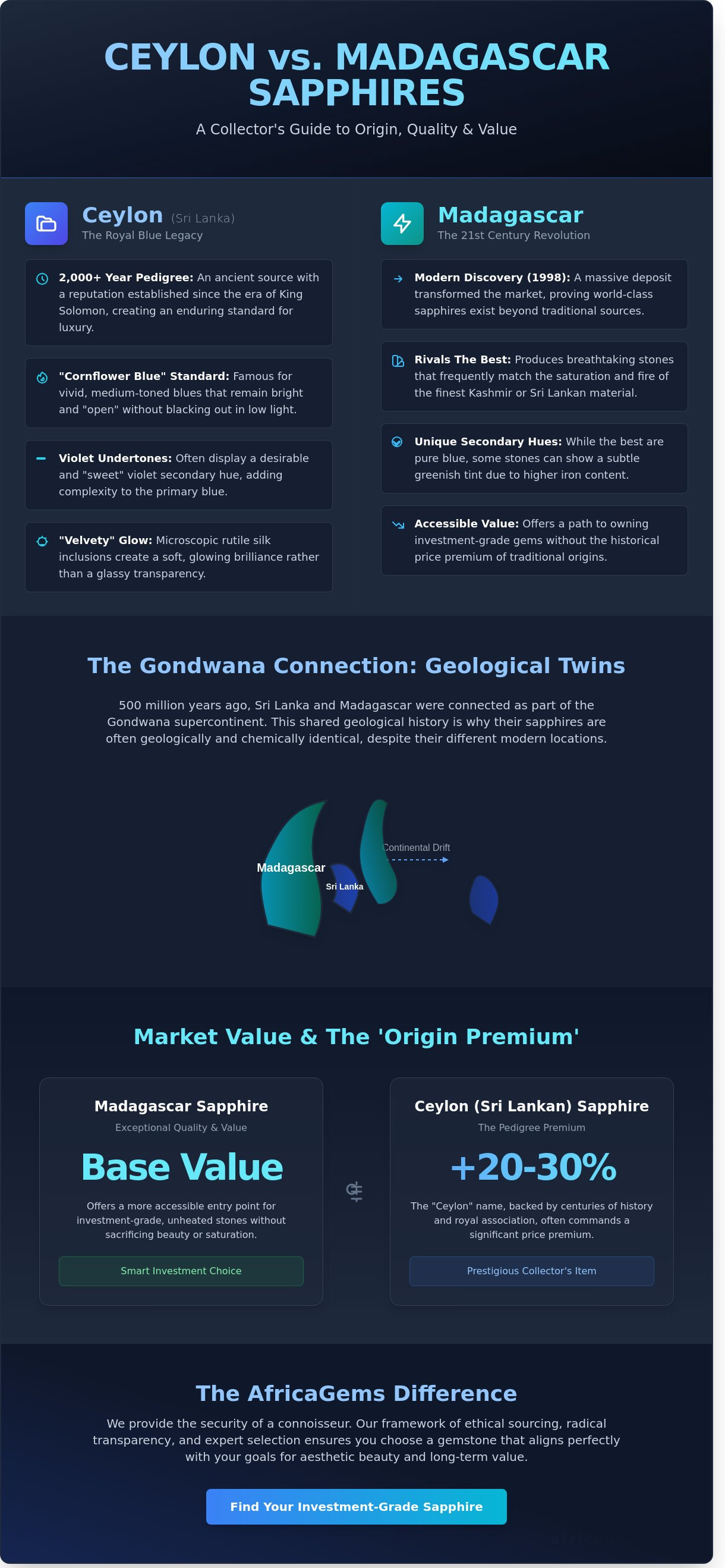
To understand the nuances of ceylon sapphire vs madagascar sapphire, we must look back roughly 550 million years. During the Pan-African Orogeny, the supercontinent Gondwana formed, placing the landmasses of present-day Sri Lanka and Madagascar directly adjacent to one another. They shared the same metamorphic basement rocks and high-pressure thermal conditions. This shared history means the gemstones mined in Ilakaka, Madagascar, are effectively siblings to those found in Ratnapura, Sri Lanka. This geological reality creates a fascinating challenge for the modern collector because the "earth DNA" of these two locations is virtually identical.
The "Twin" theory is a reality in high-end gemology. Because these regions were once part of the same mountain-building event, their inclusions and internal structures mirror each other. Even veteran gemologists often find it impossible to differentiate between them using standard 10x magnification or refractive index tests. It often requires advanced trace-element analysis, such as Laser Ablation Inductively Coupled Plasma Mass Spectrometry, to find the microscopic chemical signatures that separate these two origins. For the savvy buyer, this means Madagascar offers a geological bargain. You can often acquire a stone with the exact physical and visual profile of a classic Sri Lankan gem at a more accessible price point.
Shared Mineral Chemistry
Both regions produce world-class blue sapphires because their chemical blueprints are nearly identical. The presence of iron and titanium in specific ratios creates that coveted cornflower or royal blue. Pleochroism is the phenomenon where a sapphire shows different colors, such as violet-blue or greenish-blue, depending on the angle of light entering the crystal. In both origins, this property is highly pronounced. Because the host rock is so similar, the saturation and clarity levels found in Madagascar often rival the finest "investment-grade" stones from Sri Lanka.
- Iron Levels: Low to moderate iron content in both regions allows for high transparency and "open" colors that don't go black in low light.
- Crystal Habit: Both locations produce well-formed hexagonal crystals that allow lapidaries to maximize weight retention and light return.
- Inclusion Suites: Fine "silk" (rutile needles) is common in both, which can create the velvety glow prized by connoisseurs.
Why 'Origin' Still Matters to the Market
While the physical properties are twins, the global market treats them differently. This is the "romance of origin" vs. the "reality of the stone." Sri Lanka has a 2,000-year history of mining, creating a legacy that commands a natural premium. Madagascar is the newcomer; major deposits were only discovered in the late 1990s. This lack of historical "brand" name is the only reason for the price gap in the ceylon sapphire vs madagascar sapphire debate.
For a serious investment portfolio, a certified Ceylon origin provides a layer of historical security that many traditionalists prefer. Provenance adds a story to the stone, and in the world of rare minerals, the story has its own value. However, we believe in radical transparency. If the physical beauty, durability, and chemical purity are equal, the "geological twin" from Madagascar represents an intelligent acquisition for those who prioritize the stone's inherent quality over its zip code.
Market Value and the 'Unheated' Premium in 2026
The 2026 gemstone market shows a distinct divergence in how collectors value origin. For investment-grade sapphires exceeding 5 carats, the price gap remains a defining factor for portfolios. Historically, Ceylon stones command a higher entry price due to their centuries-old pedigree. However, the surge in high-quality Madagascar production has tightened this spread. When comparing ceylon sapphire vs madagascar sapphire, the "unheated" status acts as the primary multiplier for value. An unheated stone from either origin can fetch 50% to 100% more than its heat-treated counterpart. This premium reflects the extreme rarity of nature producing a perfect blue without human intervention, a factor that has become the "gold standard" for 2026 investors.
Pricing Trends and Investment Potential
Recent auction data indicates that Ceylon sapphires typically maintain a 15% to 25% price premium over Madagascar stones of identical color and clarity. This origin premium is largely driven by liquidity in the secondary market. Reports from major auction houses show that Ceylon stones often sell faster because the name is globally recognized by traditional collectors. For those focused on maximizing their budget, Madagascar is often the better choice for buying gemstones online. You can often secure a larger, more saturated Madagascar stone for the same price as a smaller Ceylon specimen, providing superior visual impact for the same capital outlay.
The Necessity of Independent Certification
You shouldn't buy a high-value sapphire without a report from a top-tier lab like GIA, AGL, or SSEF. These institutions use advanced trace element analysis to distinguish origins. By measuring the concentrations of iron, gallium, and magnesium, gemologists can pinpoint where a stone was mined. This is vital because some unscrupulous dealers rebrand Madagascar rough as Ceylon to inflate prices by that 25% margin. A certificate that explicitly states "No indications of heating" is your only guarantee of long-term value retention. This documentation ensures that your ceylon sapphire vs madagascar sapphire decision is based on geological facts rather than marketing claims.
At AfricaGems, we operate with a policy of radical transparency. We ensure every stone is accurately represented, protecting you from the origin shell game common in the wholesale trade. We believe that a stunning Madagascar sapphire should be celebrated for its own brilliance, not disguised as something else. Our commitment to full disclosure means you receive a stone with a verified history and ethical provenance.
Browse our exclusive selection of certified unheated blue sapphires and experience the AfricaGems guarantee of quality and integrity.
Choosing Your Stone: The AfricaGems Expert Recommendation
Selecting the perfect gemstone involves balancing emotional resonance with technical data. When evaluating a ceylon sapphire vs madagascar sapphire, you're choosing between two of the most productive and high-quality regions on Earth. At AfricaGems, our selection process is notoriously strict. We reject roughly 99% of the stones we inspect, curating only the top 1% that exhibit exceptional clarity and color saturation. This rigorous vetting means every stone in our inventory represents the pinnacle of its respective origin.
The "AfricaGems Difference" lies in our focus on the final cut. Many dealers prioritize weight retention, resulting in stones with "windows" or "extinction" that dull the gem's internal fire. We don't accept these compromises. Our master lapidaries evaluate the pleochroism of the rough to ensure the finished gem displays its most vibrant hue from every angle. A precision-cut sapphire from Madagascar can often outperform a poorly cut Ceylon stone in both brilliance and beauty. We believe the story of the stone begins in the ground but ends with the skill of the cutter.
When to Choose Ceylon
Ceylon sapphires are the premier choice for traditionalists and history enthusiasts. If you're inspired by the sapphire engagement rings of the British Royal Family, Sri Lanka is your destination. These stones are celebrated for their "electric" cornflower blues and an open-toned crystalline structure that allows light to dance through the gem. We recommend Ceylon for heirloom pieces where the historical weight of the name adds generational value. Since Sri Lanka has been a source for over 2,000 years, these gems carry a legacy that few other origins can match.
When to Choose Madagascar
Madagascar is the ideal choice for collectors who prioritize the "stone over the story." Since the major discoveries in Ilakaka in 1998, Madagascar has consistently produced stones with incredible "Royal Blue" saturation. These gems often mimic the velvety appearance of rare Burmese sapphires at a more accessible price point. It's the smart option for modern, high-intensity jewelry designs. If you want a loupe-clean stone with deep, rich color for your custom project, Madagascar provides unparalleled quality and ethical transparency.
Once you've selected your ideal ceylon sapphire vs madagascar sapphire, the journey continues with our bespoke design process. We collaborate with you to create a setting that protects and highlights your investment. Every purchase is backed by the personal guarantee of Marc Sarosi, ensuring your gemstone is ethically sourced, accurately graded, and truly exquisite. Our goal is to make you an informed insider, confident in the beauty and integrity of your rare mineral.
Secure Your Legacy with a Masterpiece of Nature
Choosing between a ceylon sapphire vs madagascar sapphire involves weighing 2,000 years of Sri Lankan heritage against the vibrant discoveries made in Madagascar during the late 1990s. Both origins share a geological DNA that dates back 750 million years to the Gondwana supercontinent, resulting in stones of breathtaking brilliance. Current 2026 market trends show a significant preference for unheated specimens with documented provenance and loupe-clean clarity. We've spent decades perfecting the AfricaGems Difference through radical transparency and expert curation. Marc Sarosi has been hand-selecting exquisite gems since 1984, ensuring every stone meets rigorous standards for pleochroism and ethical sourcing. You deserve complete confidence when investing in such rare minerals. That’s why we provide full disclosure on all gemstone treatments alongside a 30-day money-back guarantee to make your selection process secure. Explore our curated collection of ethically sourced Loose Blue Sapphires and find the stone that speaks to your unique aesthetic. Your journey into the world of professional gem collecting starts with a single, perfect choice.
Frequently Asked Questions
Is a Ceylon sapphire better than a Madagascar sapphire?
Quality depends on the individual stone's characteristics rather than the geographic origin alone. While Sri Lanka has a 2,000-year history of producing world-class cornflower blue gems, Madagascar's deposits discovered in 1998 produce stones that are often chemically and visually identical to the finest Sri Lankan material. A top-tier Madagascar sapphire can easily outperform a mediocre Ceylon stone in color saturation and clarity.
Why are Ceylon sapphires more expensive than Madagascar ones?
The price premium for a ceylon sapphire vs madagascar sapphire is primarily driven by historical prestige and established market demand. Collectors often pay a 15% to 30% premium for the Sri Lankan provenance because it represents a legacy origin with centuries of documented trade. Madagascar is a newer player in the market; therefore, despite producing exquisite, loupe-clean gems, it hasn't yet reached the same level of historical brand recognition.
Can you tell the difference between Ceylon and Madagascar sapphires without a lab report?
It's virtually impossible for the naked eye or even most experts to distinguish these origins without advanced gemological testing. Both regions produce stones with similar pleochroism and silk inclusions because they share the same geological Pan-African Orogenic belt. You need a report from a laboratory like GIA or GRS that uses laser ablation to analyze trace elements like iron and gallium to confirm the source.
Are Madagascar sapphires ethically sourced?
Madagascar sapphires are ethically sourced when purchased through transparent supply chains that adhere to the AfricaGems Difference standards. Since the Ilakaka rush in 1998, the industry has moved toward more regulated artisanal mining practices. We ensure our gems are conflict-free by working with suppliers who provide full disclosure, ensuring that 100% of our inventory meets strict ethical and environmental criteria.
Which origin is better for an engagement ring?
Both origins are equally suitable for an engagement ring because they both belong to the corundum family. Whether you choose a Ceylon or Madagascar stone, you're getting a gem with a Mohs hardness of 9. This makes it ideal for daily wear. The choice usually comes down to your personal budget and whether you value the historical allure of Sri Lanka or the modern value found in Madagascar's newer deposits.
What does 'unheated' mean for the value of these sapphires?
An unheated sapphire is a stone that has reached its natural color and clarity without any human intervention beyond cutting and polishing. These stones are incredibly rare, representing less than 1% of all gem-quality sapphires found globally. Because they're 100% natural, unheated specimens from either origin command a significant price premium, often doubling the value of a heat-treated stone of similar visual appearance.
Do Madagascar sapphires have the same durability as Ceylon sapphires?
Yes, Madagascar and Ceylon sapphires share the exact same physical and chemical properties. Both are composed of aluminum oxide and rank as a 9 on the Mohs scale of mineral hardness. This means they're equally resistant to scratching and chipping. Whether your gem was mined in the Ratnapura district of Sri Lanka or the Didy mine in Madagascar, it possesses the same legendary durability required for heirloom jewelry.
How do I know if my sapphire is actually from Ceylon?
The only definitive way to verify a Ceylon origin is through a reputable third-party gemological certificate. Look for reports from the GIA or SSEF that explicitly state Sri Lanka as the geographic origin. At AfricaGems, we provide radical transparency by including these reports with our high-value stones, ensuring you have documented proof of your gem's exquisite heritage and origin.