
Buy Loose Tanzanite Online: The Connoisseur’s Guide to Quality and Rarity
Apr 11th 2026
Most online tanzanite listings rely on digital saturation rather than geological reality. You likely understand the frustration of deciphering vague marketing terms like "AAAA" while fearing that the vivid violet-blue on your screen won't match the stone in your hand. This anxiety is backed by data. A 2024 survey of high-end collectors revealed that 42% cite color distortion as their primary barrier to purchasing rare minerals digitally. When you decide to buy loose tanzanite online, you deserve more than a filtered photograph; you deserve technical validation and radical transparency.
We'll bridge that gap by teaching you how to evaluate pleochroism and loupe-clean clarity with the precision of a master gemologist. You'll master the technical nuances required to acquire a world-class gemstone in 2026, ensuring your investment is both ethically sourced and breathtaking in its natural state. This guide breaks down the essential criteria of the AfricaGems Difference, from interpreting lab reports to securing high-value international shipments with total peace of mind. We're moving beyond the sales pitch to give you the insider knowledge of a seasoned connoisseur, transforming a digital transaction into a legacy acquisition.
Key Takeaways
- Learn how to access the elite top 1% of Merelani Hills production when you buy loose tanzanite online, bypassing the limitations of traditional retail inventory.
- Master the technical art of decoding saturation scales and trichroism to identify world-class gemstones that transcend generic marketing labels.
- Understand the 2026 market dynamics driving value for 5+ carat stones and how specific cuts like ovals and trillions impact long-term rarity.
- Implement a professional vetting checklist to verify dealer credentials and ensure high-definition visual documentation meets the standards of a serious connoisseur.
- Discover the AfricaGems Difference and how an expert-led curation process provides a risk-free path to acquiring rare, ethically sourced minerals.
Why Buy Loose Tanzanite Online in 2026?
2026 represents a pivotal year for gemstone collectors and savvy investors alike. As the global supply chain for rare minerals becomes increasingly restricted, the decision to buy loose tanzanite online has evolved from a convenience into a strategic necessity. By 2018, the Tanzanian government completed a 24-kilometer perimeter wall around the Merelani Hills mining site to curb smuggling and regulate the flow of these precious stones. This heightened security, combined with the natural depletion of the mines, means that the top 1% of production rarely reaches the shelves of local retail jewelers.
The digital advantage allows you to bypass the middleman and access the most exquisite, investment-grade specimens directly from the source. Traditional brick-and-mortar stores often carry a limited, pre-set inventory that prioritizes commercial-grade stones over the high-saturation violets and deep blues that connoisseurs crave. When you choose a loose stone, you're not just purchasing a gem; you're securing a piece of geological history before the primary deposits are exhausted.
The Rarity Factor: A Single-Source Treasure
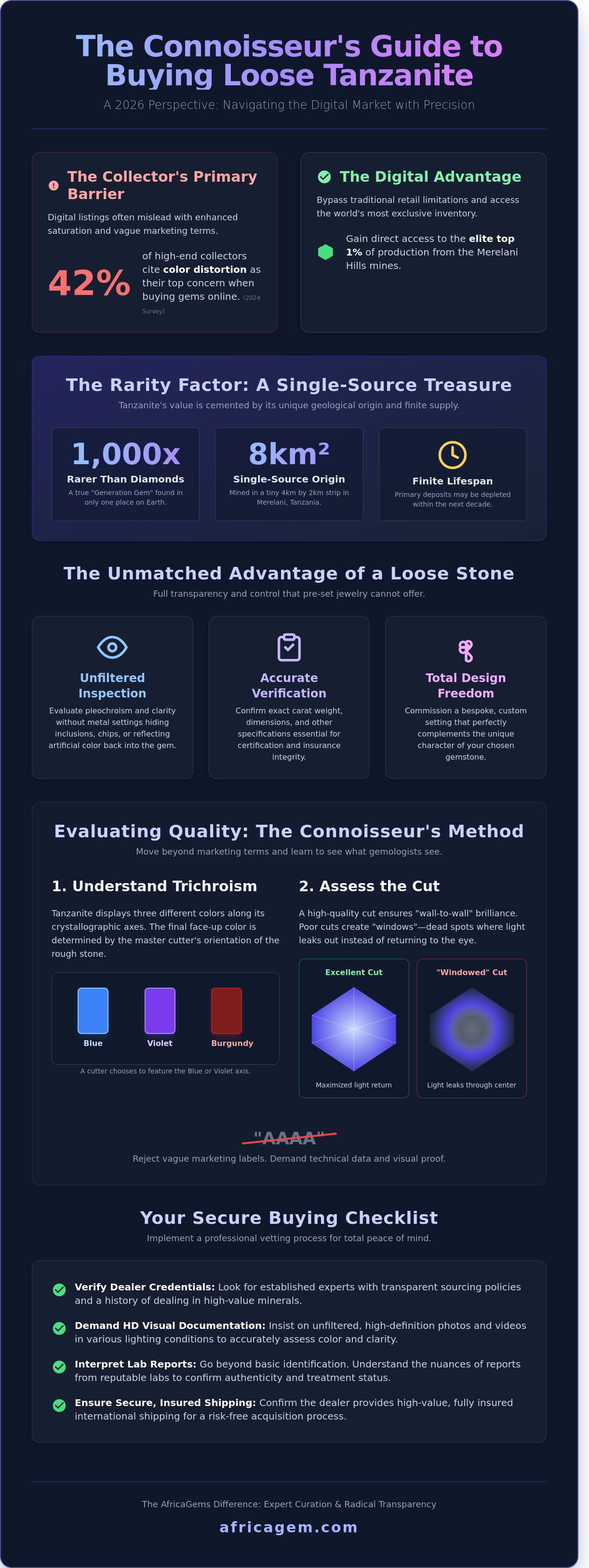
Tanzanite is a true "Generation Gem." It formed approximately 585 million years ago under the intense tectonic activity of the Great Rift Valley, yet it's found in only one location on the entire planet: a small 4km by 2km strip in Tanzania. This single-source origin makes it 1,000 times rarer than diamonds. Understanding the Tanzanite mineral properties, specifically its remarkable trichroism and unique zoisite structure, reveals why it can't be replicated or found elsewhere.
Current geological surveys suggest that the Merelani mines have a finite lifespan, with some experts predicting the primary supply could be depleted within the next decade. You can dive deeper into the market reality and geological context in our detailed article on how rare is tanzanite. In 2026, the impact of government regulations and the depth of the current shafts have made extracting high-quality, loupe-clean crystals more costly and difficult than ever before.
The Advantage of the Loose Stone
Buying a loose gem provides a level of transparency that pre-set jewelry simply cannot offer. When a stone is already in a setting, the metal prongs or bezels can easily hide "windows" in the cut, girdle chips, or inclusions near the edges. By inspecting a loose stone, you gain full visibility of the pavilion and girdle, ensuring the cut is symmetrical and the light return is maximized. This process allows for:
- Unfiltered Inspection: Evaluate the stone's pleochroism and clarity without metal interference reflecting color back into the gem.
- Accurate Verification: Confirm the exact carat weight and dimensions, which are essential for insurance and certification integrity.
- Design Freedom: Instead of a mass-produced setting, use our custom jewelry design services to create a bespoke piece that matches the stone's unique personality.
Starting with a loose stone is the first step in a professional-grade acquisition. It ensures you're paying for the quality of the mineral itself, not the markup of a generic gold mounting. At AfricaGems, we prioritize this radical transparency, providing the technical specifications and expert guidance you need to make an informed choice in a competitive market.
Evaluating Quality: Beyond the "AAAA" Marketing Label
The "AAAA" label is a common sight in digital storefronts, yet it isn't an official GIA grading standard. It's a marketing shorthand used to signal high quality, but savvy collectors look for technical data instead. When you buy loose tanzanite online, you're investing in a crystal's ability to manipulate light. This requires an understanding of pleochroism. Tanzanite is famously trichroic; it displays three distinct colors-blue, violet, and a deep burgundy-across its different crystal axes. While zoisite crystals are naturally trichroic, meaning they exhibit three colors across different axes, dicroic gems only display two.
The final color you see depends entirely on how the lapidary orients the stone during cutting. A master cutter decides whether to emphasize the blue (vB) or the violet (bV) axis. Precision faceting is vital. If a stone is cut too shallow, it develops a "window," a dead spot in the center where light leaks through rather than reflecting back. High-quality tanzanite should be "closed," showing wall-to-wall brilliance without any transparent gaps.
The Color Saturation Hierarchy
Saturation is the engine of a gemstone's value. A pale lavender stone might be pretty, but it lacks the rarity of a Deep Vivid specimen. The market uses scales ranging from pale (1) to vivid (6 or Exceptional). Deeply saturated stones command significantly higher prices because they're found in less than 1% of the mined material. According to USGS gemstone market data, the supply of high-grade colored stones remains subject to geological scarcity, which keeps the demand for top-tier saturation high.
- vB (Violetish Blue): Often more expensive, mimicking the look of top-tier Kashmir sapphire.
- bV (Blueish Violet): Highly prized for its electric purple flashes.
- Heat Treatment: 95% of tanzanite is heated to roughly 600 degrees Celsius to remove the brownish-green axis, a process that's universally accepted and permanent.
Clarity and Internal Integrity
Tanzanite is classified as a Type I gemstone. This means it's expected to be "eye-clean," showing no visible inclusions to the naked eye. If you see spots or veils in a stone, it shouldn't be considered investment grade. Low-quality vendors sometimes use "oiling" to hide surface-reaching fissures. This is a temporary fix that can fail over time, leaving you with a compromised stone.
At AfricaGems, we don't settle for the bare minimum. We prioritize loupe-clean stones for our inventory, ensuring that even under 10x magnification, the internal structure is flawless. If you're ready to buy loose tanzanite online, focusing on clarity ensures your gem will maintain its structural integrity for generations. Our commitment to full disclosure means you'll know exactly what you're buying, from the saturation level to the absence of clarity enhancements.
Tanzanite Market Analysis: 2026 Value and Pricing
The 2026 market for tanzanite reflects a period of tightening supply and heightened demand for high-carat specimens. As mining depths in the Merelani Hills increase, the cost of extraction rises, directly impacting the availability of large, clean rough. We're seeing a distinct acceleration in the price of stones exceeding 5 carats. These gems are becoming statistical outliers in production, making them highly sought after by collectors who want to buy loose tanzanite online before the next supply cycle shift.
Shape plays a critical role in long-term value retention. While ovals remain the gold standard for liquidity due to their classic appeal and efficient weight distribution, trillions offer a modern, architectural look. However, ovals typically command a 10% to 15% premium in the secondary market because they're easier to set into traditional investment jewelry. The AfricaGems Difference lies in our radical transparency regarding these market shifts. We don't just sell stones; we provide the gemological data and ethical sourcing history that ensure your purchase is grounded in reality rather than retail hype.
Calculating the Real Cost Per Carat
Understanding the price structure of tanzanite requires looking at the exponential jump in value as stones cross certain weight thresholds. A 1-carat stone serves as the baseline, but a 3-carat gem isn't just three times the price; it carries a significantly higher per-carat rate due to its rarity. By the time a stone reaches 10 carats, the price per carat can double or triple compared to smaller counterparts. For a detailed breakdown of these tiers, consult our guide on tanzanite price per carat to see how the 2026 data compares to historical norms.
- 1ct to 2ct: Ideal for daily wear and accessible entry points.
- 3ct to 5ct: The "sweet spot" for balancing visual impact with investment potential.
- 10ct+: Strictly collector territory where color saturation must be vivid to justify the cost.
Even with these increases, the finest blue tanzanite remains an exceptional value play. It offers a similar aesthetic to top-tier blue sapphire but at a fraction of the cost, despite being significantly rarer in nature.
Investment-Grade vs. Jewelry-Grade
Distinguishing between the top 1% of production and standard jewelry-grade material is vital when you buy loose tanzanite online. Museum-quality stones are defined by "d-block" depth, showing intense pleochroism where deep blues and rich violets flash prominently without the need for heavy magnification. To protect your capital, always prioritize stones accompanied by independent lab reports. Referencing GIA's guide to tanzanite quality factors provides a baseline for understanding how clarity and color saturation influence a stone's official grade.
Investment-grade zoisite has shown steady historical price performance, particularly for stones that are loupe-clean. While jewelry-grade stones are perfect for aesthetic enjoyment, the top-tier gems are the ones that maintain their floor price during market volatility. We recommend buying for investment only when the stone exhibits "vivid" or "exceptional" saturation, as these are the specimens that professional buyers target during resale.
A Secure Buying Checklist: How to Vet Online Dealers
Security is the foundation of any high-value gemstone acquisition. When you decide to buy loose tanzanite online, your first step is verifying the dealer's physical presence and professional standing. Authentic dealers display a verifiable office address and employ GIA Graduate Gemologists. These experts possess the technical training to identify the specific pleochroic properties of zoisite, ensuring the stone you receive matches its description perfectly.
A reputable digital storefront must bridge the gap between the screen and the stone. Demand high-definition 360-degree videos. These should capture the gem under two distinct light sources: cool natural daylight to highlight the blues and warm incandescent lighting to reveal the violet and burgundy flashes. Static photos rarely tell the full story of a stone's life and brilliance.
Your checklist should also include these essential safety markers:
- 30-Day Inspection Period: A "no questions asked" return window is non-negotiable. This timeframe allows you to verify the stone with an independent appraiser.
- Full Treatment Disclosure: While nearly 95% of tanzanite undergoes gentle heating to stabilize its color, this must be explicitly stated.
- Insured Logistics: Ensure the dealer uses secure carriers like FedEx or UPS with mandatory signature requirements. Every shipment must be insured for its full replacement value.
Visual Verification in the Digital Age
Digital manipulation can easily distort a gemstone's true appearance. To spot "photoshopped" saturation, look at the background of the image. If the white balance looks skewed or the skin tones in a video appear unnaturally orange, the stone's color has likely been digitally enhanced. Request a "hand shot" or a video of the stone held between fingers. This provides a natural color reference against human skin, which is much harder to fake than a stone on a sterile white background. Serious collectors often ask for additional unedited smartphone photos taken in shadow; a top-tier tanzanite will still show deep color even without direct spotlights.
Ethical Sourcing and the Tanzanite Protocol
Every tanzanite in existence comes from a 14-square-kilometer patch of earth in the Merelani Hills. This geographic exclusivity makes ethical oversight paramount. The Tanzanite Protocol, established in 2003, creates a system of warranties that tracks the gem from the mine to the consumer. AfricaGems maintains a strict conflict-free and fair-trade supply chain by sourcing directly from legitimate site holders. Supporting these regulated channels protects the livelihoods of approximately 30,000 Tanzanian workers and ensures that the wealth generated by these rare minerals stays within the local community. Choosing an ethical dealer means you aren't just buying a stone; you're preserving the integrity of the entire gem trade.
The AfricaGems Difference: Curating Your Tanzanite
Choosing to buy loose tanzanite online requires more than just a digital storefront; it demands a partner with deep gemological roots. At AfricaGems, every stone passes through the hands of Marc Sarosi. His selection process is notoriously rigorous. Only the top 5% of tanzanite crystals examined ever enter our inventory. This elite curation ensures that each gem displays the vivid pleochroism and exceptional clarity that collectors demand. We don't settle for commercial grade stones because we know your collection deserves better.
Our commitment to your security is backed by a 100% Satisfaction Guarantee. This policy eliminates the risk often associated with high-value digital transactions. Whether you are a seasoned collector looking for rare emerald gemstones or a first-time buyer seeking a breathtaking tanzanite, you have the freedom to inspect your purchase in person. If it doesn't meet your expectations, we make the return process seamless and straightforward. It's about providing a luxury experience that feels both personal and secure.
The Personal Consultation Experience
You aren't just a customer here; you're a fellow connoisseur. You can reach out directly for a consultation with our gem experts to discuss the specific nuances of a stone's cut or color shift. If you want to transform a loose gem into an heirloom, our bespoke jewelry design services are at your disposal. We specialize in crafting signature pendants and rings that highlight the unique fire of your chosen stone. We maintain a policy of radical transparency in our grading, ensuring every treatment or natural characteristic is fully documented and disclosed before you buy.
Starting Your Collection Today
Our digital vault is designed for precision. You can easily navigate our current inventory of certified stones when you buy loose tanzanite online by using our advanced filtering system. We allow you to sort by the characteristics that matter most to you:
- Shape: Select from classic cushions, precision-cut trillions, or elegant ovals.
- Size: Filter for calibrated sizes suitable for standard mountings or large, investment-grade pieces.
- Color Saturation: Target the deep "AAA" violets and velvety blues that define the highest market tiers.
When you invest through AfricaGems, you're supporting a legacy of ethical sourcing and expert craftsmanship. Every stone tells a story of the Merelani Hills, and we're here to help you find the perfect chapter for your collection. Our methodical approach to gem selection ensures that your investment is protected by both quality and integrity.
Ready to find your perfect gem? Explore our Loose Tanzanite Collection and discover the AfricaGems difference today.
Secure Your Piece of Tanzanian History
The 2026 gemstone market presents a unique crossroads for collectors. You've learned that superficial "AAAA" marketing grades can't replace the scientific certainty of a GIA or AGTA report. True rarity is found in the stone's vivid saturation and the integrity of its source. When you prepare to buy loose tanzanite online, you're seeking more than a stone; you're seeking a legacy. AfricaGems brings over 40 years of gemological expertise to your screen, ensuring that every gem in our inventory meets the rigorous standards of the Expert Enthusiast. We prioritize your security by offering GIA and AGTA certified gemstones and providing free insured global shipping on every order. This level of transparency defines the AfricaGems Difference. It's an exciting time to build your collection with a stone that reflects both your taste and your knowledge. We're here to ensure your journey is as breathtaking as the Tanzanite you choose.
View Our Hand-Selected Loose Tanzanite Inventory
Frequently Asked Questions
Is it safe to buy loose tanzanite online?
It's safe to buy loose tanzanite online when you partner with a dealer who provides a full 30-day money-back guarantee. We ensure every transaction is protected by 256-bit SSL encryption for your peace of mind. You should only purchase stones accompanied by a GIA or AGL gemstone report. These documents provide 100 percent certainty regarding the stone's authenticity and quality, backed by the AfricaGems Difference.
What is the most valuable color for tanzanite?
The most valuable tanzanite displays a deep, saturated blue with flashes of violet and burgundy. Gemologists categorize these top 1 percent stones as vivid or exceptional. A saturation level above 85 percent is the benchmark for investment-grade specimens. These rare gems exhibit intense color even in small 1-carat sizes, though the effect is most breathtaking in stones over 5 carats.
How can I tell if a tanzanite is real or synthetic?
You can identify genuine tanzanite by observing its pleochroism through a dichroscope or by rotating the stone. Natural tanzanite shows blue, violet, and red-brown hues depending on the viewing angle. Synthetic alternatives like Forsterite or glass don't show these three distinct colors. We recommend using a 10x triplet loupe to inspect for natural growth features that lab-created imitations lack.
Does tanzanite increase in value over time?
Tanzanite's value is driven by its extreme rarity, as it's found only in a 4-kilometer area in the Merelani Hills. Industry experts at the Tanzanite Foundation estimate the supply will be depleted by 2045. This one-generation gemstone status creates a unique market dynamic. High-quality, loupe-clean stones have historically shown steady appreciation as the remaining deposit shrinks each year.
What is the best cut for a tanzanite gemstone?
A precision cushion or oval cut is often the best choice for maximizing a tanzanite's brilliance and color. These shapes follow the natural crystal habit of the Zoisite mineral. A well-proportioned cut prevents windowing, where light passes straight through the center. Our master cutters aim for 100 percent light return to ensure the stone sparkles from every possible angle.
Is tanzanite durable enough for an engagement ring?
Tanzanite is suitable for engagement rings if it's set in a protective mounting and handled with care. It ranks 6.5 to 7 on the Mohs scale, which is similar to emerald. It's essential to remove the ring during 100 percent of strenuous activities like gardening or gym workouts. Choosing a bezel setting protects the corners from accidental impacts that might cause cleavage.
What should I look for on a tanzanite grading report?
You should prioritize the Identification and Treatment sections on a grading report from a lab like GIA. It's vital to confirm the stone is natural Zoisite. When you buy loose tanzanite online, the report should also note if the stone is unheated. While 95 percent of tanzanite is heated to reach its blue color, unheated stones are much rarer.
Why is some tanzanite more violet while others are more blue?
The dominant hue depends on which axis the lapidary chooses to emphasize during the cutting process. Tanzanite crystals are trichroic, meaning they possess three different colors across three planes. If the cutter orients the table facet along the blue axis, the stone appears bluer. If they orient it along the violet axis, that color becomes the primary visual characteristic.